A Comprehensive Buyer’s Guide to Enterprise SaaS Attribution Partners
Explore our guide for enterprise SaaS teams on selecting attribution partners, tackling long sales cycles, and enhancing CRM data quality.

You launch campaigns. Demos come in. Sixteen months later, the board asks which channels actually drove it, and no one in the room can give a straight answer.
That is not a reporting failure. It is an attribution failure. And in enterprise SaaS, where sales cycles routinely run six to twelve months and buying committees stretch across seven or more stakeholders, most attribution setups are not built for the reality of the deals being closed.
This guide is for CMOs evaluating whether their current attribution approach is fit for purpose, and what to look for when assessing potential enterprise SaaS paid media attribution partners. It covers the structural challenges that make enterprise attribution different, the CRM data quality issues that undermine most models, what the limitations of incrementality-based approaches actually mean in practice, and how to use attribution outputs to construct a board-level narrative that holds up to scrutiny.
Why Enterprise SaaS Attribution Is a Structurally Different Problem
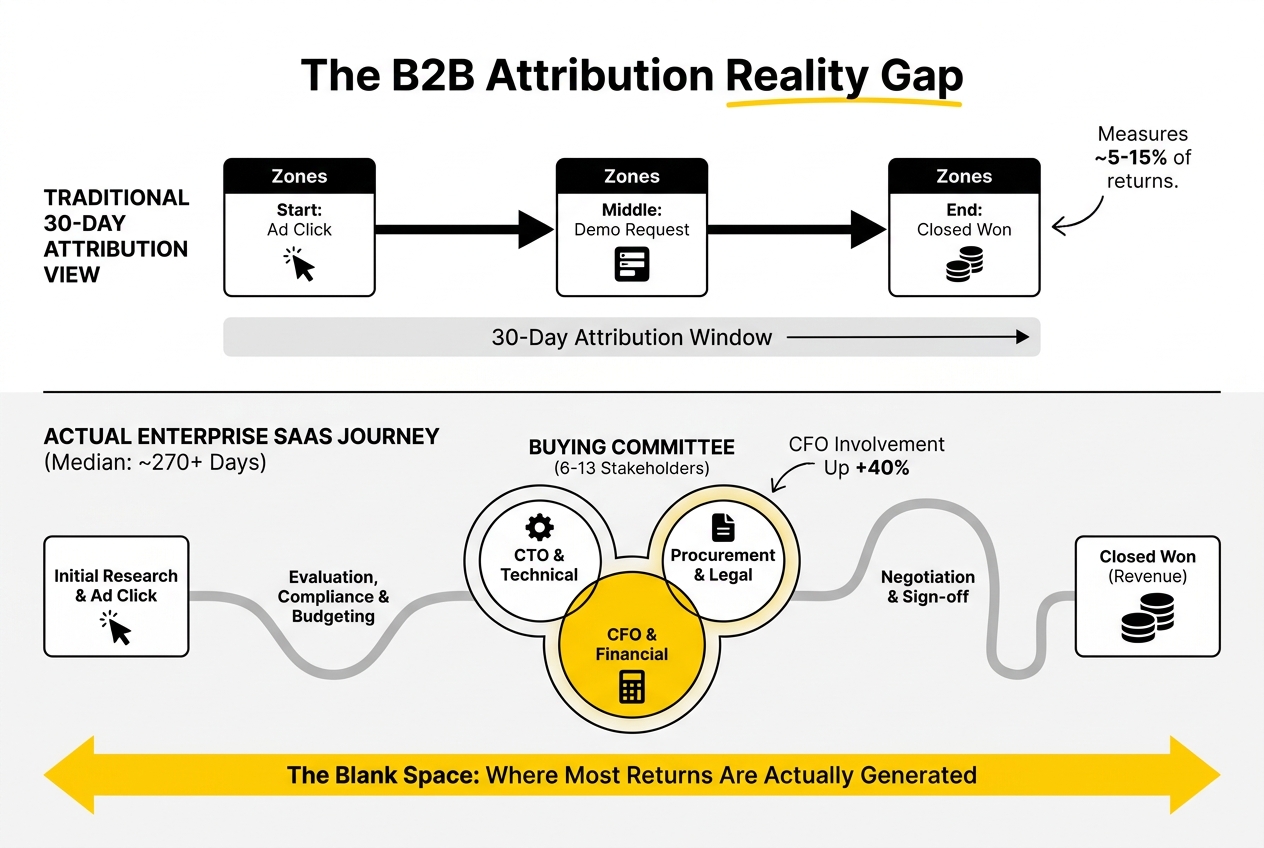
Most attribution platforms were designed for journeys with a beginning, middle, and end that fit inside a 30-day window. Enterprise SaaS deals do not work that way.
According to 2026 B2B SaaS sales cycle benchmarks, the median deal takes 84 days to close. Enterprise deals, particularly those with higher ACV or compliance requirements, routinely extend to 270 days or beyond. When ad platforms default to 30-day attribution windows, teams running enterprise campaigns are measuring 5 to 15 percent of their actual returns and drawing budget decisions from the rest of that blank space.
The buying committee problem compounds this. The average B2B deal now involves 6.8 stakeholders, up from 5.4 in 2020, with enterprise deals averaging closer to 13 decision-makers. CFO involvement in software purchase decisions has risen 40 percent since 2023, meaning the old pattern of a champion-driven sale through procurement no longer applies cleanly. A single CTO contact in your CRM does not represent how the deal is actually progressing.
The result is that most SaaS teams are running attribution models that credit one or two touchpoints with a deal that took 14 months and crossed five departments. That is not directional. It is misleading.
The CRM Data Quality Problem Nobody Wants to Own
Attribution is only as good as the data underneath it. In enterprise SaaS, that means CRM data, and CRM data quality is almost always the primary obstacle.
According to RevSure’s 2025 State of B2B Marketing Attribution report, over 86 percent of respondents reported struggling to connect multiple stakeholders to the same opportunity. Contact records are created for whoever attended the first meeting. Subsequent stakeholders are logged inconsistently or not at all. Anonymous web activity from new decision-makers arrives mid-cycle with no linkage to the existing opportunity. By the time a deal closes, the attribution model is reading a partial account of what actually happened.
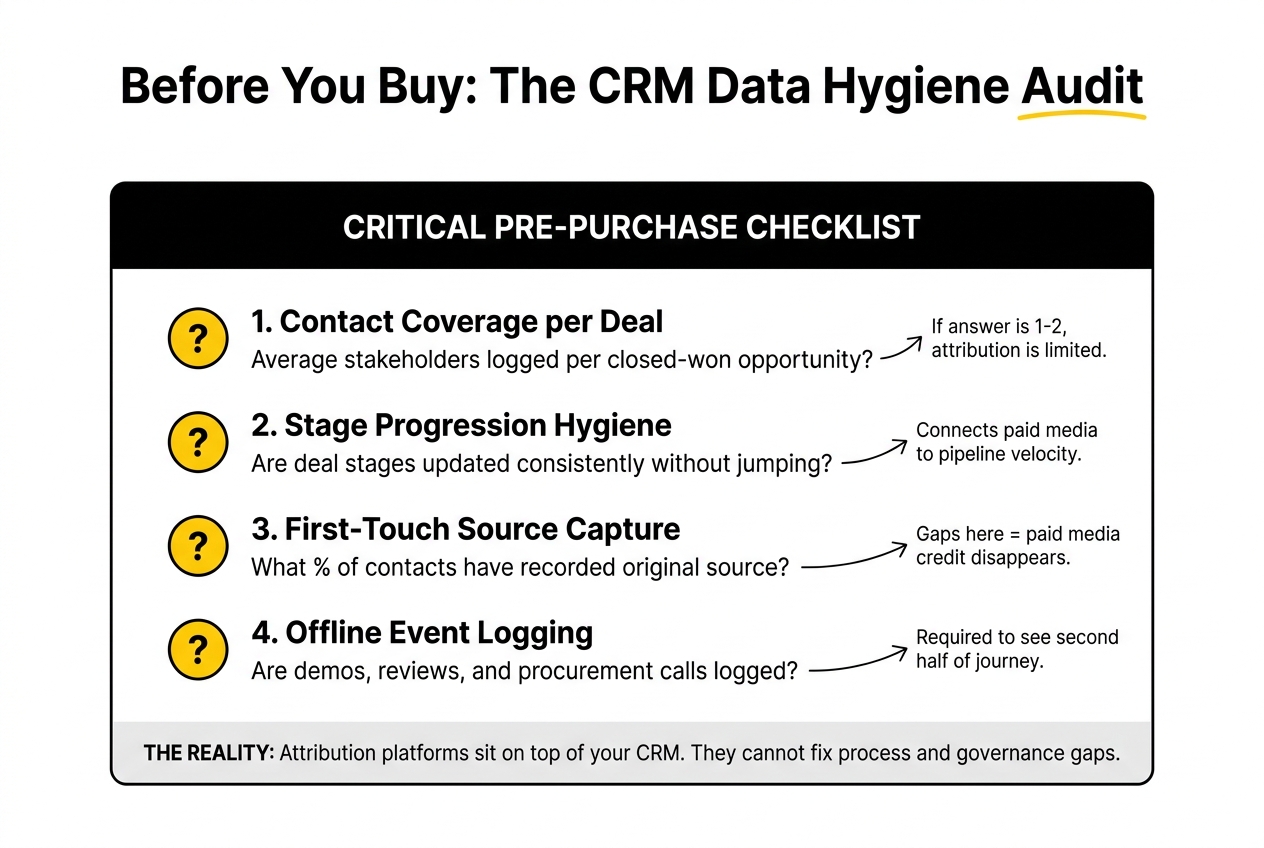
This is not a technology problem. It is a process and governance problem. A new attribution platform sits on top of whatever is in the CRM. If the CRM records touchpoints for one contact but missed the six-month procurement review where the CFO signed off on vendor risk, no amount of attribution sophistication recovers that signal.
Before evaluating attribution partners, the more useful exercise is a CRM data audit. Specifically:
- Contact coverage per deal: How many stakeholders are logged per closed-won opportunity, on average? If the answer is one or two, account-level attribution will be limited regardless of which platform is adopted.
- Stage progression hygiene: Are deal stages updated consistently as they progress, or do deals jump from early stage to closed-won without intermediate records? Clean stage data is what allows attribution to connect paid media to pipeline velocity, not just pipeline creation.
- First-touch source capture: What percentage of contacts have a recorded original source? Gaps here are where paid media credit disappears.
- Offline event logging: Demos, product reviews, and procurement calls need to be logged as activities. If they are not, the model cannot see the second half of most enterprise journeys.
The honest reality is that partners worth working with will surface these gaps early. Any attribution vendor that promises to solve your measurement problem without asking about data hygiene first is selling something that will not work.
Incrementality in Enterprise Attribution: A Useful Concept With Serious Limits
Incrementality testing asks a specific question: would these deals have happened without this spend? It is a legitimate measurement approach in the right context. In enterprise SaaS, that context is rarely met.
Incrementality tests require enough deal volume for statistical significance. For a team closing 20 to 40 enterprise deals per quarter, the sample sizes are too small for a holdout test to return reliable results. Even teams with higher volume face the problem that enterprise sales cycles stretch across multiple reporting periods, making clean experiment design difficult without corrupting ongoing pipeline.
The more practical approach for most enterprise SaaS teams is directional multi-touch attribution combined with self-reported data. The model gives you a trackable baseline across paid channels. The self-reported layer, typically a form field asking prospects how they first heard about the company, captures the dark funnel activity that no pixel can track. Neither source is perfect. Together, they are more useful than either alone.
As Chris Walker and the Refine Labs team have argued for years, the biggest attribution distortion in B2B SaaS is not the model itself. It is the absence of a mechanism to capture demand that was shaped by content, community, podcasts, and peer referrals before the prospect ever clicked an ad. Incrementality testing does not solve this. It measures what is measurable and leaves the rest invisible.
When evaluating attribution partners, the question to ask is not whether they offer incrementality testing. It is whether they have a framework for combining trackable attribution with untracked demand signals, and whether they can translate that combined picture into channel guidance that is useful for budget decisions.
What Effective Attribution Partners Actually Deliver
The market for attribution tools and agencies has matured. Most platforms now handle multi-touch models, CRM integration, and account-level tracking. The differentiation is not in the feature list. It is in whether the partner can connect measurement to decisions.
Here is what to look for when evaluating a paid media attribution agency for enterprise SaaS:
Attribution window configuration. The partner should be able to match attribution windows to your actual sales cycle length, not platform defaults. If your enterprise cycle averages 180 days, the model needs to look back 180 days. This sounds obvious. Most standard setups do not do it.
Account-level tracking across the buying committee. Contact-level attribution is not sufficient for enterprise. The platform needs to aggregate engagement across all stakeholders tied to an opportunity and map those touchpoints at the account level. Platforms like HockeyStack and Dreamdata are built specifically for this. Generic tools retrofitted from e-commerce contexts are not.
Offline conversion integration. Demos, qualification calls, and procurement reviews need to flow back into the attribution model. This requires CRM-to-ad-platform integration, typically via offline conversion imports or direct API connections to Salesforce or HubSpot. A partner that only measures on-platform activity is missing the second half of your funnel.
Pipeline stage visibility, not just pipeline creation. Attribution that tells you which campaigns created pipeline is useful. Attribution that also tells you which campaigns produced deals that moved quickly through stages and closed at higher rates is significantly more useful. Cost-per-opportunity is a starting point. Cost-per-qualified-pipeline-stage is where budget decisions should actually be made.
Honest model transparency. Black-box data-driven attribution requires substantial deal volume, typically 1,000-plus closed deals, for the underlying machine learning to produce reliable outputs. Most enterprise SaaS teams are not at that volume. A credible partner will tell you this and recommend a rule-based multi-touch model instead of selling you sophistication that does not apply to your dataset.
Translating Attribution Data Into Board-Level Narratives
The board does not need to understand the attribution model. They need to understand whether the marketing budget is working, and whether the signals point toward growth or risk.
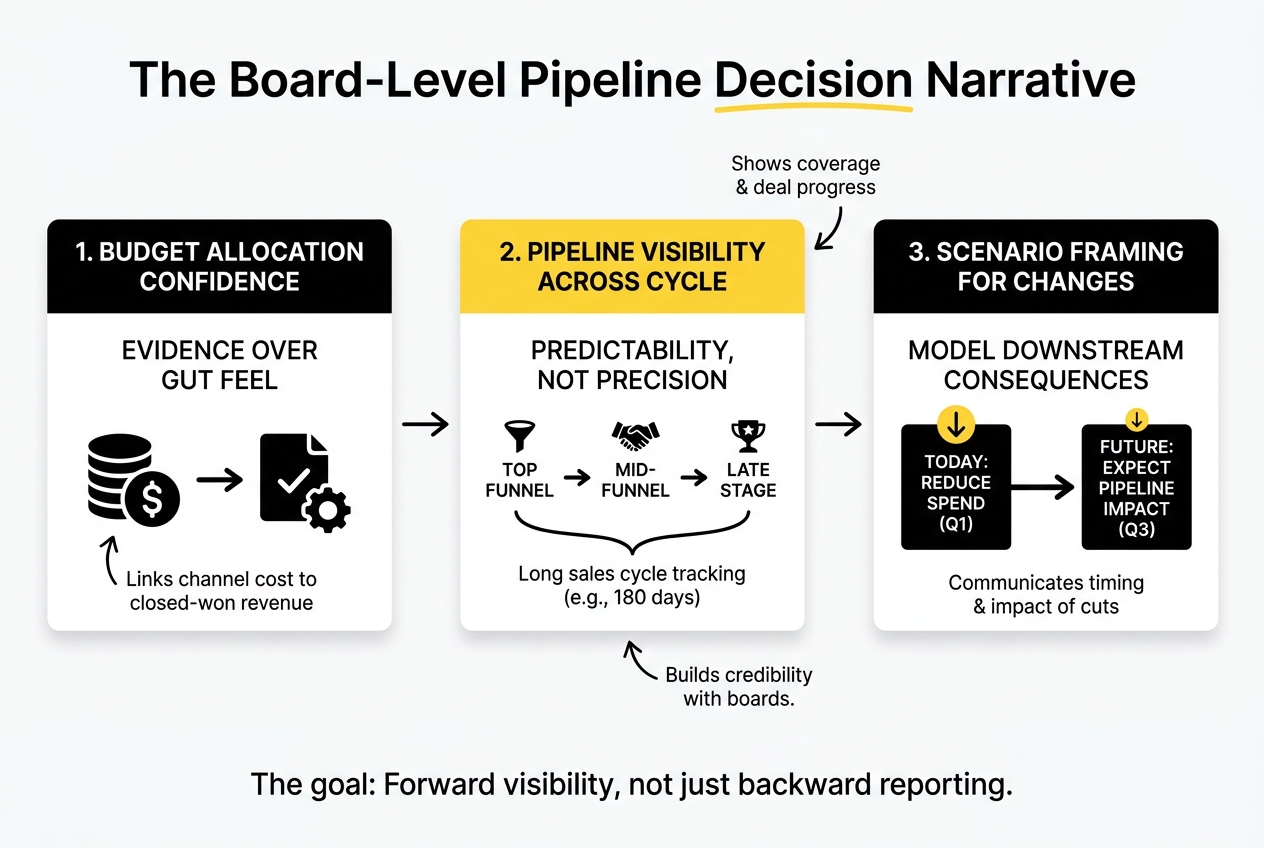
Attribution data supports board-level communication in three specific ways.
Budget allocation confidence. When a CMO presents a budget request with channel-level cost-per-opportunity data linked to closed-won revenue, the conversation shifts from gut feel to evidence. This is where the quality of pipeline decision analytics for SaaS determines whether marketing owns the growth narrative or is asked to justify it after the fact.
Pipeline visibility across the cycle. Enterprise deals are long. Boards and investors want predictability more than they want precision. Attribution that shows pipeline coverage, how far deals are through the cycle, and which paid channels are filling the top versus mid-funnel gives leadership the forward visibility they are looking for in board decks. Vanity metrics do not. MQL volume without pipeline stage linkage does not either.
Scenario framing for budget changes. When budgets are cut or reallocated, CMOs need to communicate what the downstream consequences will be and when they will show up in pipeline. Attribution data that is connected to sales cycle length and deal velocity allows for this kind of modelling. A team with 180-day cycle data can say: if we reduce spend on this channel by 40 percent in Q1, we expect to see pipeline impact in Q3. That is a board-level narrative.
The limitation worth acknowledging in this context is timing. Attribution data tells you what happened. It is directional for future decisions, but it is not a guarantee. Making that distinction clearly, rather than overselling model precision, tends to build more credibility with boards than presenting attribution outputs as certainties.
Evaluating Attribution Partners: A Practical Checklist for SaaS Revenue Teams
When shortlisting potential partners, run each candidate through these criteria before getting to a proposal stage:
- Do they ask about your current CRM data quality before talking about solutions?
- Can they configure attribution windows that match your actual sales cycle length?
- Do they support account-level attribution across buying committees, or only contact-level?
- How do they handle offline touchpoints such as demos and discovery calls?
- What is their recommended model for teams with fewer than 500 closed deals per year?
- Can they produce pipeline stage attribution, not just pipeline creation metrics?
- Do they have a process for combining trackable and self-reported data sources?
- Can their reporting output translate into a board-ready narrative, or does it require a data team to interpret?
No partner will score perfectly across all of these. The exercise is to surface where their model has gaps and whether they are transparent about those gaps. A partner who claims their platform solves the attribution problem completely is not telling you the truth. Attribution will never be perfect. The goal is consistent, directional data that improves budget decisions over time.
For a practical evaluation framework to use alongside this guide, see SaaS Agencies Strong on Attribution and Reporting: Evaluation Checklist for Revenue Teams (coming soon).
Frequently Asked Questions
What are the unique challenges of attribution in long sales cycles for enterprise SaaS?
The primary challenge is that standard attribution windows, typically 30 days, capture a small fraction of the actual buying journey. Enterprise deals routinely run six to twelve months, involve multiple stakeholders, and include offline touchpoints that standard platforms cannot track. Attribution set up for shorter cycles systematically undervalues the channels that influence early-stage awareness and mid-cycle nurturing, which are often the channels doing the most important work in enterprise deals.
How can high-quality CRM data improve paid media attribution for SaaS companies?
CRM data is the foundation on which attribution models are built. When deal stage progression is logged consistently, multiple stakeholders are recorded per opportunity, and offline activities are captured as CRM activities, attribution platforms can trace marketing touchpoints to pipeline outcomes with significantly more accuracy. Poor CRM hygiene, where contacts are incomplete and stages skip, produces attribution outputs that cannot be trusted for budget decisions, regardless of which platform is used.
What are the limitations of incrementality in attribution models for enterprise SaaS?
Incrementality testing requires sufficient deal volume for statistical significance. Enterprise SaaS teams with fewer than 40 to 50 deals per quarter typically cannot run clean holdout experiments without corrupting the pipeline data they rely on for forecasting. Incrementality also cannot capture dark funnel demand, the awareness driven by content, community, and peer influence before a prospect engages with a trackable channel. For most enterprise SaaS teams, directional multi-touch attribution combined with self-reported data is a more practical approach.
How does effective attribution support board-level decision-making in SaaS organisations?
Attribution data supports board conversations in three ways: it provides channel-level cost-per-opportunity data to justify budget allocation, it gives pipeline visibility across long sales cycles for predictability forecasting, and it enables scenario modelling when budgets are reallocated. The key is connecting attribution outputs to the business metrics boards care about, specifically sales-qualified pipeline coverage, pipeline velocity, and cost-per-closed-won, rather than presenting channel-level metrics that require translation.
What metrics should CMOs focus on when evaluating attribution partners?
The most useful metrics for evaluating attribution partner performance are cost-per-opportunity by channel, pipeline stage progression by campaign, MQL-to-SQL conversion by source, and pipeline velocity by cohort. These connect paid media activity to sales outcomes in a way that justifies budget decisions. Impressions, clicks, and cost-per-lead are inadequate on their own. The question to ask any prospective partner is: how does your reporting connect ad spend to sales-qualified pipeline and closed-won revenue?
How can attribution models help articulate narratives around growth and budget allocation?
Attribution models create the data foundation for forward-looking budget arguments. When a CMO can show that a specific set of campaigns produced pipeline that closed at a higher rate, faster, and at lower cost-per-acquisition, they can argue for protecting or increasing that spend with evidence rather than instinct. The narrative is stronger when attribution data is connected to pipeline coverage ratios, because the question boards ask is not “what did we spend” but “do we have enough pipeline to hit the number.”
What are the best practices for measuring the effectiveness of paid media in long sales cycles?
Key practices include: extending attribution windows to match actual sales cycle length, using offline conversion tracking to capture demo and qualification call data, applying cohort-based ROAS measurement at 90, 180, and 365 days rather than point-in-time, and supplementing platform data with self-reported attribution to capture dark funnel influence. Teams should also establish a consistent reporting cadence that separates pipeline creation metrics from pipeline velocity metrics, since these reflect different aspects of paid media performance.
What role does data-driven decision-making play in the success of enterprise SaaS marketing?
What actually matters is whether marketing decisions, particularly budget allocation, channel mix, and campaign prioritisation, are made with reference to pipeline outcomes rather than platform metrics. That requires a measurement infrastructure that connects paid media activity to CRM data and reports on cost-per-qualified-opportunity and pipeline stage progression. Teams that optimise for MQL volume without that downstream connection tend to produce leads that sales will not work.
Working Through This? We Can Help.
Enterprise attribution is where most paid media programmes have their biggest measurement gap. If you are assessing your current setup, or evaluating partners and want a second opinion on what questions to ask, this is the kind of thing we work through with SaaS teams regularly. Worth a conversation if you are at that point.


.png)