Assessing SaaS Marketing Agencies for Effective Analytics and Reporting
A buyer-focused checklist for marketing operations specialists to assess SaaS marketing agencies on CRM integration, offline conversion tracking, data integrity, and strategic reporting.

Your campaigns are running. Leads are coming in. The agency’s monthly report shows green arrows pointing upward. Then your VP of Sales asks why the pipeline number hasn’t moved, and nobody in the room can connect the two conversations.
This is the gap most SaaS marketing agencies never close. Not because the underlying data doesn’t exist, but because their reporting infrastructure was not built to find it. When you’re evaluating SaaS marketing agencies for analytics and reporting, the question isn’t whether they send a report. It’s whether that report tells you anything useful about revenue.
According to Gartner’s Q1 2025 survey, 68% of B2B marketers cite correct attribution as a top challenge. That’s not a tooling problem. It’s a methodology problem, and it starts with the agency you choose.
This checklist covers the specific capabilities to probe when assessing a SaaS marketing agency on its analytics and reporting services. It is written for marketing operations specialists who already know what good looks like, and need to verify whether a prospective partner can match it.
What Effective Analytics Reporting for SaaS Marketing Actually Requires
Most agencies report on what happened. The agencies worth working with report on what it means.
There is a meaningful difference between a dashboard that shows clicks, impressions, and cost-per-lead, and one that shows how a paid search campaign contributed to a deal that closed 90 days later. SaaS sales cycles are long, buying committees involve multiple stakeholders, and the touchpoint that drove awareness is rarely the one that gets credit in a last-click model.
Effective analytics reporting for SaaS marketing connects campaign data to pipeline and revenue, accounts for the time lag between first touch and closed deal, and provides context that leadership teams can actually use. It is not a data dump. It is an interpreted view of what the data says about growth.
The sections below break down the specific elements to assess in any SaaS marketing agency’s reporting capability. Use them as a checklist when reviewing proposals or running agency audits.
CRM Integration: The Foundation of Quality Data
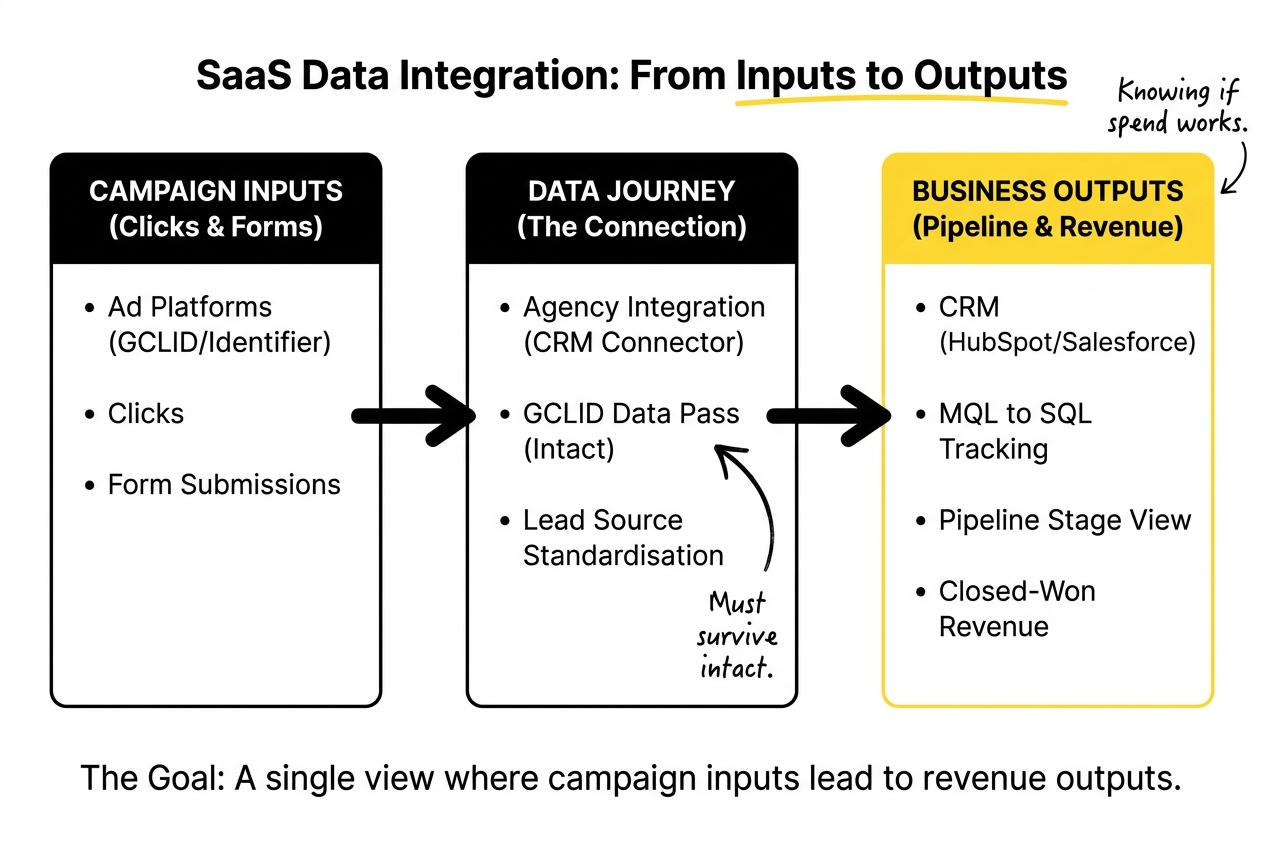
A SaaS marketing agency that cannot connect its campaign data to your CRM is measuring the wrong things. Clicks and form submissions are inputs. Pipeline and closed-won revenue are outputs. You need both in the same view to know whether your spend is working.
Ask any prospective agency how they pass lead data back into your CRM, whether that is HubSpot, Salesforce, or Pipedrive. Specifically, ask whether they capture and pass the GCLID or equivalent click identifier from ad platforms through to your CRM records, and whether that data survives the journey intact.
The test is straightforward: can the agency pull a report showing which paid campaigns contributed to deals in a given stage, filtered by lead source, with revenue values attached? If they cannot demonstrate this, their CRM integration is decorative rather than functional.
Strong CRM integration also enables proper MQL-to-SQL tracking. If your MQL volume is climbing but your MQL-to-deal gap is widening, that is a signal about lead quality, not campaign performance. An agency with real CRM visibility can see this problem before you raise it. One without it will keep optimising for top-of-funnel volume and declare success.
For a broader view of what analytics infrastructure should look like across a SaaS marketing programme, the parent hub covers the measurement foundations in more detail.
Offline Conversion Tracking: Closing the Attribution Gap
In SaaS, many of the most commercially significant conversion events happen away from the browser. A demo booked by phone, a contract signed after an in-person meeting, a trial-to-paid conversion that the platform never saw, these are offline conversions, and they are systematically missing from most agencies’ reporting.
Offline conversion tracking (OCT) is the process of feeding these events back into ad platforms so that bidding algorithms can optimise toward revenue-generating outcomes rather than form fills. For agencies managing Google Ads or LinkedIn campaigns, this typically means passing closed or progressed CRM deal data back to the platform via an API or direct integration.
A relevant note for 2026 planning: Meta deprecated OCAPI in May 2025, making server-side Conversions API (CAPI) the only supported method for offline conversion tracking on that platform. Any agency still referencing OCAPI in their setup is working from outdated documentation.
The questions to ask are practical:
- How do they capture and match offline events to original ad clicks?
- What is their process for uploading CRM data to ad platforms on a defined cadence?
- How do they handle attribution timing when deals close weeks or months after initial contact?
An agency that cannot answer these questions in operational detail is relying on platform-reported conversions only. For a SaaS business with any meaningful sales cycle, that produces a systematically distorted picture of campaign performance.
Change Logs: Protecting Data Integrity Over Time
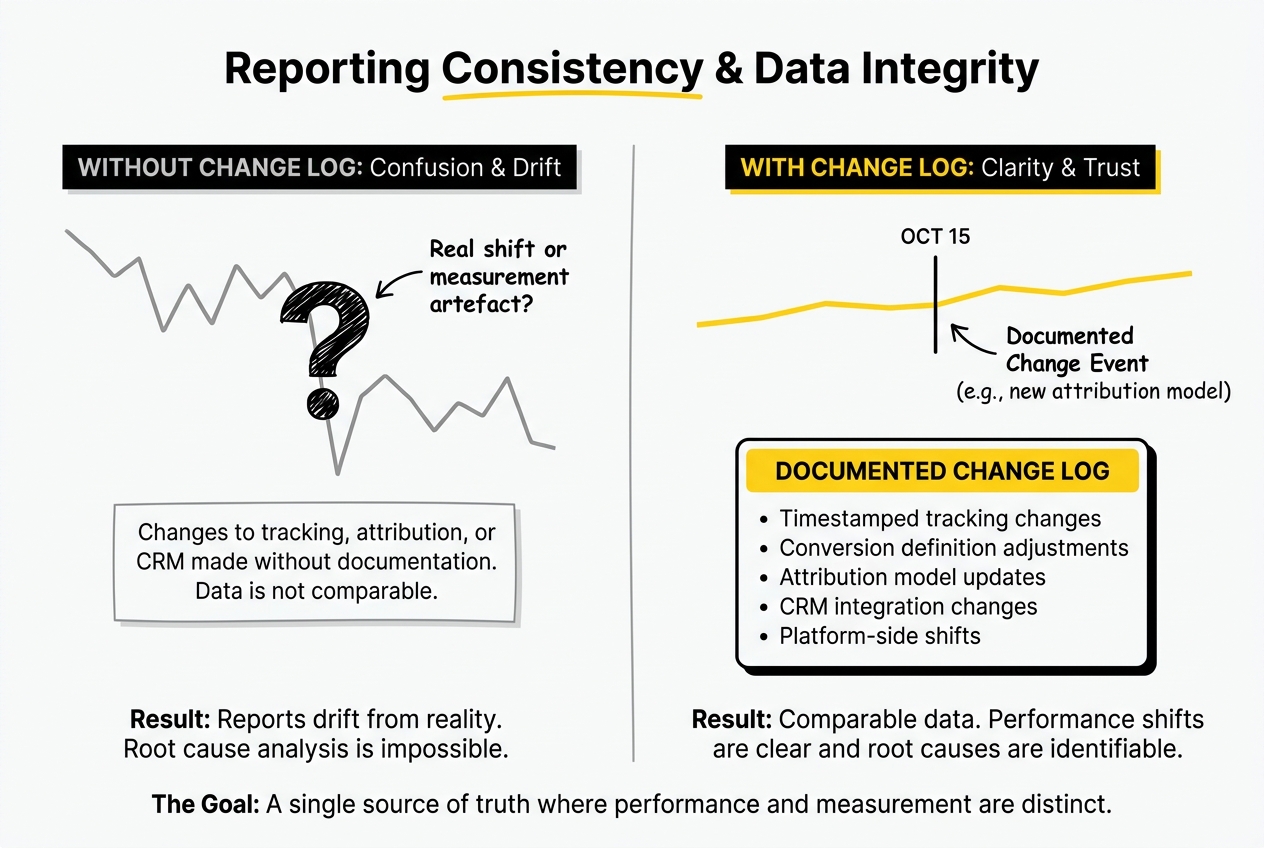
Analytics reports are only comparable over time if the underlying measurement setup stays consistent. When changes are made to tracking configuration, conversion definitions, campaign structure, or attribution windows, the numbers before and after that change are not measuring the same thing. Without a change log, you cannot tell the difference between a real performance shift and a measurement artefact.
Data integrity requires that every material change to tracking or reporting configuration is documented, timestamped, and shared with the client. This includes:
- Changes to conversion actions or event triggers
- Adjustments to attribution windows or models
- CRM integration updates or field mapping changes
- Platform-side changes (bid strategy shifts, audience updates, match type adjustments)
When reviewing an agency’s reporting processes, ask to see a sample change log from a current client engagement. Agencies that run rigorous measurement treat the log as a standard operating document. Agencies that do not have one will often describe the practice in vague terms rather than pointing to something concrete.
The absence of a change log is a significant risk for marketing operations teams. It makes root cause analysis impossible and creates the conditions for reporting that gradually drifts from reality without anyone noticing.
Strategic Commentary for Leadership Teams
Reporting and commentary are different things. A report shows what happened. Commentary explains what it means and recommends what to do next.
Marketing operations specialists typically understand the data and can interpret it themselves. The challenge is translating that interpretation for a leadership team or board that is asking about pipeline and revenue, not cost-per-click. Strategic commentary from an agency bridges that gap, framing campaign performance in commercial terms that hold up in board meetings.
What good strategic commentary looks like:
- A clear narrative that connects campaign activity to pipeline outcomes, not a bulleted list of metrics
- Explicit reasoning when performance deviates from trend, including a recommended response
- Forward-looking commentary on what the data suggests about the coming period
- A distinction between what the data confirms, what it indicates, and where there is genuine uncertainty
Ask agencies how they structure their strategic commentary. If the answer is “we include a summary section at the top of the dashboard,” that is probably not enough. The summary section is useful. The question is whether it is written by someone who understands the business context and can connect marketing activity to commercial outcomes.
Attribution Accuracy: Best Practices to Verify
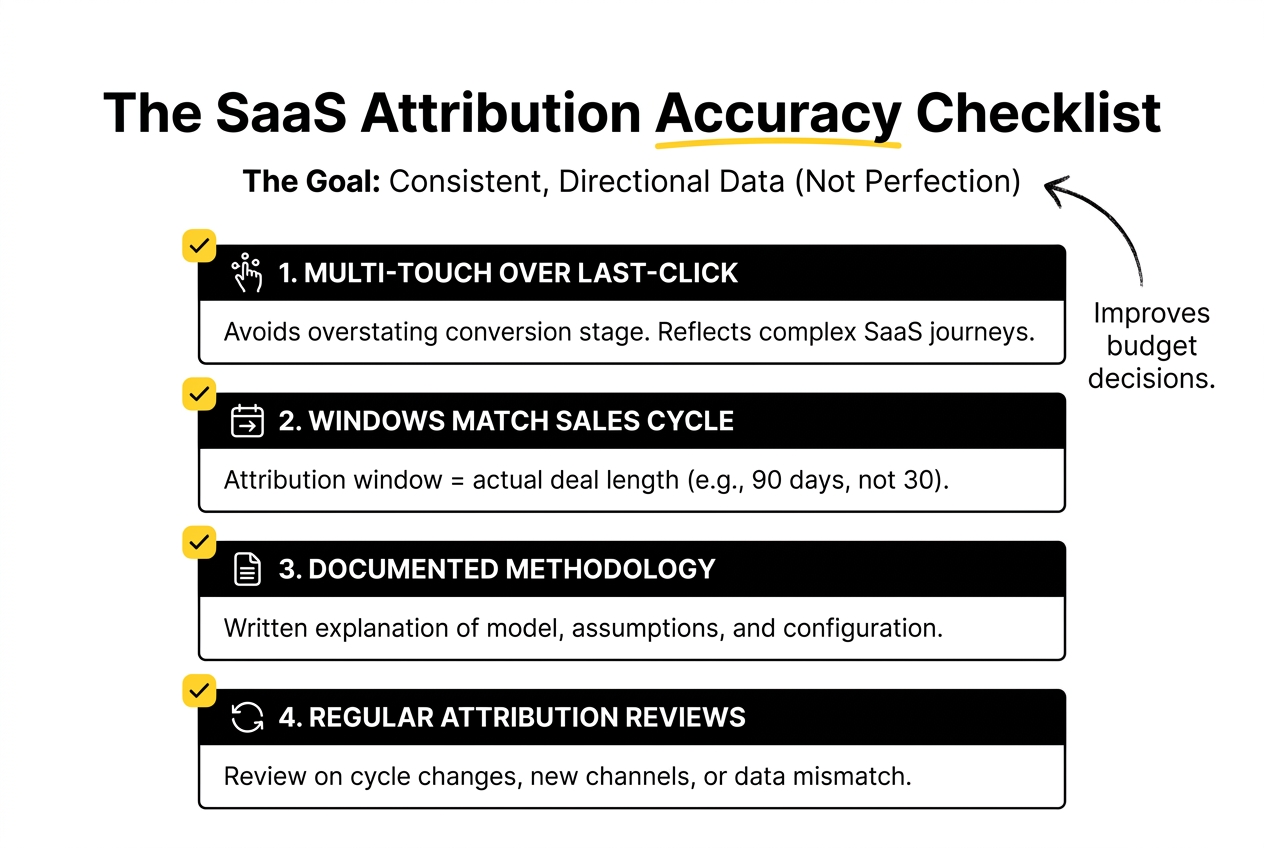
Attribution will never be perfect. A SaaS deal that involves six stakeholders over three months, across organic search, paid social, a webinar, an SDR sequence, and a product trial, cannot be definitively attributed to a single source. The goal is not perfect attribution. It is consistent, directional data that improves budget decisions.
The best practices to look for in a SaaS marketing agency’s attribution approach:
Multi-touch models over last-click. Last-click attribution systematically overstates the value of conversion-stage touchpoints and understates the value of awareness and nurture channels. An agency running last-click attribution on a SaaS product with a 60-day sales cycle is optimising the wrong thing.
Attribution windows matched to sales cycle length. If your average deal takes 90 days from first touch to close, a 30-day attribution window produces misleading data. The agency should configure windows that reflect your actual sales cycle.
Documented methodology. The agency should be able to explain, in writing, exactly how they attribute conversions in your account. This includes which model they use, why, and what assumptions underpin it. Verbal descriptions are not sufficient for a marketing operations specialist evaluating a partner.
Regular attribution reviews. Attribution models should be reviewed when sales cycle length changes, when new channels are added, or when CRM data suggests a systematic mismatch between reported leads and closed revenue.
Seamless Integration Within Your Existing MarTech Stack
Adding an agency to your team should reduce operational complexity, not create new data silos. Top SaaS marketing agencies for data-driven insights understand that they are entering an existing MarTech environment and that their job is to work within it, not around it.
The evaluation criteria here are practical. Can the agency work with your current CRM, analytics platform, and data warehouse without requiring you to switch tools or run parallel systems? Do they have established integration processes for the platforms you already use? What is their approach when a required integration does not exist out of the box?
The agencies that handle this well are explicit about their integration processes in the proposal stage. They ask about your current stack, identify any gaps or conflicts early, and have documented processes for common integrations. Agencies that are vague about integration in proposals tend to be vague about it in delivery as well.
The Evaluation Checklist
When assessing a SaaS marketing agency on its analytics and reporting services, use the following criteria:
CRM integration
- GCLID capture and end-to-end lead tracking to the CRM
- Pipeline and revenue reporting by lead source
- MQL-to-SQL tracking and visibility into lead quality
Offline conversion tracking
- Operational process for uploading CRM conversion data to ad platforms
- Server-side tracking setup (CAPI for Meta, Enhanced Conversions for Google)
- Attribution timing methodology for long sales cycles
Data integrity
- Change log documentation for all material tracking and configuration changes
- Conversion definition consistency and version control
- Process for root cause analysis when data anomalies appear
Reporting quality
- Strategic commentary written for a commercial audience, not a technical one
- Clear narrative connecting campaign activity to pipeline outcomes
- Explicit handling of data uncertainty
Attribution methodology
- Multi-touch model in use, with documented rationale
- Attribution windows configured to match sales cycle
- Regular attribution reviews built into the engagement cadence
MarTech integration
- Confirmed compatibility with your existing CRM, analytics, and data stack
- Documented integration processes for key platforms
- Clear escalation process when integrations fail or produce unexpected data
Common Pitfalls When Selecting a SaaS Marketing Agency for Analytics
The most common mistake is treating analytics capability as a secondary consideration. Marketing operations specialists know better, but procurement processes often focus on channel expertise and case studies, while measurement depth only surfaces later in the conversation.
A related mistake is accepting platform-reported conversions as the primary reporting source. Ad platforms have strong incentives to report favourable attribution. An agency that relies on Google Ads or LinkedIn’s own conversion data without CRM validation is giving you an optimistic picture.
Finally, be cautious of agencies that promise analytics capabilities they have not yet built for your specific setup. Integration with HubSpot on a standard contact-level model is straightforward. Integration that maps account-level multi-touch attribution to a custom CRM pipeline stage requires meaningful configuration. Ask to see evidence of the specific integration you need, not just a claim that they can do it.
Frequently Asked Questions
What key features should SaaS marketing agencies provide in their analytics and reporting services?
Agencies should provide CRM-integrated reporting that connects campaign data to pipeline and revenue, offline conversion tracking for deal events that happen away from the browser, documented change logs for tracking configuration, and strategic commentary that frames performance in commercial terms. These features collectively produce reporting that improves decisions rather than simply describing activity.
How can CRM integration enhance the effectiveness of analytics for SaaS marketing?
CRM integration allows agencies to connect ad platform data to deal outcomes, showing which campaigns contributed to qualified pipeline and closed revenue rather than just top-of-funnel metrics. It enables MQL-to-SQL tracking, reveals lead quality issues early, and powers bidding optimisation toward revenue-generating conversion events rather than form fills.
What is offline conversion tracking and why is it important for SaaS marketing agencies?
Offline conversion tracking is the process of recording commercial events that happen outside the browser, such as phone demos, in-person meetings, or trial-to-paid conversions, and feeding that data back into ad platforms for attribution and bidding purposes. For SaaS businesses with sales cycles involving human touchpoints, it closes a systematic gap between ad platform data and actual revenue outcomes.
What role do change logs play in maintaining data integrity for SaaS analytics?
Change logs document every material adjustment to tracking configuration, conversion definitions, and attribution settings. Without them, reported performance shifts cannot be reliably attributed to real changes in campaign effectiveness versus changes in how things are being measured. They are essential for root cause analysis and for ensuring that month-on-month comparisons are actually comparing the same thing.
How can strategic commentary from agencies support leadership teams in SaaS companies?
Strategic commentary translates campaign data into commercial language that leadership teams can act on. Where a dashboard shows metrics, commentary explains what those metrics mean for pipeline, what changed and why, and what the recommended response is. For marketing operations specialists presenting to a board or C-suite, an agency that can produce this commentary reduces the interpretation burden significantly.
What are the best practices for ensuring attribution accuracy in SaaS marketing analytics?
Use a multi-touch attribution model rather than last-click, configure attribution windows that match your actual sales cycle length, document the methodology in writing, and review the model periodically as your business evolves. Attribution accuracy is not about finding a perfect model. It is about using a consistent, documented approach that produces directional data reliable enough to inform budget decisions.
How do SaaS marketing agencies ensure seamless integration within existing MarTech stacks?
Strong agencies assess your current stack in the proposal stage, identify integration requirements and any gaps, and have documented processes for common CRM and analytics platform integrations. They work within your existing tools rather than requiring new platforms, and they have a clear escalation process when integrations produce unexpected data.
What criteria should SaaS marketing operations specialists use to evaluate agency partners?
The core criteria are CRM integration depth, offline conversion tracking capability, change log documentation, strategic commentary quality, multi-touch attribution methodology, and confirmed MarTech stack compatibility. These should be assessed through specific questions and evidence requests rather than taken at face value from proposal decks.
What common pitfalls should SaaS companies avoid when selecting a marketing agency for analytics services?
Avoid treating analytics capability as a secondary consideration, accepting platform-reported conversions without CRM validation, and approving agencies on claimed integration capabilities rather than demonstrated ones. The gap between what agencies say they can do and what their standard processes actually deliver tends to show up three months into an engagement.
If the analytics and reporting capabilities of your current or prospective agency do not stack up against this checklist, it is worth a conversation. This is the kind of assessment we run with SaaS teams regularly.


.png)