Structuring SaaS PPC Accounts for PLG vs Sales-Led Funnels
PLG and sales-led funnels need completely different PPC account structures, conversion hierarchies, and bid strategies. Here's the blueprint for both.

Most SaaS PPC accounts fail quietly. Not because the targeting is wrong or the budgets are too low. They fail because the account was built without a coherent answer to one question: how do your customers actually buy?
If you're product-led, someone finds you, signs up for free, uses the product, and eventually pays. If you're sales-led, someone raises their hand, gets on a call, goes through a sales process, and closes. These are fundamentally different revenue motions, and yet most teams try to optimise one Google Ads account to serve both. That's like asking one athlete to compete in a sprint and a marathon at the same time.
This article gives you a practical SaaS PPC account structure blueprint for both motions: what to build, how to split campaigns, which conversion actions to use, and how to think about bidding when PLG and sales-led funnels operate on completely different timelines and signals.
If you're already running paid search and your reporting doesn't map cleanly to how deals actually happen, this is where the problem usually starts. Service Blueprint: What ‘SaaS PPC & Paid Search Management UK’ Should Actually Include, also on this blog, takes this further.
The Core Problem: One Account Can't Optimise to Two Conversion Truths
Google's Smart Bidding doesn't care about your GTM strategy. It cares about conversion data. Feed it the wrong signal, or a mixed signal, and it will optimise toward the path of least resistance, not the path that generates pipeline.
Here's what this looks like in practice. A SaaS company running both PLG and sales-led motions tracks "trial signup" as their primary conversion. The algorithm learns which search queries, devices, and times of day produce trial signups at low cost. It doubles down. CPAs look great. Then the revenue team notices that paid demos are dropping and SQLs aren't flowing. Why? Because the account was quietly being steered toward self-serve trial traffic that never converted to paid, and away from high-intent commercial buyers who want to talk to sales.
The fix isn't complicated, but it requires intentional structure from day one. You need separate conversion hierarchies, separate bid strategies, and often separate campaign families, based on the motion you're optimising for.
Step One: Define Your Motion (or Motions)
Before touching campaign structure, you need clarity on which motion you're running:
- Pure PLG: The product is the primary acquisition channel. Users sign up, activate, and convert to paid without sales intervention. Think Notion, Figma, or Loom at their early stages.
- Pure sales-led: No self-serve. Every deal requires a conversation. Typically enterprise, complex product, high ACV. Think anything where "request a demo" is the only CTA.
- Hybrid (PLG + sales-led): Both motions coexist. PLG serves SMB and mid-market through self-serve. Sales-led closes enterprise. Increasingly common as SaaS companies scale.
The motion you're running determines everything downstream: what you bid on, what you optimise for, and how you structure campaigns. Get this wrong and you're building on sand.
PLG PPC Strategy: Account Structure Blueprint
In a PLG motion, the job of paid search is to bring in users who are likely to activate and eventually convert to paid. Volume matters, but not at the expense of quality, signups who bounce on day one are worthless to your algorithm.
Campaign Families
Split campaigns by search intent, not product feature. The intent-based structure gives Smart Bidding clean, coherent signals and makes it easier to understand what's driving activations downstream.
- Brand campaigns: Your name, your product, variations. High intent, low funnel. Protect these aggressively. Bid on your brand even if organic rank is strong, competitors will if you don't.
- Problem-aware / category campaigns: Queries like "project management software for remote teams" or "best collaboration tool for design agencies." These users know they have a problem and are evaluating solutions. Strong for PLG because self-serve lowers the barrier to try.
- Competitor campaigns: Users searching for alternatives to direct competitors. High intent, strong fit for PLG if you have a credible trial offer. These tend to be expensive, qualify them carefully with tight ad messaging and dedicated landing pages.
- Integration / use case campaigns: "Figma plugin for design handoff" or "Slack alternative for startups." Work well for PLG tools with broad integrations or strong community presence.
- What to avoid at PLG volume: Broad "awareness" keywords like "productivity app" or "team software" without strong intent signals. These inflate trial numbers with users who were never going to stick.
Conversion Hierarchy for PLG
This is the most important structural decision in a PLG account. You need a hierarchy of conversion events, and you need to be deliberate about which one Smart Bidding is actually targeting.
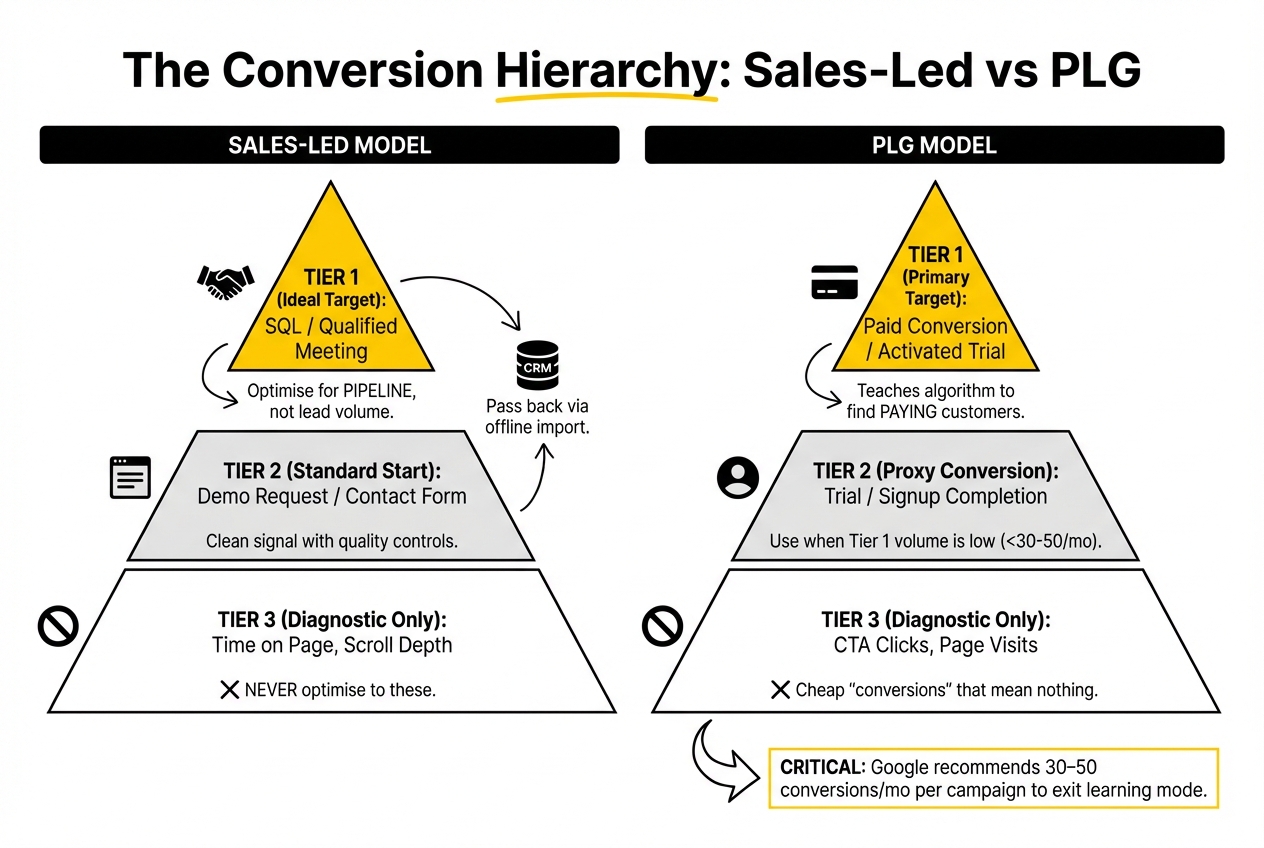
- Tier 1 (primary optimisation target): Paid conversion or activated trial. If you can pass back downstream conversion data via offline conversion import, this is the gold standard. It teaches the algorithm to find users who actually become paying customers, not just people who clicked "Start for free."
- Tier 2 (proxy conversion, used when Tier 1 volume is insufficient): Trial/signup completion. Broad enough to give the algorithm learning data, but you're explicitly accepting that it's a proxy.
- Tier 3 (diagnostic only, never use as bidding target): Landing page engagement, CTA clicks, pricing page visits. These produce cheap "conversions" that mean nothing.
The volume threshold to be aware of: Google recommends at least 30, 50 conversions per month per campaign to exit learning mode with Target CPA or Target ROAS. If your paid conversion volume is below that, use signup as the primary target and monitor downstream quality manually.
Bidding Logic for PLG
Start with Maximise Conversions to build volume, then shift to Target CPA once you have 4, 6 weeks of consistent data. Don't rush the transition, a Target CPA bid strategy with insufficient data will constrict delivery and inflate CPAs.
If you have downstream paid conversion data, Target CPA against paid conversion is the goal. Volume will drop and CPCs will rise. But the economics almost always improve because you're no longer paying for signups that never activate.
Landing Experience for PLG
PLG landing pages have one job: reduce friction between click and trial. That means:
- Self-serve signup flow, not a demo request form
- Social proof at the right level (product reviews, G2 badges, user counts, not just enterprise logos)
- Clear "time to value" messaging: what will the user accomplish in their first session?
- Pricing visibility, PLG buyers want to understand the free/paid boundary before signing up
If your PLG landing page leads with "Book a demo," you're working against the motion.
Sales-Led PPC Strategy: Account Structure Blueprint
In a sales-led motion, PPC is a pipeline engine. Every click should be moving a qualified buyer toward a conversation with your sales team. Volume is not the priority. Quality is.
Campaign Families
Sales-led accounts should be structured around buyer intent layers and ICP segmentation, not product features.
- High-intent bottom-funnel: Queries where the buyer is actively looking to buy or compare: "best [category] software for [industry]," "[product] alternative," "enterprise [category] solution." These should receive the majority of budget. Users here are short-listing. Your ad and landing page need to earn the right to a call.
- ICP + use case: "Software for [specific job title]," "solution for [specific pain point]." More targeted, often lower volume, but higher lead quality when the match is tight. Works well when you have strong ICP definition.
- Competitor campaigns: In sales-led, you're not competing on ease of trial, you're competing on outcomes, trust, and sales experience. Lead with case studies and proof.
- Brand defence: Non-negotiable. Your demo request form is downstream of your brand.
- What to deprioritise: Broad educational queries where the buyer is too early to engage with sales. These generate leads that sales teams ignore, which erodes trust in PPC as a channel.
Conversion Hierarchy for Sales-Led
- Tier 1 (ideal): SQL or qualified meeting, passed back via offline conversion import from CRM. This tells Smart Bidding which leads actually made it through discovery and into the pipeline. Operationally harder to set up, but it's the only way to optimise for pipeline rather than lead volume.
- Tier 2 (standard starting point): Demo request / "Contact Sales" form submission. Clean signal if your form has quality controls; noisy if it doesn't.
- Tier 3 (diagnostic only): Time on page, scroll depth, chatbot engagement. Never optimise to these.
On lead quality controls: business email validation and company size dropdowns reduce volume but improve SQL rate. High-intent queries can handle more friction; mid-funnel queries may need lighter gating. Test both before standardising.
Bidding Logic for Sales-Led
Start with Maximise Conversions (targeting demo requests) and evolve toward Target CPA as volume stabilises. The challenge is that demo-request CPAs can be volatile, one bad week of low-quality leads disrupts the algorithm's learning.
If you have SQL data to pass back and sufficient volume (30+ qualified meetings/month across campaigns), Target CPA against SQL is the right destination. In practice, most mid-market SaaS companies don't hit this per-campaign threshold, so hybrid approaches, Target CPA at the account level while managing CPCs manually at campaign level, are common.
Landing Experience for Sales-Led
Commercial buyers evaluating a solution for a 90-day sales cycle are not signing up for a free trial. They're deciding whether this is worth 30 minutes of their time.
What converts in sales-led:
- Specific social proof that mirrors their company profile (industry, size, use case)
- Clear statement of what the demo involves and what they'll walk away with
- Security and compliance signals if the buyer is enterprise (SOC 2, GDPR, SSO)
- ROI framing: not "book a demo" but "see how [Company X] reduced [metric] by [X]%"
- Short form, save qualification questions for the SDR, not the landing page
Hybrid GTM PPC Account Structure: Running Both Motions Together
Most SaaS companies reach a point where both motions coexist. PLG serves the long tail; sales-led closes enterprise deals. The structural challenge is keeping the two motions from contaminating each other's conversion data.
When to Separate
The default answer: separate campaign families with separate conversion actions and separate bid strategies. If PLG and sales-led campaigns share a conversion goal, Smart Bidding will optimise to the combined signal, which is usually dominated by the higher-volume motion (PLG signups) and will gradually starve the lower-volume motion (demo requests) of spend.
Separate conversion actions are non-negotiable. "Trial Signup" and "Demo Request" must be distinct goals, used in distinct bid strategies.
PQL-to-SQL Bridging
In a hybrid motion, some PLG users eventually reach product-qualified lead (PQL) status and should enter a sales conversation. From a campaign structure perspective: don't mix PQL retargeting with cold demo-request campaigns. Retargeting users who have already completed a trial with a "Talk to Sales" message is a legitimate tactic, but run it as a standalone campaign with separate budget, messaging, and conversion tracking. If it blends into your cold SLG traffic, the conversion data becomes meaningless.
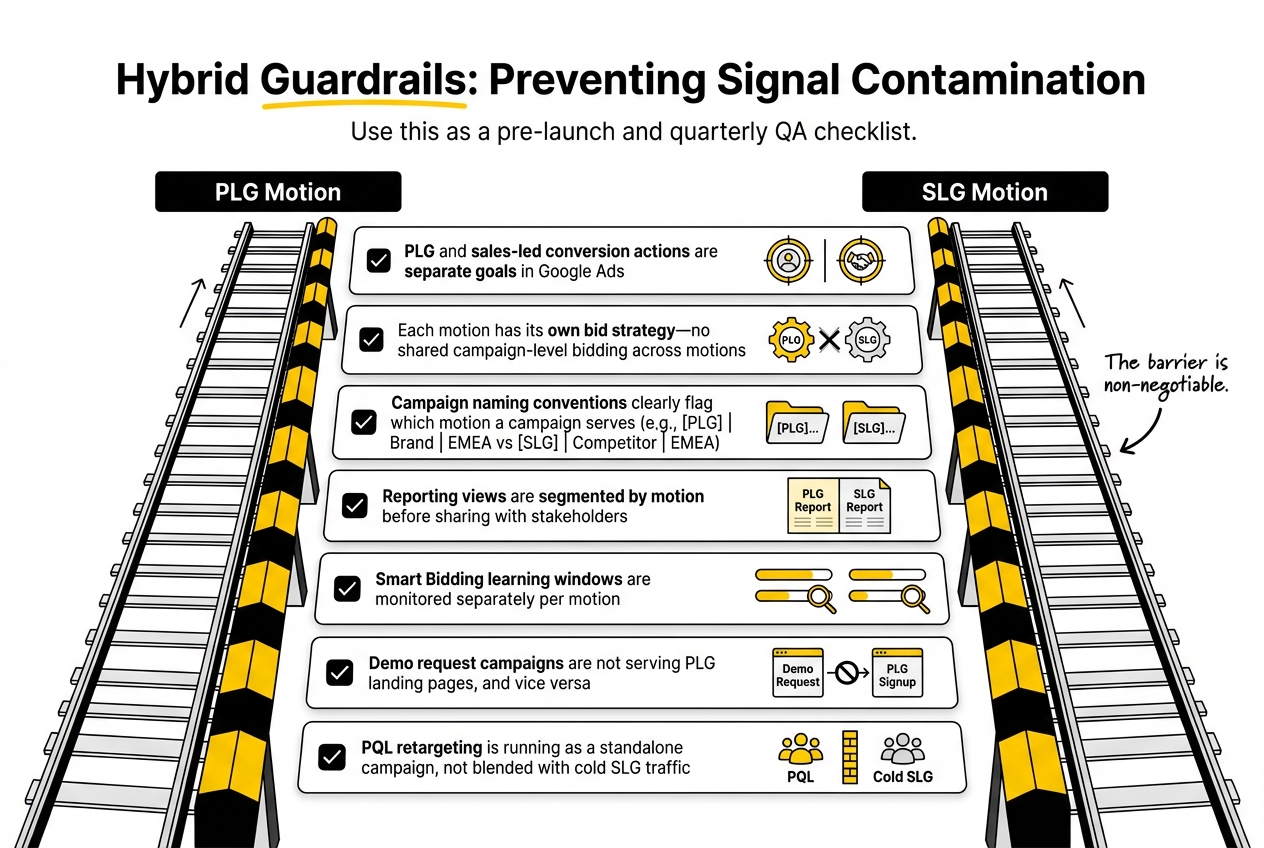
Hybrid Guardrails: Preventing Signal Contamination
Use this as a pre-launch and quarterly QA checklist:
- PLG and sales-led conversion actions are separate goals in Google Ads
- Each motion has its own bid strategy, no shared campaign-level bidding across motions
- Campaign naming conventions clearly flag which motion a campaign serves (e.g., [PLG] | Brand | EMEA vs [SLG] | Competitor | EMEA)
- Reporting views are segmented by motion before sharing with stakeholders
- Smart Bidding learning windows are monitored separately per motion
- Demo request campaigns are not serving PLG landing pages, and vice versa
- PQL retargeting is running as a standalone campaign, not blended with cold SLG traffic
When NOT to Split: The Minimum Viable Structure Rule
Splitting by motion requires volume. Smart Bidding campaigns with fewer than 20, 30 conversions per month will underperform regardless of how elegant the structure is.
If you're early stage, pre-PMF, or running with limited budget, you don't need the full blueprint. You need a minimum viable structure:
- 1, 2 core campaign types (brand + one non-brand intent cluster)
- 1 primary conversion action that best proxies revenue
- Manual CPC or Maximise Clicks while you build volume
- Clean naming conventions so the account can grow into a structured system later
Don't architect for scale you don't have yet. The best SaaS PPC account structure is the one you can actually manage and optimise with your current data.
Restructure Checklist: Migrating Without Losing Learnings
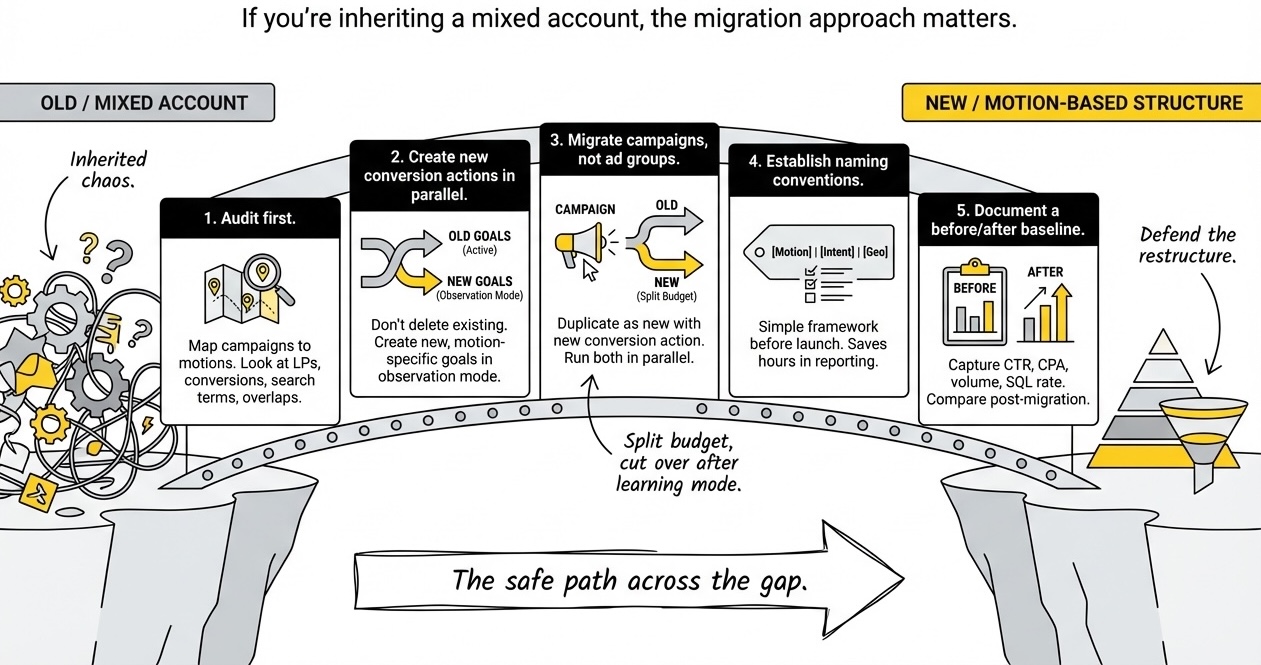
If you're inheriting a mixed account and need to introduce motion-based structure, the migration approach matters.
Step 1, Audit first. Map which campaigns are effectively serving which motion. Look at landing page destinations, conversion actions recorded, search term reports, and audience overlaps.
Step 2, Create new conversion actions in parallel. Don't delete existing conversions. Create new, motion-specific goals in observation mode while the old ones stay active.
Step 3, Migrate campaigns, not ad groups. Duplicate as new campaigns with the new conversion action, run both in parallel with split budget, and cut over once the new campaign exits learning mode and matches performance.
Step 4, Establish naming conventions before launch. A simple framework: [Motion] | [Intent Type] | [Geo/Segment]. Takes ten minutes and saves hours in reporting.
Step 5, Document a before/after baseline. Capture CTR, CPA, conversion volume, and downstream SQL/activation rate for 4 weeks before migration. Compare at 4 and 8 weeks post-migration. If you don't set the baseline, you can't defend the restructure.
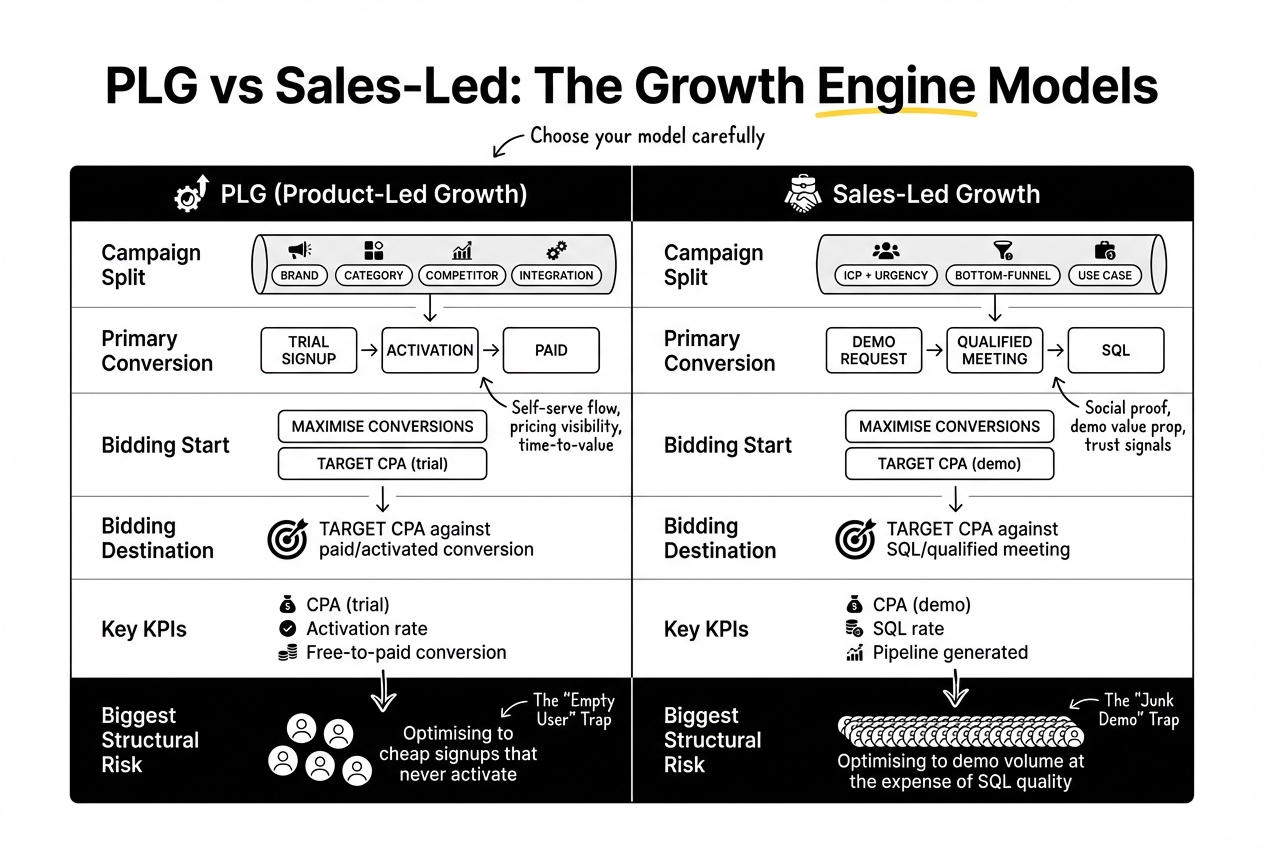
PLG vs Sales-Led: At a Glance
PLGSales-LedCampaign splitIntent type (brand, category, competitor, integration)ICP + urgency (bottom-funnel, use case, competitor)Primary conversionTrial signup → Activation → PaidDemo request → Qualified meeting → SQLBidding startMaximise Conversions → Target CPA (trial)Maximise Conversions → Target CPA (demo)Bidding destinationTarget CPA against paid/activated conversionTarget CPA against SQL/qualified meetingLanding page focusSelf-serve flow, pricing visibility, time-to-valueSocial proof, demo value prop, trust signalsKey KPIsCPA (trial), activation rate, free-to-paid conversionCPA (demo), SQL rate, pipeline generatedBiggest structural riskOptimising to cheap signups that never activateOptimising to demo volume at the expense of SQL quality
FAQ
How should you structure a SaaS PPC account differently for PLG vs sales-led?
PLG accounts are built around intent clusters, brand, category, competitor, integration, with conversion hierarchies cascading from trial to activation to paid. Sales-led accounts are built around ICP and urgency layers, bottom-funnel, competitor, use case, with hierarchies cascading from demo request to qualified meeting to SQL. The campaign families, conversion actions, and bid strategies follow completely different logic.
Should PLG and sales-led motions live in the same Google Ads account or be separated?
Same account is fine. The separation needs to happen at the campaign, conversion action, and bid strategy level, not the account level. Separate accounts create management overhead without meaningful performance benefit.
What conversions should PLG teams optimise for: trial starts, activations, or paid upgrades?
The ideal is paid upgrade or activation. Trial starts are a useful proxy when volume is low, but they train the algorithm to find the cheapest signups, not the most valuable ones. If you can pass back activation events or paid conversion data, do it.
What conversions should sales-led teams optimise for: demo requests, qualified meetings, or SQLs?
Start with demo requests. Migrate to qualified meetings or SQLs via offline conversion import as soon as pipeline volume supports it. The jump from demo requests to SQLs as the primary signal almost always improves lead quality, but you need at least 30 qualifying events per month per campaign to make it work.
How do you prevent PLG signups from polluting sales-led optimisation in a hybrid motion?
Separate conversion actions, separate bid strategies, separate campaign families. If PLG and SLG campaigns share a conversion goal, Smart Bidding consolidates the signal and skews toward the higher-volume motion.
When is it too early to split campaigns by motion?
If a motion-specific campaign would generate fewer than 20, 30 conversions per month, it's too early. Use a minimum viable structure until volume supports splitting.
What's the best way to restructure an existing account without losing learnings?
Build parallel campaigns with new conversion actions while keeping the old campaigns live. Split budget, run both, and cut over once the new campaign has stabilised. Never rebuild from scratch, you lose historical quality scores and Smart Bidding learning data.
Getting This Done Properly
Getting this right end-to-end, defining the right motion, building the campaign architecture, setting up the correct conversion hierarchy, and maintaining clean reporting, is the kind of work that takes weeks to implement and months to validate.
If you'd rather have a specialist ppc for saas agency handle this alongside your team, that's what we do. We work exclusively with B2B SaaS companies and we've run this playbook across enough accounts to know where the edge cases are.