Service Blueprint: What ‘SaaS PPC & Paid Search Management UK’ Should Actually Include
See what SaaS PPC and paid search management in the UK should actually include, from strategy and tracking to testing, reporting, and growth planning.

Most SaaS demand gen leaders have been through it. You hire an agency for SaaS PPC management, they get access to the account, do some keyword tidying, set up a dashboard, and then spend the next 12 months reporting on impressions and click-through rates. Pipeline stays flat. The conversation at board level gets awkward. And when you push back, the agency sends a longer report.
The problem is usually not the agency’s effort. It’s scope creep in the wrong direction: too much account maintenance, not enough commercial ownership.
This article maps out what a serious SaaS Google Ads agency engagement should actually include, workstream by workstream, so you can benchmark any proposal or retainer against a clear standard.
The Difference Between Account Maintenance and SaaS PPC Management
These are not the same thing, even though both tend to show up under the same heading in agency proposals.
Account maintenance means someone is in the platform regularly: adjusting bids, adding negatives, checking for disapproved ads, monitoring budget pacing. That work is necessary. But on its own, it does not move the needle on pipeline quality or cost-per-opportunity. It keeps the car running. It does not decide where to drive.
True SaaS PPC management adds a strategic layer on top: which audiences are worth bidding on, how landing page messaging affects conversion rates, how CRM data should feed back into campaign optimisation, whether the funnel model (sales-led, demo-led, PLG) is actually reflected in campaign structure. These decisions shape outcomes. Bid adjustments don’t.
A useful test: can your agency explain, in plain terms, why you are bidding on a specific keyword, what conversion event that keyword is optimised toward, and what happens to leads from that keyword downstream in your CRM? If the answers are vague, you have account maintenance dressed up as management.
The Eight Workstreams of a SaaS PPC Management Engagement
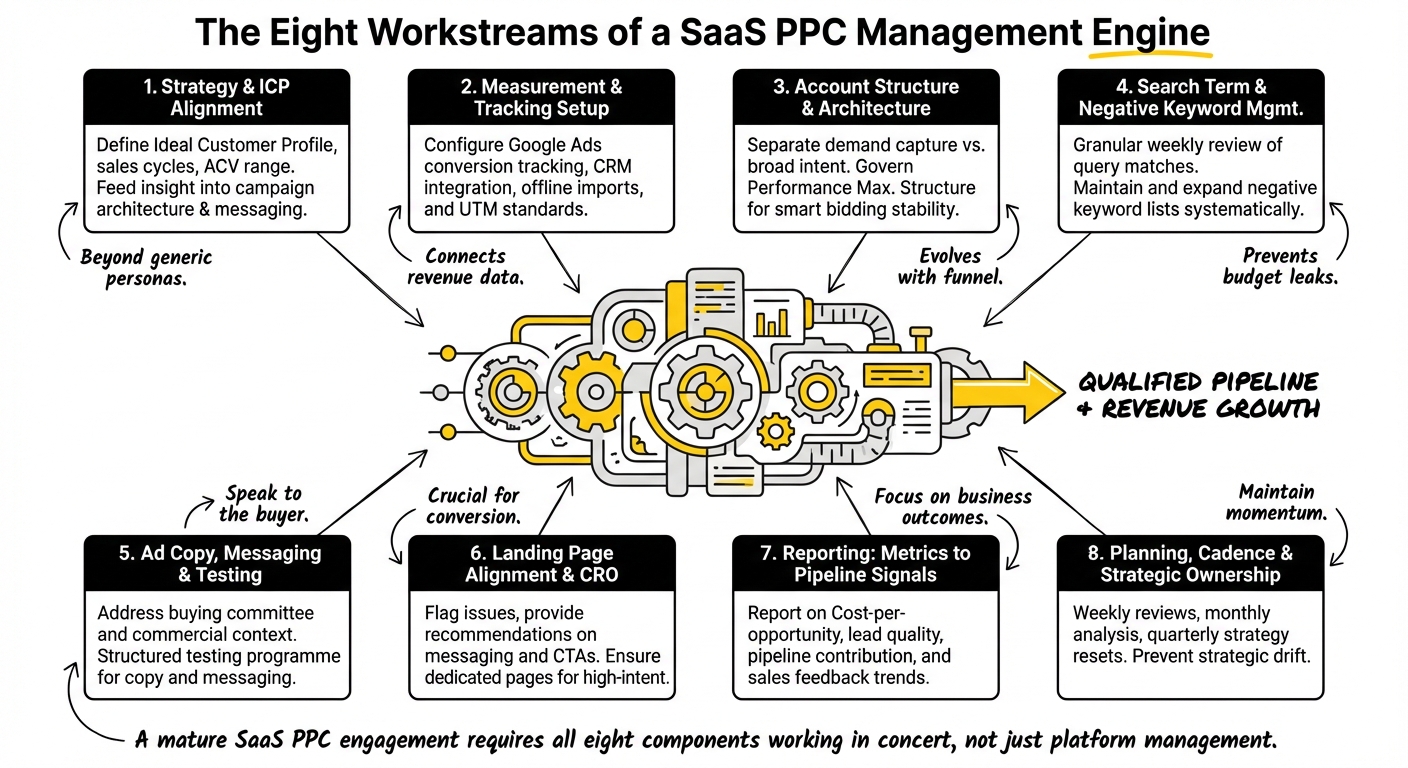
1. Strategy and ICP Alignment
Before a single campaign is launched or restructured, a SaaS PPC agency needs to understand your ideal customer profile (ICP) at a level that most generalist agencies skip entirely.
This means knowing: which company types and job titles convert to closed-won revenue (not just demos), what sales cycle length looks like by segment, how your product is sold (self-serve, sales-assisted, enterprise), and what ACV range justifies the cost-per-lead you can afford.
This ICP understanding should feed directly into campaign architecture: which keywords to bid on and which to exclude, what messaging to use by audience segment, how to weight budget across funnel stages, and how to interpret lead quality feedback from sales.
Without this, campaign decisions get made on platform data alone, and platform data does not tell you whether a lead was ever going to buy.
2. Measurement and Tracking Setup
This is where most agencies underdeliver, not because it is technically difficult, but because getting it right requires coordination with your analytics, CRM, and sales teams, and many agencies prefer to avoid that friction.
A solid measurement setup for B2B SaaS PPC includes:
- Google Ads conversion tracking correctly configured for your primary action (demo request, trial sign-up, contact form) with no duplicate counting
- CRM integration so that lead quality and pipeline progression can be fed back to the platform for smart bidding optimisation
- Offline conversion imports where demos or trials take time to qualify (common in sales-led models with a 2-4 week sales cycle before SQL)
- A clear hierarchy of conversion actions: what counts as a primary conversion, what is a secondary signal, what should never be used for smart bidding optimisation
- UTM parameter standards maintained consistently across every ad, so channel attribution holds up in CRM reporting
The reporting you can produce later is only as good as the tracking you set up at the start. If your agency cannot walk you through each of these points, the measurement layer is incomplete.
3. Account Structure and Campaign Architecture
Account structure is not a one-time setup task. It should reflect your funnel strategy and evolve as you learn which audience segments and intent levels perform.
For most B2B SaaS companies, this means separating demand capture (branded search, competitor search, high-intent category terms) from broader intent terms, maintaining dedicated campaigns by product line or use case where relevant, and building campaign structures that allow budget to be shifted quickly when performance data warrants it.
The architecture decisions that matter most in SaaS PPC management are:
- How branded and non-branded campaigns are separated (blending them distorts your true cost of acquisition)
- How Performance Max is governed, since unconstrained PMax will consume budget across irrelevant inventory without clear audience signals feeding it
- Whether your account is structured to support smart bidding with sufficient conversion volume per campaign (Google’s Target CPA and Target ROAS algorithms need roughly 30 conversions per month per campaign to stabilise)
- How competitor and alternative-search campaigns are handled, since these attract high-intent buyers who are comparing options and respond to different messaging
4. Search Term Control and Negative Keyword Management
This is the granular work that most clients never see but directly affects whether your budget reaches the right buyers.
In B2B SaaS, the range between a good and bad search query match can be enormous. Someone searching “CRM software for sales teams” and someone searching “free CRM” represent completely different buying situations. If your campaigns are not systematically reviewed for irrelevant matches and your negative keyword lists are not maintained and expanded regularly, budget leaks are constant.
A SaaS PPC agency should own ongoing search term reviews as a non-negotiable weekly task, with a documented process for how findings feed back into negative keyword lists, match type decisions, and occasionally ad copy or landing page adjustments.
5. Ad Copy, Messaging, and Testing
This workstream is where SaaS-specific understanding either shows up or disappears entirely.
Generic PPC copy focuses on features and calls to action. SaaS PPC copy for a B2B audience needs to address the buying committee, reflect the sales motion, and speak to the commercial context the buyer is operating in. A message that works for a startup evaluating their first CRM is not the same message that works for a Head of Revenue Ops at a Series B company replacing an existing stack.
A mature SaaS ppc management engagement includes a structured testing programme for ad copy and messaging, with hypotheses documented before tests run, results tracked against conversion rates and lead quality (not just CTR), and findings applied forward to landing page and broader campaign strategy.
Testing cadence matters here. If your agency has not tested a meaningful copy or messaging hypothesis in the last 90 days, they are maintaining, not managing.
6. Landing Page Alignment and CRO Support
The most common gap in PPC retainers for B2B SaaS companies is landing page ownership.
Agencies will say “we manage campaigns, not the website.” That position made more sense when traffic landed on generic website pages. In 2026, when smart bidding is optimising toward conversion events, the quality of the landing page the traffic hits is inseparable from campaign performance. If a page converts at 2% when it should convert at 5%, no amount of bid management will close that gap.
A SaaS PPC agency does not need to build and own every landing page. But they should be accountable for flagging landing page issues, providing specific recommendations on messaging alignment, copy, and CTA framing, and ensuring that dedicated landing pages exist for high-intent campaigns where the main website is too generic to convert.
For companies running a SaaS PPC engine for B2B SaaS at scale, landing page iteration is one of the highest-leverage activities available. Agencies that sit outside it are leaving performance on the table.
7. Reporting: From Platform Metrics to Pipeline Signals
The gap between what agencies report and what actually matters to a demand gen leader is one of the most consistent problems in SaaS PPC management.
Platform metrics: impressions, clicks, CTR, CPC. These are operational data. They help you understand account health and spot problems. They are not business outcomes.
What a SaaS demand gen leader needs to see in reporting:
- Cost-per-lead and cost-per-opportunity by campaign and channel
- Lead quality distribution: what percentage of leads are reaching SQL or demo stage
- Pipeline contribution: how much qualified pipeline has been created from paid search in the period
- Sales feedback: are the leads that paid search is generating worth the time of the sales team
- Trend direction: is cost-per-opportunity improving, stable, or deteriorating quarter on quarter
If your monthly report does not contain most of these, it is an account performance report, not a business performance report. The difference matters because only one of them tells you whether the retainer is working.
8. Planning, Cadence, and Strategic Ownership
Ongoing management has a rhythm. Getting this wrong is how retainers drift into maintenance mode without anyone noticing.
The operating cadence for a serious SaaS PPC management engagement looks like:
Weekly: Search term review, budget pacing check, bid performance monitoring, flagging of any anomalies or opportunities requiring same-week decisions.
Monthly: Full campaign performance review against pipeline and revenue targets, landing page and conversion rate analysis, ad copy performance and testing updates, lead quality feedback from CRM, budget reallocation recommendations for the coming month.
Quarterly: Strategy reset against current business goals, ICP and messaging review, account structure assessment, competitive landscape review, forward planning for budget and test priorities.
The quarterly review is often the first thing that gets dropped when an agency is stretched across too many accounts. If it is not happening, strategic drift is almost guaranteed.
What “UK” Should and Should Not Mean
UK is not just a geographic modifier. For B2B SaaS companies operating in the UK market, it signals something more specific: an agency that understands the commercial context, communication norms, and buying behaviour of UK buyers, and can bring that into campaign positioning and messaging decisions. How to Build a SaaS PPC Engine for B2B SaaS (Not Just Run Ads), also on this blog, takes this further.
What it should mean in practice: familiarity with UK SaaS market dynamics, understanding of how UK-based buying committees operate, communication standards that match how UK marketing teams expect to work with an agency partner (direct, no-fluff, commercially oriented), and the ability to work in GMT without creating a structural lag in responsiveness.
What it should not mean: a superficial “UK” badge applied to campaigns targeting London postcodes, or generic localisation tactics that any offshore agency could replicate with a flag emoji.
What Good Onboarding Looks Like in the First 90 Days
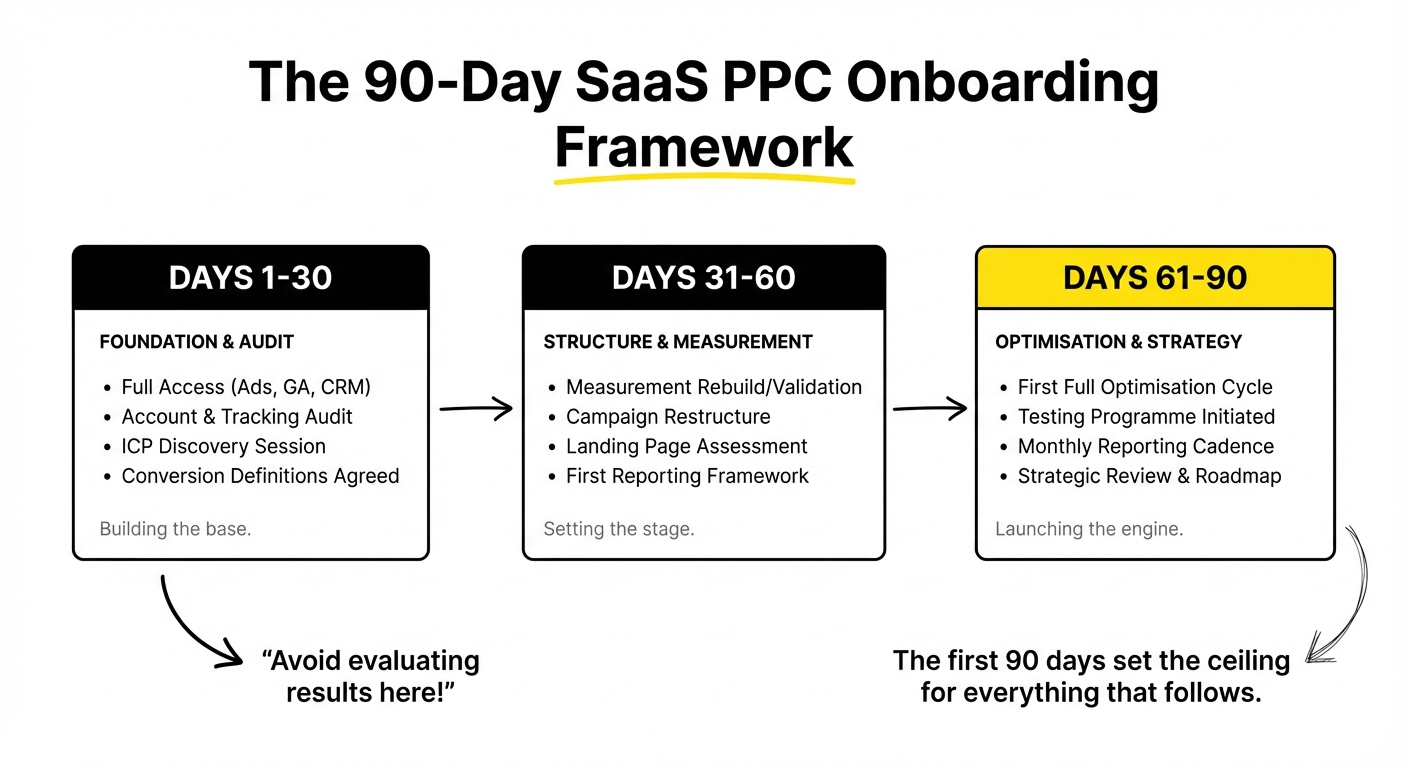
The first 90 days set the ceiling for everything that follows. A SaaS PPC agency that rushes into optimisation without proper onboarding is building on sand.
A structured onboarding for a SaaS PPC management engagement should cover:
Days 1-30: Access handover and audit. This means full access to Google Ads, Google Analytics, CRM, and any attribution tooling. A full account audit covering structure, tracking integrity, historical performance, and current measurement gaps. ICP discovery session with marketing and sales. Agreement on conversion definitions and what gets optimised toward.
Days 31-60: Measurement rebuild or validation, campaign restructure where needed, landing page assessment, initial copy and messaging review. First reporting framework agreed and shared. Any quick structural wins implemented.
Days 61-90: First full optimisation cycle complete. Testing programme initiated. Monthly reporting cadence established. First strategic review delivered with forward recommendations.
If an agency is asking you to evaluate results at 30 days, the onboarding was not structured correctly.
Warning Signs That a PPC Retainer Is Too Generic for B2B SaaS
Some patterns show up consistently in retainers that are set up for maintenance rather than growth:
- Reporting focuses on impressions, CTR, and CPC with no reference to pipeline, lead quality, or cost-per-opportunity
- No CRM integration or lead quality feedback loop exists after 6+ months
- Landing pages have not been reviewed or updated in the last quarter
- No structured copy testing has happened in the past 90 days
- Strategy conversations happen only when you initiate them
- The same agency contact handles your account alongside 15+ others
- Quarterly planning sessions were never established
None of these individually means the agency is incompetent. But when several are present together, the engagement has drifted from management to maintenance, and pipeline performance will reflect that.
Frequently Asked Questions
What should a SaaS PPC management service actually include?
A complete SaaS PPC management service should cover strategy and ICP alignment, conversion tracking and measurement setup, campaign architecture and account structure, ongoing search term control, ad copy testing, landing page alignment, pipeline-level reporting, and a regular operating cadence of weekly, monthly, and quarterly reviews. The agency should be accountable for business outcomes such as cost-per-opportunity and pipeline contribution, not just platform metrics.
What is the difference between SaaS PPC management and basic Google Ads account maintenance?
Account maintenance keeps campaigns running: bids adjusted, negatives added, budgets monitored. SaaS PPC management adds strategic ownership above that: ICP-aligned campaign architecture, CRM-connected measurement, structured testing, landing page input, and reporting that tracks lead quality and pipeline rather than clicks and impressions. The difference shows up in your sales pipeline, not in the platform dashboard.
How do you evaluate a SaaS PPC agency proposal in the UK?
Look for clear deliverables across all eight workstreams: strategy, tracking, account structure, search term management, creative testing, landing pages, reporting, and operating cadence. Ask specifically how they handle CRM integration and lead quality feedback. Ask what their quarterly planning process looks like. If the proposal focuses primarily on campaign setup and monthly optimisation without addressing measurement and pipeline reporting, it describes maintenance, not management.
Should a SaaS PPC agency help with tracking, CRM feedback, and offline conversions?
Yes. In B2B SaaS, the platform conversion event (a demo request or form submission) is rarely the end of the conversion story. Most leads take weeks to qualify through sales. Without CRM integration and offline conversion imports, the agency is optimising toward an action that does not directly predict revenue, and smart bidding will reflect that misalignment. This is one of the most common gaps in generalist PPC retainers.
How often should a paid search management partner review strategy and budget allocation?
Weekly operational reviews should cover pacing, anomalies, and search terms. Monthly reviews should cover full campaign performance against pipeline targets, lead quality, and budget allocation for the coming month. Quarterly reviews should cover strategy, messaging, ICP alignment, and forward planning. If quarterly strategic reviews are not happening, the engagement is likely drifting.
What deliverables should you expect during the first 90 days of a SaaS PPC engagement?
The first 30 days should deliver a full account and tracking audit, access review, and ICP discovery. Days 31 to 60 should deliver measurement validation or rebuild, campaign restructure where needed, and a landing page assessment. By day 90 you should have the first complete optimisation cycle, a testing programme in motion, and a monthly reporting cadence established. Agencies that skip structured onboarding tend to carry its gaps for the entire length of the retainer.
Does a SaaS PPC agency need to support landing pages and messaging as well as media buying?
They do not need to build every page, but they should be accountable for landing page performance as part of campaign results. In an environment where smart bidding optimises toward conversion events, a landing page converting at 2% when it should convert at 5% is a campaign performance problem, not just a website problem. An agency that sits entirely outside the landing page conversation is missing one of the highest-leverage levers in the account.
What are the warning signs that a PPC retainer is too generic for B2B SaaS?
Key warning signs include reporting that stops at clicks and CPL with no pipeline or lead quality data, no CRM integration after the first few months, no copy testing in the last quarter, strategy conversations that only happen when you initiate them, and no quarterly planning sessions. Individually these can have explanations. Together, they indicate an engagement that has settled into maintenance mode.
If you are working through a retainer review or evaluating a new agency proposal, this is the kind of scope conversation we have with SaaS teams regularly. Worth a conversation if you are at that point.