Avoiding False Efficiency Gains in SaaS Paid Media
How to spot false efficiency gains in SaaS paid media that lower CPL while damaging lead quality, and the practices that keep efficiency real.

Your cost-per-lead is down 30 percent quarter on quarter. Conversion volume is up. The paid media dashboard has never looked better. Then sales stops returning your messages, because the leads you have been sending them have quietly stopped converting.
That is a false efficiency gain, and it is one of the most common traps in SaaS paid media. The metric improves while the thing it is supposed to represent gets worse. CPL falls because the campaign started buying cheaper, lower-intent traffic, not because you are acquiring customers more efficiently.
False efficiency gains in SaaS paid media are dangerous precisely because they look like progress. They pass the dashboard test, survive the weekly report, and only surface months later when pipeline dries up and sales trust is already gone. This article is about spotting them early and fixing the incentives that create them.
What false efficiency gains actually are
A false efficiency gain is any improvement in a paid media metric that does not correspond to a real improvement in business outcomes. The number on the dashboard gets better. The qualified pipeline, the revenue, and the lead quality behind it do not.
The mechanism is almost always the same. A platform metric, usually CPL or conversion volume, improves because the campaign started attracting cheaper, easier conversions. Those conversions are people who complete a form but never buy: freelancers, students, job seekers, and prospects sitting well outside your ICP.
The impact of paid media on lead quality runs directly through the optimisation target. Feed a platform a form-submit event and it will find the cheapest person who will submit a form. The algorithm is doing exactly what you asked. You just asked for the wrong thing.
The most common false efficiency gains in SaaS paid media are:
- Optimising campaigns to form-fills instead of qualified pipeline
- Expanding broad match and Performance Max to chase cheaper clicks
- Loosening the form or offer to lift conversion rate
- Treating every lead as equal value in reporting
- Making CPL the target rather than a diagnostic
Each one lowers a headline number. Each one, left unchecked, degrades the leads sales actually works.
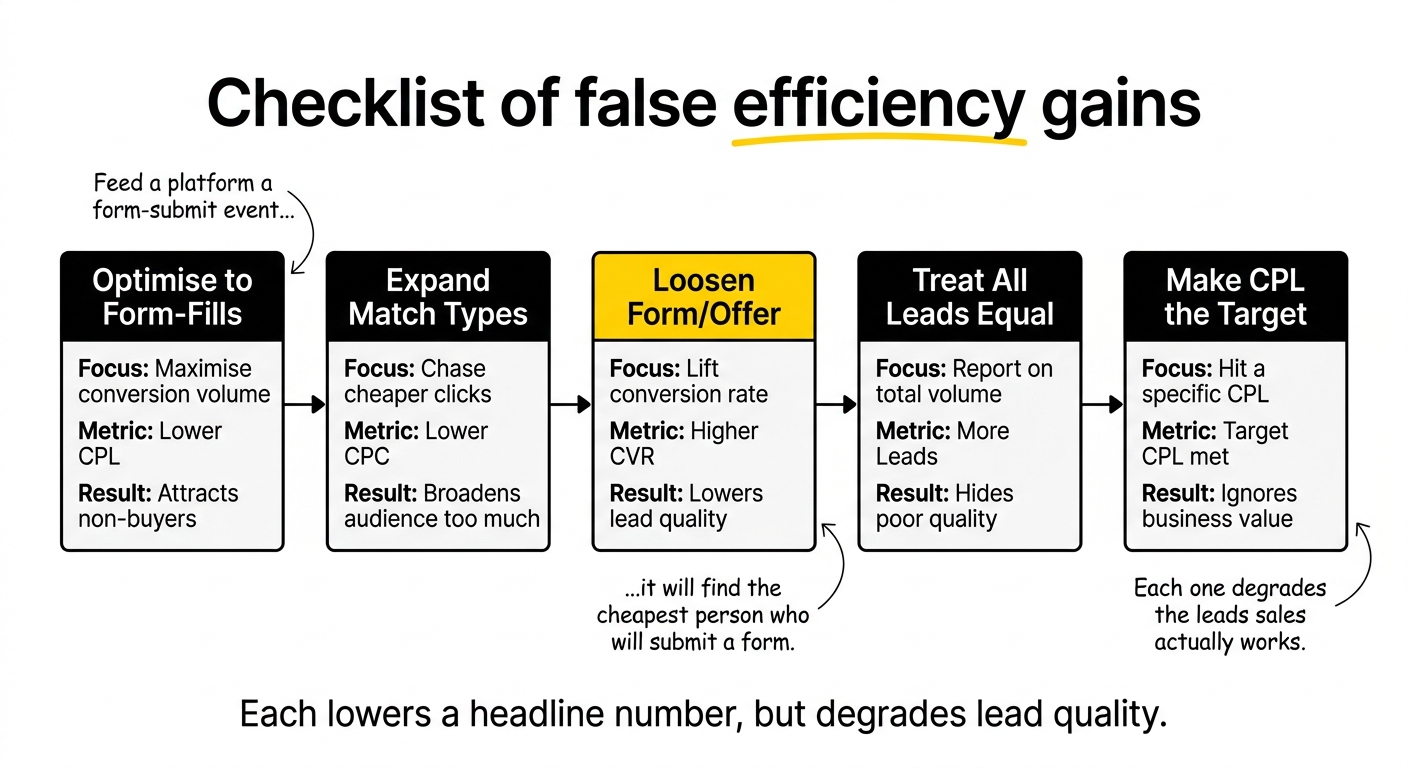
How false efficiency gains happen in paid media
Optimising to form-fills instead of pipeline
This is the root cause behind most of the others. When Smart Bidding or Advantage campaigns optimise toward a web conversion like a lead or a form submission, they learn to find the cheapest people who trigger that event. Most SaaS teams never close the loop, so the platform never learns what a good lead looks like.
As Search Engine Land has noted, tracking a single conversion point like a form submission opens the door to junk data and wasted spend. The fix is to feed CRM outcomes, MQL, SQL, opportunity, and closed-won, back to the platform so it optimises for buyers rather than browsers.
Broad match and Performance Max expansion
Widening match types or leaning on Performance Max almost always lowers CPL, because both reach cheaper, lower-intent inventory. In a B2B SaaS context that cheaper traffic is usually worse traffic. Broad match is more aggressive than ever, and irrelevant search traffic remains one of the largest sources of wasted spend.
Performance Max compounds the problem by treating every form fill as equal value unless you tell it otherwise. Without a quality-based conversion signal and a real audience seed, it optimises for volume over qualified leads. For most B2B programmes, search campaigns give you tighter control over who converts.
Loosening the form or offer to lift conversion rate
Stripping fields from a form or softening the offer reliably lifts conversion rate. It also lets more low-fit prospects through. A three-field form converts better than a seven-field form, but the extra conversions are disproportionately the people who were never going to buy. Conversion rate up, lead quality down. The tactical detail of getting conversion changes right without this trade-off is a topic in its own right, and one we treat separately.
Averaging leads that are not equal
A demo request and a gated-ebook download are not the same lead, but a CPL figure treats them identically. When reporting blends them, a campaign that shifts its mix toward cheap content downloads will show a falling CPL and rising volume while its contribution to pipeline collapses. The average hides the shift.
Why low CPL erodes sales trust
The most expensive consequence of false efficiency gains never appears on a marketing dashboard. It shows up in the relationship between marketing and sales.
When marketing keeps sending leads that do not convert, sales learns to ignore them. Reps deprioritise the queue, stop following up quickly, and start treating every marketing lead as suspect, including the good ones. Research consistently attributes a large share of lost opportunities to leads that were never properly qualified before sales pursued them, and the same dynamic runs in reverse: once sales stops trusting the source, even qualified leads go cold from slow follow-up.
Sales trust in marketing is hard to rebuild once it breaks. A quarter of cheap, junk-heavy leads can undo a year of credibility. That is the real cost of optimising CPL in isolation, and it does not reverse the moment you fix the campaign.
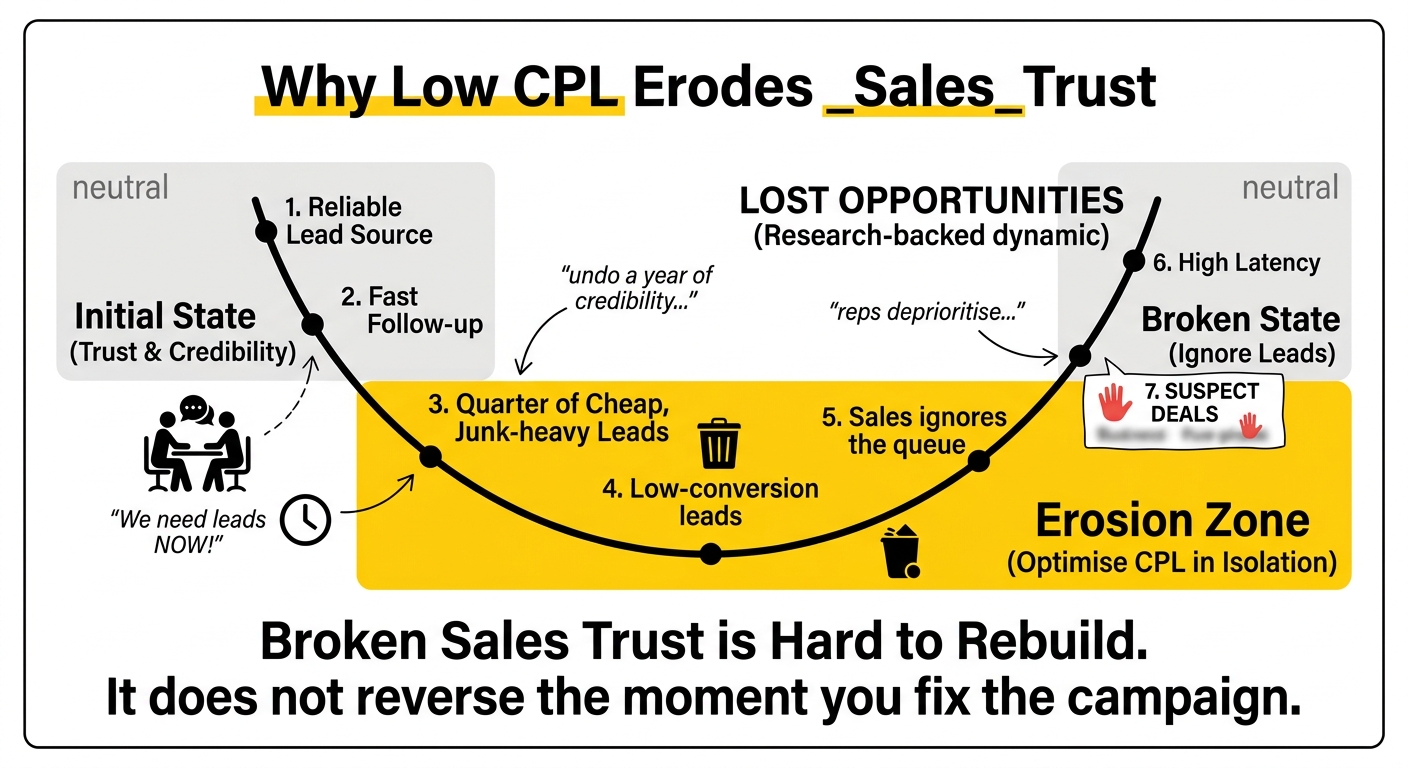
How to tell real efficiency from false
The test is simple: does the improvement survive contact with the CRM? Real efficiency gains show up downstream as more qualified pipeline per pound. False ones evaporate somewhere between the form and the opportunity.
Three checks separate the two:
- Compare the dashboard to the CRM. If the ad platform reports 150 leads and your CRM shows 90, your tracking is inflating efficiency. If it reports 150 and only 15 are contactable and qualified, your quality has collapsed regardless of CPL.
- Track cost per qualified lead, not just CPL. Cost per qualified lead often runs three to five times raw CPL, because most form fills never clear the qualification bar. Judge spend against qualified pipeline and average contract value.
- Read MQL-to-SQL and sales acceptance by source. A channel with a low CPL and a low acceptance rate is not efficient. It is cheap.
Measuring lead quality properly at this layer is what makes the distinction visible. If you are also working on the wider question of bringing acquisition cost down, the broader framework sits in Reducing SaaS CAC While Improving Lead Quality, which covers the strategic view this article drills into for paid media specifically.
How to protect efficiency and lead quality at the same time
None of this argues against efficiency. It argues for measuring it against the right outcome. A few practices keep SaaS marketing metrics honest.
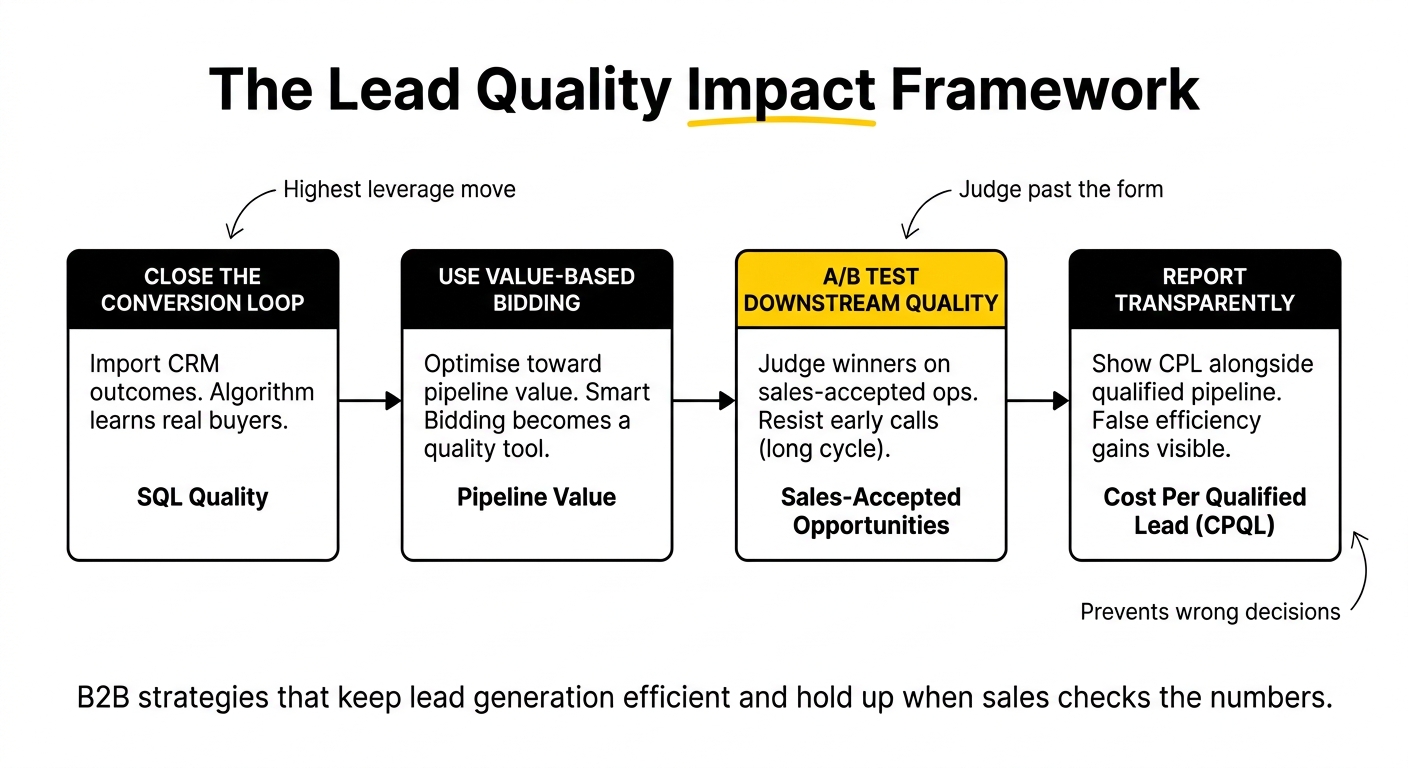
Close the conversion loop. Import CRM outcomes back into the ad platforms so bidding optimises for revenue, not form volume. Teams that switch from web conversions to CRM-based signals commonly report meaningful lifts in SQL quality without increasing spend, because the algorithm finally learns who the real buyers are. This is the single highest-leverage move in CPL optimisation done properly.
Use value-based bidding. Once qualified-lead and deal data flow back, let the platform optimise toward pipeline value rather than lead count. This turns Smart Bidding from a volume tool into a quality tool.
A/B test against downstream quality, not CPL. A/B testing in paid media only helps if you judge the winner on the right metric. A variant that lowers CPL can lose on sales-accepted opportunities. Run tests long enough to see how each variant performs past the form, through MQL and SQL, before declaring a winner. In a long SaaS sales cycle that means resisting the urge to call it in week two.
Report transparently. Transparent reporting is not a courtesy, it is a control. Showing CPL alongside qualified pipeline, acceptance rate, and cost per qualified lead makes false efficiency gains visible before they do damage. A data-driven strategy is only as good as the data you choose to put in front of people, and lead volume on its own invites the wrong decisions.
These are the b2b marketing strategies that keep lead generation efficient in a way that holds up when sales checks the numbers.
Where to start
If your CPL has been improving and you are not certain the quality has held, run one comparison this week: pull cost per qualified lead and sales acceptance rate by channel, next to your CPL. The gap between the two columns is your exposure to false efficiency gains.
From there, the priority order is consistent. Fix conversion tracking so the platform optimises on qualified outcomes. Close the CRM loop and move to value-based bidding. Tighten match types and audiences where cheap traffic is leaking in. Then hold every future test and report to the qualified-pipeline standard, not the CPL standard.
Efficiency and lead quality are not opposites. They only look like opposites when you measure efficiency at the wrong point in the funnel. Measured at the point where revenue is decided, the cheapest lead and the best lead are rarely the same, and the job of performance marketing is to tell them apart.
This is the kind of diagnostic we run with SaaS teams when the paid media numbers look strong but the pipeline does not follow. If you want a second read on whether your efficiency is real, we are happy to take a look.
Frequently Asked Questions
What are false efficiency gains in SaaS paid media?
False efficiency gains are improvements in paid media metrics that do not reflect real business results. A campaign's cost-per-lead drops or conversion volume rises, but the qualified pipeline and revenue behind those numbers stay flat or decline. They typically happen when a platform optimises toward cheap conversions like form-fills, attracting low-intent prospects who complete a form but never buy. The dashboard improves while lead quality quietly gets worse.
How can misleading metrics affect lead quality in B2B marketing?
Misleading metrics shift behaviour toward whatever they reward. When CPL or conversion volume is the goal, campaigns optimise to attract the cheapest, easiest conversions, which are rarely your best-fit buyers. The platform learns to find people who fill forms rather than people who purchase. Over time this pulls in freelancers, students, and out-of-ICP prospects, so lead quality falls even as the reported numbers look increasingly efficient.
What is the impact of cost-per-lead (CPL) on sales trust?
Optimising for a low CPL in isolation erodes sales trust. When marketing sends cheaper leads that do not convert, sales starts deprioritising the queue and treating all marketing leads as suspect, including the qualified ones. Follow-up slows, good leads go cold, and the marketing-to-sales relationship breaks down. Trust is slow to rebuild: a single quarter of junk-heavy leads can undo a year of credibility, long after the campaign is fixed.
What strategies can B2B marketers use to maintain lead quality while optimising for efficiency?
Measure efficiency against qualified pipeline, not lead volume. Close the CRM loop so the ad platforms optimise on MQL, SQL, and deal outcomes rather than form-fills, then use value-based bidding to chase pipeline value. Tighten match types and audiences where cheap traffic leaks in, and report cost per qualified lead alongside CPL. These practices keep spend efficient in a way that still produces leads sales will work.
How does A/B testing contribute to better lead quality in paid media campaigns?
A/B testing improves lead quality only when the winning variant is judged on downstream results. A version that lowers CPL can produce worse sales-accepted opportunities, so calling the test on CPL alone rewards the wrong outcome. Effective A/B testing in paid media runs long enough to see how each variant performs through MQL and SQL, which in a long SaaS sales cycle means weeks, not days. Test creative, audiences, and offers against qualified pipeline.
What role does transparent reporting play in B2B marketing effectiveness?
Transparent reporting is a control that exposes false efficiency gains before they cause damage. Showing CPL next to qualified pipeline, sales acceptance rate, and cost per qualified lead makes it obvious when a falling cost-per-lead is masking declining quality. Reporting only volume and cost invites decisions that optimise the wrong metric. Transparency also protects the marketing-to-sales relationship, because both teams are looking at the same, complete picture.
How can performance-obsessed marketers identify false efficiency gains in their strategies?
Compare the ad platform to the CRM. If reported leads outnumber what reaches the CRM, tracking is inflating efficiency. If leads arrive but few are contactable or qualified, quality has dropped regardless of CPL. Track cost per qualified lead, which often runs three to five times raw CPL, and watch MQL-to-SQL and acceptance rate by source. A channel with a low CPL and a low acceptance rate is cheap, not efficient.
What are the risks of prioritising cost savings over lead quality in paid media?
Prioritising cost savings over quality produces short-term dashboard wins and long-term pipeline damage. You attract more low-fit leads, inflate real customer acquisition cost once sales time on junk is counted, and erode the sales team's trust in marketing. Because SaaS sales cycles are long, the damage often appears a quarter or two after the CPL improvement, making it easy to celebrate the wrong result before the consequences arrive.