How to Prioritise SaaS PPC Landing Page Tests for Better CAC
A framework for ranking SaaS PPC landing page tests by their impact on customer acquisition cost and pipeline quality, not conversion rate alone.

You have twenty landing page test ideas and time to run three. Most teams pick by gut, or by which change looks likely to lift conversion rate the most. Both are the wrong filter if the goal is customer acquisition cost. A test can lift conversion and still raise your blended CAC, because a cheaper conversion that attracts poorer-fit leads costs more once it fails to reach sales-qualified pipeline.
That distinction sits at the heart of prioritising tests for SaaS PPC landing pages based on CAC impact. With B2B SaaS acquisition costs up 40 to 60% since 2023, the question is no longer “which test wins” but “which test moves the number that actually threatens the business.” For a performance-driven marketing manager, ranking experiments by their effect on CAC rather than raw conversion is what turns a busy testing calendar into a measurable efficiency gain.
This guide gives you a framework for optimising landing pages for CAC: why CAC beats conversion rate as a prioritisation filter, how landing page changes actually move the number, a scoring model to rank your test backlog, and how to measure whether a test delivered. For the wider picture of how these pages fit together, see our SaaS landing pages hub.
What CAC-impact prioritisation means
CAC-impact prioritisation is a method for ranking landing page test ideas by their expected effect on customer acquisition cost and pipeline quality, so you run the experiments that improve acquisition efficiency first rather than the ones that merely lift surface conversion.
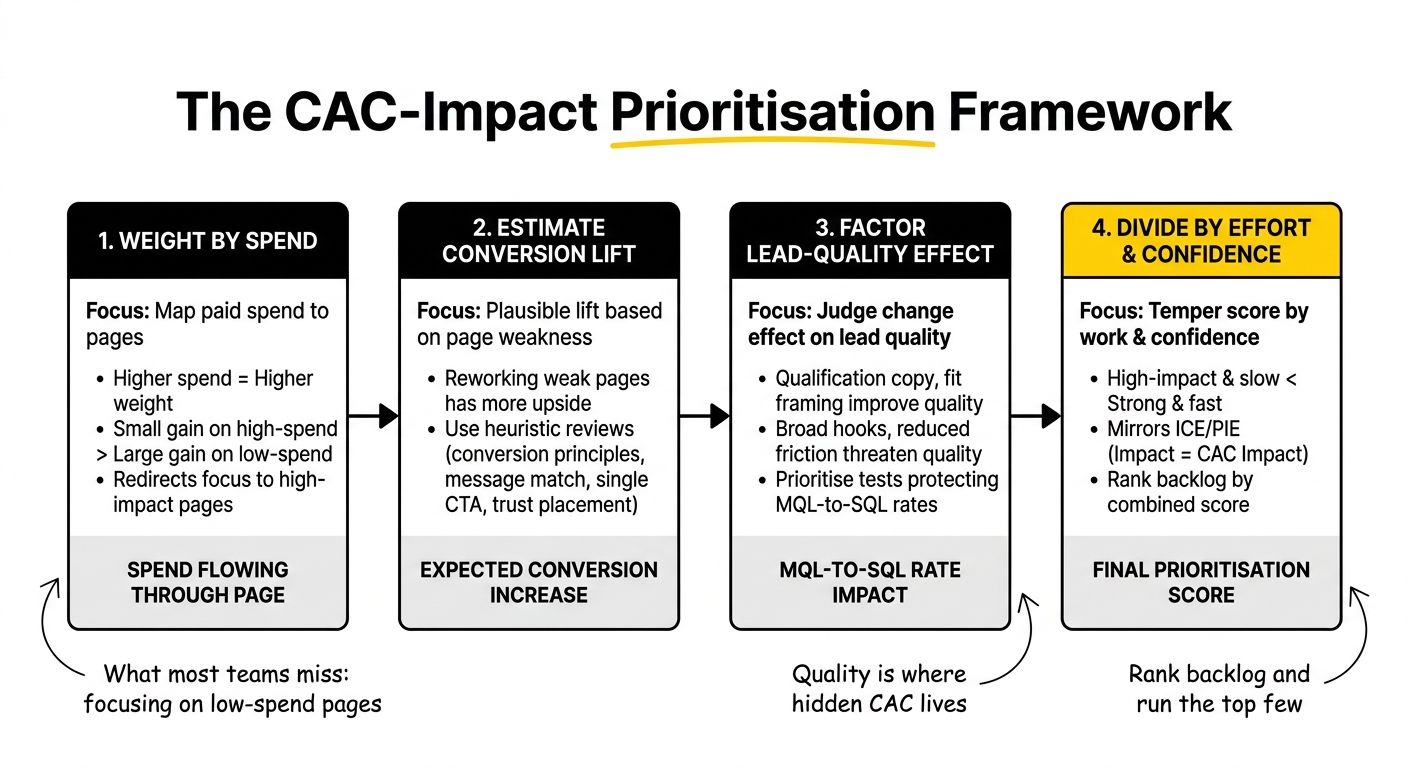
Ranking SaaS PPC landing page tests by their effect on CAC follows a repeatable sequence:
- Weight each test by the paid spend flowing through the page it affects.
- Estimate the conversion lift the change could produce.
- Factor in whether the change improves, holds, or degrades lead quality.
- Divide by the effort to build it and your confidence it will work.
- Rank the backlog by the resulting score and run the top few.
The framework forces a harder question than “will this convert better.” It asks whether a test will lower the cost of a qualified customer, which is the only conversion improvement that reaches the bottom line.
Why prioritise by CAC, not conversion rate alone
Customer acquisition cost is total sales and marketing spend divided by new customers acquired. Average B2B SaaS CAC sat around $700 to $1,200 in 2026, running from roughly $100 to $500 for self-serve products up to $5,000 or more for enterprise. Whatever your figure, it is the number investors and boards judge efficiency by, and landing pages are one of the few levers that move it without spending more.
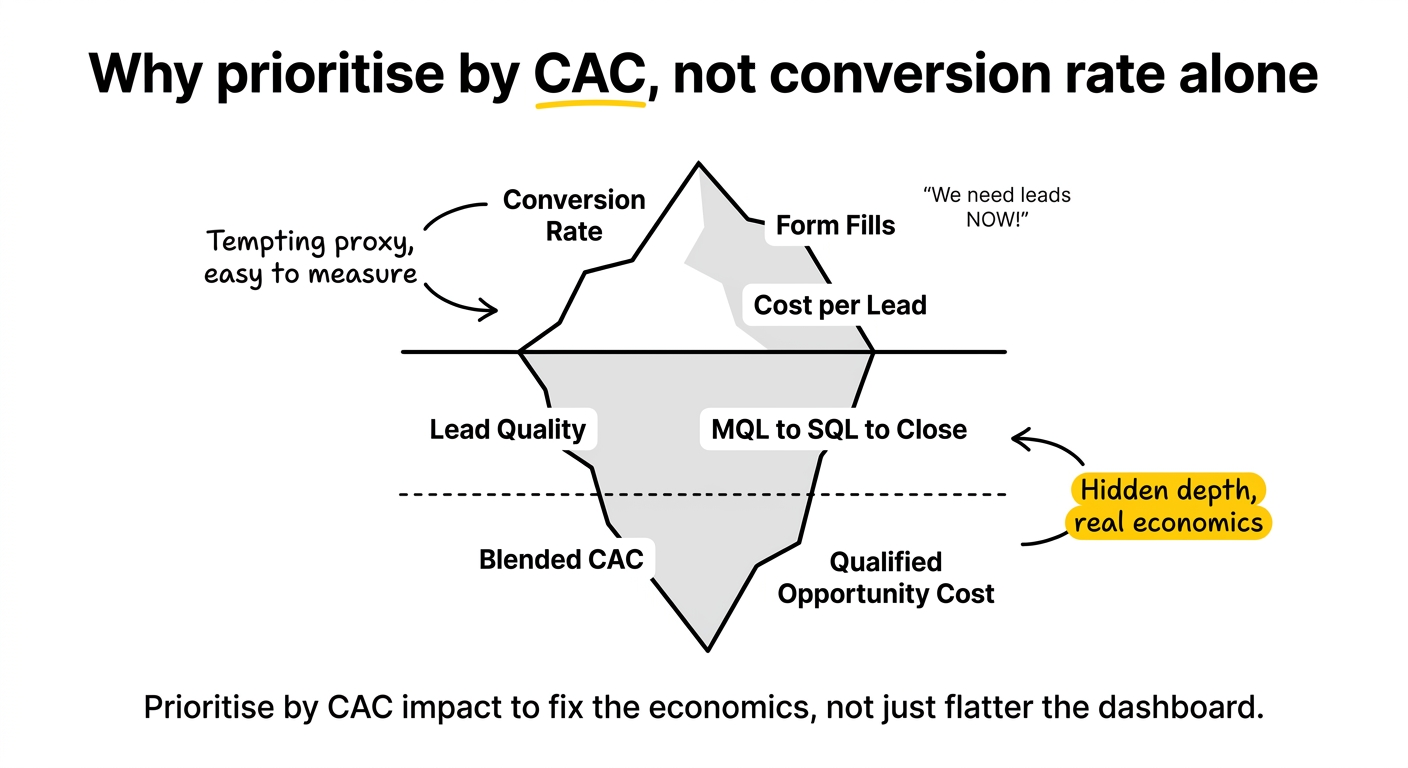
Conversion rate is a tempting proxy because it is easy to measure, but it is only half the equation. A low cost per lead often hides weak conversion quality: a cheaper lead source can produce a higher blended CAC if those leads convert poorly from MQL to SQL to close. A landing page variant with a provocative hook might lift form fills and lower cost per lead while quietly raising CAC, because the extra leads never become pipeline. Prioritising by conversion rate rewards exactly that kind of false win.
Prioritising by CAC impact closes the loophole. It asks not just whether more people convert, but whether the right people convert and what that costs per qualified opportunity. This is the lens that separates a test which flatters the dashboard from one that improves the economics.
How landing page changes actually move CAC
Three mechanics connect a landing page test to CAC, and the framework weighs all three.
The first is conversion rate. Holding spend constant, a higher conversion rate lowers cost per acquisition directly. A page converting at 10% instead of 2% produces five times the qualified leads from the same traffic, and a conversion lift has the same effect on CAC as an equivalent cut in cost per click, except that it compounds across every campaign feeding the page.
The second is lead quality. Two variants can convert at the same rate while producing very different MQL-to-SQL rates. Since CAC is measured against customers won, not forms filled, a change that improves qualification, clearer fit framing, sharper message match, can lower CAC even without lifting raw conversion, simply by sending sales better-fit leads.
The third is spend weight. A test on a page absorbing the bulk of your paid budget moves blended CAC far more than the same test on a low-traffic page, even if both produce identical percentage lifts. This is why the money pages come first. A 20% win on your highest-spend page can outweigh five wins on pages that barely see budget.
The CAC-impact prioritisation framework
Weight by spend flowing through the page
Start by mapping paid spend to pages. The pages carrying the most budget have the most CAC to gain or lose, so they earn the highest weight. A modest improvement on a page taking half your spend beats a large improvement on one taking two percent. This single step redirects most teams away from tinkering with pages that cannot move the number.
Estimate the conversion lift
For each idea, estimate the plausible conversion lift, informed by how weak the current page is and how big the change is. Reworking a vague value proposition on an underperforming page carries far more upside than adjusting a page already converting well. Heuristic review against known conversion principles, message match, single focused CTA, trust placement, can flag the biggest gaps before you spend a cycle testing them.
Factor in lead-quality effect
Next, judge whether the change is likely to improve, preserve, or threaten lead quality. Qualification copy, fit framing, and message match tend to improve it. Broad, curiosity-driven hooks and reduced form friction can threaten it by pulling in poorer-fit traffic. Weight tests that protect or improve MQL-to-SQL rates above those that only chase volume, because quality is where hidden CAC lives.
Divide by effort and confidence
Finally, temper the score by how much work the change takes and how confident you are it will work. A high-impact test that needs a month of engineering ranks below a strong test you can ship this week. This mirrors the logic of ICE and PIE scoring, adapted so that impact means CAC impact rather than generic conversion. Rank the backlog by the combined score and run the top few. The elements most worth this scrutiny are the high-leverage messaging blocks, since they carry the largest expected effect.
High-impact versus low-impact tests
Not all tests deserve a slot. High-impact tests tend to change something structural: the offer, the core value proposition, message match between ad and page, or the qualification copy that governs lead quality. These move conversion, lead quality, or both, and they belong at the top of a CAC-ranked backlog.
Low-impact tests are the cosmetic ones, button colours, minor copy tweaks, image swaps, run on pages that carry little spend. They rarely move CAC enough to justify the cycle, and on limited traffic they may never reach a readable result. When your traffic is thin, the method for running these experiments matters as much as the ranking, which we cover in our guide to low-traffic CRO iterations. User experience changes sit somewhere in between: friction reduction can lift conversion meaningfully, though it has to be done without weakening the messaging that qualifies buyers, a balance we explore in Landing Page UX Experiments That Reduce Friction Without Weakening SaaS Messaging.
Measuring the CAC impact of a test
A CAC-focused programme has to measure past the form fill. Integrating A/B testing in digital marketing with your analytics and CRM is what lets you attribute a test not just to conversion but to cost per SQL and pipeline. Without that connection, you are analysing results on the wrong metric and cannot tell a genuine CAC win from a volume mirage.
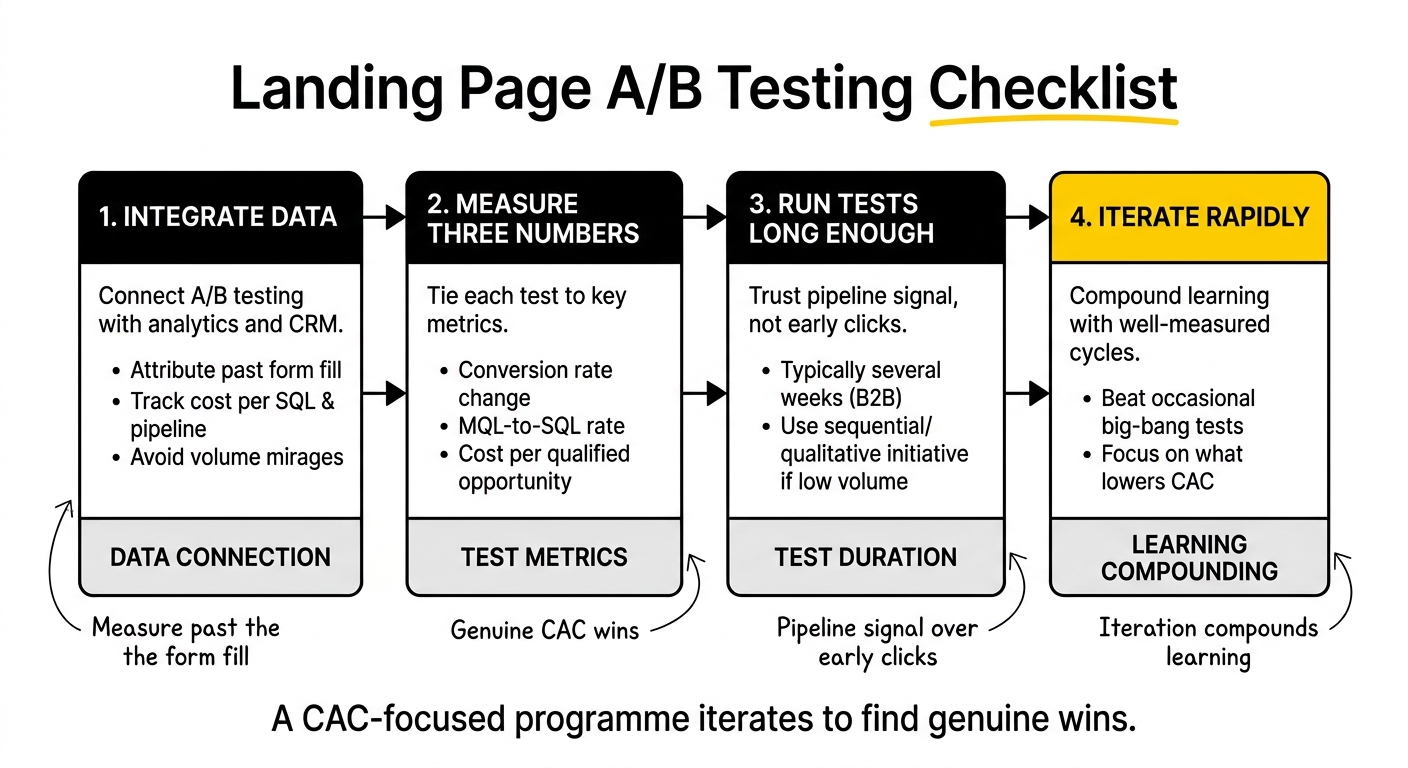
Practically, tie each test to three numbers: the conversion rate change, the downstream MQL-to-SQL rate for leads from each variant, and the resulting cost per qualified opportunity. Run tests long enough to trust the pipeline signal rather than the early click, typically several weeks on B2B traffic, and where volume is too low for classic significance, lean on the sequential and qualitative methods suited to it. Rapid, well-measured cycles beat occasional big-bang tests, because each iteration compounds the learning about what lowers your CAC.
Common pitfalls to avoid
A few errors quietly undo CAC-focused testing:
- Prioritising by conversion rate alone. The fastest way to scale a page that produces cheap, unqualified leads.
- Chasing low cost per lead. A cheaper lead that never becomes pipeline raises blended CAC, not lowers it.
- Testing low-spend pages first. Wins that cannot move the blended number however well they perform.
- Calling tests on form fills. Declaring victory before the MQL-to-SQL data exists.
- Ignoring lead quality. The single largest source of hidden CAC in paid search.
- Mistaking a volume spike for efficiency. A false efficiency gain that damages pipeline downstream.
If you want a second view on how to rank your own test backlog by CAC impact, that is the kind of work we do with SaaS teams regularly.
Frequently Asked Questions
What makes a good SaaS landing page?
A good SaaS PPC landing page matches the ad that produced the click, states a clear outcome-focused value proposition, backs it with specific proof, answers the main objection, qualifies for fit, and drives one focused call to action. Judged by CAC, the best pages do not just convert well, they convert the right visitors, so the leads they generate reach sales-qualified pipeline rather than inflating form-fill counts.
What performance metrics do you prioritise when evaluating PPC campaigns?
For a CAC-focused programme, the metrics that matter are cost per qualified opportunity, MQL-to-SQL conversion by source, pipeline generated, and blended CAC, alongside conversion rate as a supporting signal rather than the headline. Cost per lead and click-through rate stay on the report as guardrails. The discipline is judging campaigns by the cost of qualified customers won, not the volume of leads collected.
How can landing page tests impact Customer Acquisition Cost (CAC) in SaaS?
Landing page tests move CAC through three mechanics: conversion rate, which lowers cost per acquisition directly when spend is held constant; lead quality, which changes how many conversions become customers; and spend weight, since a win on a high-budget page moves blended CAC far more than the same win elsewhere. A test that lifts qualified conversion on a money page can cut CAC without any increase in ad spend.
What are the key elements to test on a SaaS PPC landing page?
Prioritise structural elements with the largest expected CAC impact: the offer, the value proposition headline, message match between ad and page, proof placement, qualification copy, and the call to action. These influence conversion, lead quality, or both. Cosmetic elements like button colours rarely move CAC enough to justify a test cycle, especially on pages that carry little paid spend.
How do you measure the effectiveness of A/B tests on landing pages?
Measure past the form fill by connecting your testing tool to analytics and CRM. Track the conversion rate change, the MQL-to-SQL rate for each variant, and the cost per qualified opportunity that results. Run the test long enough to trust the downstream pipeline signal rather than the early click, and on low traffic use sequential or qualitative methods. The goal is to confirm a CAC improvement, not just a conversion lift.
What common mistakes should be avoided when creating SaaS landing pages for PPC?
The costly ones are prioritising conversion rate over CAC, chasing a low cost per lead that produces unqualified traffic, testing low-spend pages that cannot move the blended number, calling tests on form fills before quality data exists, and mistaking a volume spike for genuine efficiency. Each leads to scaling pages that generate cheap leads sales cannot use, which raises CAC rather than lowering it.
How can marketers prioritise landing page tests based on potential CAC impact?
Score each test idea by four factors: the paid spend flowing through the affected page, the plausible conversion lift, the likely effect on lead quality, and the effort and confidence involved. Weight impact toward CAC rather than generic conversion, rank the backlog by the combined score, and run the top few. This concentrates effort on high-spend pages and structural changes that move qualified acquisition cost.
What role does user experience play in the effectiveness of SaaS landing pages?
User experience affects both halves of the CAC equation. A fast, focused, mobile-friendly page lifts conversion, while a cluttered or slow one loses paid clicks you have already paid for. The caveat is that friction reduction must not strip out the messaging that qualifies buyers, since a smoother page that attracts poorer-fit leads can raise CAC. Good UX makes qualified conversion easier without diluting fit.
How can data-backed recommendations improve landing page performance for SaaS?
Data-backed recommendations replace opinion with evidence, both in choosing what to test and in judging results. Heuristic review against proven conversion principles flags the biggest gaps before you spend a cycle, and CRM-connected measurement confirms whether a change lowered cost per qualified opportunity. This turns testing from a stream of hunches into a prioritised programme where each decision is tied to its expected and actual CAC impact.
What strategies can be implemented to optimise PPC campaigns for better lead quality?
Align landing page messaging with the intent behind each keyword, use qualification copy to help poor-fit visitors self-select out, and keep forms lean but focused on the fields sales needs. Measure lead quality by MQL-to-SQL rate per source and optimise toward it, not toward raw volume. Testing these qualification levers and ranking them by CAC impact steadily improves both lead quality and acquisition efficiency.