Implementing Low-Traffic CRO Iterations for SaaS Landing Pages
How to run CRO on low-traffic SaaS landing pages: big-swing tests, sequential baselines, micro-conversions, qualitative evidence, and paid-search integration.

Most CRO advice assumes a firehose of traffic: run an A/B test, wait two weeks, read the 95% significance, ship the winner. If your SaaS landing pages see a few hundred to a few thousand sessions a month, that playbook quietly fails you. At 800 sessions a month, a classic A/B test to detect a 20% lift can take the better part of a year, and by the time it finishes, your product, pricing, and traffic mix have all moved on. The test is measuring a version of your site that no longer exists.
For a Head of Growth running a dual product-led and sales-led motion, that is not a conversion programme. It is a waiting game with bad odds while competitors with more traffic iterate every three weeks and compound their gains. The way out is not more patience. It is a different method. Low-traffic conversion rate optimisation tweaks for SaaS landing pages rely on structured experimentation, qualitative evidence, and low-risk iteration rather than the statistical rituals that only work at scale.
This guide covers experiment-led approaches for improving SaaS landing pages when traffic is thin: why classic testing breaks, the mindset shift it demands, the low-risk methods that actually work, and how to measure success without fooling yourself.
What low-traffic CRO iteration means
Low-traffic CRO iteration is the practice of improving SaaS landing page conversion through structured, low-risk changes and qualitative evidence, rather than waiting for classic A/B tests that thin traffic cannot power within a useful timeframe.
Conversion rate optimisation for SaaS with limited traffic uses a different toolkit. The core moves:
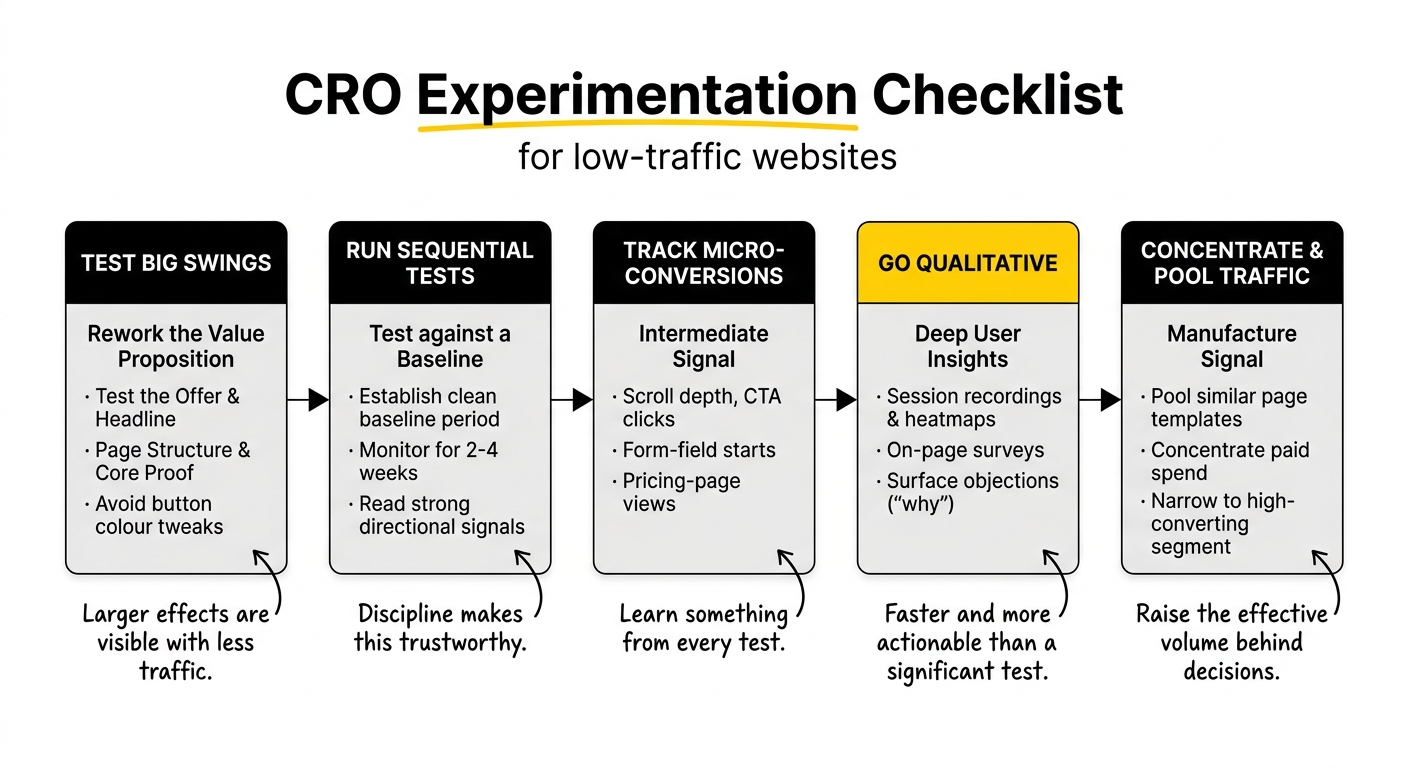
- Test big, high-impact changes rather than minor tweaks.
- Run sequential tests against a baseline, reading guardrail metrics.
- Track micro-conversions for earlier signal.
- Use qualitative evidence such as session recordings, heatmaps, and surveys.
- Concentrate and pool traffic so signal arrives faster.
The through-line is that CRO is not the same thing as A/B testing. A/B testing is one tool in CRO, and it is the tool that breaks first when traffic is low. Everything below is about the rest of the toolkit.
Why classic A/B testing breaks at low traffic
The maths is unforgiving. A page converting at 2 to 5% typically needs on the order of a thousand or more conversions per variant to detect a modest 10 to 20% relative lift at 95% confidence. A SaaS pricing page pulling 800 visits a month does not have that statistical power, and no amount of careful setup manufactures it.
The practical threshold most practitioners now use: below roughly 5,000 sessions a month, treat classic A/B testing as a selective tool for your highest-traffic pages only, not the backbone of your programme. Run it on the hero or pricing page if those genuinely get the volume, and use other methods everywhere else.
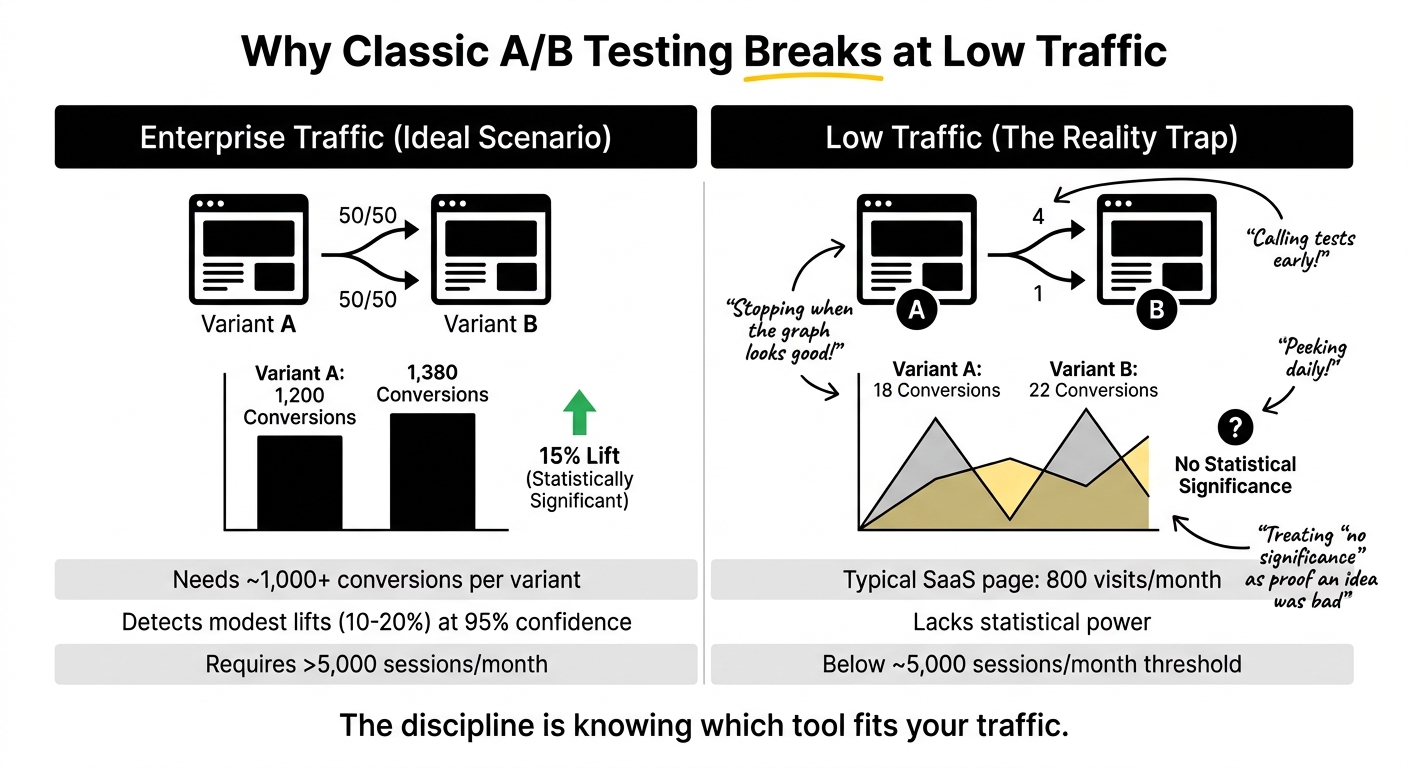
This is where low-traffic teams go wrong by borrowing enterprise experimentation rituals without enterprise traffic. Calling a test after a handful of conversions, peeking daily and stopping when the graph looks good, or treating “no significance” as proof an idea was bad are all ways of using the language of experimentation to make a weak decision sound stronger than it is. The discipline is knowing which tool fits your traffic.
The mindset shift: from proving to improving
When you cannot measure the precise impact of a change, the goal shifts. Instead of “prove this change lifted conversion by X%,” the question becomes “understand why people are not converting, then make the highest-confidence fix.” Before scale gives you statistical power, disciplined judgement has to stand in for certainty.
Expected-value thinking makes this rigorous rather than reckless. If a change is likely to reduce confusion, is cheap to implement, and is easy to reverse, then shipping it is often the more rational choice than waiting months for weak statistical evidence. A clearer headline or a removed redundant form field does not need a significance test to justify it. The risk you are managing is not “might this be wrong,” but “is this cheap and reversible enough that being wrong costs little.” That is what low-risk CRO testing for SaaS actually means in practice.
Five low-risk methods that work on thin traffic
Test big swings, not button colours
Larger changes produce larger effects, and larger effects cross any detection threshold with far less traffic. A 30% improvement from a reworked value proposition is visible on volume that would never reveal a 5% lift from a button tweak. So on thin traffic, test the things that matter: the offer, the headline, the page structure, the core proof. Testing cosmetic details while the value proposition is unclear is the most common waste of a low-traffic programme. This is where a clear grasp of your landing page messaging blocks pays off, because it tells you which big element to rework first.
Run sequential tests against a baseline
When you cannot split traffic and wait for significance, test in time instead. Establish a clean baseline period, deploy the change, then monitor performance over the following two to four weeks against that baseline. You may not reach significance on the primary conversion metric, but you can read strong directional signals. The discipline that makes this trustworthy is a clean baseline: hold the traffic source and audience temperature constant, and avoid running the comparison across a holiday or a major campaign that would distort it.
Track micro-conversions
Final conversions are rare on low traffic, but the steps leading to them are not. Scroll depth, time on the key section, clicks on the CTA, form-field starts, and pricing-page views all happen far more often than a completed demo request. Tracking these micro-conversions gives you intermediate signal, so you learn something from every test even when the final conversion count is too small to move. They are also early indicators of whether a change is helping before the revenue metric confirms it.
Go qualitative
What you lose in quantitative power, you make up in qualitative depth. Session recordings show where users hesitate or rage-click. Heatmaps show what gets seen and what gets skipped. On-page surveys and a single well-placed question (“what nearly stopped you signing up?”) surface objections no dashboard will. For user experience enhancement for SaaS, this qualitative layer is not a consolation prize for low traffic, it is often faster and more actionable than a significant test, because it tells you why rather than just what.
Concentrate and pool traffic
You can manufacture signal by focusing it. Pool similar page templates so several low-traffic pages inform one test. Concentrate paid spend onto the single page you are iterating rather than spreading it thin. Narrow to your highest-converting segment so the baseline is higher and effects register more clearly. Each move raises the effective volume behind a decision, which is exactly what structured experimentation in SaaS marketing needs to function at small scale.
Integrating CRO with paid search
For a growth leader, CRO and paid search are one system, not two. Improving conversion rate is usually more leveraged than increasing ad spend: a 20% lift in conversion has the same effect on CAC as a 20% cut in cost per click, and it compounds across every traffic source rather than the one channel you are bidding on. Our CRO for SaaS hub maps how these pages fit the wider funnel.
Paid search also solves part of the low-traffic problem directly. Concentrating campaign budget onto the page you are iterating raises its volume enough to read a signal sooner, and it gives you a consistent, controllable traffic source for a clean baseline. The one discipline to hold is not to mix sources mid-test, since blending paid and organic or cold and retargeted traffic corrupts the comparison. Deciding which tests deserve that concentrated budget in the first place is a prioritisation question in its own right, which we cover in Prioritising SaaS PPC Landing Page Tests by CAC Impact.
Measuring CRO success in low-traffic environments
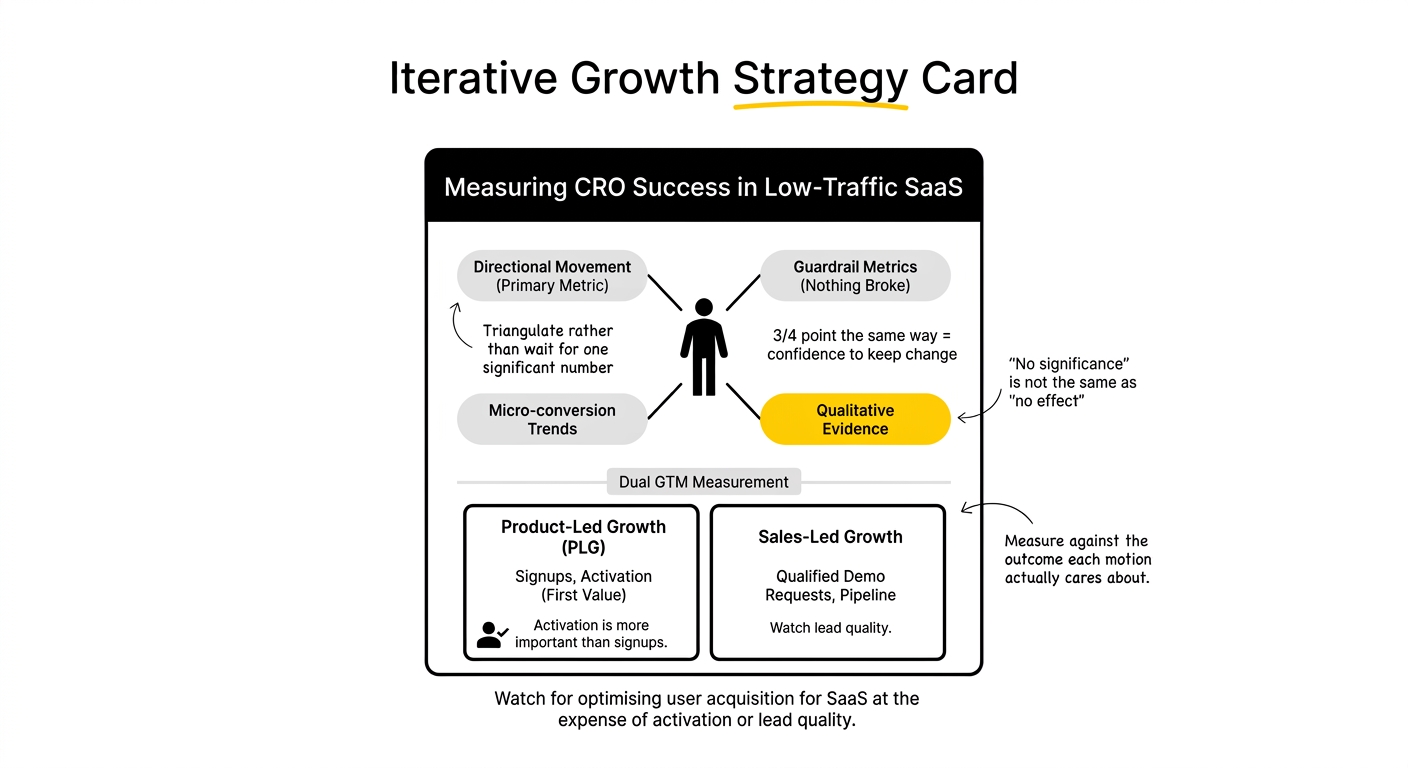
Measuring CRO success in SaaS on thin traffic means triangulating rather than waiting for a single significant number. Combine directional movement in the primary metric, guardrail metrics that confirm nothing broke, micro-conversion trends, and qualitative evidence into one judgement. When three of those point the same way, you have enough confidence to keep a change even without textbook significance. Crucially, “no significance” is not the same as “no effect”, it usually just means not enough traffic to confirm one, so do not retire a sound idea on that basis.
What you optimise toward depends on your motion, and a dual GTM team has to hold both. For the product-led path, the meaningful SaaS landing page metrics are signups and, more importantly, activation, whether new users reach first value. For the sales-led path, the metric is qualified demo requests and the pipeline they produce. A change that lifts PLG signups but lowers demo quality is not a clean win, so measure the change against the outcome each motion actually cares about, and watch for optimising user acquisition for SaaS at the expense of activation or lead quality.
Common mistakes to avoid
A handful of errors undo most low-traffic programmes:
- Running underpowered A/B tests anyway. Waiting a year for a result the traffic can never deliver.
- Calling winners on a handful of conversions. Reading noise as signal because the graph looks good today.
- Testing tiny tweaks first. Button colours while the value proposition is unclear.
- Treating “no significance” as failure. Discarding good ideas that simply lacked the traffic to prove out.
- Mixing traffic sources mid-test. Blending paid, organic, cold, and retargeted traffic so no baseline is clean.
- Ignoring the qualitative layer. Debating conversion rates while never watching a single session recording.
If you want a second view on which method fits your traffic level and where your pages are leaking, that is the kind of work we do with SaaS growth teams regularly.
Frequently Asked Questions
What are effective low-traffic CRO strategies for SaaS landing pages?
The strategies that work on thin traffic are testing big, high-impact changes rather than minor tweaks, running sequential tests against a clean baseline with guardrail metrics, tracking micro-conversions for earlier signal, using qualitative evidence like session recordings and surveys, and concentrating or pooling traffic so signal arrives faster. The unifying idea is that CRO is broader than A/B testing, which is the first tool to break when volume is low.
How can structured experimentation improve conversion rates for SaaS?
Structured experimentation replaces guesswork with a repeatable loop: form a clear hypothesis, make one meaningful change, measure it against a baseline and guardrail metrics, then decide and iterate. On low traffic it prevents two failure modes, shipping random tweaks with no learning, and waiting forever for significance that never comes. The structure is what lets a small team compound small, confident improvements instead of stalling.
What metrics should be used to measure CRO success in low-traffic environments?
Triangulate rather than rely on one significant number. Combine directional movement in the primary conversion metric, guardrail metrics such as bounce and scroll depth, micro-conversion trends, and qualitative evidence. When several point the same way, that is enough to act. Match the primary metric to your motion: activation for product-led growth, qualified demo requests and pipeline for sales-led, so you never optimise volume at the expense of quality.
How to implement low-risk testing methods for SaaS landing pages?
Favour changes that are cheap to build, easy to reverse, and likely to reduce confusion, then deploy them and monitor against a baseline period. Use sequential testing rather than split testing when you cannot reach significance, and lean on micro-conversions and qualitative signal for confidence. The point of low-risk iteration is that being wrong costs little, so you can move quickly and learn continuously instead of waiting on underpowered tests.
What are common mistakes to avoid in CRO for SaaS?
The frequent errors are running A/B tests the traffic cannot power, calling winners on a handful of conversions, testing cosmetic tweaks while the value proposition is weak, treating “no significance” as proof an idea failed, mixing traffic sources so no baseline is clean, and ignoring qualitative data entirely. Each one either wastes months or turns noise into a confident but wrong decision.
How can rapid iteration enhance user experience on SaaS landing pages?
Rapid iteration lets you fix friction as you find it rather than batching changes behind a slow test. Watching where users hesitate, then shipping a clearer headline, a shorter form, or a stronger proof point, and checking the next cohort, improves the experience in weeks rather than quarters. Because each change is small and reversible, you can act on user insight quickly without risking the page, which compounds into a materially better experience over time.
What role does user feedback play in low-traffic CRO iterations?
On thin traffic, user feedback often does the job that statistics cannot. Session recordings, heatmaps, and a single on-page question reveal why visitors hesitate or leave, which is exactly what a low-conversion page needs to know. Qualitative evidence surfaces objections and confusion no dashboard shows, and it turns a vague “conversion is low” into a specific, fixable problem. It is frequently the fastest route to a high-confidence change.
How to integrate CRO efforts with paid search for SaaS growth?
Treat them as one system. A conversion rate lift has the same CAC impact as an equivalent cut in cost per click, and it compounds across all channels. Practically, concentrate paid budget on the page you are iterating to raise its volume and give you a clean, consistent traffic source for a baseline. Just avoid mixing sources mid-test, since blending paid and organic traffic corrupts the comparison you are trying to read.
What are the benefits of product-led vs sales-led growth strategies in CRO?
Each motion changes what you optimise for. Product-led growth aims for self-serve signups and activation, so CRO focuses on reducing friction to first value. Sales-led growth aims for qualified demos and pipeline, so CRO focuses on qualification and expectation-setting. A dual-motion team gets the benefit of both but must measure each change against the right outcome, since a variant that helps one motion can quietly harm the other if judged on the wrong metric.
How can small changes in landing page design impact conversion rates for SaaS?
Small, well-chosen changes can move conversion more than their size suggests, because they often remove a specific point of friction or confusion, a confusing headline, an unnecessary form field, a buried CTA. On low traffic, the trick is choosing small changes with large expected impact and shipping the cheap, reversible ones without waiting for significance. Over successive iterations, these compound into a substantially better-performing page.