Enhancing Offline Conversion Strategies with SaaS Revenue Signals
How to feed Google Ads SaaS revenue signals through offline conversions, with a value-weighted stage ladder that adds depth without narrowing bidding or breaking reporting.

The logic seems airtight. Smart Bidding chases whatever you tell it to, so tell it to chase revenue. Import closed-won deals, switch bidding to them, and watch the junk disappear.
Three months later, volume has collapsed, CPCs have climbed and the campaigns are spending on a shrinking set of brand and competitor terms. The algorithm did exactly what it was told. It just didn’t have enough to learn from.
Offline conversion optimisation using SaaS revenue signals is about getting the best of both sides. You give bidding the depth of your CRM data without starving it of volume or timeliness. This article covers how to choose which revenue signals to import, how to value them, how to spot an algorithm that’s narrowing, and how to keep attribution and reporting reliable across the MarTech stack.
What Offline Conversions Are in SaaS PPC
An offline conversion is a conversion that happens outside the ad platform’s tracking, usually in the CRM, and is imported back into the platform against the original ad click. In SaaS, typical examples are a sales-qualified lead, an opportunity created or a closed-won deal.
A SaaS revenue signal is any offline conversion that carries information about commercial value: a pipeline stage, an opportunity amount, a plan tier or an expected contract value. Revenue signals are what turn offline conversion tracking from a reporting exercise into a bidding input.
The reason this matters is simple. Smart Bidding optimises for whichever conversion types you include in the Conversions column. If that column holds form fills, bidding finds form fillers. If it holds revenue signals, bidding looks for buyers. The rest of this article is about doing the second without breaking the first.
Why Bidding on the Deepest Signal Backfires
The instinct is to import the deepest event available, usually closed-won revenue, and bid on that alone. In most B2B SaaS accounts, it fails for three reasons.
Too few examples. A campaign producing hundreds of demo requests a month may produce a handful of closed-won deals. Smart Bidding can’t build a reliable model of a good click from single-digit monthly outcomes. It overreacts to every win and every gap.
Too late to count. Google won’t import offline conversions uploaded more than 90 days after the associated last click, and the limit for enhanced conversions for leads is 63 days. With a five or six-month sales cycle, most closed-won deals arrive after the window has shut. The ones that do make it in are your fastest deals, which aren’t necessarily your best.
Too narrow to explore. When an algorithm has few positive examples, it concentrates spend on the patterns it can see: brand terms, competitor terms and the narrow set of queries that produced past wins. It stops exploring the queries where new demand starts. Volume falls, CPCs rise and the account quietly shrinks.
This is the core of avoiding narrow algorithms in marketing. Depth of signal is only useful if there’s enough of it, early enough, to learn from.
The Revenue Signal Ladder
Rather than choosing one stage, use several. Import each funnel stage that happens within the upload window, and give each stage a value. That value should reflect its expected revenue, not just its existence.
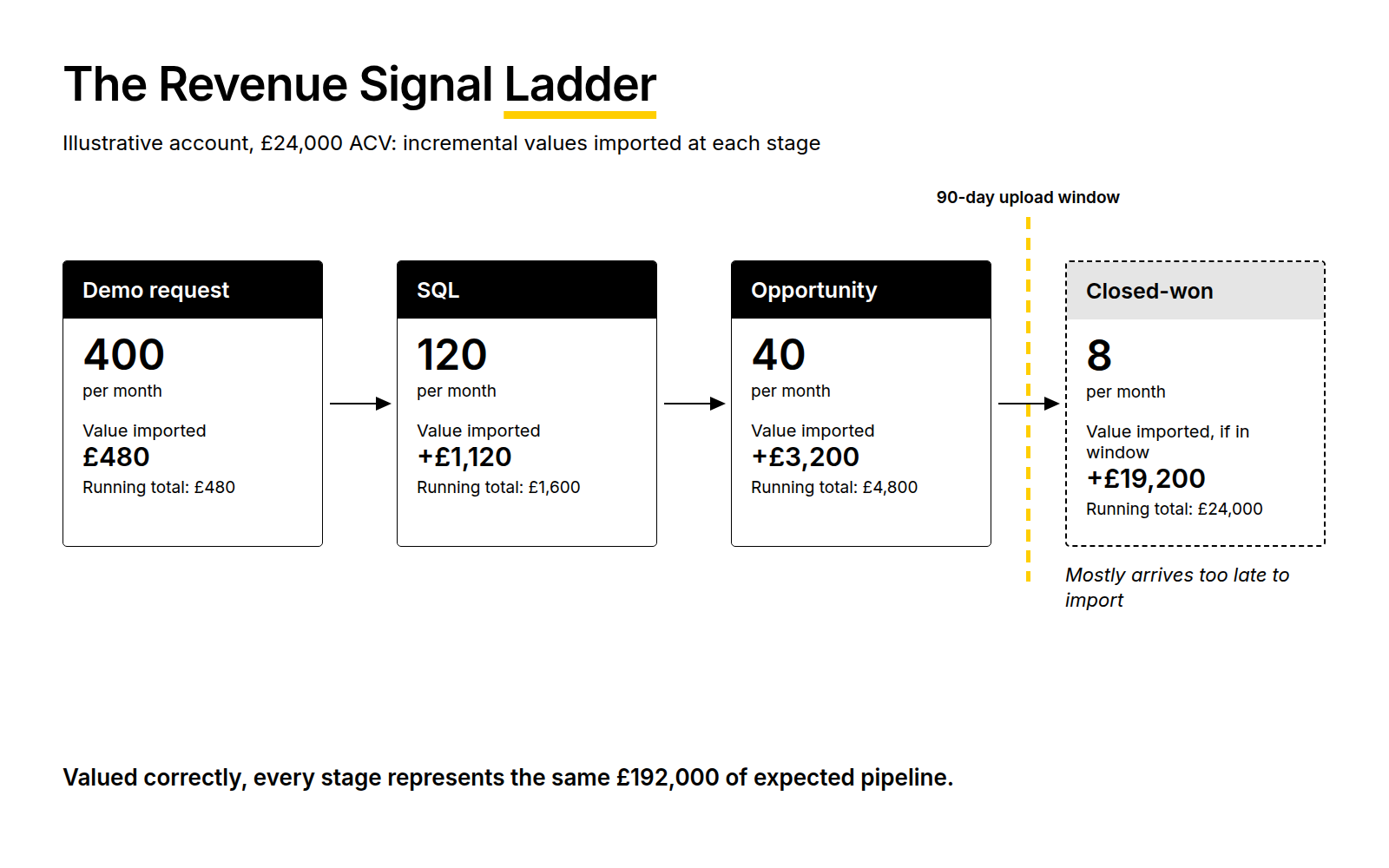
Consider an illustrative Series B SaaS account with an average contract value of £24,000. In a typical month, paid search produces:
- 400 demo requests, of which 2% eventually close. Expected value per demo request: £480.
- 120 sales-qualified leads, of which about 6.7% close. Expected value per SQL: £1,600.
- 40 opportunities, of which 20% close. Expected value per opportunity: £4,800.
- 8 closed-won deals at £24,000 each, most of them arriving after the 90-day window.
Notice the pattern. Every stage, valued correctly, represents the same £192,000 of expected pipeline. What changes is how many examples the algorithm gets and how quickly it gets them. Demo requests give it 400 examples within hours. Closed-won gives it 8, mostly too late to count.
The ladder lets bidding use all of them. Shallow stages provide volume and speed. Deeper stages tell the algorithm which of those early signals actually matter.
Import Incremental Values, Not Totals
If you import every stage at its full expected value, a single click that progresses from demo to opportunity gets credited three times. Avoid this by importing the increment at each stage, so the total value of any click equals the expected value of the deepest stage it reached:
- Demo request: £480.
- SQL: an additional £1,120, bringing the total to £1,600.
- Opportunity: an additional £3,200, bringing the total to £4,800.
- Closed-won (if inside the window): an additional £19,200, bringing the total to £24,000.
Bid with a value-based strategy such as Maximise conversion value or target ROAS. The algorithm now has hundreds of monthly signals, weighted by how likely each is to become revenue.
Use Stable Values, Not Raw Deal Amounts
It’s tempting to import the actual opportunity amount for each deal. Resist it, at least at first. A single enterprise deal worth ten times your average can dominate the model for weeks and pull bidding towards whatever query happened to produce it.
Use expected values by segment instead, such as ACV by company size band. Refresh them quarterly from CRM data. Values that reflect real revenue patterns, without the noise of individual outliers, give bidding a stable target to learn from.
How to Spot an Algorithm That’s Narrowing
Narrowing rarely announces itself. It shows up as a set of slow trends that are easy to explain away individually. Check these monthly after any change to primary conversions or values:
- Falling impressions and clicks with no change in budget or targeting.
- Rising CPCs as spend concentrates on a smaller set of competitive terms.
- A shrinking search term mix, with brand and competitor queries taking a growing share of spend.
- Fewer new queries generating conversions month on month.
- Volatile daily performance, a sign the algorithm is reacting to individual conversions rather than patterns.
If several of these move together, the signal is too thin. The usual fixes are adding a shallower stage back as a primary conversion with a low value, and pooling campaigns into a portfolio bid strategy so they share conversion data. Consolidating campaigns that split volume too finely also helps.
As a working rule, if a campaign can’t generate a few dozen value-weighted primary conversions a month, it doesn’t have enough signal to bid on deep stages alone.
Choosing Which Deeper Funnel Events to Import
Deeper funnel events optimisation depends on picking the right stages, not the most stages. Three tests decide whether an event belongs on the ladder:
- Timing: it must happen reliably within 63 days of the click for enhanced conversions for leads, or 90 days for GCLID-only import.
- Definition: sales must apply it consistently. A stage that means different things to different reps is noise, not signal.
- Distinctiveness: it must separate good leads from bad ones. If almost every demo request becomes an SQL, the SQL stage adds little new information.
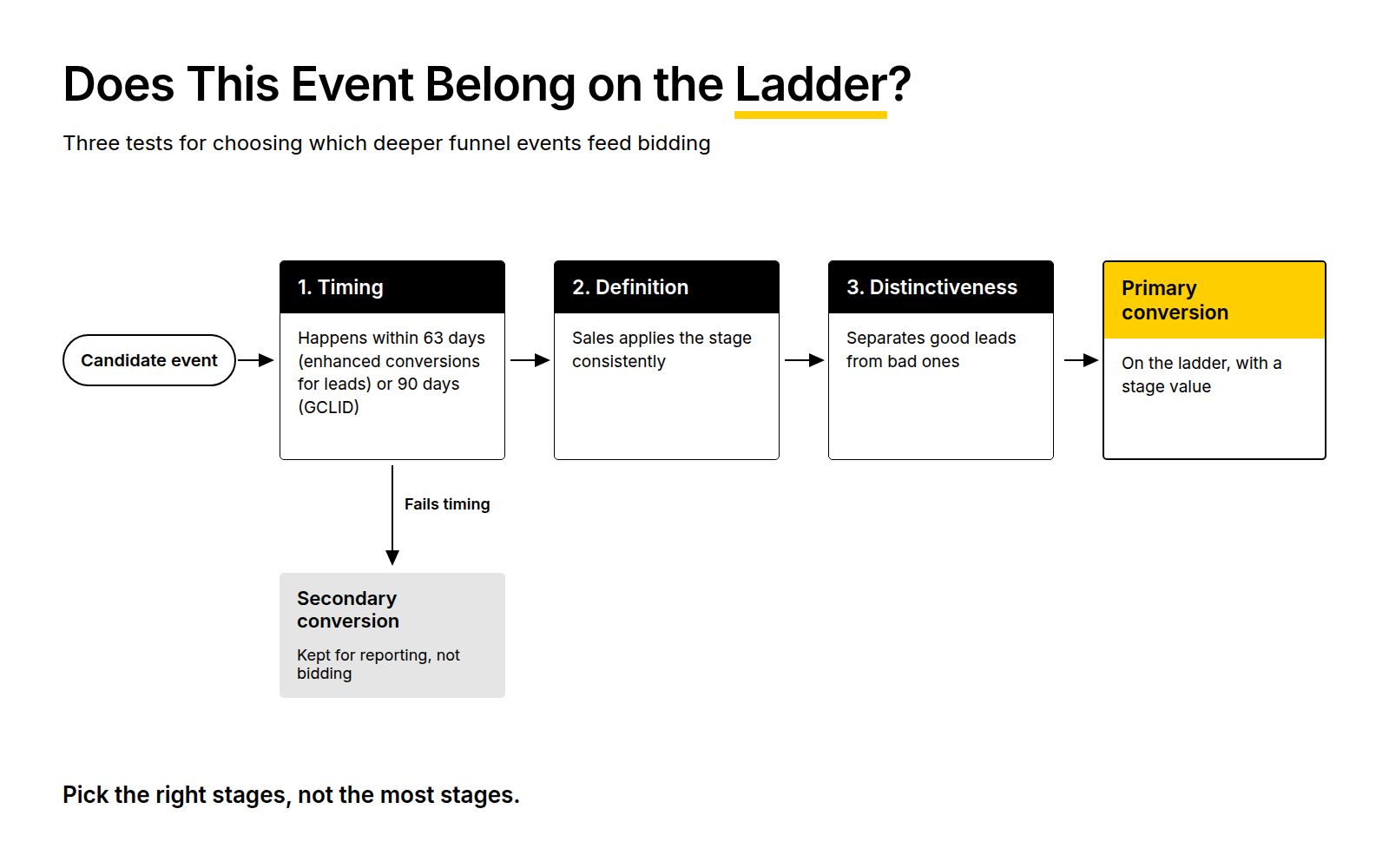
Events that fail the timing test can still be valuable for reporting. Keep them as secondary conversions, so they appear in the account without influencing bidding. For a detailed review of which events SaaS teams should import or exclude, see Choosing the Right Offline Conversion Events for SaaS PPC Success. For mapping pipeline stages to conversion actions, see Optimising PPC Campaigns with Stage-Based Offline Conversions.
MarTech Stack Integration Without the Rebuild
SaaS revenue signals integration doesn’t usually need new tools. It needs the existing ones connected properly. Use this process to set it up:
- Capture the GCLID and the lead’s email address on every form submission, and store both on the CRM record.
- Choose the stages that pass the timing, definition and distinctiveness tests.
- Calculate an expected value for each stage from the last four to six quarters of CRM data.
- Import incremental stage values daily through Google’s Data Manager or a native CRM connector.
- Set value-weighted stages as primary conversions, and keep everything else as secondary.
- Monitor for narrowing monthly, and reconcile imported conversions against the CRM.
Two platform changes affect how you build this in 2026. Google now recommends that advertisers new to offline conversion import start with enhanced conversions for leads. This matches on hashed first-party data such as email address, alongside the click ID. And from 15 June 2026, offline conversion import and enhanced conversions for leads uploads moved to the Data Manager API and are blocked in the Google Ads API. Any custom script still uploading through the Google Ads API needs migrating.
Upload frequency matters as much as the method. Daily uploads keep the signal timely. Weekly or monthly batches delay the algorithm’s feedback and risk pushing conversions outside the upload window.
Attribution and Reporting You Can Rely On
Attribution for offline conversions involves two systems that will never fully agree. Google Ads credits imported conversions to ad clicks using its own attribution model. The CRM credits opportunities based on lead source, first touch or whatever rules your team has set. Expecting them to match exactly leads to endless reconciliation work.
Instead, track three numbers every month:
- Match rate: the share of CRM stage events that Google Ads successfully matched to a click. A falling match rate usually means GCLIDs aren’t being captured or emails aren’t being hashed correctly.
- Count reconciliation: imported conversions in Google Ads against the same stage counts in the CRM for paid search leads. Small gaps are normal. Sudden divergence is a broken pipeline.
- Value reconciliation: imported conversion value against CRM pipeline value from paid search. This checks your stage values still reflect reality.
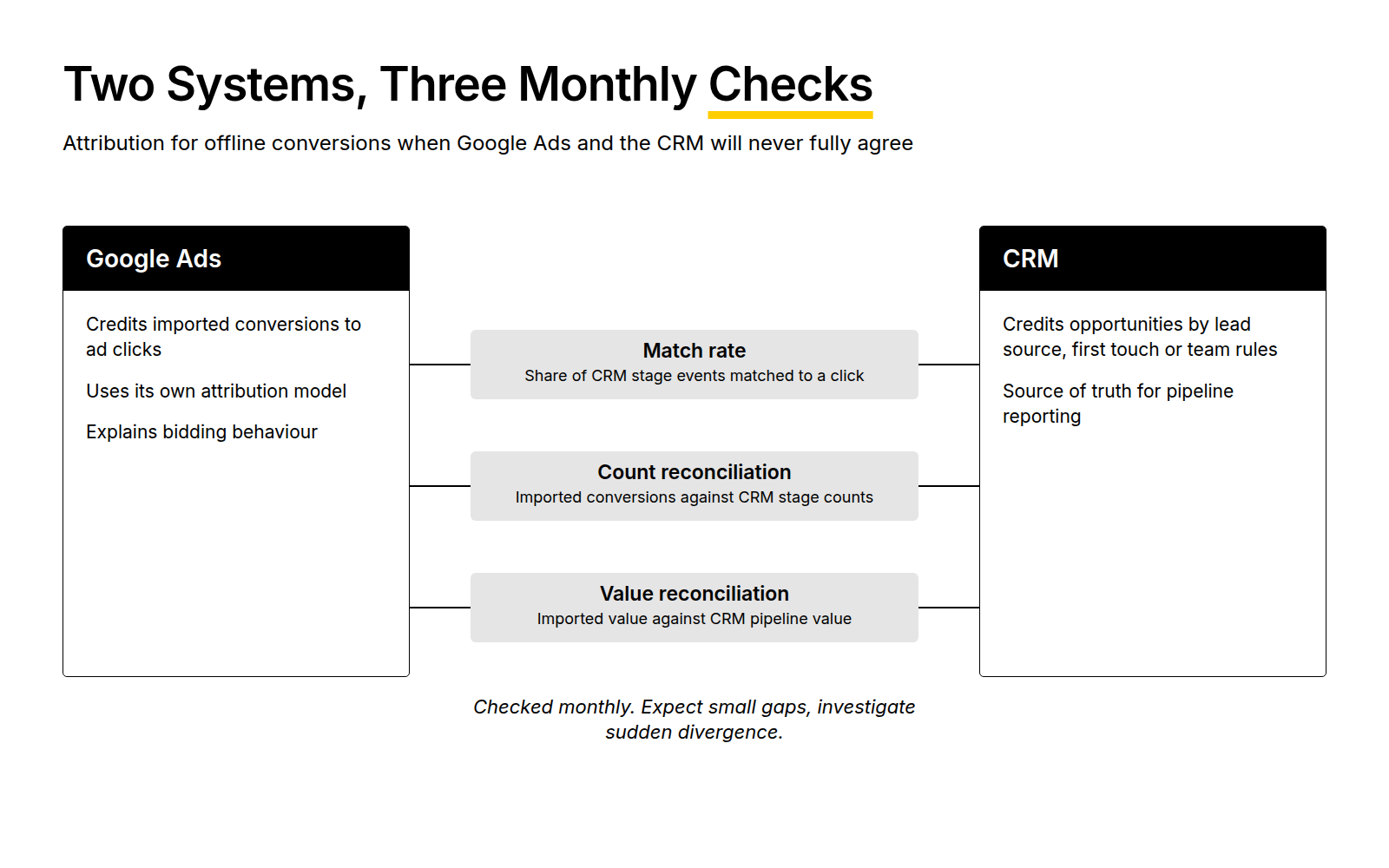
For marketing operations, lead quality reporting should come from the CRM, with Google Ads data used to explain bidding behaviour. Our approach to saas attribution is built around keeping those two views consistent. For measuring lead quality before closed-won data arrives, see Measuring Lead Quality in SaaS PPC: From MQLs to Revenue.
Common Pitfalls
These are the mistakes that most often undermine offline conversion strategies:
- Bidding on closed-won alone. Too few conversions, mostly too late to import.
- Importing full stage values at every step. Clicks get credited several times over and conversion value inflates.
- Using raw deal amounts. One large deal distorts bidding for weeks.
- Uploading in batches. Delayed signals weaken bidding and push conversions out of the window.
- Leaving old form-fill conversions as primary. Bidding continues to chase form volume alongside the revenue signals.
- Ignoring match rate. Broken GCLID capture can silently remove most of your signal.
Frequently Asked Questions
What are offline conversions and why are they important for SaaS revenue signals?
Offline conversions are conversion events that happen in the CRM, such as SQLs, opportunities or closed-won deals, and are imported back to the ad platform against the original click. They matter because Smart Bidding only optimises for the conversions it can see. Without them, bidding treats every form fill as equally valuable.
How can SaaS revenue signals improve offline conversion optimisation?
Revenue signals tell bidding which conversions are worth more. By importing funnel stages with expected values, such as demo requests, SQLs and opportunities, you give the algorithm both volume and a measure of quality. Bidding then favours clicks that resemble past revenue rather than clicks that simply fill in forms.
What are best practices for measuring offline conversions in a digital marketing context?
Capture the GCLID and email on every form, and upload stage events daily rather than in batches. Use incremental values so clicks aren’t credited more than once. Track match rate, and reconcile conversion counts and values against the CRM monthly. Keep events that fall outside the upload window as secondary conversions for reporting only.
How can marketing operations specialists effectively attribute offline conversions to online efforts?
Use the click ID and hashed email captured at form submission to match CRM events back to ad clicks. Accept that Google Ads and the CRM use different attribution logic. Treat the CRM as the source of truth for pipeline reporting, and use Google Ads data to understand how bidding responds.
What strategies can be implemented to enhance lead quality through offline conversion optimisation?
Make value-weighted pipeline stages the primary conversions, and move form fills to secondary. Assign expected values by stage and segment, so bidding favours clicks likely to become revenue. Watch for narrowing, and keep enough shallow-stage volume for the algorithm to keep exploring new queries.
How do deeper funnel events impact the overall marketing strategy?
Deeper funnel events shift paid media from generating volume to generating pipeline. They change which queries and audiences bidding favours, and can improve lead quality significantly. Used alone, they can also starve bidding of data and shrink reach. Balancing depth with volume protects both quality and growth.
What common pitfalls should be avoided when optimising offline conversion strategies?
The most common are bidding on closed-won alone, importing full values at every stage, and using raw deal amounts that let outliers distort bidding. Others include uploading in infrequent batches, leaving form fills as primary conversions, and not monitoring match rate.
How can existing MarTech stacks be leveraged to track offline conversions?
Most stacks already hold everything needed. Forms can capture the click ID and email, the CRM can store them alongside pipeline stages, and Google’s Data Manager or native CRM connectors can upload stage events. The work is usually in field mapping, stage definitions and upload scheduling rather than new tools.
What role does data integration play in optimising offline conversions?
Data integration determines whether the signal arrives at all. If click IDs aren’t captured, emails aren’t passed through or stages aren’t mapped correctly, conversions fail to match and bidding loses its signal. Reliable integration between forms, CRM and ad platform is the foundation every other optimisation depends on.
How can marketing operations leaders ensure reliable reporting for offline conversions?
Track match rate, count reconciliation and value reconciliation monthly. Investigate sudden changes in any of them, since they usually indicate a broken capture or upload. Report pipeline from the CRM, and keep stage definitions and values documented so the numbers mean the same thing from quarter to quarter.
If your offline conversions are set up but bidding seems to be shrinking rather than improving, the signal mix is usually the place to start. This is the kind of setup we review with SaaS marketing operations teams regularly, and we’re happy to take a look at yours.