Maximise Your PPC: Focus on Sales Accepted Opportunities
How to optimise B2B PPC conversion for sales accepted opportunities rather than form fills: the metrics, A/B testing approach, sales feedback loop and reporting cadence.

The landing page test came back a winner. Conversion rate up 50%, cost per lead down a third. Six weeks later, sales says the leads are worse than ever and pipeline from paid search has dropped.
Nobody made a mistake in the test. They measured the wrong thing. Conversion optimisation for increased sales accepted opportunities from PPC starts with a different success metric: not how many people fill in the form, but how many of them sales accepts as worth working.
This article sets out how to make that shift in practice. It covers the metrics to track, the conversion levers that raise sales acceptance rather than just volume, how to run A/B tests against sales outcomes, and the reporting and feedback cadence that keeps marketing and sales working from the same numbers.
What a Sales Accepted Opportunity Is
A sales accepted opportunity (SAO) is a lead that sales has reviewed, qualified and accepted as a genuine opportunity worth pursuing. It sits after the form fill and the MQL, and before closed-won. It’s the first point in the funnel where sales, not marketing, has confirmed the lead is real.
SAOs are a better optimisation target than form fills for one practical reason: they arrive fast enough to act on. Closed-won revenue takes months in B2B SaaS. Sales acceptance usually happens within days. That makes SAOs the earliest signal of lead quality that sales will actually stand behind.
Definitions vary between teams, and agreeing yours with sales comes first. We’ve covered how to set those definitions in Transforming Leads into Revenue-Qualified Opportunities for Better CAC. This article assumes you have one and focuses on how to optimise towards it.
Why Form-Fill Optimisation Works Against Sales Acceptance
Most conversion advice is written for volume. Shorter forms, fewer fields, softer calls to action, more urgency. Each of these reduces friction, and in B2B, friction is often doing useful work.
Benchmarks reinforce the habit. WordStream’s 2025 Google Ads benchmarks put the average conversion rate at 7.52% and the average cost per lead at $70.11. Those figures measure form submissions, not opportunities. A team optimising towards them can hit every benchmark and still starve the pipeline.
There’s a second effect that makes this worse. Smart Bidding learns from whatever conversion you feed it. If the conversion is a form fill, Google gets better at finding people who fill in forms, including students, competitors and job seekers. The bidding algorithm then optimises against your interests, and does it efficiently.
The fix isn’t to stop optimising conversion rates. It’s to change which conversion you’re optimising.
The Metrics That Matter for Sales Acceptance
PPC conversion improvement for higher sales accepted opportunities needs a metric stack that runs from click to acceptance. Track these at campaign, keyword and landing page level:
- SAOs per 1,000 clicks: the single best measure of whether traffic and landing page together produce real pipeline. It combines conversion rate and lead quality in one number.
- Lead-to-SAO rate: the share of form fills that sales accepts. Track this by campaign and landing page, not just in aggregate.
- Cost per SAO: the paid media metric that should replace cost per lead in weekly reporting.
- Rejection reasons: why sales turned leads down. This is the most useful diagnostic data you’ll get, and most teams don’t collect it.
- Time to acceptance: how long sales takes to accept or reject. Slow acceptance delays your optimisation signal.
Conversion rate and cost per click still matter, but as inputs, not outcomes. A falling conversion rate with a rising SAO rate is often a good result.
These metrics also connect directly to customer acquisition cost. CAC is the total cost of winning a customer, including media and sales costs. If you know cost per SAO and your SAO-to-win rate, you can estimate the media component of CAC within weeks, long before closed-won data catches up.
Conversion Optimisation Strategies for B2B PPC That Raise Sales Acceptance
The levers below are the ones we see move SAO rate most reliably. Some reduce volume. That’s usually the point.
Match the Page to the Search Intent
A searcher typing “[competitor] alternative” and one typing “what is [category]” are at different stages and need different pages. Sending both to the same demo page produces demo requests from people who weren’t ready, and sales rejects them.
Build landing pages by intent stage. Send high-intent, solution-aware traffic to demo or trial pages. Send problem-aware traffic to pages that educate and qualify before asking for a meeting. The acceptance rate on demo requests rises because fewer of them come from people who should have been somewhere else.
Use Form Fields to Route, Not Just to Filter
Adding fields is the bluntest qualification tool. It cuts junk, but it also cuts good leads who don’t want to type out their life story. A better approach uses one or two qualifying fields, such as company size or role, to change what happens next.
ICP-fit visitors get an instant calendar booking with an account executive. Others get a lighter follow-up path. Form enrichment tools can fill in company data automatically, so the visible form stays short while sales still gets what it needs. The goal is a fast route for good-fit buyers, not a wall for everyone. For more on the qualification side, see Enhancing Qualified Leads in B2B SaaS PPC Campaigns.
Set Expectations on the Page
Leads get rejected when they turn out to be the wrong size, the wrong use case or the wrong budget. Many of those mismatches could have been prevented on the landing page.
Say who the product is for. Show starting prices or pricing logic where you can. Name the company sizes or industries you serve. Some visitors will leave, and they’re the ones sales would have rejected anyway. User engagement on the page may drop slightly. Acceptance rate usually rises.
Feed Sales Acceptance Back Into Bidding
Once you’re tracking SAOs in the CRM, import them into Google Ads as an offline conversion and make them the primary bidding signal. This is the single biggest change most B2B accounts can make. It turns Smart Bidding from a form-fill finder into an opportunity finder.
The practical detail matters: capturing the click ID on the form, passing it into the CRM and mapping pipeline stages to conversion actions. We’ve covered it in Optimising PPC Campaigns with Stage-Based Offline Conversions.
A/B Testing Against Sales Outcomes, Not Form Fills
A/B testing is where form-fill thinking does the most damage, because a “winning” test gets rolled out and its cost doesn’t show up until weeks later.
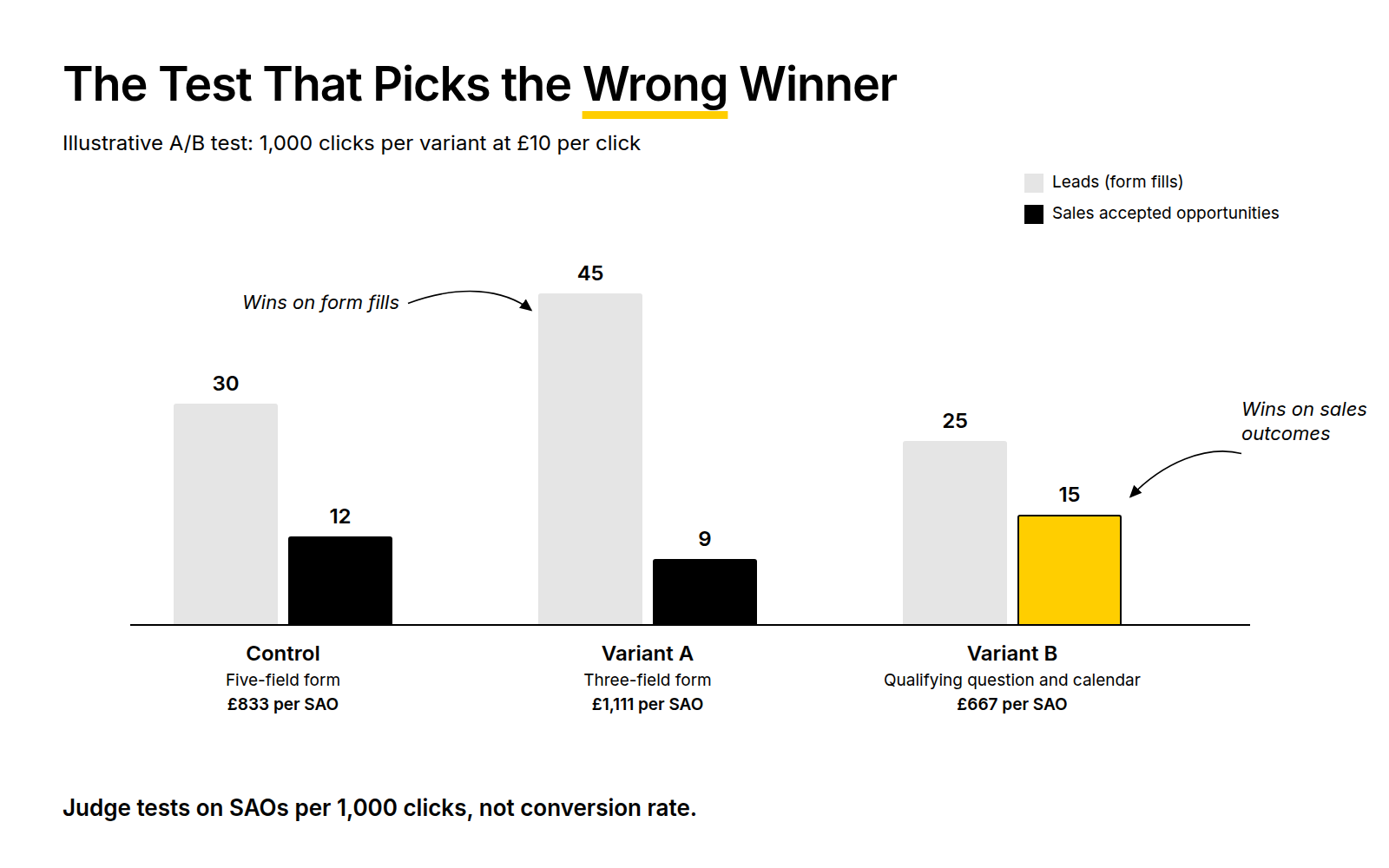
Consider an illustrative test on a SaaS demo page, with 1,000 clicks per variant at £10 per click:
- Control (five-field form): 3% conversion rate, 30 leads, 40% accepted by sales. That’s 12 SAOs at £833 each.
- Variant A (three-field form): 4.5% conversion rate, 45 leads, 20% accepted. That’s 9 SAOs at £1,111 each.
- Variant B (qualifying question plus calendar booking for ICP-fit visitors): 2.5% conversion rate, 25 leads, 60% accepted. That’s 15 SAOs at £667 each.
On form-fill metrics, Variant A wins clearly: 50% more conversions and a cost per lead a third lower. On sales outcomes, it loses, with 25% fewer SAOs and a 33% higher cost per SAO. Variant B has the lowest conversion rate and the highest cost per lead, and produces 25% more SAOs at a 20% lower cost each.
Best practices for PPC conversion rates in B2B start with this distinction. Run tests in this order:
- Write a hypothesis tied to SAOs, not form fills, such as “routing ICP-fit visitors to a calendar will raise SAOs per 1,000 clicks”.
- Set SAOs per 1,000 clicks as the primary metric, with conversion rate and cost per lead as secondary metrics.
- Agree the sample size and duration before launch, including time for sales to accept or reject the leads.
- Read the result only once acceptance data is complete for every lead in the test window.
- Roll out the winner and log the result, including tests that didn’t win.
The trade-off is volume. SAO-based tests need more traffic than form-fill tests, because SAOs are rarer than leads. The illustrative numbers above are too small to call with confidence. Most accounts would need several thousand clicks per variant. If your traffic can’t support that, test bigger changes less often rather than small changes quickly. Our guide to low-traffic CRO iterations covers how to work within that constraint.
Build a Feedback Loop With Sales
Rejection reasons are the raw material for conversion optimisation, and sales is the only team that has them. Without a structured loop, that knowledge stays in SDRs’ heads and Slack threads.
Three things make the loop work:
- A mandatory rejection reason field in the CRM, with a short fixed list such as wrong company size, no budget, student or job seeker, competitor, and existing customer.
- A weekly review where marketing reads rejection reasons by campaign and landing page, and agrees one or two changes.
- Closing the loop visibly. When a rejection pattern leads to a change, tell sales. Feedback dries up quickly when nobody can see it being used.
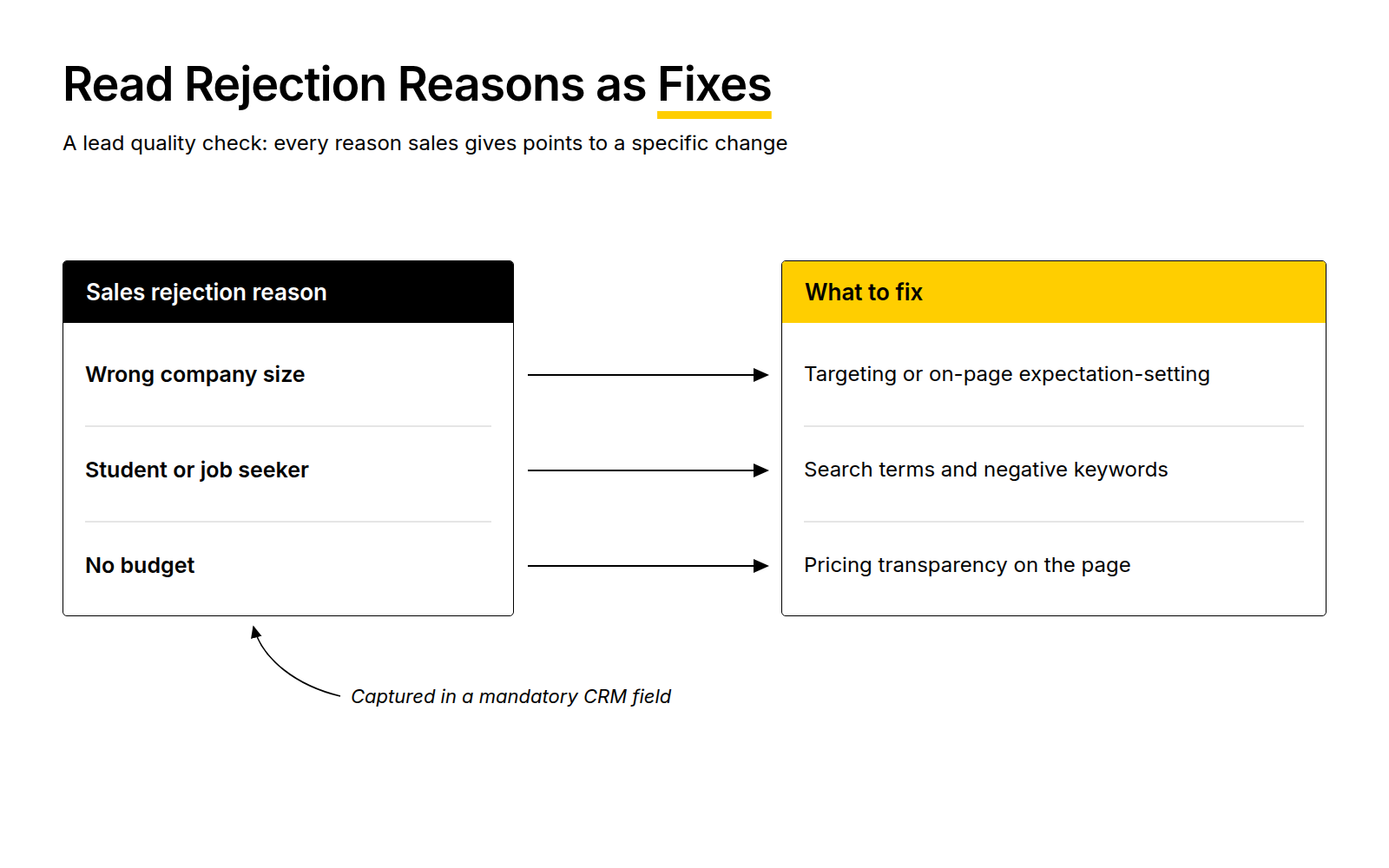
Each rejection reason points to a specific fix. “Wrong company size” usually means targeting or on-page expectation-setting. “Student or job seeker” points to search terms and negative keywords. “No budget” often means the page hides pricing. The detail of running this with SDR teams is covered in Building a Sales Feedback Loop for PPC. Connecting CRM feedback directly to landing page decisions is the subject of Salesforce & HubSpot CRO Integrations for Landing Page Feedback.
Transparent Reporting That Sales and Marketing Both Trust
Reporting is where most PPC programmes lose credibility with sales. Marketing reports leads. Sales reports pipeline. The numbers never reconcile, and every review becomes an argument about whose data is right.
Fix this with one shared view, built on CRM data, that both teams use. It should show SAOs, lead-to-SAO rate and cost per SAO by campaign and landing page, updated weekly. Google Analytics still has a role: GA4 shows how visitors behave on the page, where they drop off and which elements they engage with. It explains why conversion rates move. The CRM tells you whether those conversions mattered.
Transparency also means reporting what didn’t work. A test log that includes losing variants, and the reasoning behind each decision, builds more trust with sales than a dashboard of wins.
A Disciplined Optimisation Cadence
The final piece is rhythm. Most PPC programmes either change things too often to learn anything or too rarely to improve. A fixed cadence solves both.
- Weekly: review rejection reasons, search terms and SAO rate by campaign. Add negatives and fix obvious mismatches.
- Fortnightly: check running tests. Don’t call results early, and confirm acceptance data is complete before reading them.
- Monthly: review cost per SAO by campaign and landing page, check bidding is learning from SAO conversions, and decide what to test next.
- Quarterly: review the SAO definition and rejection reason list with sales, and refresh landing pages by intent stage.
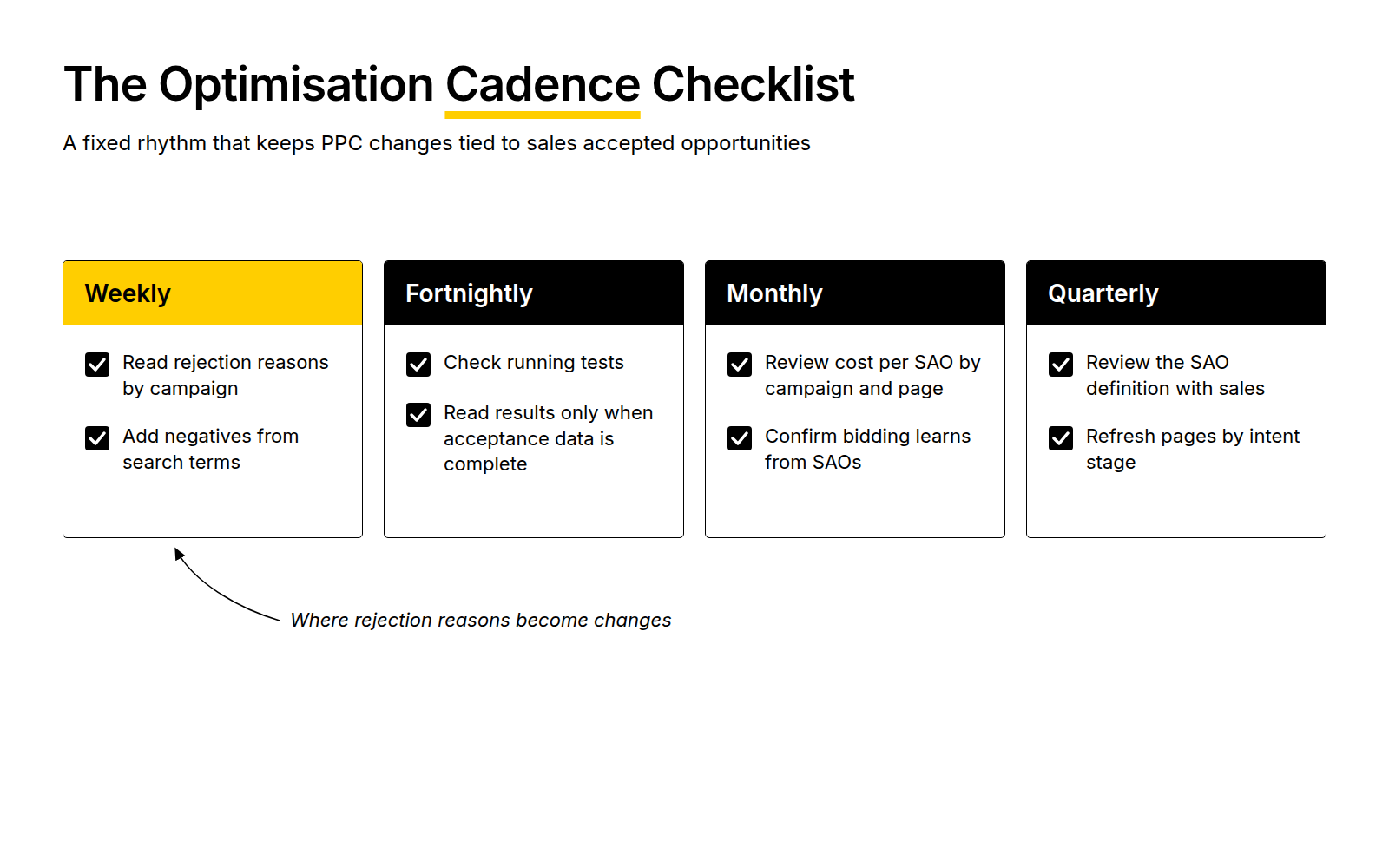
To increase sales accepted opportunities from PPC consistently, the cadence matters more than any single tactic. It keeps optimisation decisions tied to outcomes sales can see.
Common Pitfalls to Avoid
These are the mistakes that most often undermine SAO-focused optimisation:
- Calling tests on conversion rate. The most expensive error, because the damage arrives weeks after the “win” is rolled out.
- Bidding on form fills while reporting on SAOs. Smart Bidding will optimise against your reporting metric.
- Adding form fields as the only qualification lever. It cuts good leads along with bad ones.
- Running one landing page for all intent stages. Problem-aware visitors book demos they aren’t ready for.
- Collecting no rejection reasons. Without them, you know quality is poor but not why.
- Changing the SAO definition mid-test. It invalidates every comparison running at the time.
Frequently Asked Questions
How do you optimise a PPC campaign for better sales accepted opportunities?
Make SAOs the primary conversion in Google Ads by importing them as an offline conversion. Then report cost per SAO instead of cost per lead. Match landing pages to search intent, use form fields to route good-fit visitors to sales quickly, and set expectations on the page so poor-fit visitors self-select out. Review rejection reasons weekly to find what to fix next.
What strategies can improve the conversion rate from PPC leads to sales accepted opportunities?
Send each intent stage to the right page, so demo requests come from solution-aware buyers. Add one or two qualifying fields that route ICP-fit visitors to a calendar booking. Show who the product is for and how pricing works. Use enrichment to keep forms short while giving sales the data it needs, and act on sales rejection reasons.
What are the best practices for A/B testing in PPC campaigns?
Tie every hypothesis to sales outcomes, and use SAOs per 1,000 clicks as the primary metric. Agree sample size and duration before launch, allowing time for sales to accept or reject leads. Only read results once acceptance data is complete. Log every test, including losers, and test bigger changes less often if traffic is limited.
How can transparent reporting enhance PPC campaign performance?
Shared reporting built on CRM data ends arguments about whose numbers are right. When sales and marketing both see SAOs and cost per SAO by campaign, problems surface faster and fixes get agreed sooner. Reporting losing tests and the reasoning behind decisions builds trust, which keeps sales engaged in the feedback loop.
What metrics should B2B marketing managers focus on to improve lead quality in PPC?
Focus on SAOs per 1,000 clicks, lead-to-SAO rate, cost per SAO, rejection reasons and time to acceptance. Track each by campaign, keyword and landing page. Conversion rate and cost per click remain useful as inputs, but they shouldn’t be the measure of success, because they reward volume rather than quality.
How can feedback loops between marketing and sales teams improve conversion rates?
Sales rejection reasons tell marketing exactly why leads fail. With a mandatory rejection field and a weekly review, each pattern maps to a fix. Wrong company size points to targeting, job seekers point to negative keywords, and budget objections point to pricing transparency. Telling sales which changes their feedback drove keeps the loop running.
What role does data-driven decision-making play in PPC conversion optimisation?
It decides which data you trust. Platform conversion data rewards form volume, while CRM data shows whether those conversions became real opportunities. Data-driven optimisation in B2B means making decisions on sales outcomes, using GA4 to explain on-page behaviour and the CRM to judge results.
How can I track and reduce customer acquisition costs in PPC campaigns?
Customer acquisition cost is the total cost of winning a customer, including media and sales costs. Track cost per SAO weekly and divide it by your SAO-to-win rate for an early estimate of the media component. Reduce it by bidding on SAOs, cutting traffic that sales rejects, and improving the share of visitors who become accepted opportunities.
What are the key components of an effective conversion optimisation strategy?
An agreed SAO definition, offline conversion tracking that feeds SAOs into bidding, landing pages built by intent stage, and qualifying forms that route rather than block. Add an A/B testing process measured on SAOs, a structured sales feedback loop, shared CRM-based reporting and a fixed optimisation cadence.
What are common pitfalls to avoid when optimising PPC for sales accepted opportunities?
The most costly is calling tests on conversion rate, because damage to pipeline shows up weeks later. Others include bidding on form fills while reporting on SAOs, relying only on extra form fields to qualify, using one landing page for every intent stage, and not collecting rejection reasons from sales.
If your PPC lead volume looks healthy but sales isn’t accepting the opportunities, the gap is usually fixable. Our conversion rate optimisation services are built around exactly this problem, and we’re happy to look at where your funnel is losing qualified buyers.