Navigating Your First 180 Days of SaaS Paid Acquisition Post-GTM Shift
A phased 180-day plan for rebuilding SaaS paid acquisition after a GTM shift: what to protect, what to rebuild, how to test and when to scale, with budget and attribution guidance.

The board has approved the new go-to-market. You’re moving upmarket, or into a new vertical, or from product-led to sales-led. The strategy deck is clear. Your paid acquisition programme, however, was built for the old motion. Its keywords, audiences, conversion actions, bidding history and benchmarks are all calibrated for a buyer you’re no longer prioritising.
That’s the real starting point for a 180-day SaaS paid acquisition strategy after a GTM shift. Most of what’s running still produces numbers, but some of those numbers now measure the wrong thing. The temptation is to rebuild everything at once. The risk is losing the pipeline that’s still working while the new engine is unproven.
This article sets out a phased plan for the first six months. It covers what to protect, what to rebuild, how to test, when to scale, and how to handle budget, attribution and board expectations along the way.
What a Post-GTM Shift Paid Acquisition Plan Is
A paid acquisition strategy in SaaS is the plan for how paid channels generate pipeline. It covers which buyers to target, through which channels, with what offers, at what budget, measured against which outcomes.
The first 180-day SaaS customer acquisition plan after a go-to-market change is a phased rebuild of that strategy. It protects the demand that still fits the new direction, rebuilds targeting and measurement around the new ICP and sales motion, and tests before scaling. Its goal isn’t to replace everything in six months. It’s to arrive at month seven with a programme that’s aligned to the new GTM and has evidence behind every budget decision.
What a GTM Shift Breaks in Paid Acquisition
GTM shifts come in several forms, and each breaks something different:
- A new ICP, such as moving from SMB to mid-market. Keywords, audiences and messaging tuned for the old buyer attract the wrong leads, and historic conversion data teaches bidding to find them.
- A new market or region. Search demand, competitors and costs change, and existing benchmarks no longer apply.
- A new sales motion, such as product-led to sales-led. Conversion events change from sign-ups to demo requests, sales cycles lengthen and lead volume drops while deal size rises.
- A new growth target or ACV band. Acceptable cost per opportunity and CAC payback change, which changes how much each channel can be allowed to spend.
Most shifts combine two or more of these. Identify which ones apply before changing anything, because each points to a different part of the programme that needs rebuilding.
The 180-Day Roadmap
The go-to-market shift paid marketing plan runs in four phases:
- Days 0 to 30, diagnose and protect: audit what still fits, protect working demand and redefine success.
- Days 31 to 60, rebuild the foundations: targeting, offers, tracking and attribution for the new motion.
- Days 61 to 120, test and learn: structured tests against leading indicators.
- Days 121 to 180, scale and systematise: fund what works and set the operating rhythm.
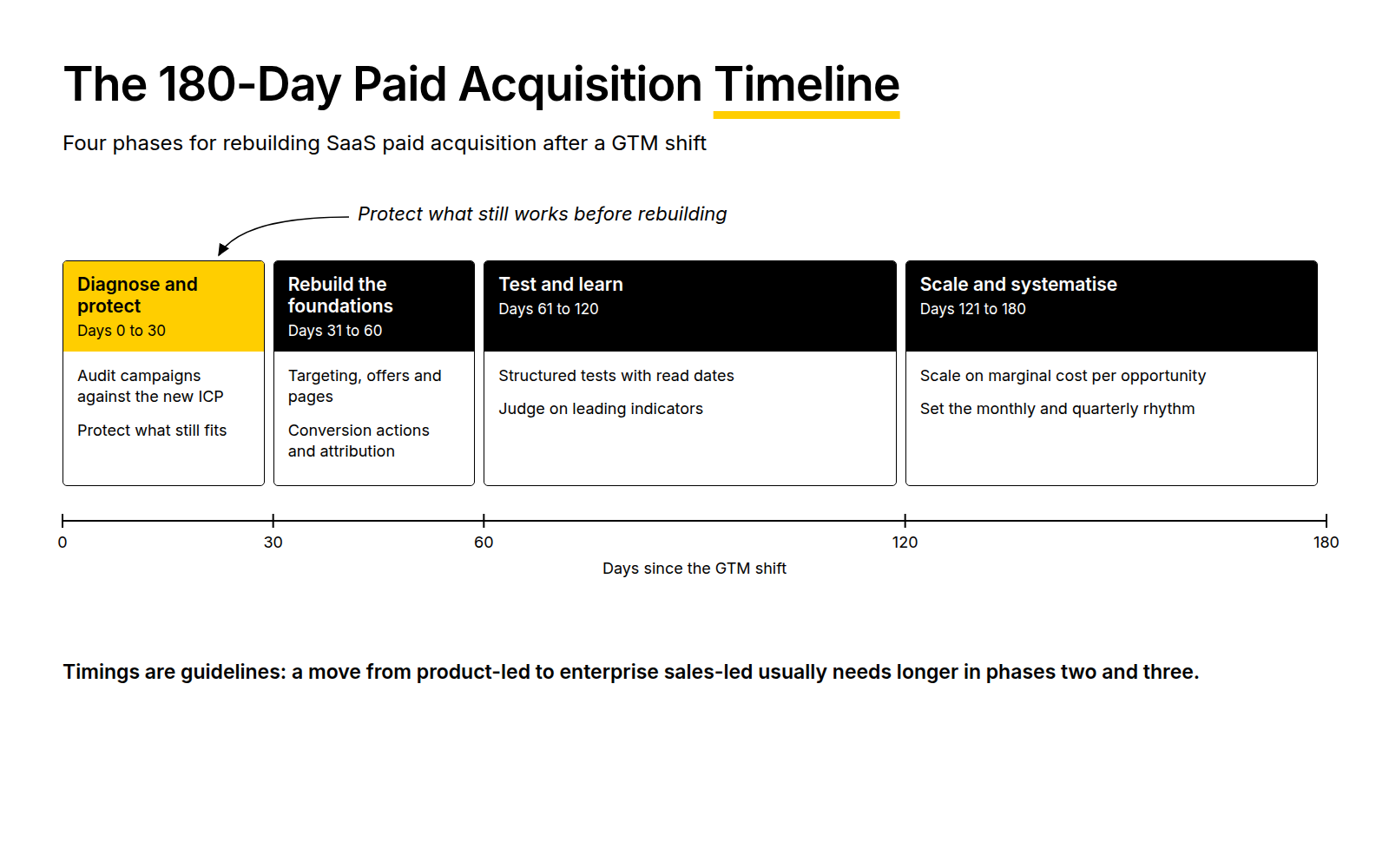
The timings are guidelines. A shift into a new region with a similar buyer may move faster. A move from product-led to enterprise sales-led will usually need longer in phases two and three.
Days 0 to 30: Diagnose and Protect
The first month is about understanding before changing. Audit every campaign against the new ICP and motion, and sort it into three groups: still fits, needs adapting, or no longer fits.
Protect what still fits. Brand search and high-intent terms that the new buyer also searches for usually keep working through a shift, and cutting them early creates a pipeline gap you’ll spend months recovering from.
Use this month to redefine success with sales and finance. Agree the new conversion events, the opportunity definition for the new motion, and target ranges for cost per opportunity and payback. Express targets as ranges, because you don’t yet have the data to commit to precise numbers. Avoid large budget reallocations until the audit is finished.
Days 31 to 60: Rebuild the Foundations
This phase rebuilds the parts of the programme that the shift broke.
Start with targeting. Map the new ICP’s pain points to the searches and audiences that express them. Product marketing usually has the clearest view of how the new buyer describes their problem, so involve them here. Our guide to turning ICP pain points into high-intent SaaS search demand covers this process in detail.
Then rebuild offers and landing pages for the new sales motion. A sales-led enterprise buyer needs a different offer and page from a self-serve trial user.
Finally, rebuild measurement. Update conversion actions so bidding learns from the new definition of a good lead, map the new pipeline stages, and create an attribution model the board can rely on. That means setting up CRM-sourced pipeline as the conservative view, alongside data-driven attribution as the broader view. The full measurement plan for a GTM shift is the subject of SaaS GTM Measurement Plans for Acquisition, Sales & Customer Data.
Days 61 to 120: Test and Learn
With foundations in place, run structured tests rather than ad hoc changes. Each test should have a hypothesis tied to the new ICP, a primary metric and a read date agreed in advance.
Long sales cycles mean closed-won revenue from these tests won’t arrive for months. Judge them on leading indicators instead: lead-to-SQL rate, cost per opportunity and the share of opportunities that match the new ICP. These are early growth leads, not final proof, so present them that way.
Feed customer and sales feedback into each test cycle. Win-loss notes, sales rejection reasons and early customer conversations tell you whether the new targeting attracts the right buyers before revenue data can.
Days 121 to 180: Scale and Systematise
By month five, some tests will have clear signals. Scale them using marginal cost per opportunity, not the average, because the next pound in a new channel rarely performs like the first.
This phase is also about building the operating rhythm that runs after day 180. Set monthly reporting against the new targets, quarterly budget reallocation rules and payback targets for each channel. For the longer-term operating model, see Building a Scale-Ready SaaS PPC Engine After PMF and Evolving PPC Operating Models for Series B SaaS Companies.
Budget Optimisation During a GTM Shift
Budget optimisation during a shift is about balancing three needs: protecting current pipeline, building the new engine and leaving room to explore. A simple way to allocate resources is to split budget into three envelopes:
- Protect: campaigns that still fit the new ICP and produce pipeline today.
- Rebuild: new targeting, offers and channels aimed at the new ICP and motion.
- Explore: small, time-boxed tests in channels or segments with no track record yet.
As a starting point, many teams begin around 80% protect, 15% rebuild and 5% explore in the first month. They move towards roughly 60%, 30% and 10% by the test phase as evidence builds. These are starting points to adjust, not benchmarks to hit. A shift that makes most existing campaigns obsolete will need a faster move towards rebuild.
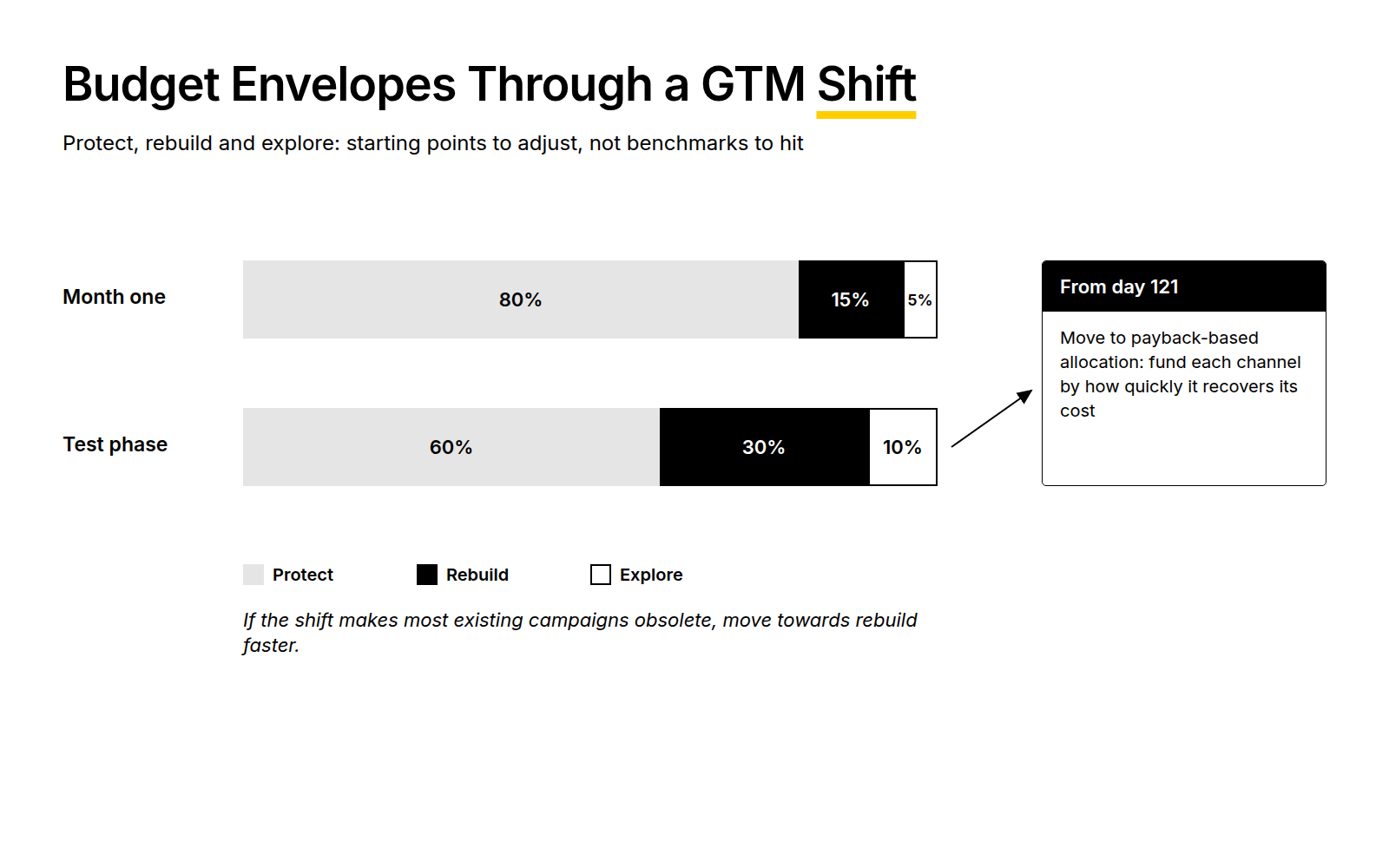
From day 121, move away from the envelopes and towards payback-based allocation, where each channel is funded according to how quickly it recovers its cost. Our guide to aligning paid media budget with CAC payback targets sets out that approach. For realistic channel-level cost expectations, see Understanding Channel-Level CAC Benchmarks for B2B SaaS.
Metrics for Each Phase
The right metrics change as the plan progresses:
- Days 0 to 30: pipeline from protected campaigns, and the share of current leads that match the new ICP.
- Days 31 to 60: tracking accuracy, CRM match rates and early conversion rates on new pages.
- Days 61 to 120: lead-to-SQL rate, cost per opportunity and ICP-fit share of opportunities from tests.
- Days 121 to 180: pipeline and revenue by channel, cost per opportunity trends and early CAC payback.
Traffic increase on its own is not a success metric during a shift. More traffic from the old ICP is a step backwards.
Attribution After a GTM Shift
A GTM shift resets the baselines that attribution depends on. Historic conversion data reflects the old buyer, so comparing new campaigns against old benchmarks is misleading. Treat the first months as a new baseline period.
Data-driven attribution needs volume, and new campaigns rarely have it early on. Until they do, rely on CRM-sourced pipeline and self-reported attribution from demo forms. Introduce data-driven attribution as volume builds. Multi-channel programmes make this harder, because a new ICP often discovers you through channels that don’t get last-click credit, such as LinkedIn, content or peer recommendations.
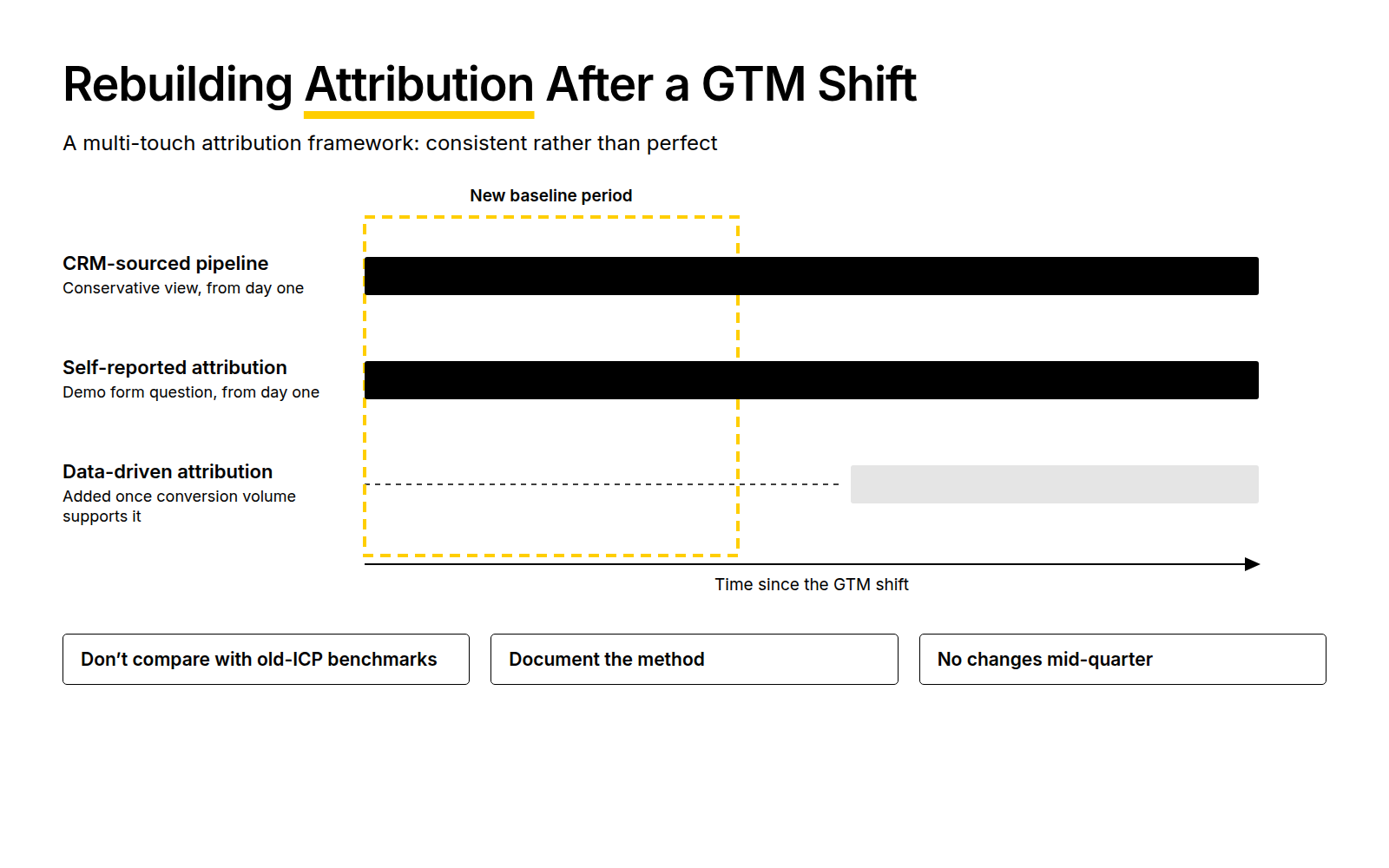
Channel attribution modelling during a shift should be consistent rather than perfect. Pick the approach, document it, and don’t change it mid-quarter. Changes in the numbers should reflect changes in performance, not changes in method.
Managing Board and CFO Expectations
A GTM shift usually produces a dip before a recovery. Lead volume often falls as targeting moves to a smaller, higher-value audience. Cost per lead may rise, and closed-won revenue from the new ICP lags behind. Boards and CFOs who aren’t prepared for this read it as failure.
Set expectations at the start. Present the 180-day plan with the milestones for each phase, what will be known at each point and the leading indicators you’ll report. Agree in advance what would trigger a change of course. This turns the dip from a surprise into a planned stage.
Report quarter-over-quarter progress on the new targets, not the old ones. Comparing a sales-led enterprise pipeline against last year’s self-serve sign-ups tells the board nothing useful.
Common Challenges During a GTM Shift
These problems come up in most shifts:
- Cutting working campaigns too early. It creates a pipeline gap while the new engine is still unproven.
- Keeping old conversion actions. Bidding keeps optimising for the old buyer.
- Judging new tests on revenue too soon. Long cycles mean revenue arrives after the decision deadline.
- Comparing against old benchmarks. Different buyers mean different costs and conversion rates.
- Rebuilding without sales input. Sales feedback is the fastest signal of whether new targeting works.
- Not resetting board expectations. A planned dip looks like failure when nobody was told to expect it.
Frequently Asked Questions
What is a paid acquisition strategy in the context of SaaS?
A paid acquisition strategy is the plan for how paid channels generate pipeline and revenue. It defines which buyers to target, through which channels, with what offers and budget, and how success is measured. In B2B SaaS, success should be measured in opportunities, pipeline and payback, not clicks or form fills.
How do changes in the ideal customer profile (ICP) impact paid acquisition efforts?
A new ICP changes the searches, audiences and messages that reach the right buyer. Existing campaigns and conversion data are tuned for the old buyer, so they keep attracting the wrong leads, and bidding learns from them. Targeting, offers and conversion actions all need rebuilding around the new ICP.
What actionable steps should B2B SaaS marketing leaders take after a GTM shift?
Start by auditing campaigns against the new ICP and protecting what still fits. Then redefine success with sales and finance, and rebuild targeting, offers, tracking and attribution. Run structured tests judged on leading indicators, then scale what works using marginal cost per opportunity. Set board expectations at the start.
How can SaaS companies optimise budget allocation for paid acquisition?
During a GTM shift, split budget into protect, rebuild and explore envelopes, shifting weight towards rebuild as evidence builds. Once tests produce clear signals, move to payback-based allocation, funding each channel according to how quickly it recovers its acquisition cost. Use marginal rather than average costs for scaling decisions.
What metrics should be used to measure the success of a paid acquisition strategy?
Use pipeline and revenue by channel, cost per opportunity and CAC payback as the main measures. During a GTM shift, add leading indicators such as lead-to-SQL rate and the share of opportunities that match the new ICP. Traffic and lead volume alone can be misleading.
How can attribution models be established to link spend to outcomes in SaaS marketing?
Start with CRM-sourced pipeline as the conservative view and self-reported attribution from demo forms. Add data-driven attribution once conversion volume supports it. Document the approach and keep it consistent across each quarter, so changes in the numbers reflect changes in performance rather than method.
What are the common challenges faced during a GTM shift in SaaS marketing?
The most common are cutting working campaigns too early, leaving old conversion actions in place, and judging new tests on revenue before it can arrive. Others include comparing results against old benchmarks, rebuilding without sales input, and failing to prepare the board for a temporary dip in lead volume.
How can marketing leaders align paid acquisition strategies with revenue goals?
Agree the opportunity definition, conversion events and target ranges with sales and finance before rebuilding. Measure paid acquisition on pipeline and payback rather than leads. Report quarter-over-quarter progress against the new revenue targets, and fund channels based on their contribution to those targets.
What role does market dynamics play in shaping a SaaS paid acquisition plan?
Market dynamics set the costs and opportunities a plan works within. A new market changes search demand, competitor activity and click costs. A new segment changes how buyers research and who influences the decision. Plans should be built on fresh data from the new market rather than assumptions carried over from the old one.
How can SaaS companies ensure consistent quarter-over-quarter growth after a GTM shift?
Protect working demand while the new engine is built, so pipeline doesn’t collapse during the transition. Set board expectations for a temporary dip, and report against leading indicators until revenue data arrives. From around day 121, scale proven channels using marginal costs and set a quarterly reallocation rhythm.
A GTM shift is one of the hardest moments for a paid acquisition programme, and one of the most important to get right. If you’re planning the first six months after a shift, our saas ppc agency team works through exactly this kind of rebuild, and we’re happy to talk through yours.