Establishing Governance Rules for SaaS Paid Media Plans
A governance framework for SaaS paid media covering decision rights, test approvals, budget modification rules, and escalation triggers, built for data-driven CMOs who need board-ready narratives, not reconstructions after the fact.

A board member asks why spend shifted 20% into a new channel last quarter. The honest answer, in most SaaS organisations, is that someone made a reasonable call under time pressure and nobody wrote down why. That's not a strategy problem. It's a governance gap, and it's the kind that quietly erodes a CMO's credibility long before any campaign underperforms.
Governance rules for SaaS paid media aren't bureaucracy layered on top of a strategy. They're the decision infrastructure that lets a data-driven CMO move fast on experiments while still being able to explain, precisely, why every material change happened. Without that infrastructure, attribution clarity and board-ready narratives are built after the fact, from memory, which is exactly when they fall apart under scrutiny.
Why SaaS Paid Media Needs Governance Rules, Not Just a Strategy
A strategy tells you where you're going. Governance tells you who can change the plan, under what conditions, and who needs to know when they do. SaaS paid media accumulates decision points at a pace most governance structures were never built for: platform algorithm shifts, attribution model changes, agency-initiated tests, budget reallocations mid-quarter. Each one is defensible in isolation. Collectively, undocumented, they produce a quarter nobody can fully explain.
Gartner's 2025 Marketing Technology Survey found that only 15% of organisations qualify as high performers on martech ROI, and identified operational complexity, not the tools themselves, as the primary barrier. The high performers weren't distinguished by better platforms. They were distinguished by templatised, governed operations. The same logic applies directly to paid media decision-making.
Decision Rights: Who Can Change What, Without Escalating Every Time
Decision rights are the foundation everything else in this framework sits on. Without them, every change becomes a negotiation, and every negotiation becomes a delay.
Define three tiers explicitly. First, changes the agency or in-house team can make without sign-off: bid adjustments within an agreed range, creative rotation, minor audience refinements. Second, changes requiring CMO or director sign-off: new channel entry, budget shifts above an agreed threshold, messaging changes that touch brand positioning. Third, changes requiring board or executive visibility: anything materially affecting quarterly spend allocation or company-wide attribution methodology.
Saas marketing decision rights that stay implicit inevitably default to whoever is most confident in the room, which is a poor substitute for a documented threshold. Write the tiers down, share them with the agency, and revisit them quarterly as spend and team maturity change.
Test Approval Processes: Governing Experiments Without Killing Velocity
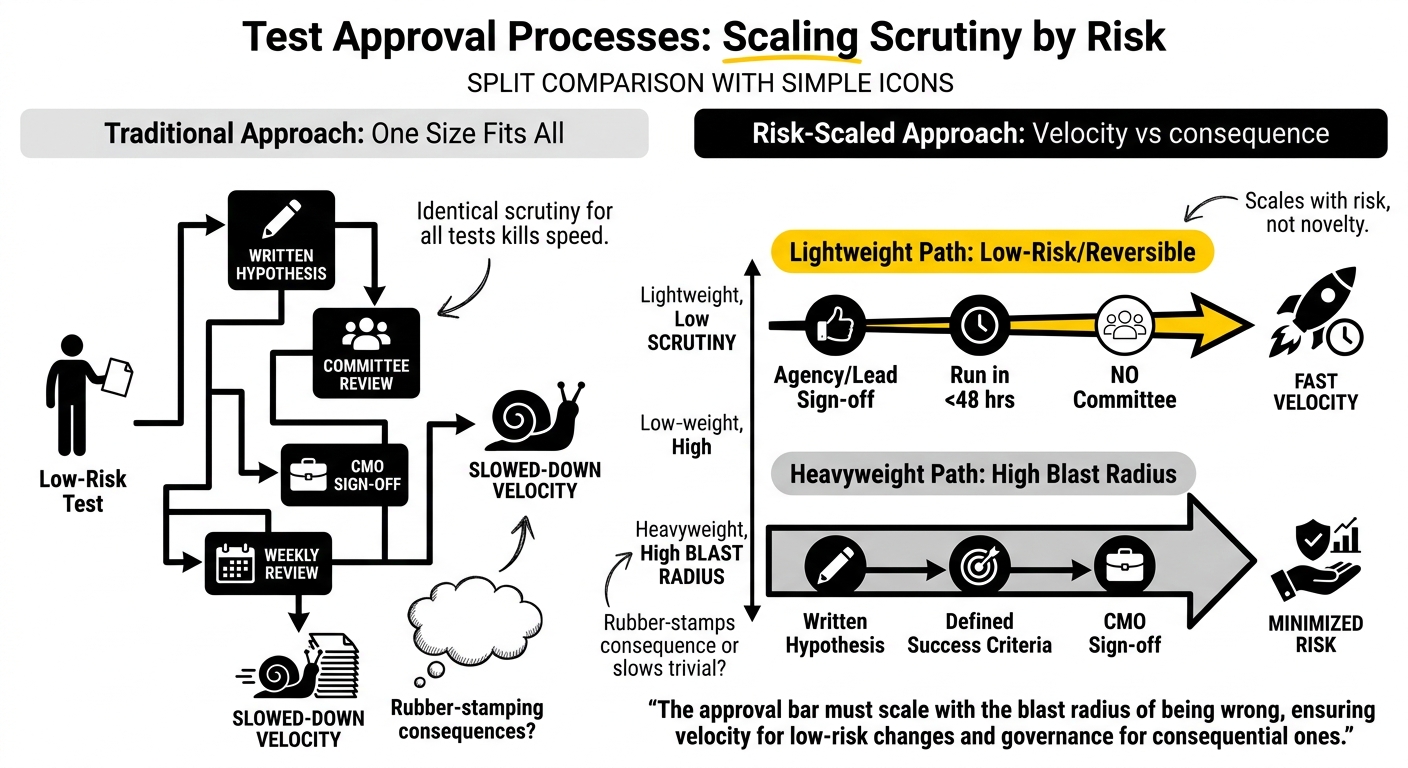
Best practices for SaaS marketing experiments start from a simple principle: not every test needs the same level of scrutiny. A landing page copy variant and a fundamental change to attribution methodology are not the same category of risk, and treating them identically either slows down the trivial or rubber-stamps the consequential.
Set a lightweight approval path for low-risk, reversible tests, agency or team lead sign-off, run within 48 hours, no committee required. Reserve a heavier path for tests that touch pricing perception, core messaging, or methodology: written hypothesis, defined success criteria, and CMO sign-off before launch. Test approval processes for SaaS marketing work best when the bar scales with the blast radius of being wrong, not with how interesting the idea is.
Budget Modification Rules: When a Change Needs Sign-Off vs When It Doesn't
Budget modification rules for SaaS media should answer one question cleanly: at what threshold does a reallocation stop being tactical and start being strategic. A 10% shift within an already-approved channel mix is tactical. A 10% shift that moves spend into a channel not in the original plan is strategic, regardless of the dollar amount.
Set a percentage and absolute-dollar threshold, whichever triggers first, above which any change requires documented rationale and sign-off before execution, not retroactive justification after the fact. This single rule prevents the majority of “why did spend move” conversations that otherwise land, unexplained, on a board slide.
Escalation Rules: What Actually Warrants Going Up a Level
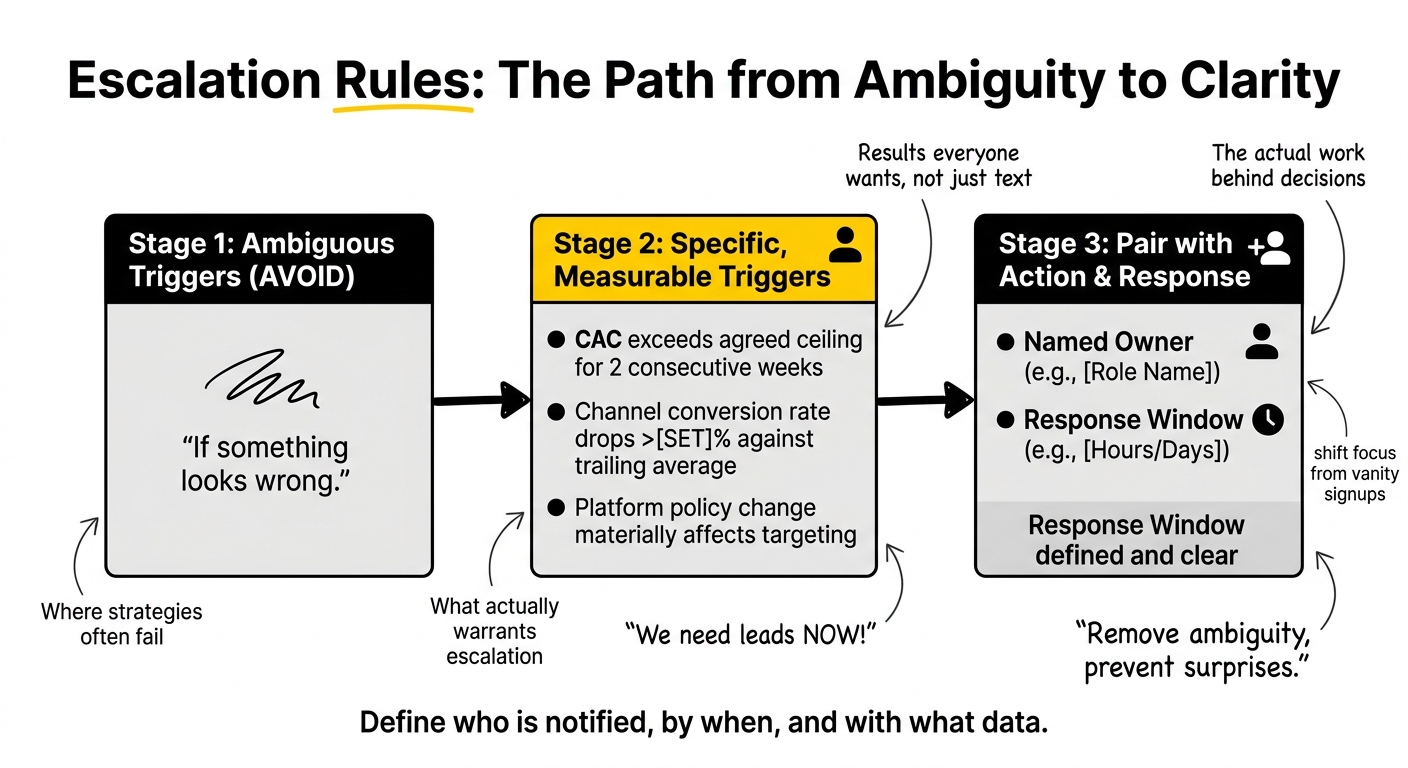
Escalation strategies for SaaS media campaigns fail most often because the trigger is vague: “if something looks wrong.” Vague triggers get ignored under deadline pressure precisely when they matter most.
Define specific, measurable triggers instead: CAC exceeding an agreed ceiling for two consecutive weeks, a channel's conversion rate dropping more than a set percentage against its trailing average, or a platform policy change materially affecting targeting capability. Pair each trigger with a named owner and a response window. Escalation rules for SaaS marketing that specify exactly who is notified, by when, and with what data, remove the ambiguity that turns a manageable issue into a quarter-ending surprise.
Attribution Clarity as a Governance Function, Not Just a Reporting One
Attribution disputes are rarely about the data. They're about who gets to decide what the data means when two models disagree, and that decision needs an owner before the dispute happens, not during it.
Data-driven SaaS marketing governance treats the attribution model itself as a governed asset: who can change its configuration, what triggers a review of its assumptions, and how changes are communicated to anyone whose reporting depends on it. Saas media campaign governance that skips this step ends up relitigating attribution methodology every time a number looks unexpected, which is a poor use of a CMO's time and a worse look in front of the board.
Aligning Brand and Performance Metrics Inside the Same Framework
The brand-versus-performance tension isn't resolved by picking a side. It's resolved by governance that requires both sets of metrics on the same table before a decision gets made. Performance metrics for SaaS marketing, CAC, pipeline velocity, conversion rate, tell you what's working now. Brand metrics tell you what's being built for later. A governance rule that mandates both be reviewed together before a budget decision prevents the common failure mode of a performance win that quietly erodes positioning, or a brand investment nobody can defend against a growth target.
Building the Board-Ready Narrative From Governance, Not After It
A board-ready narrative built from governance records is simply a true account of what happened and why. A board-ready narrative constructed after the fact, from memory and selectively chosen wins, is a much harder story to defend under a pointed question.
Collaboration frameworks for SaaS teams that log decisions as they happen, threshold triggered, rationale documented, owner named, hand the CMO a ready-made narrative every quarter. Accountability in SaaS paid media isn't a defensive posture. It's what makes the eventual board conversation shorter, not longer.
A Worked Example: Governance Absorbing a Platform Shock
Take a hypothetical Series C SaaS company running a governed framework when a major ad platform changes its default attribution window mid-quarter. Under the framework, the change trips a defined escalation trigger, methodology change materially affecting reported conversions, which routes automatically to the CMO and the analytics owner within 48 hours, not weeks later when the board asks why pipeline numbers moved.
The CMO reviews the change against the documented attribution governance rule, decides whether to adjust the internal model or hold steady and flag the discrepancy, and logs the rationale before the next reporting cycle closes. When the board eventually asks about the shift, the answer already exists, dated and reasoned, rather than being reconstructed under pressure in the days before the meeting.
A Starting Governance Framework
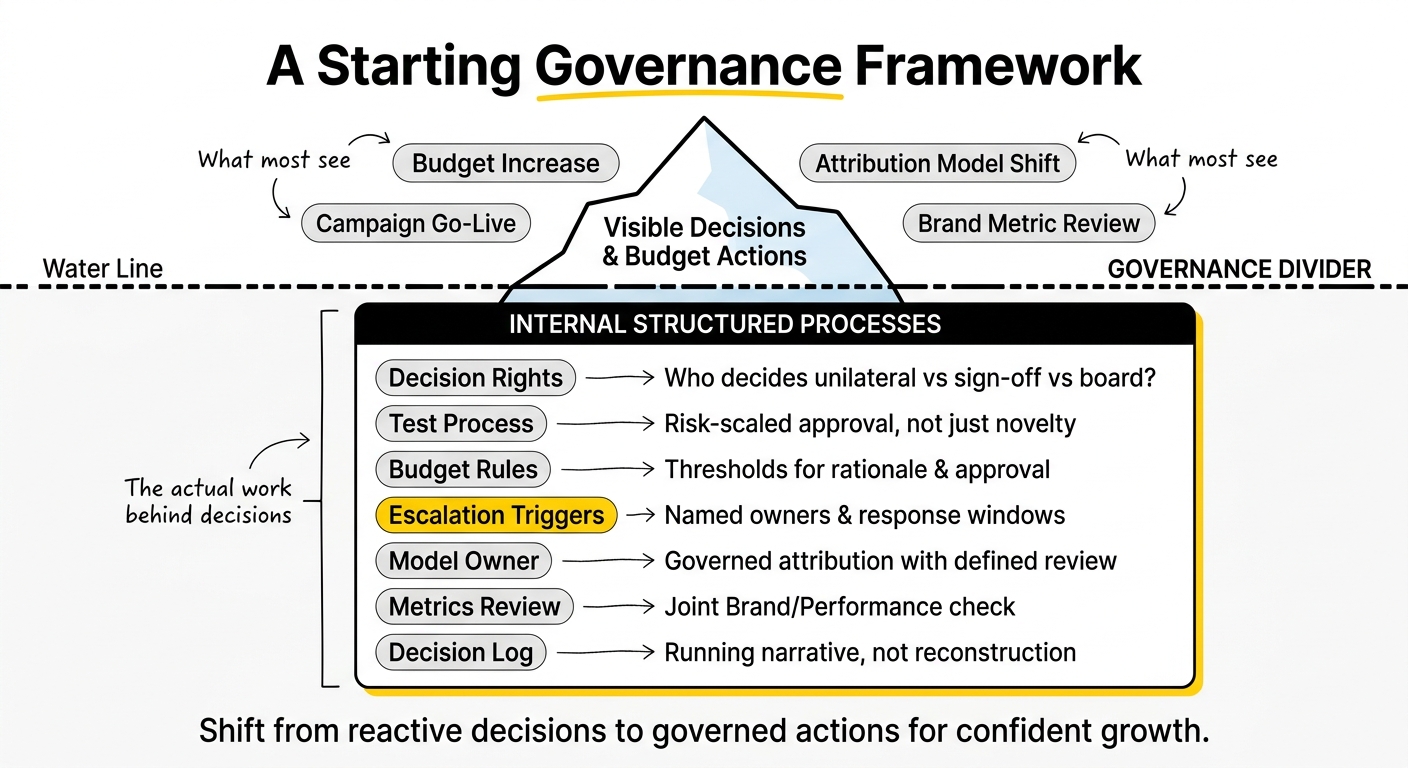
Bringing the sections above together, the core rules to establish:
- Three-tier decision rights: unilateral, sign-off required, board visibility required
- A two-track test approval process scaled to risk, not novelty
- A budget modification threshold, percentage or dollar, whichever triggers first, requiring documented rationale before execution
- Specific, measurable escalation triggers with named owners and response windows
- A governed attribution model with a defined owner and review trigger
- A joint review of brand and performance metrics before major budget decisions
- A running decision log that becomes the board narrative, rather than a reconstruction exercise
Frequently Asked Questions
What are governance rules for SaaS paid media plans?
The documented decision rights, approval thresholds, and escalation triggers that determine who can change a paid media plan, under what conditions, and who needs to be informed when they do.
How can SaaS teams establish clear decision rights in paid media?
Define three tiers explicitly: changes requiring no sign-off, changes requiring director or CMO sign-off, and changes requiring board visibility, then share the thresholds with the agency so they don't default to guesswork.
What are best practices for test approvals in SaaS paid media experiments?
Scale the approval bar to the risk of being wrong, not the novelty of the idea. Low-risk, reversible tests need a lightweight sign-off; anything touching pricing perception or core messaging needs a written hypothesis and CMO approval.
How should budget modifications be handled in SaaS paid media plans?
Set a percentage or dollar threshold, whichever triggers first, above which any reallocation requires documented rationale before execution. Below that threshold, tactical shifts can proceed without a full approval cycle.
What escalation processes should be in place for SaaS paid media campaigns?
Specific, measurable triggers, such as CAC breaching a ceiling for two consecutive weeks, paired with a named owner and a defined response window. Vague triggers get ignored under deadline pressure.
How can structured collaboration enhance accountability in paid media management?
A running decision log that captures the trigger, rationale, and owner for every material change turns accountability into a byproduct of normal operations, rather than a separate reporting exercise done after the fact.
What role does attribution play in SaaS paid media governance?
Attribution needs a governed owner and a defined review trigger, so disputes about what the data means are resolved against an agreed process rather than relitigated every time a number looks unexpected.
How can governance structures facilitate predictable growth in SaaS marketing?
By replacing ad hoc, individually reasonable decisions with a consistent threshold structure, so spend changes and experiments follow a predictable pattern the board can track quarter over quarter.
What metrics should SaaS teams align with brand positioning in paid media?
Performance metrics like CAC and conversion rate should be reviewed alongside brand-tracking metrics before major budget decisions, so a short-term performance win doesn't get approved at the cost of long-term positioning.
How can CMOs craft board-ready narratives using governance frameworks in paid media?
By treating the governance decision log as the narrative's source material. A quarter documented in real time, with triggers and rationale attached, produces a defensible board story without a reconstruction exercise beforehand.
If your organisation is scaling past the point where informal decision-making holds up, this is the kind of governance structure we help SaaS teams build as a SaaS paid media agency. Worth establishing before the next board question, not after it.


.png)