Crafting Effective SaaS Competitor Messaging in Paid Search
Learn how to craft SaaS competitor messaging in paid search without copycat positioning. Strategies for stronger differentiation, better lead quality, and smarter PPC copy.

Most SaaS teams approach competitor targeting in paid search by doing what the competitor does, but slightly better. Same ad structure. Same value claims. Same CTA. They bid on the competitor’s brand name, write copy that reads as a point-by-point rebuttal, and then wonder why click-through rates are decent but lead quality is flat.
Copycat positioning is a lead quality problem, not just a creative one. When your messaging is built around what a competitor says, you attract the same audience they attract, including the segments you can’t convert, don’t want to convert, or can’t retain. You inherit their positioning and their pipeline risks at the same time.
This article is about building SaaS competitor messaging that differentiates on your own terms, backed by a structured approach to positioning, ad copy, comparison pages, and testing. The goal is paid search that attracts the right buyers at the right moment, not just buyers who are already thinking about someone else.
Why Copycat Positioning Costs More Than It Looks
The obvious risk with imitation positioning is commoditisation. If your ad says “everything Competitor X does, plus more”, a prospect has no reason to trust you over the category leader. You’ve framed the decision as a feature parity game you’re unlikely to win.
The less obvious risk is intent mismatch. Competitor keyword traffic contains a wide spread of search intent. Some searchers are evaluating alternatives because they’re genuinely unhappy with the product. Some want training content or a support login. Some are researchers doing competitive intelligence for their own jobs. Bidding broadly and matching messaging to the highest-volume interpretation means most of your clicks are low-quality by default.
There’s also a quality score dimension. Google rewards relevance between the search query, the ad, and the landing page. Ads that echo a competitor’s positioning without a clear, specific value claim tend to produce weaker quality scores, which raises your cost-per-click and reduces impression share. The paid search mechanism penalises vague differentiation at the bidding level.
A better framing: competitor campaigns in paid search work when they’re designed to intercept buyers at the moment they’re questioning whether the competitor is right for them, not to intercept every search that includes a competitor’s name. That framing changes everything about how the messaging should be written.
Start With Positioning Before Touching Ad Copy
The most common mistake in SaaS competitor campaigns is writing the ad copy first. Teams go straight to “vs.” headlines, claims about switching ease, or price comparisons, without establishing what they’re actually trying to say about themselves.
April Dunford’s positioning framework offers a more useful starting point. Rather than asking “how are we different from Competitor X?”, the question is: “What would our best-fit customers do if we didn’t exist?” That answer reveals the real competitive alternatives, which often aren’t just the obvious SaaS rivals. For an enterprise workflow tool, the alternative might be a combination of spreadsheets, Slack, and informal process. For a B2B analytics platform, it might be a BI consultant and a data warehouse setup.
Once you understand the real alternative, the differentiated value becomes clearer and more specific. And when differentiated value is specific, ad copy writes itself. The problem most SaaS PPC teams have is that they’re trying to write copy before they’ve done the positioning work.
This isn’t a positioning article in full, but the practical output from this exercise is a messaging document: your core value claim, the three or four things that are genuinely unique about your product or approach, and the customer segment that cares most about those things. That document is the source of truth for all competitor campaign copy. Without it, you’re guessing.
Structuring Campaigns Around Intent, Not Just Keywords
Not all competitor search traffic is equal. A search for “[Competitor] pricing” is fundamentally different from “[Competitor] vs [your category] tools”. One signals a buyer in cost evaluation mode. The other signals someone doing early-stage research. Your messaging needs to match the intent, not just the keyword.
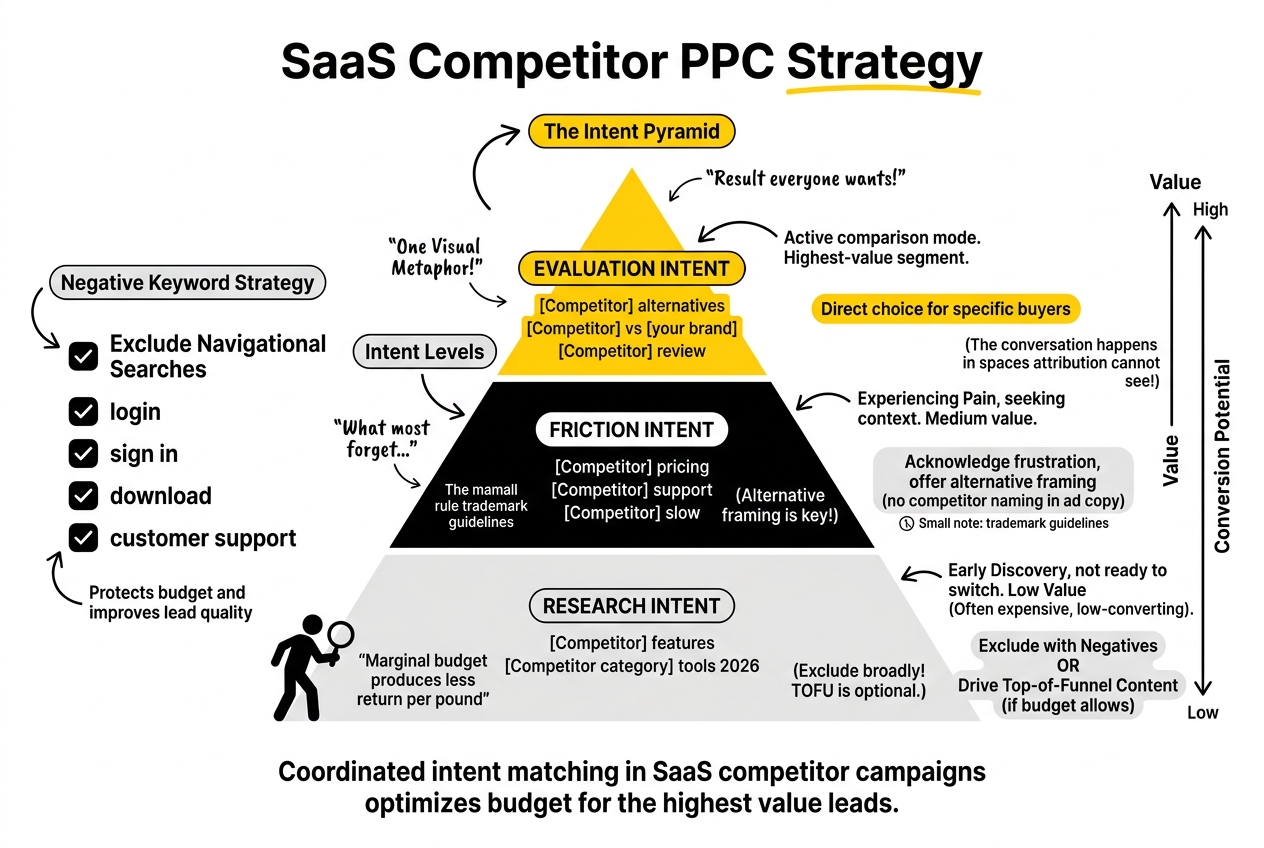
A practical structure for SaaS competitor campaigns in paid search splits into three intent layers:
- Evaluation intent: Searches like “[Competitor] alternatives”, “[Competitor] vs [your brand]”, “[Competitor] review”. These buyers are in active comparison mode. They already know the competitor and are looking for reasons to explore other options. This is your highest-value segment. The message should be direct: here’s what makes us the right choice for a specific type of buyer, not a claim that you’re better across the board.
- Friction intent: Searches like “[Competitor] pricing”, “[Competitor] support”, “[Competitor] slow”. These buyers are experiencing pain with the competitor and looking for context or alternatives. The message should acknowledge the frustration category and offer a clear alternative framing, without naming the competitor directly in the ad copy in ways that might breach trademark guidelines.
- Research intent: Broad searches like “[Competitor] features” or “[Competitor category] tools 2026”. These buyers are in early discovery. They’re not ready to switch. Bidding on these terms is often expensive and low-converting for direct response campaigns. Either exclude them with negative keywords, or use them to drive top-of-funnel awareness content if your budget allows.
Negative keyword strategy is as important as the positive list. Excluding branded competitor searches where the intent is clearly navigational (“login”, “sign in”, “download”, “customer support”) protects budget and improves lead quality immediately.
Writing PPC Copy That Differentiates Without Imitating
The structural tension in competitor ad copy is this: you need enough relevance to the search query to earn a click, but enough differentiation to earn a conversion. Leaning too far into relevance produces copycat positioning. Leaning too far into your own messaging produces low click-through rates from an audience thinking about someone else.
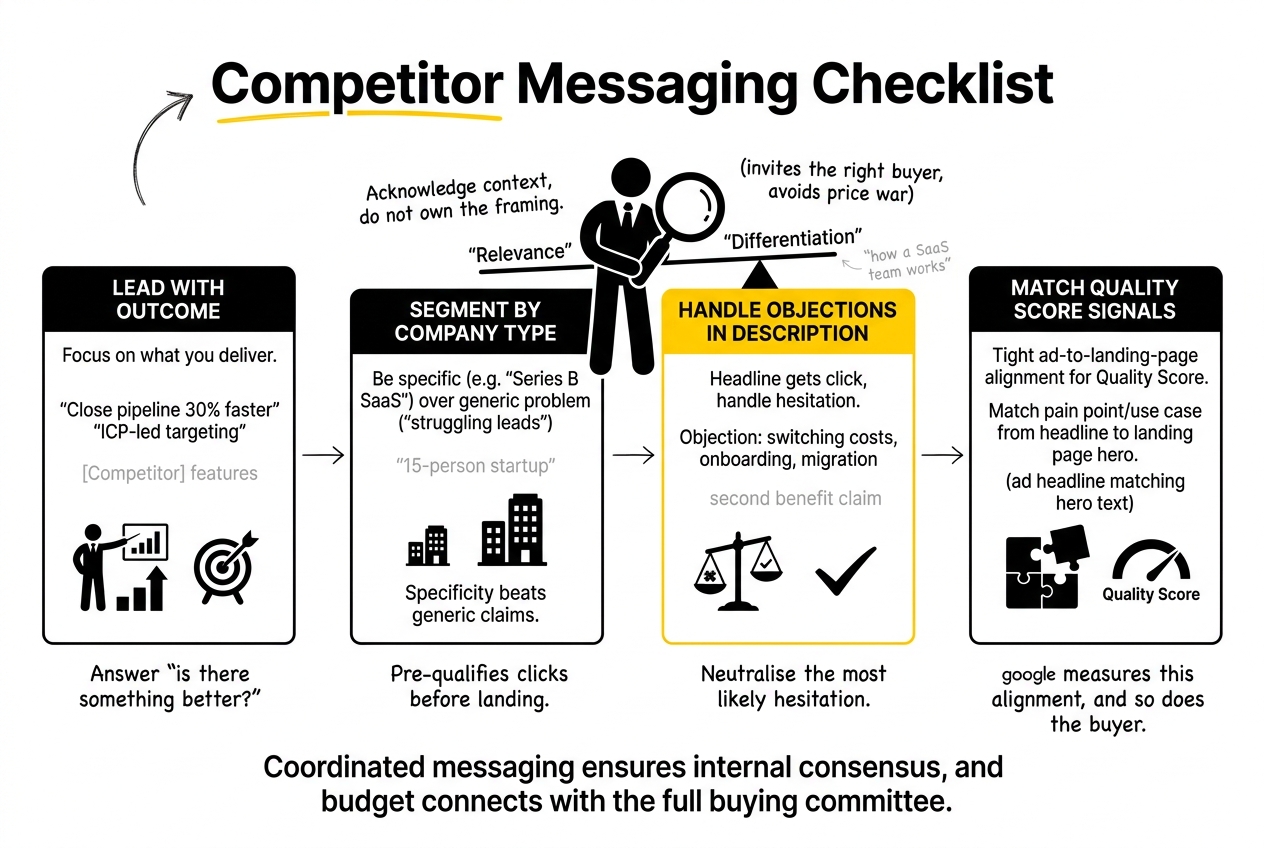
The resolution is to acknowledge the context without owning the framing. Your headline can signal that you’re a relevant alternative without being a feature-by-feature rebuttal. For example: a project management SaaS targeting a well-known competitor might run a headline like “Built for How SaaS Teams Actually Work” rather than “More Features Than [Competitor] at Half the Price”. The first headline invites the right buyer. The second one starts a price and feature war.
Several specific copy principles are worth following:
- Lead with outcome, not comparison. The buyer searching for a competitor’s alternatives is implicitly asking “is there something better for my situation?” Answer that with what you deliver, not with what the competitor lacks. “Close pipeline 30% faster with ICP-led targeting” speaks to the outcome. “Unlike [Competitor], we include ICP targeting” speaks to the product war.
- Segment your message by company type, not just problem. Series B SaaS has different needs from a 15-person startup. If your product genuinely serves one better, say so. Specificity beats generic claims every time, and it pre-qualifies clicks before they land on your page.
- Use the description lines to handle the objection. The headline gets the click. The description lines should address the most likely hesitation from someone considering a switch. Switching costs, onboarding time, data migration, support quality. Name the objection and neutralise it. “Most teams are live in under a week. Dedicated onboarding included.” is more useful than a second benefit claim.
- Match Quality Score signals by keeping ad-to-landing-page alignment tight. If your headline references a specific pain point or use case, the landing page hero section should reflect it. Google measures this alignment, and so does the buyer. A mismatch between what you promised in the ad and what they see on the page increases bounce rates and kills your quality score at the same time.
Building Comparison Pages That Convert
Comparison pages are the most direct expression of competitor positioning in paid search. They’re also the most frequently done badly.
The common failure mode is a comparison table that lists features and puts a tick next to everything you have and a cross or blank space next to competitor limitations. Buyers see through this immediately. It signals bias and reduces trust rather than building it.
A more effective approach builds the comparison around the buyer’s decision criteria, not your feature set. This means asking: what are the three or four things a buyer in this segment actually cares about when switching? Those become the comparison axes, and on those axes, you present the trade-offs honestly. If the competitor is better or equivalent on something, say so. The concession builds credibility and makes the cases where you genuinely win more persuasive.
Structurally, a comparison page that earns quality leads should contain:
- A clear audience statement up front. “This comparison is for [specific buyer type] who need [specific outcome].” This pre-qualifies the reader and anchors the rest of the page.
- An honest summary of what the competitor does well and who it suits. If a visitor arrives from a competitor keyword search and your page reads as pure advocacy for yourself, they leave. If your page acknowledges that the competitor is a strong choice for certain buyers and explains where the fit breaks down, you hold them.
- Evidence, not claims. G2 or Capterra ratings where you compare favourably, customer quotes that speak directly to the switch decision, and specific outcome data where you have it. “Customers who switched from [category] average 23% lower cost-per-opportunity in the first 90 days” is a real claim. “We’re better” is not.
- A low-friction next step. Comparison page visitors are in evaluation mode. The CTA should reflect that. A demo request is appropriate. A free trial without sales friction is better where your product allows it. Asking for excessive form fields at this stage kills conversion rates. PPC search landing pages average around 10.9% conversion for high-intent traffic according to current benchmarks, but that drops significantly when the page adds unnecessary friction to an already considered buyer.
Using Unique Paid Search Tactics for SaaS Differentiation
Beyond standard competitor bidding, several tactics create differentiated presence in paid search that competitors are less likely to match.
- ICP-led keyword expansion. Most SaaS competitor campaigns bid on the obvious terms. An underused approach is building keyword clusters around the specific ICP characteristics that distinguish your best-fit buyers from the competitor’s. If your platform serves enterprise revenue teams specifically, adding qualifiers like “enterprise revenue intelligence” or “B2B revenue operations platform” to your competitor campaign ad groups captures buyers who’ve already self-qualified. These terms have lower competition and better conversion rates.
- Switching-cost copy. One of the genuine barriers to competitor switching is the perceived switching cost. Competitors rarely address this proactively in their own campaigns. If you have a migration programme, an onboarding guarantee, or a dedicated success resource for switchers, this becomes a significant differentiator in ad copy. Naming the concern and pre-emptively neutralising it removes a barrier the competitor has left standing.
- RLSA layering on competitor campaigns. Remarketing Lists for Search Ads allow you to overlay audience data on top of keyword campaigns. A visitor who has already been to your pricing page or started a trial is a fundamentally different prospect than a cold search visitor. Using RLSA to adjust bids upward and customise messaging for warm audiences within competitor keyword campaigns means your highest-value leads see more relevant copy at higher impression share.
- Contextual timing. Competitor campaigns often get more efficient after a competitor’s pricing change, a public product outage, or a negative earnings announcement. These moments create a spike in evaluation intent. A responsive team that adjusts messaging within hours of a competitor event captures qualified traffic at a point when buyer attention is at its highest. This requires monitoring and quick copy turnaround, but the cost-per-opportunity difference in those windows can be significant.
A/B Testing Competitor Messaging: What to Test and What to Leave Alone
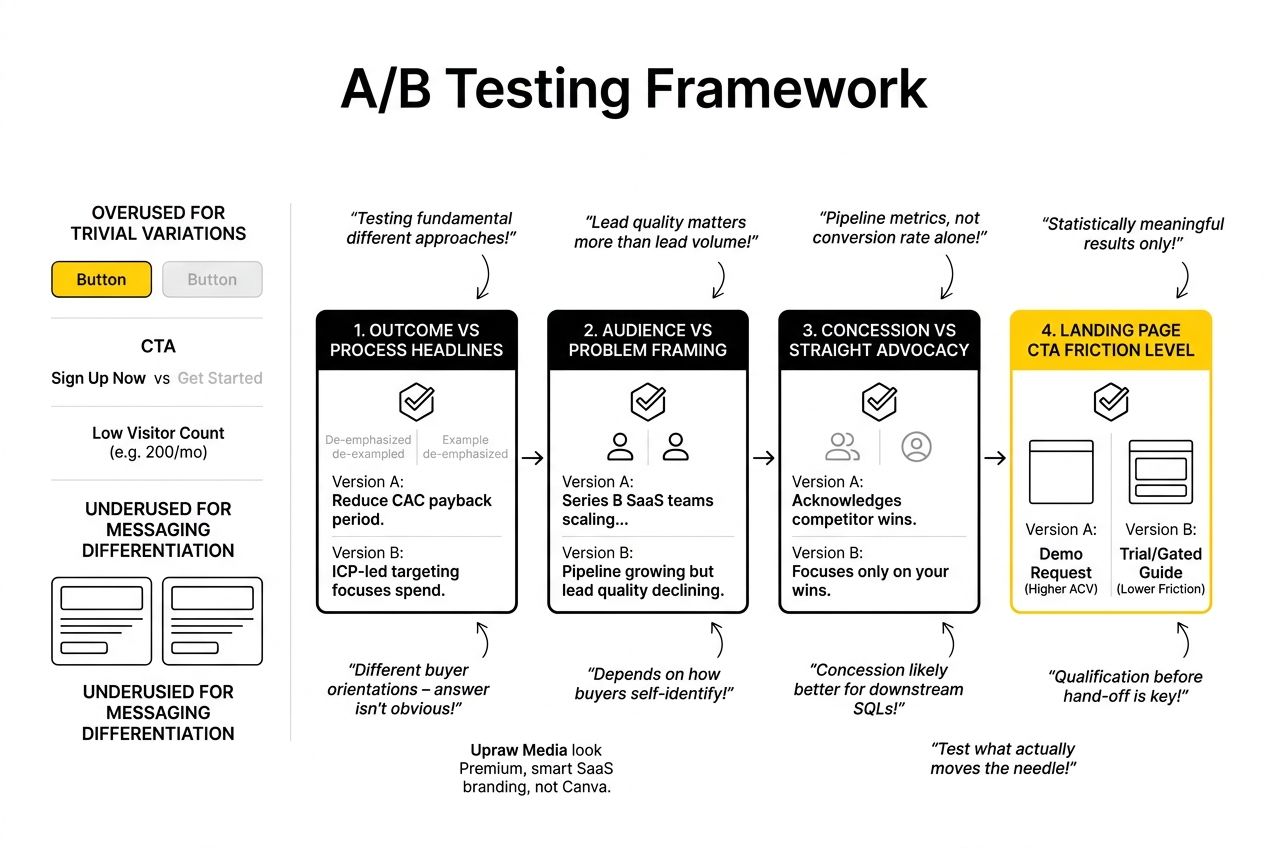
A/B testing in competitor campaigns is underused for messaging differentiation and overused for trivial variations. Testing button colour or CTA wording on a comparison page with 200 monthly visitors will never produce statistically meaningful results. Testing fundamentally different positioning approaches on a campaign with sufficient volume will.
The meaningful tests in SaaS competitor messaging:
- Outcome-led versus process-led headlines. One version of the ad speaks to the result (“Reduce your CAC payback period”). One version speaks to how you get there (“ICP-led targeting that focuses spend on accounts most likely to close”). These are different buyer orientations and the answer isn’t always the obvious one.
- Audience segment framing versus problem framing. One version of the comparison page is written for “Series B SaaS teams scaling beyond founder-led sales”. One version is written around the problem “pipeline is growing but lead quality is declining”. Both describe the same buyer, but the one that resonates depends on how your buyers self-identify when searching.
- Concession-style comparison versus straight advocacy. One version of the comparison page acknowledges where the competitor wins. One version focuses only on where you win. Testing this directly will likely show the concession version performs better on downstream metrics like MQL-to-SQL conversion, even if straight advocacy converts at a higher raw rate. Lead quality matters more than lead volume.
- Landing page CTA friction level. A demo request form versus a trial sign-up versus a gated comparison guide. The right answer depends on your sales motion, your ACV, and your onboarding capacity. For higher-ACV products, a well-structured demo request often produces better pipeline than a low-friction trial, because the qualification happens before the hand-off to sales rather than after.
The discipline with A/B testing is to define success by pipeline metrics, not conversion rate alone. A competitor campaign that converts at 8% but produces leads that sales won’t touch is worse than one that converts at 4% but produces SQLs. Measure what matters to the board, not what’s easiest to measure in the ads platform.
The Role of Competitive Intelligence Tools
Building differentiating SaaS competitor messaging at scale requires ongoing visibility into what the market is saying, not just a quarterly analysis.
Tools like SpyFu, Semrush, and Auction Insights within Google Ads show what competitors are bidding on, what copy they’re running, and where impression share is moving. This isn’t about copying what you observe. It’s about identifying positioning gaps. If all five major competitors in your category are leading with ease-of-use claims, that’s a signal to differentiate on a different axis, because the market conversation has already made ease-of-use a table-stakes claim rather than a differentiator.
G2 and Capterra reviews are another underused input. Reading the negative reviews of your competitors tells you what their buyers are frustrated with, which is exactly the pain your messaging should address. Not by saying “unlike them, we don’t do X”, but by making the solution to that pain the centre of your own value claim. If competitor reviews consistently cite poor reporting visibility, your messaging should lead with reporting depth and data accessibility, framed as a positive.
Customer win/loss interviews provide the most specific input. When deals are won against a specific competitor, understanding why, and when they’re lost, understanding why, builds the messaging foundation that no ad intelligence tool can replicate. The language your own customers use to explain why they chose you is often the most persuasive copy available. It just needs to be collected and used.
Keeping Messaging Proactive Rather Than Reactive
The reactive pattern in SaaS competitor campaigns looks like this: a competitor announces a new feature or drops their price, and the PPC team scrambles to update copy in response. This approach keeps your messaging permanently derivative, always one step behind, and anchored in the competitor’s narrative.
Proactive messaging means making decisions based on your own positioning clarity rather than competitor movements. It means that when a competitor launches a new feature that you don’t have, your response isn’t to devalue the feature but to reaffirm the segment where your differentiated value is clearest. You don’t change the story. You reinforce it.
Practically, this requires a messaging review cadence that isn’t triggered by competitor events. Quarterly positioning reviews that look at win/loss data, search term reports, and lead quality metrics are more valuable than reactive copy changes made under pressure. Decisions made under pressure default to imitation.
The discipline is to know your positioning well enough that competitor events don’t require an urgent response. Your best-fit buyer has specific characteristics, specific needs, and specific contexts where your product is the obvious choice. Competitor noise doesn’t change that. Keeping your messaging anchored to that clarity is what makes it sustainable over time.
If you’re working through competitor messaging strategy for a SaaS paid search programme, this is the kind of work our SaaS paid advertising agency team runs across every client engagement. Worth a conversation if you’re at that point.
Frequently Asked Questions
What are the key elements of effective SaaS competitor messaging in paid search?
Effective SaaS competitor messaging starts with positioning clarity before any ad copy is written. You need a specific articulation of your differentiated value for a defined buyer segment, a campaign structure built around search intent rather than keyword volume, ad copy that leads with outcomes rather than comparisons, and landing pages that match message to intent. Quality score, lead quality, and pipeline conversion all improve when these elements are aligned.
How can B2B marketing managers differentiate their messaging from competitors in paid search campaigns?
The starting point is understanding what makes your product genuinely useful to a specific buyer type, not what makes it generically different from a named competitor. Segment your competitor keyword campaigns by intent (evaluation, friction, research), write copy that speaks to the outcome a switching buyer is trying to achieve, and use comparison pages that acknowledge competitor strengths rather than presenting purely self-serving tables. Differentiation earned through specificity is more durable than differentiation earned through competitor-bashing.
What strategies can be employed to create compelling comparison pages for SaaS products?
Build comparison pages around the buyer’s decision criteria, not your feature list. Open with an audience statement that tells the reader who the page is for. Present trade-offs honestly, including where the competitor performs well, to build credibility. Use outcome-based evidence rather than feature tick-boxes. And ensure the CTA reflects the evaluation mindset of the visitor: a demo request or structured trial works better than a high-friction form that asks for information a prospect hasn’t decided to share yet.
How can A/B testing improve the effectiveness of PPC copy in SaaS marketing?
Test positioning hypotheses, not cosmetic variations. Meaningful tests include outcome-led versus process-led headlines, audience-segment framing versus problem framing, concession-style comparison pages versus pure advocacy, and different CTA friction levels. Define success by pipeline metrics (MQL-to-SQL rate, cost-per-opportunity, qualified pipeline generated) rather than raw conversion rate. Lead quality is more important than volume in SaaS, and the test that wins on conversion rate is not always the one that wins on pipeline.
What role does a data-driven approach play in optimising paid search campaigns?
Data-driven strategy in SaaS competitor campaigns means measuring what connects to revenue, not just what the ads platform reports as conversions. Impression share data, search term reports, auction insights, quality score trends, and downstream CRM data (opportunity creation rate, win rate by source) give a fuller picture than click-through rate alone. The data should inform positioning decisions, not just bid adjustments. If specific competitor keyword clusters are producing low MQL-to-SQL ratios, that’s a positioning signal, not just a bidding problem.
How can marketing managers ensure their messaging is proactive rather than reactive in competitive landscapes?
Run a quarterly messaging review that pulls from win/loss interview data, search term performance reports, and lead quality metrics from the CRM. Don’t update copy in response to competitor announcements without first assessing whether the update serves your positioning or undermines it. Reactive copy tends toward imitation. Proactive messaging is anchored in your own differentiated value claim and reinforced consistently, regardless of what competitors are doing at any given moment.
What are the common pitfalls to avoid when crafting paid search messaging for SaaS competitors?
Writing ad copy before completing positioning work, building comparison pages that are purely self-serving, bidding on navigational competitor searches (login, support, download) that carry no evaluation intent, measuring campaign success by conversion rate alone without downstream qualification, and updating messaging reactively in response to competitor moves without positioning clarity. Each of these produces either poor-quality leads or unsustainable messaging that requires constant reactive maintenance.
How can the quality score impact ad placement in paid search for SaaS companies?
Quality Score in Google Ads is determined by expected click-through rate, ad relevance to the search query, and landing page experience. Weak differentiation in ad copy reduces expected CTR. Mismatched messaging between ad and landing page harms landing page experience. Both push quality scores down, which raises the cost-per-click you pay and reduces your ad’s position relative to competitors. Strong, specific competitor messaging that genuinely matches search intent produces better quality scores, which means lower CPCs and better placement with the same or lower budget.
What metrics should B2B marketing managers focus on to enhance lead quality in paid search?
The primary metrics for lead quality are MQL-to-SQL conversion rate by campaign source, cost-per-opportunity (not cost-per-lead), pipeline influenced by paid search as a percentage of total pipeline, and ACV of deals sourced through competitor campaigns versus branded or category campaigns. Secondary signals include time-to-close from paid search leads, win rate from paid search opportunities, and CAC payback period by acquisition source. These metrics require CRM integration with your ads platform, which should be a prerequisite before scaling competitor campaign spend.
What are some examples of successful SaaS competitor messaging strategies in paid search?
Across campaigns we’ve managed, the most consistent pattern is that competitor campaigns improve when messaging shifts from broad feature comparisons to outcome-based copy targeting a specific ICP segment. Restructuring ad groups by search intent (evaluation, friction, research) and pairing each with a dedicated landing page rather than sending all competitor traffic to a generic comparison page typically reduces cost-per-opportunity by narrowing the audience while increasing the relevance of the buying signal.


.png)