Maximising Paid Acquisition Signals through GTM CRM Integration
Learn how CRM hygiene, lifecycle stage definitions, and sales feedback can sharpen paid search and social signals for B2B SaaS demand generation.

Your Google Ads campaigns report a healthy cost-per-lead. Your LinkedIn pipeline looks busy. But quarter-end arrives and the revenue number does not reflect any of it. The problem is rarely the ads. It is the signal those ads are optimising toward.
Most B2B SaaS paid media programmes tell Google and LinkedIn to find more people who fill in forms. The bidding algorithms do exactly that. What they do not know, because no one has told them, is which of those form fills became qualified opportunities, which advanced through the pipeline, and which closed. The gap between form submission and closed-won revenue is where most paid acquisition programmes quietly break.
Bridging that gap requires connecting your CRM to your ad platforms in a way that turns downstream pipeline events into upstream acquisition signals. This article covers how to structure that integration through Google Tag Manager (GTM), what lifecycle stage definitions need to be in place before any of it works, and how to bring sales feedback into the loop so the system learns from what actually converts, not just what clicks.
This is squarely a marketing operations problem. It requires clean data, agreed definitions, and a technical setup that most teams underinvest in. But the upside is significant: paid search and paid social campaigns that optimise toward qualified pipeline rather than lead volume, and attribution data that holds up in board meetings.
Why Form Submissions Are an Unreliable Acquisition Signal
The default conversion event for most B2B SaaS paid campaigns is the form fill. Someone downloads a guide, requests a demo, or starts a trial. The platform records a conversion, Smart Bidding notes the signal, and the algorithm goes looking for more of the same.
The trouble is that form-fill quality varies enormously. A demo request from a VP of Marketing at a Series B SaaS company and a demo request from a student researching the category are both counted as conversions. The algorithm has no way to distinguish them unless you tell it to.
This is not a new problem, but it is getting more expensive. According to Benchmarkit’s 2025 SaaS Performance Metrics report, B2B SaaS companies now spend a median of $2.00 in sales and marketing to acquire $1.00 of new customer ARR, a 14% increase from the prior year. When paid campaigns optimise toward volume-based signals, every incremental lead gets more expensive and pipeline quality tends to stay flat.
The fix is to move the conversion event downstream. Instead of telling the algorithm that a form fill is a conversion, you tell it that a sales-qualified lead is a conversion, or better still, that a deal reaching a specific pipeline stage is a conversion. To do that, the CRM and the ad platforms need to be connected, and the CRM needs to be clean enough to trust.
The Role of Lifecycle Stage Definitions in Paid Acquisition
Before any GTM CRM integration can work, lifecycle stage definitions need to be agreed upon, written down, and enforced consistently across systems. This is not a technical step. It is a commercial alignment step that most teams skip.
The problem with skipping it is straightforward. If “MQL” means one thing in HubSpot and something different in your sales team’s conversation, then the signal you pass back to Google Ads is noise. The algorithm will optimise toward a definition nobody actually uses.
Lifecycle stages for B2B SaaS paid acquisition purposes should be defined clearly at a minimum:
- Lead: A record that has submitted a form or engaged with a paid touchpoint. No qualification has occurred.
- MQL: A lead that meets agreed scoring criteria based on firmographic fit and behavioural signals. Marketing has qualified it for sales outreach.
- SQL: A lead that a sales rep has reviewed and accepted. Active outreach or discovery is underway.
- Opportunity: A deal has been created. The account has confirmed interest and budget conversation is in progress.
- Closed Won: A contract has been signed and ARR is booked.
The conversion event you send to your ad platforms should be at least at the SQL stage, and ideally at Opportunity or beyond. Sending MQL data is a step up from form fills, but MQL definitions are often loose and include a significant proportion of records that sales will not work. Opportunity stage is where the signal gets genuinely useful.
Consistent lifecycle stage definitions also solve a secondary problem: attribution accuracy. If deals are regularly sitting in the wrong stage because reps do not update the CRM, or because the automation logic has not been configured correctly, your attribution reporting tells a distorted story. The data your marketing ops team sees does not match what the sales team experiences, and budget decisions get made on a flawed picture.
The operational rule here is simple: if your lifecycle stages are not defined, agreed, and enforced in your CRM before you set up any GTM integration, the integration will not improve your paid acquisition signals. It will automate the inconsistency at greater speed.
CRM Hygiene as a Prerequisite for Signal Quality
Lifecycle stage alignment is the definitional layer. CRM hygiene is the operational layer that makes it real.
Dirty CRM data is endemic in B2B SaaS. Research consistently puts the degradation rate of contact databases at 20 to 25% annually as people change roles, companies get acquired, and contact details go stale. The practical consequence for paid acquisition is that audience lists built from CRM exports contain records that no longer reflect your ICP, suppression lists fail to suppress because duplicate records are not deduplicated, and attribution data reports credit to contacts who were never actually in the buying process.
The hygiene issues that most directly affect paid acquisition signal quality are:
Duplicate records: When the same person exists in your CRM under multiple records, their lifecycle stage may be correct on one record and incorrect on another. If the ad platform matches against the incorrect record, the conversion event either misfires or does not fire at all. Enforced deduplication rules, either through native CRM logic or a tool like Clearbit or ZoomInfo enrichment, prevent this.
Stale lifecycle stages: A deal that died six months ago but is still sitting in “Opportunity” in the CRM inflates pipeline figures and distorts any automation that triggers off stage changes. Regular pipeline scrubs and automated stage decay rules, where records automatically revert to an earlier stage if there has been no activity for a defined period, keep this in check.
Inconsistent picklist values: “Demo Booked,” “Demo Requested,” and “Demo - SDR” are three values that mean the same thing but register as different states in any reporting or automation logic. Free-text fields in lifecycle-relevant properties should be replaced with enforced dropdown selections. This applies to lead source, lifecycle stage, deal stage, and any property that feeds an automation workflow or an ad platform audience.
Missing required fields: If records enter your CRM without a company domain, job title, or lead source, downstream audience segmentation and attribution both degrade. Required field validation at the point of ingestion stops the problem before it compounds.
CRM hygiene is continuous work, not a one-off project. A quarterly audit that checks completeness rates, duplicate volumes, and lifecycle stage distribution catches drift before it affects campaign performance. According to research cited by Gartner, companies lose an average of $15 million annually due to poor data quality. In paid acquisition specifically, the cost manifests as wasted spend optimising toward the wrong audience profiles.
How GTM CRM Integration Automates Paid Acquisition Signals
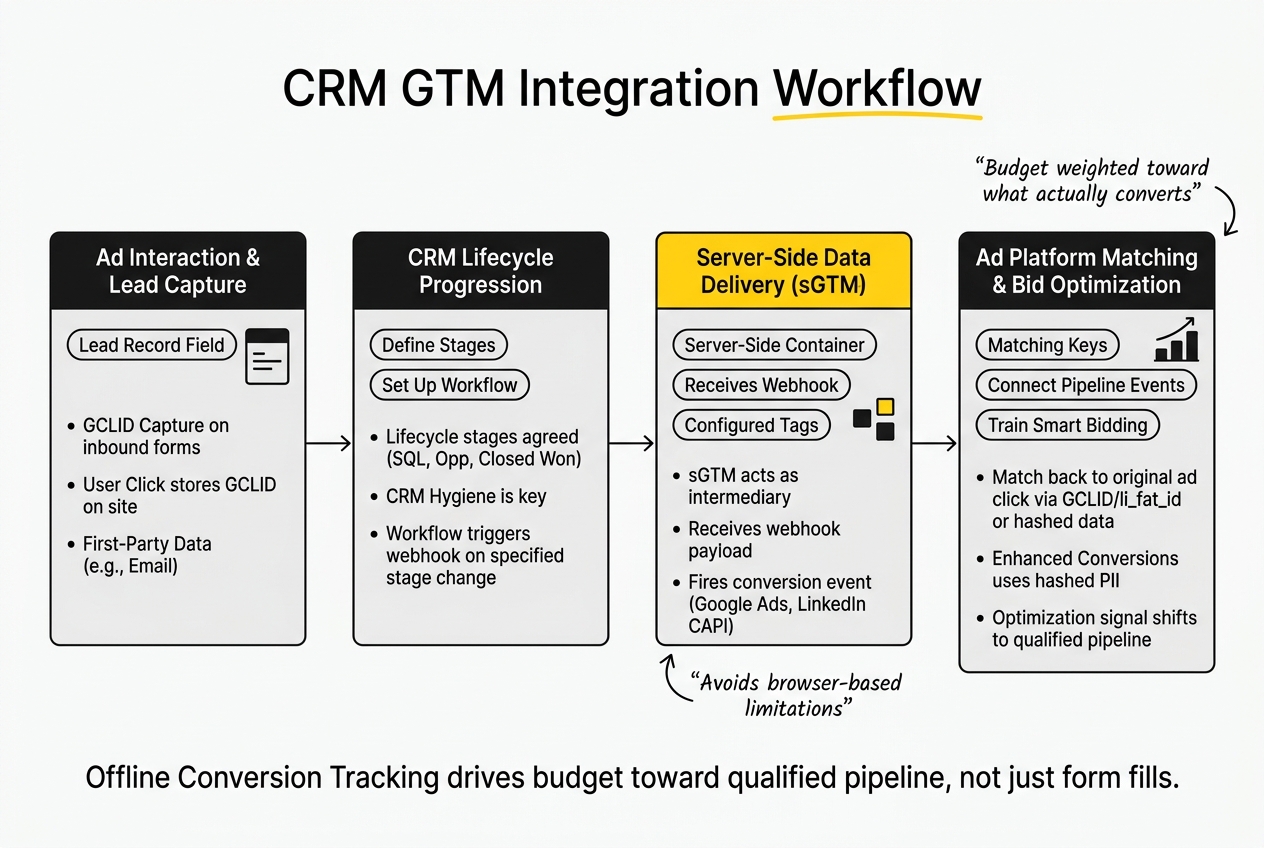
With lifecycle stage definitions agreed and CRM hygiene in reasonable shape, the technical integration can be built. The core mechanism is offline conversion tracking: taking events that happen inside your CRM and sending them back to your ad platforms so the bidding algorithms can use them as optimisation signals.
How it works in Google Ads: When a user clicks a Google ad and lands on your site, Google stores a unique click identifier called a GCLID. If that user then fills in a form, the GCLID should be captured and stored against their CRM record. Later, when that record advances to SQL, Opportunity, or Closed Won, you can send that event back to Google Ads with the original GCLID as the matching key. Google connects the downstream pipeline event to the original ad click and uses it to train Smart Bidding.
The practical effect is that Smart Bidding stops optimising for form fills and starts optimising for the keyword, audience, and creative combinations that produce qualified pipeline. The cost-per-lead number often goes up on paper. The cost-per-opportunity and cost-per-closed-deal go down, because the budget is now weighted toward what actually converts.
The GTM layer: Server-side Google Tag Manager (sGTM) acts as the intermediary between your CRM and your ad platforms. When a lifecycle stage change occurs in your CRM, a webhook or API call triggers the sGTM container, which fires the appropriate conversion event to Google Ads or the LinkedIn Conversion API. The server-side approach avoids browser-based tracking limitations, improves data accuracy in a cookieless environment, and gives you more control over what gets sent and when.
The setup requires three things to be in place:
- GCLID capture on every inbound form submission, stored as a CRM field alongside the lead record.
- A CRM workflow that fires a webhook when a specified lifecycle stage is reached.
- A server-side GTM container configured with Google Ads and LinkedIn Conversion API tags, set to receive the webhook payload and forward the conversion event to the relevant platform.
Google’s Enhanced Conversions for Leads adds a second matching layer using hashed first-party data, typically the lead’s email address, which improves match rates in cases where GCLID is missing due to consent restrictions or browser limitations. Implementing both GCLID-based matching and Enhanced Conversions maximises the percentage of pipeline events that successfully close the attribution loop.
LinkedIn parallel: The LinkedIn Conversions API operates on the same principle. When a record in your CRM reaches a defined stage, a server-side event fires to LinkedIn, matching back to the original ad interaction via the LinkedIn Click ID (li_fat_id) or hashed email. This is particularly valuable for LinkedIn campaigns targeting specific job functions or seniority levels, where the gap between ad click and deal qualification is long and multi-touch.
Integrating Sales Feedback as a Live Acquisition Signal
Offline conversion tracking solves the signal quality problem for ad platform algorithms. But there is a second signal loop that most marketing operations teams underuse: structured sales feedback.
When a deal closes lost, most CRMs capture a close reason, often a single dropdown value from a short list. When a deal progresses unusually quickly, nothing is typically captured at all. This is a significant data waste. Sales reps are the closest observers of what the paid acquisition funnel is actually delivering, and their qualitative observations about lead quality, buyer readiness, and fit are signals that can be used to refine targeting, exclusion lists, and bidding strategy in a structured way.
The mechanism for turning sales feedback into acquisition signals involves two practices:
Close reason capture and action: Every closed-lost deal should have a mandatory close reason that maps to a defined taxonomy: wrong ICP, budget, timing, competitor, no champion. When analysis of close reasons shows a concentration in “wrong ICP,” that is a signal to tighten audience targeting upstream. If “timing” is the dominant reason, it is a signal that the campaign is reaching the right people but too early in their consideration process, pointing toward a nurture investment rather than a targeting problem.
Sales-to-marketing feedback cadences: A fortnightly or monthly structured conversation between a marketing ops lead and two or three sales reps, focused specifically on lead quality from paid channels, surfaces qualitative signals that close reason data cannot capture. Which companies are coming in with a clear problem definition? Which are still in early research mode? Which ICPs are advancing fastest through the pipeline? These observations translate directly into bid adjustments, audience refinements, and negative keyword lists.
The signal needs to be structured to be actionable. Anecdotal conversations do not produce the data consistency that CRM automation requires. When close reasons are consistently captured and sales feedback is mapped to defined ICP criteria, the information can be used to update CRM audience segments, which in turn update the ad platform audience lists in near real time.
Best Practices for GTM CRM Paid Signals
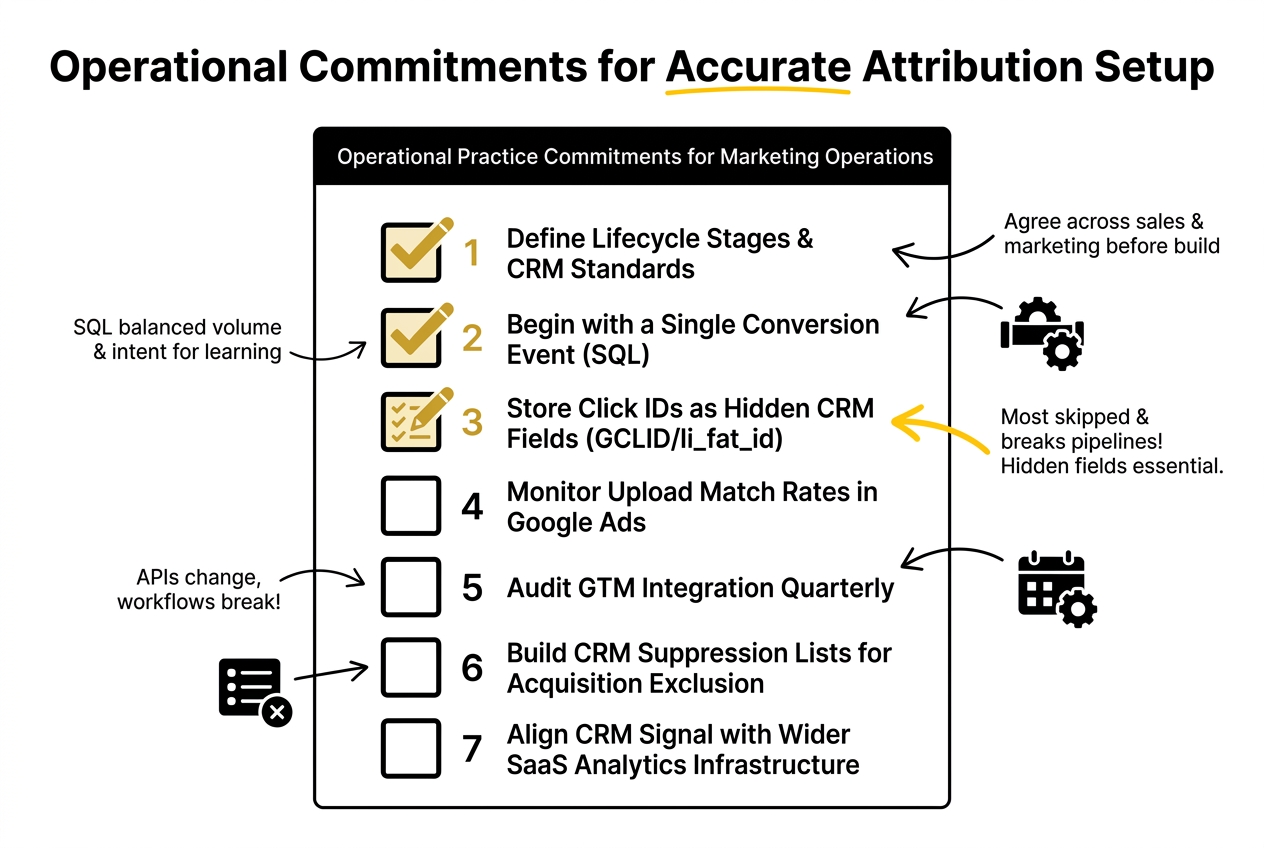
Pulling the above into operational practice requires a few structural commitments from the marketing operations function.
Define before you build. Lifecycle stage definitions and CRM field standards need to be agreed across sales and marketing before the GTM integration is configured. Building the technical layer on top of undefined stages creates a brittle system that needs to be rebuilt when the definitions change.
Start with a single conversion event. Rather than attempting to pass multiple lifecycle stages to Google Ads simultaneously, start with one. SQL is usually the best starting point: it is far enough downstream to signal genuine intent and qualification, it occurs early enough in the pipeline that the algorithm has enough conversion volume to learn from. Add Opportunity and Closed Won as second-stage events once the initial integration is stable.
Store GCLIDs and li_fat_ids as standard CRM fields. This is the most commonly skipped step and the one that breaks the most attribution pipelines. The click identifier needs to be captured in the form submission, passed into the CRM as a hidden field, and stored against the lead record. If this is not in place, the offline conversion match rate will be low regardless of how well the rest of the integration is configured.
Monitor match rates. After implementation, Google Ads reports the match rate for uploaded offline conversions. A match rate below 60% typically indicates a GCLID capture problem or a data formatting issue. Targeting above 80% is achievable with correct implementation and keeps the algorithm signal reliable.
Audit the integration quarterly. Platform APIs change. CRM workflows break. Lead source values drift. A quarterly check of match rates, conversion volume, and lifecycle stage distribution catches degradation before it affects campaign performance.
Build suppression lists from CRM data. Existing customers, churned accounts, and disqualified leads should be suppressed from paid acquisition targeting. This reduces wasted spend on audiences that cannot convert and improves the quality of the remaining impression pool. Customer Match lists in Google Ads and LinkedIn Matched Audiences, both built from CRM exports, are the mechanism.
For teams building attribution reporting across all acquisition channels, aligning the CRM signal setup with your wider saas analytics infrastructure ensures that the conversion events feeding your ad platforms also feed your central reporting view.
Monitoring What Matters
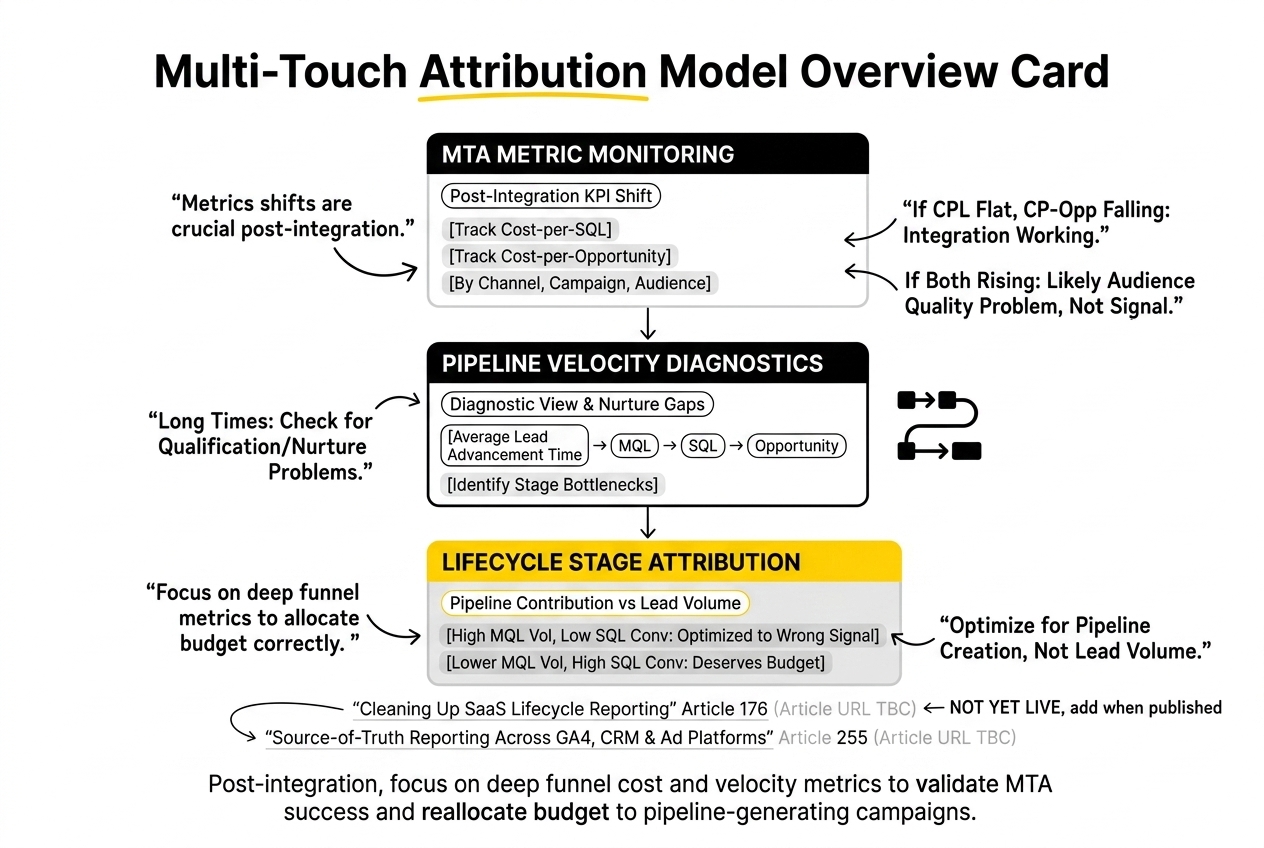
Once GTM CRM integration is live, the metrics to monitor are different from standard paid media KPIs.
The reporting layer should be tracking cost-per-SQL and cost-per-opportunity by channel, campaign, and audience segment. These are the numbers that reflect whether the signal integration is working. If cost-per-lead is flat but cost-per-opportunity is falling, the integration is doing its job. If both are rising together, the problem is likely audience quality rather than signal quality.
Pipeline velocity by lead source provides a second diagnostic view. How long does it take, on average, for a paid-acquired lead to advance from MQL to SQL to Opportunity? Unusually long times at any stage point to either a qualification problem at that stage or a nurture gap between stages. Both of these are actionable.
Attribution by lifecycle stage reveals which campaigns are contributing to pipeline creation versus which are merely generating lead volume. A campaign that drives high MQL volume but low SQL conversion is optimised toward the wrong signal. One that drives lower MQL volume but high SQL conversion is operating correctly and deserves more budget.
Upraw’s View
The reason most paid acquisition CRM integrations fail is not technical. It is organisational. The technical setup for offline conversion tracking is well-documented and achievable within a single sprint for most teams.
What consistently gets in the way is undefined lifecycle stages that nobody has ever formally aligned on, CRM records that marketing, sales, and customer success all write to but nobody owns, and an implicit assumption that the ad platforms will figure out lead quality from platform signals alone.
They will not. Ad platform algorithms are powerful but they are bounded by the data you give them. If the data is form fills, they will find more form fills. If the data is qualified pipeline, they will find more of that instead.
The shift requires treating paid acquisition signal quality as a marketing operations problem rather than a campaign problem. That means owning the CRM data layer, structuring sales feedback into the system, and building the GTM integration to close the loop between the ad click and the business outcome. When those elements are in place, paid search and paid social stop functioning as lead generation channels and start functioning as pipeline generation channels.
If this is something you are working through, we are happy to take a look at your setup and identify where the signal gaps are.
Frequently Asked Questions
What is the significance of integrating lifecycle stage definitions in GTM CRM integration for paid acquisition signals?
Lifecycle stage definitions determine what conversion events you send to ad platforms. If a form fill is your conversion event, Smart Bidding optimises toward form fills. If SQL or Opportunity is your conversion event, the algorithm learns which keywords and audiences produce pipeline. Without agreed and enforced stage definitions, the integration passes inconsistent signals that the algorithm cannot learn from reliably. Clear definitions are the commercial logic layer that the technical setup depends on.
How does maintaining CRM hygiene impact the effectiveness of paid search and paid social campaigns?
Ad platforms use CRM data to build audiences, suppression lists, and offline conversion matching. Duplicate records cause conversion events to misfire or not fire. Stale lifecycle stages distort attribution. Inconsistent field values break audience segmentation. When CRM data is inaccurate, the paid acquisition signals built on top of it are also inaccurate. CRM hygiene is not separate from campaign performance; it is a direct input to it.
What role does sales feedback play in optimising acquisition signals within a GTM CRM framework?
Sales feedback identifies the qualitative gaps that CRM data alone cannot surface. Close reason analysis shows which ICP segments are converting and which are not. Rep observations about lead quality, buyer readiness, and competitor presence translate into targeting refinements, negative keyword additions, and audience exclusions. Structured sales feedback bridges the gap between CRM records and the commercial reality of what the pipeline actually contains.
What are the best practices for ensuring data integrity in CRM systems for B2B SaaS marketing?
Define lifecycle stage triggers and field standards before building any automation. Enforce picklist values on all properties used for segmentation or reporting. Implement GCLID capture as a required field on all inbound form submissions. Run quarterly audits covering completeness rates, duplicate volume, and stage distribution. Use required field validation at data ingestion to prevent incomplete records from entering the system. Treat CRM hygiene as continuous operations work rather than a periodic cleanup project.
How can Marketing Operations Specialists leverage CRM data to enhance demand generation strategies?
CRM data reveals which acquisition channels, campaign types, and audience segments produce qualified pipeline rather than just lead volume. By analysing cost-per-SQL and cost-per-opportunity by source, marketing operations can redirect budget toward channels that produce pipeline and away from channels that produce volume. CRM-derived audiences also enable more precise paid targeting, lookalike modelling from closed-won accounts, and suppression of existing customers and disqualified segments.
What methodologies can be employed to improve data consistency across marketing technology stacks?
Start with a single source of truth: the CRM as the master record, with all other tools writing to it rather than maintaining parallel data. Enforce field standards through required fields and dropdown picklists. Document the data standards in a shared playbook accessible to all teams. Build automated workflows that update records on trigger events rather than relying on manual entry. Audit field consistency across the stack quarterly, focusing on lifecycle stage values, lead source taxonomy, and contact record completeness.
How does accurate attribution influence the success of paid acquisition campaigns?
Attribution tells you which channels, campaigns, and audiences produce pipeline and closed-won revenue. Without it, budget decisions are based on cost-per-lead metrics that do not reflect business outcomes. With accurate attribution, you can weight budget toward the combinations that produce qualified opportunities, identify which campaigns to pause, and make the case internally for investment in channels with longer payback periods but better pipeline quality.
What challenges do B2B SaaS companies face when aligning CRM with paid acquisition efforts?
The most common challenges are undefined lifecycle stage definitions that no one has formally aligned on, incomplete GCLID capture that breaks offline conversion matching, and organisational ownership gaps where marketing, sales, and RevOps each own parts of the CRM but no one owns its integrity. Technical challenges, such as API changes or webhook failures, are solvable; the operational and definitional challenges tend to persist because they require cross-functional agreement rather than a technical fix.
How can CRM integration reduce operational burdens for marketing teams?
Automated CRM-to-ad-platform sync removes the manual CSV exports, uploads, and audience refreshes that teams typically manage on a weekly basis. Automated lifecycle stage transitions triggered by defined criteria replace manual record updates. Suppression lists that update in near real time from CRM data eliminate the manual process of excluding existing customers from acquisition campaigns. The operational reduction is a secondary benefit; the primary benefit is signal quality. Both improve simultaneously when the integration is set up correctly.
What metrics should be monitored to ensure dependable measurement and reporting in GTM CRM integration?
Monitor offline conversion match rate in Google Ads (target above 80%). Track cost-per-SQL and cost-per-opportunity by channel and campaign. Review pipeline velocity by lead source to identify stage conversion gaps. Audit lifecycle stage distribution in the CRM quarterly to catch stale records. Check webhook delivery logs regularly to confirm conversion events are firing as expected. These metrics together give a reliable view of whether the integration is producing accurate signals and whether those signals are affecting campaign performance.