Optimising Retargeting Strategies for B2B SaaS Across the Customer Journey
Discover how to tailor retargeting strategies for each SaaS funnel stage to enhance lead quality and drive better pipeline outcomes.

Most B2B SaaS retargeting campaigns treat every visitor the same. Someone who spent 45 seconds on the homepage gets the same ad as someone who viewed the pricing page three times and downloaded a case study. The result is wasted spend, a cluttered ad experience, and a pipeline that looks busy but converts poorly.
The fix is not a new platform or a bigger budget. It is a structured approach to retargeting that matches the audience, message, and channel to where a buyer actually sits in the customer journey. Awareness, consideration, demo intent, sales: each stage demands a different tactic across Google and social. Get the segmentation right, and retargeting shifts from a branding afterthought to one of your most efficient pipeline levers.
This article walks through how to structure retargeting for each SaaS funnel stage, which platforms carry the most weight at each point, and what to measure so the reporting holds up in a board meeting.
Why One-Size-Fits-All Retargeting Fails SaaS Teams
The conventional retargeting setup is simple: add a pixel, build an audience of all website visitors from the last 30 days, serve them a demo-request ad. Simple to deploy, easy to report on.
The problem is that a single retargeting pool contains buyers at completely different stages of the journey. Someone in research mode does not want a demo push. Someone who has already spoken with sales does not need an explainer video. Serving the same creative to both wastes budget and, more importantly, creates friction at precisely the moment you should be reducing it.
B2B SaaS deals involve long sales cycles and multiple decision-makers. According to 2025 data compiled by First Page Sage, enterprise SaaS deals often stretch to 120-day sales cycles. In that window, a prospect will encounter your brand many times across many channels. Treating that journey as a single audience is the structural mistake most demand gen teams make.
The retargeting strategies for SaaS funnel stages that actually move pipeline are built on segmentation, not volume.
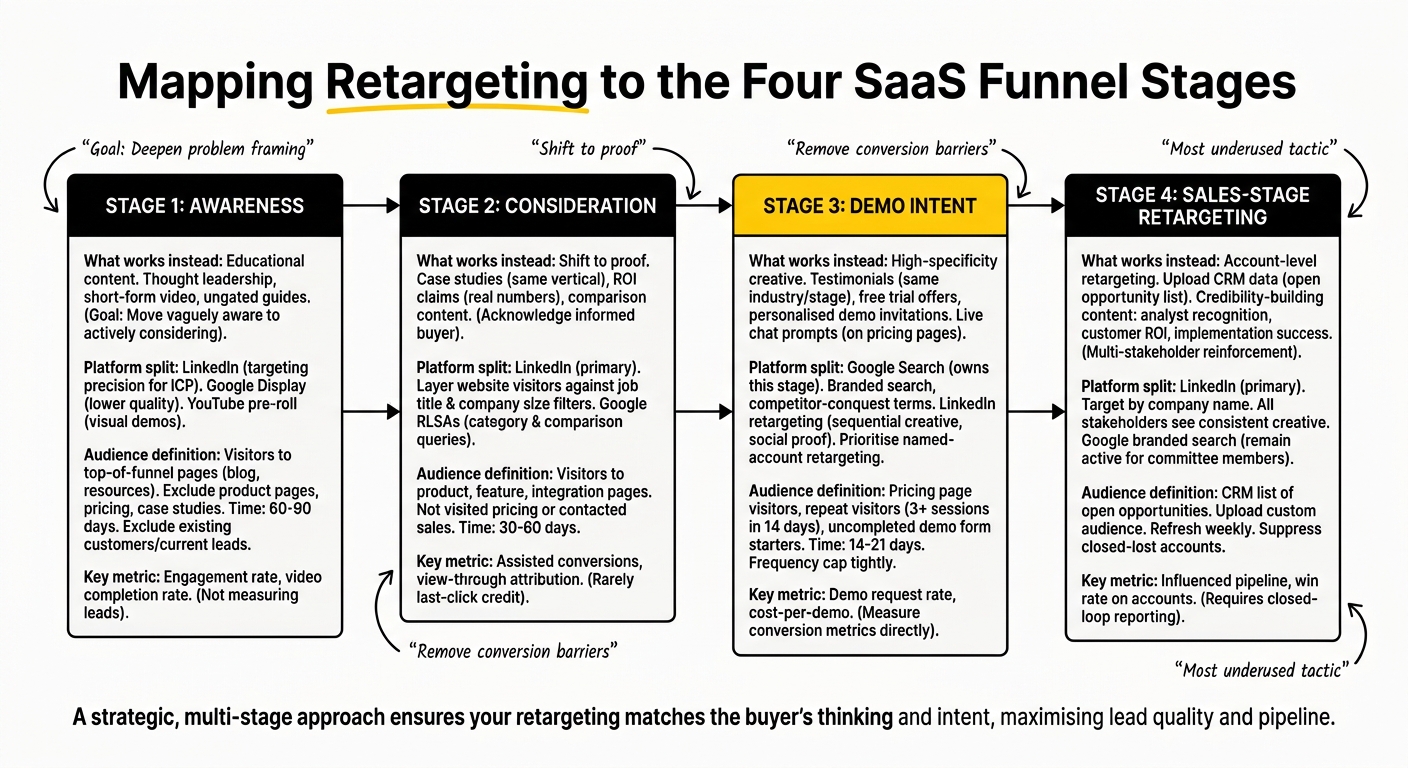
Mapping Retargeting to the Four SaaS Funnel Stages
Stage 1: Awareness
At awareness stage, a buyer has encountered your brand but does not yet understand the problem you solve or how you compare to alternatives. They visited a blog post, watched a short video, or landed on your homepage from a social ad. They are not ready for a demo request.
Retargeting this audience with a conversion-focused ad almost always fails. The cost-per-click looks fine; the conversion rate does not.
What works instead: Serve educational content that deepens the problem framing. Thought leadership articles, short-form video, and ungated guides all perform well here. The goal is to move this audience from “vaguely aware” to “actively considering the problem category.”
Platform split: LinkedIn carries this stage well. The targeting precision means you can serve educational content specifically to the job titles and company profiles that match your ICP. Google Display can support here, but the audience quality is lower. YouTube pre-roll is worth testing for product categories with visual demonstrations.
Audience definition: Visitors to top-of-funnel content pages (blog, resources section) who did not visit product pages, pricing, or case studies. Time window: 60-90 days. Exclude existing customers and current leads in your CRM.
Key metric: Engagement rate and video completion rate. You are not measuring leads at this stage. You are measuring whether people are consuming the content, which signals progression through the journey.
Stage 2: Consideration
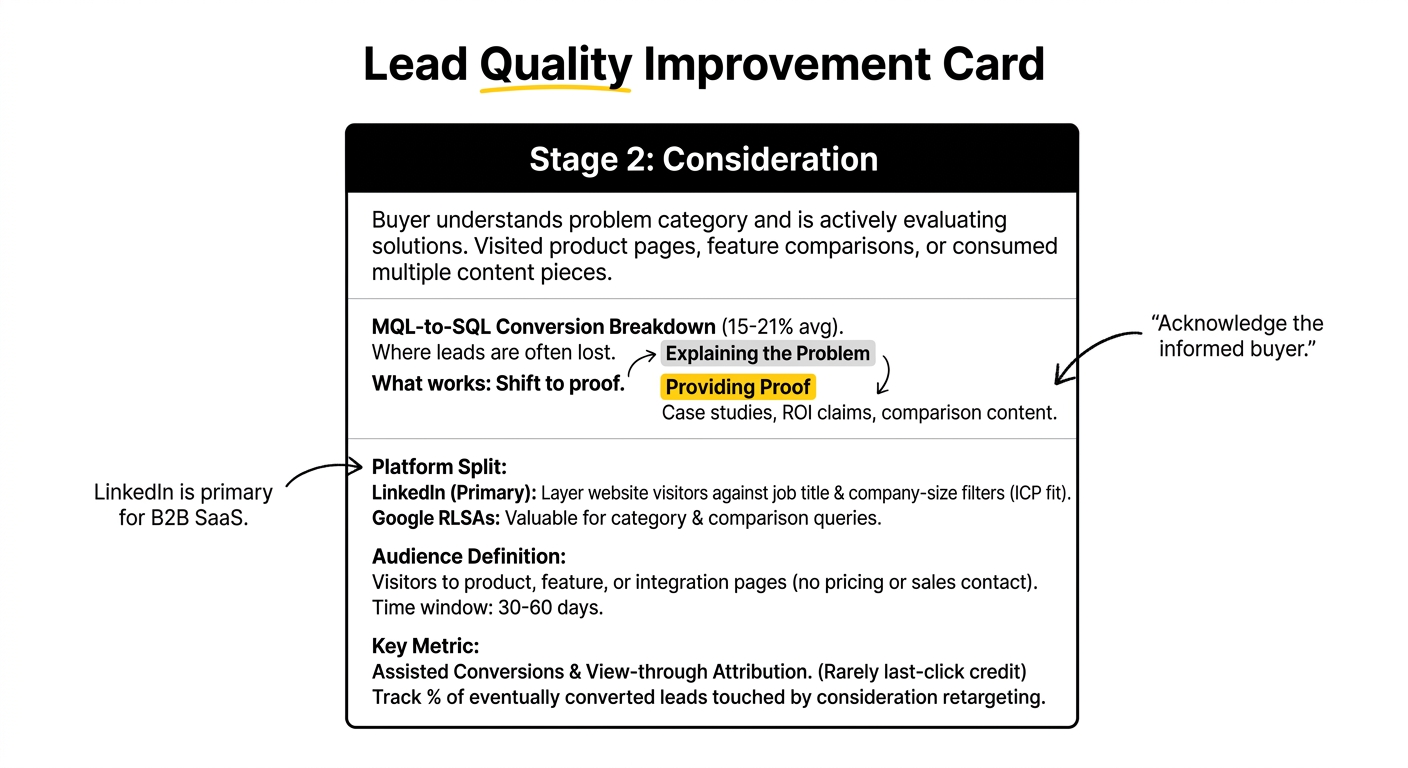
Consideration is the most complex stage to retarget well. A buyer here understands the problem category and is actively evaluating solutions. They have visited product pages, read feature comparisons, or consumed multiple pieces of content across sessions.
This is where the MQL-to-SQL conversion rate breakdown typically lives. B2B SaaS teams converting 15-21% of MQLs to SQLs on average (per 2025 benchmark data) are often losing leads at this stage because the retargeting does not match where the buyer is in their thinking. The ad is still explaining the problem. The buyer is already past that.
What works instead: Shift to proof. Case studies in the same vertical, specific ROI claims backed by real numbers, comparison content if the buyer is evaluating vendors. The creative should acknowledge that the buyer is informed and give them a reason to prefer your solution.
Platform split: LinkedIn is the primary channel for consideration retargeting in B2B SaaS. The ability to layer your website visitor audience against job title and company-size filters means you are spending on prospects who fit your ICP, not just anyone who clicked a link. Google Remarketing Lists for Search Ads (RLSAs) are valuable here too, particularly for category and comparison queries where buyers are actively comparing vendors.
Audience definition: Visitors to product pages, feature pages, or integration pages who have not visited pricing or contacted sales. Time window: 30-60 days.
Key metric: Assisted conversions and view-through attribution. Consideration-stage retargeting rarely wins last-click credit. If you measure it on direct conversions alone, it will look like it is not working. Track the percentage of eventually converted leads who were touched by consideration retargeting during their journey.
Stage 3: Demo Intent
Demo intent is where things get measurable fast. These are buyers who have visited your pricing page, returned to your website multiple times within a short window, or engaged with content specifically about implementation or ROI.
These are high-intent prospects. They are close. But they have not converted. The question is why.
Most of the time, the reason is friction or doubt: a form that feels too long, uncertainty about fit, or a competitor still in the mix. The retargeting job at this stage is to remove those barriers, not add more ad volume.
What works instead: High-specificity creative that speaks directly to the conversion barrier. Testimonials from customers in the same industry or at a similar company stage. Free trial offers or personalised demo invitations if your model supports them. Live chat prompts for visitors who return to pricing pages.
On Google, this is where branded search campaigns and competitor-conquest terms carry serious weight. A buyer in demo intent is likely searching your brand name and comparing you to two or three alternatives. Being present on those queries is not optional.
Platform split: Google Search owns this stage. The buyer is actively searching; capture that intent. LinkedIn retargeting supports with sequential creative showing social proof. Prioritise named-account retargeting on LinkedIn if your ICP list overlaps with pricing page visitors.
Audience definition: Pricing page visitors, repeat visitors (3+ sessions within 14 days), and anyone who started but did not complete a demo request form. Time window: 14-21 days. Frequency cap tightly to avoid oversaturation.
Key metric: Demo request rate and cost-per-demo. This stage is close enough to pipeline that you can measure it on conversion metrics directly.
Stage 4: Sales-Stage Retargeting
Sales-stage retargeting is the most underused tactic in B2B SaaS paid programmes. By the time a prospect enters active sales conversation, most demand gen teams consider their job done. The paid media budget moves upstream.
The mistake is real. Enterprise SaaS deals involve buying committees. The person in your CRM is not the only decision-maker. Their colleagues, legal team, and finance stakeholders are all doing their own research. If your brand is invisible to those other stakeholders during the evaluation period, a competitor will fill that space.
What works instead: Account-level retargeting using your CRM data. Upload your open opportunity list to LinkedIn Matched Audiences and Google Customer Match. Serve credibility-building content: analyst recognition, customer ROI data, implementation success stories. This is not demand generation. It is multi-stakeholder reinforcement during a live deal.
Platform split: LinkedIn is the primary channel here. The ability to target by company name means every stakeholder at an open-opportunity account can see consistent, professional creative regardless of whether they are personally in your CRM. Google branded search remains active to ensure presence when committee members search your name.
Audience definition: CRM list of open opportunities, uploaded as a custom audience. Refresh the list weekly. Suppress closed-lost accounts to avoid wasted spend.
Key metric: Influenced pipeline and win rate on accounts where retargeting was active. This requires closed-loop reporting between your CRM and ad platforms, but the signal is clear: deals where multiple stakeholders were reached by paid media during the evaluation phase tend to close faster and at higher ACV.
Google vs Social: How the Platform Role Shifts by Stage
The tendency in B2B SaaS paid media is to treat Google and social as parallel channels running the same objectives. The retargeting strategies for SaaS funnel stages that work best do not work that way. Each platform carries a different role depending on where in the journey the buyer sits.
A useful frame: Google captures intent that already exists. LinkedIn and Meta build and reinforce intent over time. For retargeting, this means Google’s strongest contribution is at the bottom of the funnel, where buyers are actively searching. LinkedIn’s strongest contribution is at the middle and top, where you are reaching buyers during the consideration and awareness windows before they have started typing queries.
In practical terms:
- Awareness retargeting: LinkedIn primary, Google Display supporting
- Consideration retargeting: LinkedIn primary, Google RLSAs for category and comparison queries
- Demo intent retargeting: Google Search primary (branded and high-intent non-branded), LinkedIn supporting with social proof
- Sales stage retargeting: LinkedIn primary (CRM-based named account), Google branded search always on
The cost dynamics support this split. As a saas ppc agency, we consistently see LinkedIn deliver a lower cost-per-opportunity for mid-market and enterprise SaaS even when the cost-per-click is three to four times higher than Google. The explanation is conversion rate downstream: LinkedIn leads from ICP-matched audiences convert from MQL to SQL at higher rates than the broad intent audiences Google captures at the top of the funnel.
That said, the platforms are not competitors within a retargeting programme. They are sequenced. LinkedIn’s upper-funnel retargeting is often what creates the brand familiarity that makes Google’s lower-funnel conversion campaigns work. A prospect who has seen your content on LinkedIn three times in the past month is far more likely to click your branded search ad and convert than a prospect who encounters your brand for the first time on Google.
Integrating Educational Content Into Your Retargeting Campaigns
Educational content for retargeting is not the same as gated lead generation content. The distinction matters.
Gated content sits at the end of a form. It requires trust before delivery. Educational retargeting content is different: it is the delivery mechanism itself. You are distributing value before asking for anything in return.
In practice, this means using your retargeting budget to put thought leadership articles, how-to videos, and diagnostic tools in front of audiences who are not yet ready to convert. A head of demand gen at a Series B analytics platform, seeing a retargeted LinkedIn article on improving MQL-to-SQL conversion rate for the second time, is building a relationship with your brand. They are not going to fill in a form today. But six weeks later, when the problem is live and they start evaluating agencies, you are already a familiar voice.
The practical structure: for awareness and early consideration audiences, allocate 30-40% of your retargeting budget to educational content distribution. Measure engagement, not conversions. Set the expectation internally that this spend will not show direct attribution in your reporting. The downstream impact shows up in your self-reported attribution (“How did you first hear about us?”) and in the shrinking time-to-close for leads who have had multiple content touchpoints before requesting a demo.
This is the connection between retargeting and pipeline outcomes that most teams miss. They measure retargeting on last-click conversions and conclude the educational content is not working. The correct lens is full-funnel influence, not first-party click attribution.
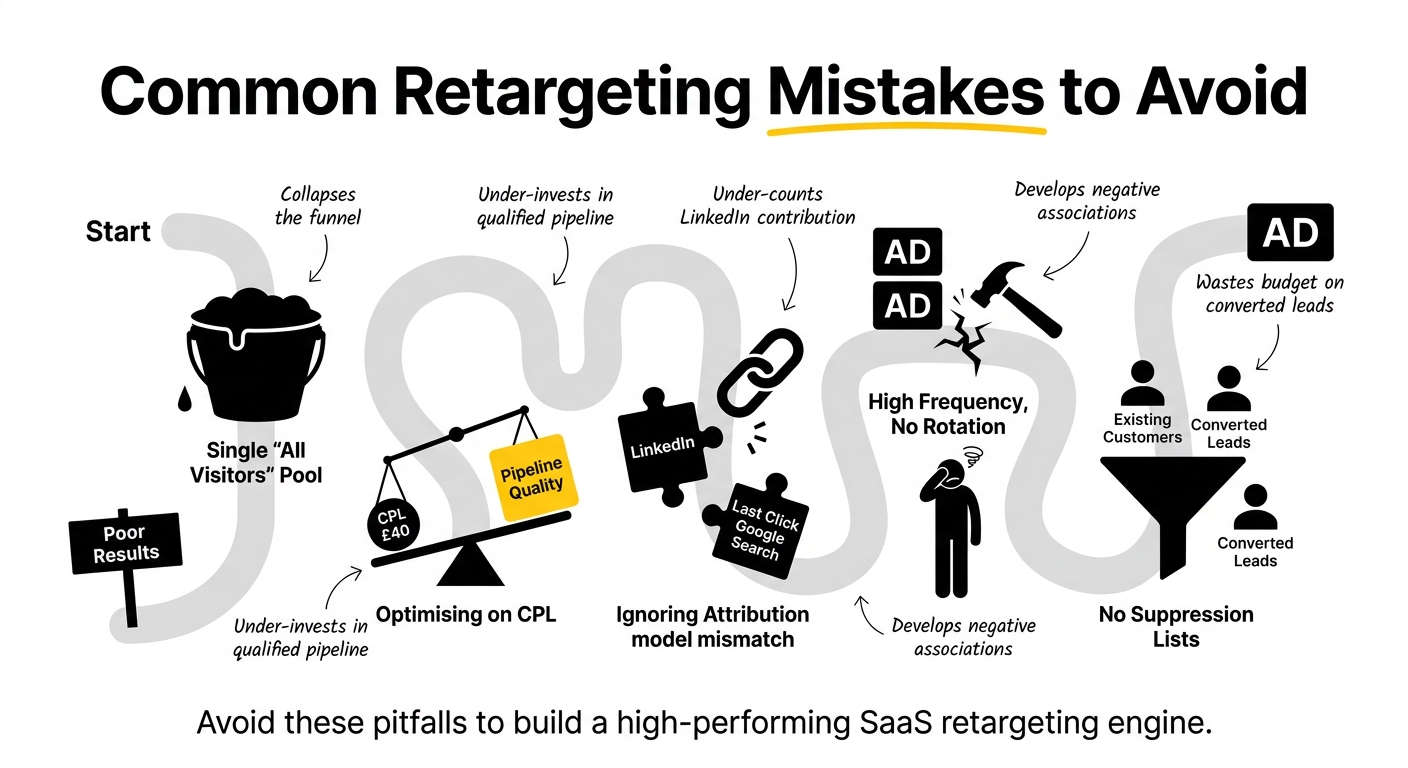
Common Retargeting Mistakes to Avoid
Single-audience retargeting pools. The most common error. A single “all visitors, last 30 days” audience collapses the funnel into one undifferentiated bucket and forces you to choose one creative approach for buyers at completely different stages.
Optimising on CPL rather than pipeline quality. A demo at £80 from a mid-funnel LinkedIn campaign targeting your exact ICP is worth far more than a demo at £40 from a broad Google Display campaign. Optimising on cost per lead without tracking what those leads become downstream will systematically under-invest in the channels that are actually building qualified pipeline.
Ignoring attribution model mismatch. LinkedIn’s contribution to pipeline is systematically undercounted in last-click models. If your attribution model assigns all credit to the final Google Search click before a demo request, LinkedIn will always look like it is not working. The solution is to supplement click attribution with view-through data and self-reported attribution fields on your demo request form.
High frequency without creative rotation. Retargeting audiences in B2B SaaS are often small. A typical mid-market SaaS company might have 500-2,000 ICP visitors per month. Without creative rotation and frequency caps, those audiences saturate quickly. Once a prospect has seen the same ad seven times, they are not going to convert on the eighth. They are going to develop negative associations.
No suppression lists. Running paid retargeting to existing customers or to leads who have already converted wastes budget and creates a poor brand experience. Keep suppression lists current and apply them across all retargeting audiences.
Measuring Retargeting Effectiveness Across the Funnel
The metrics that matter differ by stage, and this needs to be clearly defined before any retargeting programme goes live.
For awareness-stage retargeting: engagement rate, video completion rate, and scroll depth for long-form content. You are measuring intent signals, not conversions.
For consideration-stage retargeting: assisted conversions, time-to-demo from first touchpoint, and the percentage of eventual converters who were touched by consideration retargeting during their journey.
For demo intent retargeting: cost-per-demo and demo-to-opportunity rate. At this stage, the funnel is tight enough to measure on hard metrics.
For sales-stage retargeting: influenced pipeline, win rate on targeted accounts, and deal velocity. This reporting requires CRM integration with your ad platforms. Google Ads offline conversion import and LinkedIn’s revenue attribution integration are both worth setting up before launch, not as an afterthought.
The overarching principle: retargeting reporting must connect to pipeline outcomes in SaaS marketing. Engagement rates and impressions are useful diagnostic signals, but they are not the metrics that show up in board decks. Every retargeting strategy discussion should begin with “what does success look like in terms of closed-won pipeline?” and work backwards from there.
Frequently Asked Questions
What are the different stages of the SaaS customer journey for retargeting?
The four stages most relevant to B2B SaaS retargeting are awareness (initial brand exposure, early content consumption), consideration (active evaluation of the problem category and possible solutions), demo intent (high-intent behaviour such as pricing page visits and repeated sessions), and sales stage (open CRM opportunities where the buying committee is actively evaluating). Each stage requires a different audience definition, creative approach, and platform weighting.
How can retargeting strategies be tailored for each stage of the customer journey?
Tailoring starts with audience segmentation based on on-site behaviour. Awareness audiences are defined by top-of-funnel content visits with no product page engagement. Consideration audiences have visited product or feature pages. Demo intent audiences have viewed pricing, returned multiple times, or started a form without completing it. Sales-stage audiences are uploaded directly from CRM open opportunity lists. Each segment receives stage-appropriate creative and is served on the platforms best suited to that stage.
What are the best practices for retargeting in the awareness stage?
Awareness retargeting should lead with educational content, not conversion messaging. Distribute thought leadership, how-to content, and ungated resources through LinkedIn and YouTube. Measure on engagement signals rather than form fills. Frequency caps are important at this stage to avoid oversaturation on what is typically a larger but less intent-rich audience pool. Exclude anyone who has already demonstrated mid-funnel intent, as they belong in a different segment.
How can retargeting improve lead quality in the consideration stage?
Consideration retargeting improves lead quality by serving ICP-matched content to visitors who have already shown product interest. Using LinkedIn’s targeting filters to layer your website visitor audience against job title, seniority, and company size means your retargeting spend reaches buyers who actually fit your ideal customer profile, not just anyone who clicked a link. Pairing this with Google RLSAs for category and comparison queries catches the same buyers at the moment of active vendor research.
What metrics should be tracked to measure the effectiveness of retargeting campaigns?
Metrics should correspond to funnel stage. Awareness: engagement rate, content consumption signals. Consideration: assisted conversions, multi-touch attribution data. Demo intent: cost-per-demo, demo-to-opportunity conversion rate. Sales stage: influenced pipeline, deal win rate on targeted accounts. Across all stages, self-reported attribution on your demo request form provides qualitative signal that complements click-based reporting.
How can educational content be integrated into retargeting efforts?
Allocate 30-40% of retargeting budget for awareness and early consideration audiences to educational content distribution. This means running retargeting campaigns that lead to ungated articles, diagnostic tools, or video content rather than directly to a form. The goal is brand familiarity and problem framing. Measure these campaigns on engagement, not conversions, and set clear internal expectations that the attribution will not show in last-click reports.
What role does retargeting play in driving demo intent for SaaS products?
Retargeting accelerates the journey from consideration to demo intent by maintaining brand presence during the evaluation window. A prospect who is actively comparing vendors but has not requested a demo is often held back by doubt or friction. Sequential retargeting that moves from social proof to specific ROI claims to a low-barrier conversion offer (free trial, short discovery call) systematically addresses those barriers. Google branded and competitor-term campaigns are essential at this stage to capture intent at the exact moment a buyer is ready to act.
How can demand generation managers align retargeting efforts with sales goals?
The clearest alignment mechanism is using CRM data to drive retargeting audiences. Upload open opportunities to LinkedIn and Google as custom audiences. Set suppression lists from CRM data to exclude converted leads and existing customers. Feed offline conversion signals back to ad platforms so bidding algorithms optimise on pipeline-quality leads, not just form fills. Review retargeting performance in the same pipeline review where sales reports on open opportunities.
What are the common mistakes to avoid in retargeting across Google and social platforms?
The most frequent errors are single-audience retargeting pools that collapse all funnel stages into one creative approach, optimising on CPL rather than pipeline quality, ignoring attribution model mismatch between LinkedIn and last-click models, failing to rotate creative causing audience fatigue, and running retargeting without proper suppression lists for customers and converted leads.
How can reporting and insights from retargeting campaigns inform future strategies?
Retargeting data is most useful when it connects behaviour to pipeline outcomes. Track which audience segments produce the highest-quality leads by sourcing analysis in your CRM. Use view-through attribution and self-reported data to understand LinkedIn’s upper-funnel contribution that click-based models miss. A/B test creative by stage and review results on a 4-6 week cycle, long enough to account for B2B sales cycle length in the data. The question to bring to every review is not “which ad had the best CTR?” but “which retargeting audiences produced the most qualified pipeline this quarter?”
If this is the kind of full-funnel retargeting challenge your team is working through, we are happy to take a look at your current setup and share what we are seeing across similar SaaS programmes.