Fast Onboarding for Your SaaS PPC Agency: What to Expect in the First 30 Days
Discover essential steps for fast SaaS PPC onboarding in 30 days. Key activities, early wins, and balancing speed with strategy.

You’ve signed with a SaaS PPC agency. The ink is dry, the brief has been handed over, and now you’re waiting for results. The first week passes. Then the second. Your board is asking about pipeline. Your CEO wants to know when the ads go live. And your agency is still asking for access credentials.
This pattern is more common than it should be. Not because agencies are slow, but because most marketing directors don’t know what a fast onboarding process should actually look like. When you know what to expect, you can drive it. When you don’t, you’re dependent on the agency to set the pace.
This guide covers the effective onboarding process for SaaS marketing directors working with a PPC agency: what happens in each phase of the first 30 days, how to avoid the common blockers, and how to identify whether your agency is moving with genuine purpose or just keeping busy.
Why the First 30 Days Set the Tone for Everything That Follows
The first month of any PPC agency engagement is not about results. It’s about architecture. The decisions made during this window, on account structure, conversion tracking, ICP definition, and campaign priorities, compound over the following months. Get them right early and you’re building on solid ground. Rush them without thought and you’re optimising the wrong things at speed.
At Series A, the pressure to show movement is real. Your investors are watching. Your runway is finite. Monthly budget reviews mean there’s no tolerance for an agency that takes three months to “get up to speed.” But there’s an equally important truth: the fastest onboarding processes are the ones where both sides come prepared. The agency needs access. You need clarity on what they’re auditing and why. Neither of you benefits from pressure that leads to reckless early changes.
A well-structured 30-day PPC strategy for SaaS treats speed and care as compatible, not competing.
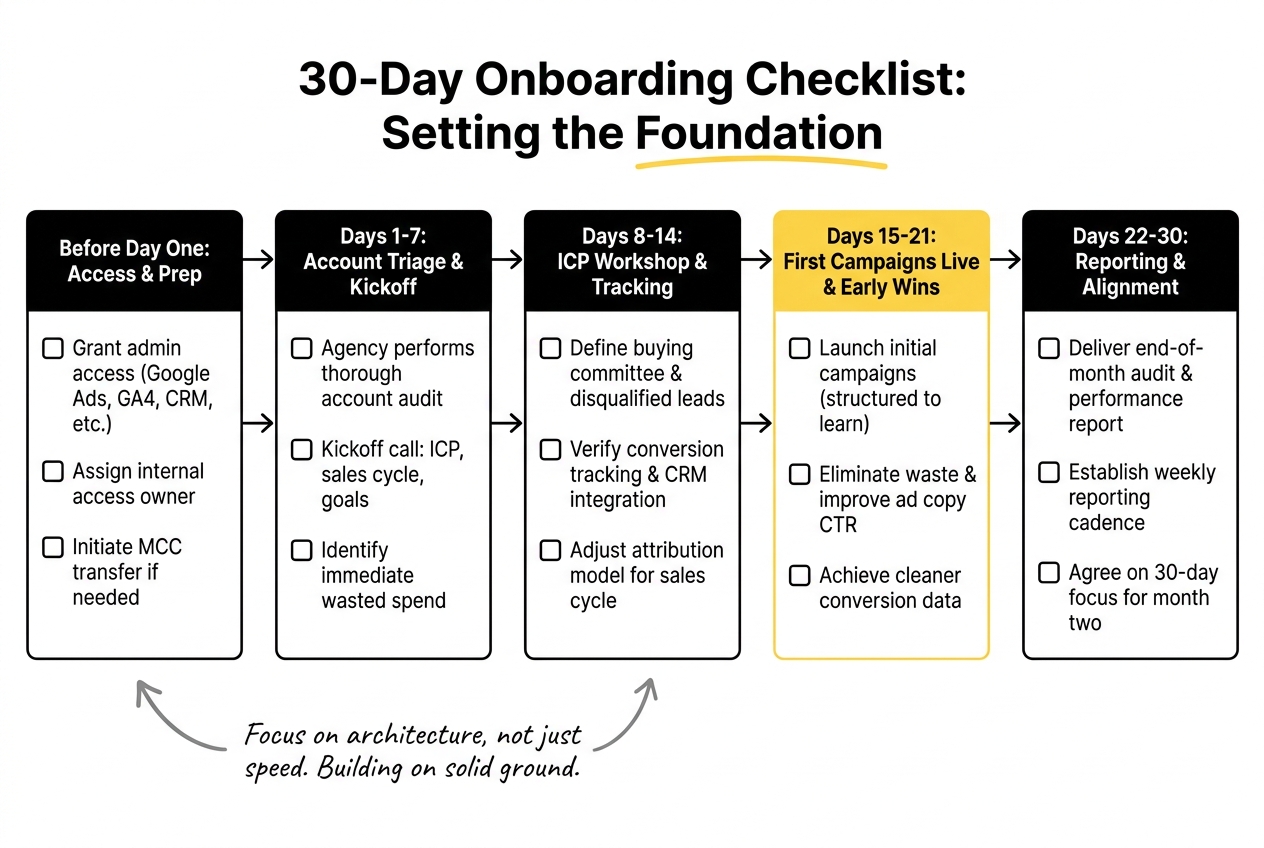
Before Day One: Access Is the Rate-Limiting Step
The single most common cause of slow onboarding is access delays. Google Ads, GA4, your CRM, LinkedIn Campaign Manager, landing page platforms, and any attribution tooling all require admin-level access. If those credentials aren’t shared before the kickoff call, the agency spends week one chasing logins instead of doing analysis.
Most agencies send an access request list during or immediately after contract signing. Treat it as a priority, not an admin task. Assign one person internally to own access provisioning. Every day of delay here is a day taken directly out of the useful part of the 30-day onboarding window.
The access checklist for a standard SaaS PPC onboarding typically includes:
- Google Ads account (admin access, not read-only)
- Google Analytics 4 property
- Google Search Console
- LinkedIn Campaign Manager (if in scope)
- Meta Business Manager (if in scope)
- CRM (HubSpot, Salesforce, or Pipedrive) with pipeline and deal stage visibility
- Landing page platform (Webflow, WordPress, Unbounce, etc.)
- Any existing attribution or call tracking tooling
If your account sits inside an agency MCC from a previous partner, you’ll also need to initiate a transfer or grant independent access. Start that process before the kickoff call.
Days 1 to 7: Account Triage and the Kickoff
The first week is diagnostic. A thorough account triage in PPC means your agency is auditing everything before touching anything. This is not administrative delay. It’s the difference between an agency that builds on your existing account history and one that blindly resets it.
The kickoff call itself should cover more than introductions. A prepared agency brings structured questions about your ICP, your sales cycle length, deal sizes, and what conversion events are already being tracked. They should be asking whether a trial signup and a demo request are treated as equivalent conversion goals, because in most SaaS businesses, they are not.
What a thorough account triage in PPC covers:
- Existing campaign structure: Where is budget currently allocated? Which campaigns are active, paused, or abandoned?
- Conversion tracking audit: Are the right events being tracked? Is attribution window set appropriately for your sales cycle?
- Keyword audit: What terms are you currently bidding on? Are they mapped to the correct funnel stage?
- Landing page alignment: Do ad groups point to pages that match the intent of the keyword?
- Wasted spend identification: Where is budget going to audiences, placements, or search terms that have no realistic path to qualified pipeline?
The output of this phase is not a campaign. It’s an honest baseline. Your agency should be able to present findings that include quick wins, specifically where obvious waste exists and what can be fixed without risk, alongside structural issues that will take longer to resolve.
Seventy percent of SaaS accounts audited by experienced PPC agencies show misalignment between keyword intent and landing page stage. The audit is where that gets caught before you spend another month on it.

Days 8 to 14: ICP Workshop and Tracking Review
By week two, the audit findings should inform a structured ICP workshop. Ideal customer profile marketing is not a one-off document exercise. For PPC purposes, the ICP determines which job titles you bid on, which pain points your ad copy leads with, and which negative audiences you exclude. An agency that skips this step and goes straight to building campaigns is using generic assumptions that don’t survive contact with your actual buyer.
A useful ICP workshop for PPC covers:
- Who is in the buying committee for your product?
- Which persona initiates the search versus which signs the contract?
- What does a disqualified lead look like? (This is as important as defining the ideal.)
- What is the average sales cycle from first click to closed-won?
- Which existing customers represent the highest LTV and lowest churn?
The answers shape targeting decisions across every channel. They also set the standard for what counts as a quality lead, which protects you from chasing MQL volume that sales won’t touch.
Alongside the ICP workshop, your agency should complete the tracking review. This means verifying that conversion events in Google Ads and GA4 are firing correctly, confirming that CRM integration is in place so pipeline data can flow back, and establishing what “a good lead” looks like at the data level. PPC performance tracking that doesn’t connect to pipeline data will always look better than it is.
If your attribution model doesn’t account for the length of your sales cycle, your reporting will consistently undervalue PPC’s contribution. This is the week to fix it.
Days 15 to 21: First Campaigns Live and Early Wins in PPC
By the end of week two, you should have a clear brief for the first campaigns. Week three is when they go live. Early wins in PPC for SaaS are not measured in closed-won revenue (your sales cycle makes that impossible in 30 days). They’re measured in leading indicators that the account is moving in the right direction.
Realistic early wins during the first month include:
- Elimination of wasted spend on irrelevant search terms or broad match keywords targeting the wrong funnel stage
- Improved ad copy CTR from copy informed by your ICP’s actual language
- Cleaner conversion tracking that gives you an accurate count of what’s happening downstream
- An initial landing page recommendation that addresses the highest-friction point in the current conversion path
What early wins are not: a sudden spike in demo requests in week three, a dramatic drop in CPA before the account has enough conversion data, or a campaign that “scales” before its targeting has been validated.
Any agency promising dramatic results in the first 30 days is either working with an account that had obvious structural problems they’ve fixed, or they’re overselling. Both are worth understanding clearly.
The first campaigns should be structured to learn, not to scale. That means appropriate budgets that generate enough data to optimise against without burning through your quarterly allocation on an untested hypothesis.
Days 22 to 30: Reporting Cadence and Strategic Alignment
The final week of onboarding should deliver two things: a clear view of what the first month’s activity has produced, and an agreed cadence for how you’ll measure progress going forward.
A useful end-of-month report for a SaaS PPC engagement covers:
- Account audit findings: What was found, what was changed, and why
- Tracking status: What events are now correctly attributed and what remains outstanding
- ICP and targeting summary: Who you’re targeting and how that differs from the previous approach
- Campaign performance to date: Leading indicators only, with honest context about what they can and cannot tell you at this stage
- 30-day focus areas for month two: What the agency plans to test, optimise, or build next
The reporting cadence itself matters as much as the report content. Weekly check-ins work well for the first 90 days. They don’t need to be long. Thirty minutes with a clear agenda covering blockers, performance signals, and upcoming priorities keeps both sides aligned without creating bureaucratic overhead.
Avoid monthly-only reporting in the early months. You lose too much time to course-correct if something is going wrong. The goal is a feedback loop that’s tight enough to catch problems early, not so tight that it creates constant context-switching.

Speed Without Recklessness: The Balance That Matters Most
The pressure to show results quickly is real for any Series A marketing director, and a competent SaaS PPC agency understands that. But there’s a version of “fast” that creates problems. Launching campaigns without completing the tracking review. Making structural changes to a high-spend account without a baseline. Pausing campaigns that have historical data before understanding what role they play in assisted conversions.
The safest early changes are the ones with clear upside and minimal downside: negative keyword additions, conversion tracking corrections, removing obvious wasted spend from non-performing ad groups. These improve the account without disrupting what’s working.
The riskier changes (restructuring campaigns, switching bidding strategies, overhauling ad copy across all ad groups) take longer to validate. An agency that wants to change everything in week one is prioritising their own narrative over your account performance.
A senior PPC operator will push back on something in the first 30 days. Not to be difficult, but because a generic brief almost always contains an assumption worth questioning, whether that’s a target CPA that’s too low for your ACV, an audience that’s too narrow to generate meaningful conversion volume, or a conversion event that’s too top-of-funnel to optimise against meaningfully. If your agency doesn’t challenge anything in the first month, that’s worth noting.
What a Well-Structured First 30 Days Actually Produces
The output of a well-executed first month is not a flood of leads. It’s an account that’s clean, tracked correctly, and pointed at the right audience. It’s a shared understanding of what success looks like beyond the platform dashboard. And it’s a reporting framework that will hold up in your next budget review.
That foundation takes the full 30 days to build properly. Teams that rush it trade short-term optics for long-term underperformance. Teams that get it right set up month two and three to actually move the metrics that matter: cost-per-opportunity, MQL-to-SQL ratio, and qualified pipeline.
If you’re evaluating a fast onboarding SaaS PPC agency partner or working through the early stages of an engagement, the questions in this guide give you a framework for holding the process to a clear standard.
This is the kind of engagement structure we work through with every new client. If you’re at the start of that process and want to compare notes, we’re happy to take a look at where you are.
Frequently Asked Questions
What are the key steps in the first 30 days of onboarding with a SaaS PPC agency?
The first 30 days should cover five core phases: access setup (before the kickoff call), account triage and audit (days 1 to 7), ICP workshop and tracking review (days 8 to 14), first campaign launches with early wins identified (days 15 to 21), and a reporting cadence established with an end-of-month strategic review (days 22 to 30). Each phase feeds the next. Skipping or compressing any of them typically creates problems that surface in month two.
How can marketing directors ensure a smooth onboarding process with a PPC agency?
The most impactful thing a marketing director can do is to remove access blockers before the kickoff call and have a clear internal owner for onboarding tasks. Beyond that: be explicit about what a qualified lead looks like, provide access to CRM pipeline data rather than just ad platform data, and set the expectation that the first month is about architecture rather than results.
What should be included in the ideal customer profile for effective PPC campaigns?
For PPC purposes, the ICP needs to define who is in the buying committee and which persona initiates the search, what pain points they’re actively searching to solve, what a disqualified lead looks like at the contact and company level, typical deal size and sales cycle length, and which existing customers represent the best retention outcomes. This informs targeting, negative audiences, ad copy, and how you define a conversion worth bidding for.
What are the common challenges during the onboarding process with a SaaS PPC agency?
Access delays are the most common. After that: misaligned conversion tracking (where the agency is optimising for events that don’t correlate with pipeline), pressure to launch campaigns before the ICP is agreed, and unclear expectations about what month one can realistically deliver. Most of these can be prevented with a clear onboarding timeline shared at contract signing.
How can early wins be achieved during the first month of onboarding with a PPC agency?
The most reliable early wins are structural fixes, not performance breakthroughs. Adding robust negative keyword lists, correcting conversion tracking events, eliminating spend on irrelevant match types or placements, and tightening audience targeting to your actual ICP. These reduce waste and improve signal quality without requiring the conversion volume that more ambitious optimisations need.
What tracking metrics should be reviewed during the onboarding process?
The tracking review should cover conversion events in Google Ads and GA4 (verifying they’re firing and attributed correctly), CRM integration to connect ad clicks to pipeline stages, attribution window settings relative to your sales cycle, and any existing call or form tracking tools. The goal is to ensure the data feeding optimisation decisions reflects real pipeline outcomes, not just platform conversions.
How important is access setup in the onboarding process with a PPC agency?
Access setup is the rate-limiting step. Every day of delay before an agency has full access to your accounts is a day removed from their analysis window. Admin-level access to Google Ads, GA4, your CRM, and any other relevant platforms should be provisioned before the kickoff call. Read-only access for any platform creates blockers during setup and testing.
What is the significance of establishing a reporting cadence in the first 30 days?
A reporting cadence agreed in the first month sets the standard for accountability throughout the engagement. Weekly check-ins work well for the first 90 days: they’re short enough to maintain without overhead, and frequent enough to catch problems before they compound. The end-of-month report should cover what was found, what was changed, what the data shows so far, and what the agency plans to do next.
How can marketing leaders balance swift action and careful changes during onboarding?
The practical distinction is between low-risk structural improvements (negative keywords, tracking fixes, wasted spend removal) and higher-risk structural changes (bidding strategy shifts, full campaign rebuilds, landing page overhauls). Prioritise the former in month one. The latter require a baseline of conversion data before they can be validated, and making them too early means you’re optimising without enough signal to know whether the change helped or hurt.
What best practices can enhance the onboarding experience with a SaaS PPC agency?
Shared access before kickoff, an internal owner for onboarding coordination, a structured ICP workshop rather than a brief document handover, CRM integration from day one, and honest expectation-setting on what month one can deliver. The agencies that onboard well are the ones that treat the first 30 days as a foundation-building phase rather than a performance phase, and the marketing directors who get the most from that period are the ones who enable it.


.png)