What a Proper SaaS Paid Media Audit Should Diagnose Before Scaling
Discover the key diagnostics a SaaS paid media audit should cover before you scale spend. Optimise account structure, tracking, and lead quality.

You double the budget. Clicks go up. MQLs look reasonable on paper. Three months later, pipeline is flat, sales are pushing back on lead quality, and nobody can explain where the spend actually went.
This is the most common scaling failure in SaaS paid media. It is not a targeting problem or a bid strategy problem. It is an audit problem. Specifically, the lack of one before the budget increase.
A proper SaaS paid media audit is not a surface check. It is a diagnostic exercise that reveals structural faults, data blind spots, and conversion blockers that will compound every time you add more spend. What works at £10,000 per month has a different failure mode than what you will encounter at £50,000. The point of the audit is to find those faults before they become expensive.
This article covers the seven areas a SaaS paid media audit agency should examine before recommending any budget increase. If your current audit does not go this deep, you are scaling on assumptions.
Why Most SaaS Teams Skip the Full Diagnostic
The pressure to scale is usually real. There is a board meeting, a growth target, a new funding round. The instinct is to move fast and figure out the rest later.
The problem is that later almost never comes. The account keeps running. The budget keeps increasing. The underlying structural issues stay invisible because the top-level metrics, cost per lead, click volume, and platform ROAS, never tell you what is actually broken.
Research from Embryo’s PPC audit work found that inaccurate conversion tracking appears in 70 to 80 percent of audited accounts, with revenue discrepancies between ad platforms and CRM data exceeding 20 percent in 65 percent of cases. That means most SaaS teams scaling paid media are doing so with a fundamentally unreliable feedback signal. They are optimising toward noise.
A comprehensive audit before scaling is not a nice-to-have. It is the only way to verify that your data is telling you the truth before you stake significantly more budget on it.

1. Account Structure: The Foundation That Affects Everything Else
Account structure is the part of a SaaS paid media audit that looks the most straightforward and is almost always where the damage is deepest.
Poor account structure in Google Ads has been associated with 30 to 50 percent wasted ad spend in disorganised campaigns, according to PPC Geeks’ 2025 audit data. The reason is mechanical. When campaigns, ad groups, and keywords are organised without clear intent separation, the bidding system cannot learn cleanly. Brand and non-brand traffic compete for the same signals. High-intent and low-intent keywords share budgets. The algorithm optimises toward the wrong outcomes because nobody gave it clean enough inputs to work with.
For SaaS accounts specifically, a structural audit should examine:
- Whether brand, competitor, category, and problem-aware campaigns are separated or collapsed together
- Whether keyword match types are creating overlap and cannibalising each other
- Whether audience exclusions are applied (especially existing customers, who account for a material portion of search volume in established SaaS products)
- Whether campaign goals are actually linked to pipeline outcomes, or just to form submissions
The structural assessment is foundational because every other fix you make sits on top of it. If the foundation is wrong, you are optimising on a faulty base.
2. Tracking Integrity: The Diagnostic You Cannot Skip
Tracking integrity is where a SaaS paid media audit tends to separate competent reviews from thorough ones.
A conversion tag that fires incorrectly is often worse than a missing tag. A missing tag creates a visible data gap. A misfiring tag feeds the bidding system false wins, and the account starts optimising toward actions that do not represent real commercial intent. By the time you notice that MQL volume is up but qualified pipeline is not moving, the damage is already deep.
A rigorous tracking audit for SaaS paid media covers three layers. First, does the event fire at the right moment? Second, does it send the correct payload? Third, does the ad platform record the same conversion that the site intended to send? All three can fail independently, and a browser-level spot check will only catch the most obvious failures.
For B2B SaaS, offline conversion tracking deserves particular attention. If CRM events, such as qualified lead status, opportunity stage, or closed-won outcomes, never feed back into Google Ads or LinkedIn, then automated bidding is making decisions based on shallow form-fill signals. The result is predictable: higher lead volume, worse quality, increasing frustration from sales.
The audit should also check UTM consistency across channels. A common scenario is a SaaS team running Google Ads, LinkedIn, and Microsoft Ads with slightly different medium and campaign labels. Nothing looks broken in-platform. But blended reporting becomes unreliable, and any cross-channel attribution work turns into manual cleanup. This is the kind of quiet failure that an audit should catch before you scale.
3. Search Intent Analysis: Are You Capturing the Right Demand?
Keyword lists tell you what terms trigger your ads. Search intent analysis tells you whether those terms represent buyers.
This distinction matters more in SaaS than in most other categories. The people searching for your category often include competitors, researchers, students, job seekers, and existing customers looking for documentation. A well-structured SaaS paid media audit should categorise the keyword set by actual purchase intent, not just by volume or cost per click.
The audit should surface:
- Informational queries that are consuming budget without commercial intent
- Competitor-branded terms that look like high intent but convert at low rates for your offer
- Category terms that attract buyers far too early in their evaluation cycle
- Missing terms that reflect how your ICP describes the problem you solve
The last point is frequently overlooked. SaaS marketing teams tend to bid on the language they use internally to describe their product. But B2B buyers describe their problems before they describe solutions. An audit of search query reports (not just keyword lists) often reveals a significant gap between the terms in the account and the language prospects actually use when they are in-market.
Aligning keyword strategy to genuine search intent is one of the highest-leverage adjustments available in any scaling SaaS paid media audit. It reduces waste and improves quality at the same time.
4. CRM Feedback: Closing the Loop Between Ads and Revenue
Most SaaS paid media accounts are optimised on lead volume. Most SaaS companies care about qualified pipeline and closed revenue. These two things are different, and the gap between them is where audit work earns its money.
A proper audit asks a simple question: what does the CRM say happened to the leads this account generated in the last six months? The answer is almost always more instructive than any in-platform metric.
Common findings from CRM analysis include:
- A high-volume keyword driving the largest lead count with the worst MQL-to-SQL conversion rate
- A campaign that looks underperforming by CPC that is actually generating a disproportionate share of qualified pipeline
- A particular landing page variant that attracts a systematically weaker ICP profile than the alternatives
- Significant spend attributed to industry segments or company sizes that sales has already disqualified as poor fit
When CRM data is brought into the audit process, the account stops being optimised on assumptions about what constitutes a good lead. Bid strategies, audience targeting, and negative keyword lists can all be updated to reflect what has actually converted to revenue, not just what filled in a form.
This feedback loop is also what enables accurate CAC payback calculations, which matter considerably at board level. Without it, you are managing a paid media programme with a broken speedometer.

5. Wasted Budget: Finding the Spend That Contributes Nothing
Wasted budget in paid media is rarely the result of one large mistake. It is usually the accumulation of many small ones that nobody thought to check.
A structured budget audit should look at:
- Search partner placement performance, which frequently shows high click volume and poor conversion quality in B2B accounts
- Display and remarketing audience overlap, which can result in the same users being served too many impressions at too high a CPM
- Time-of-day and day-of-week distribution, to identify whether spend is concentrated in periods with low commercial intent (weekends, outside business hours for high-ACV SaaS)
- Geographical distribution, to identify whether spend is landing in regions that do not match the ICP or sales coverage model
- Existing customer exposure, which is a common source of waste in SaaS accounts with material customer bases
The goal of the budget audit is not simply to cut spend. It is to identify where reallocating existing spend would produce a better return without requiring any additional investment. In a well-structured scaling exercise, budget recovered from waste funds the increase in high-intent activity.
6. Landing Page Friction: Where the Click Becomes a Dead End
Paid media audits that stop at the ad account miss half the problem. Conversion rates for B2B SaaS from paid search average around 1.89 percent, according to 2025 data. Some of that gap is targeting. A substantial portion is landing page friction.
Landing page friction in SaaS paid media takes several forms. The most common are:
- Message mismatch between ad copy and page headline, which creates a cognitive disruption that increases bounce rates even when the offer is genuinely relevant
- Form length and qualification misalignment, where a long form positioned too early in the buying journey deters consideration-stage visitors
- Missing social proof for the specific ICP segment, where a prospect from financial services or healthcare arrives at a page that only references retail or consumer use cases
- Load speed and mobile rendering failures, particularly relevant as B2B buyers increasingly research on mobile before converting on desktop
The audit should review landing page performance data alongside ad performance data, segmenting by campaign, keyword intent level, and audience type. The patterns that emerge often reveal that the same ad creative converts at dramatically different rates depending on where it sends traffic. That is a landing page problem, not an ads problem.
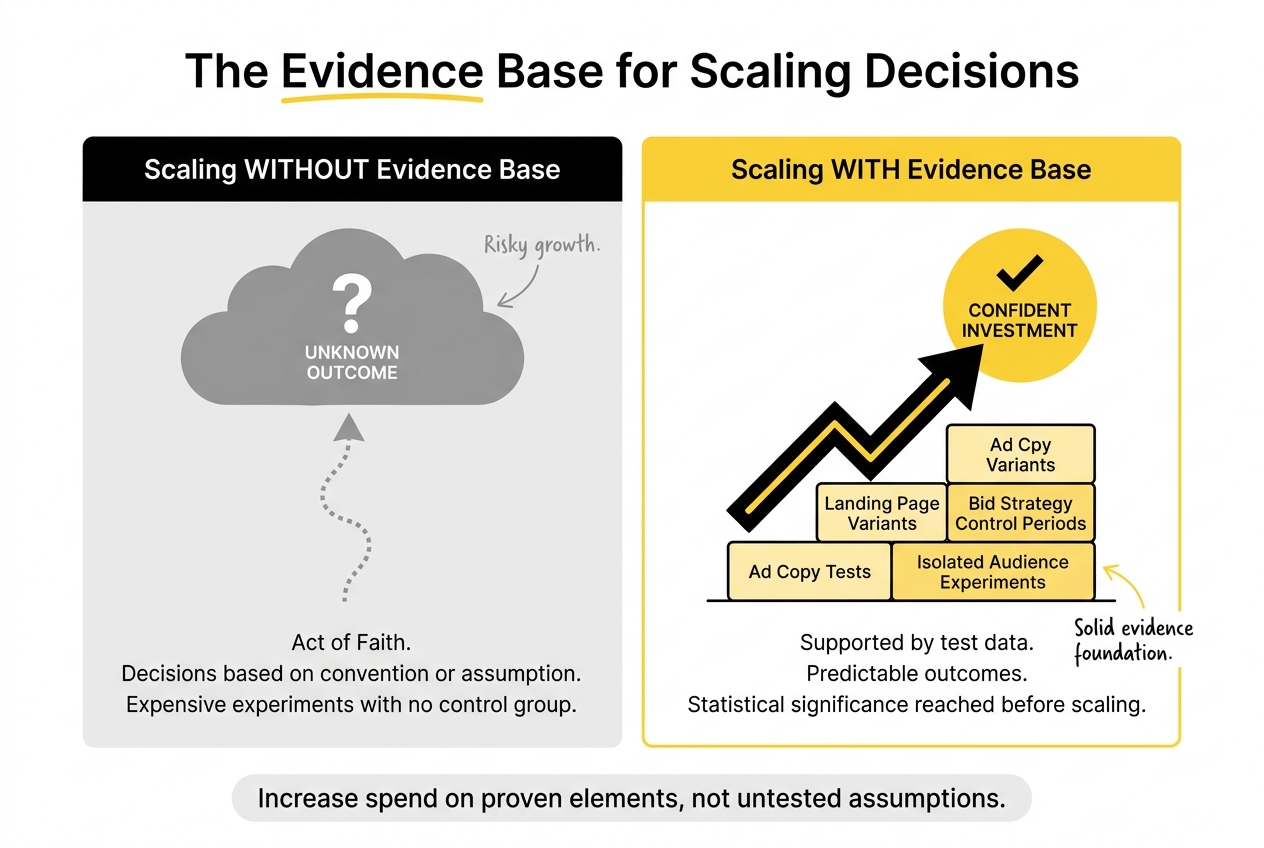
7. Testing Gaps: The Evidence Base for Scaling Decisions
Scaling paid media spend without a history of structured testing is an act of faith. It may work. It often does not. A proper audit evaluates the testing discipline in the account and identifies where the evidence base is too thin to support confident investment decisions.
Common testing gaps in SaaS paid media accounts include:
- Ad copy tests that ran for too short a period or with insufficient impression volume to reach statistical significance
- Landing page variants that were never formally compared, meaning the version in use may not be the best performer
- Bid strategy changes that happened without a before-and-after control period, making it impossible to know whether performance shifted because of the change or despite it
- Audience targeting experiments that were not isolated from other simultaneous changes
The audit should identify which decisions in the account are supported by test data and which are based on convention or assumption. Before scaling, the highest-value testing gaps should be closed. Increasing spend on an untested account structure or an untested landing page is an expensive experiment with no control group.
What a Proper Diagnostic Actually Delivers
The seven areas above are not a checklist that produces a score. They are a structured diagnostic that produces decisions.
A good SaaS paid media audit ends with a prioritised set of actions: what needs to be fixed before any budget increase, what can be addressed in parallel with early scaling, and what should wait until the higher-spend environment makes the data clearer. It also identifies the KPIs that will signal whether scaling is working, specifically metrics that hold up in board meetings: qualified pipeline volume, cost-per-opportunity, and MQL-to-SQL conversion by channel.
The audit is also the point at which a SaaS paid media agency or in-house team earns trust. Not by producing a long slide deck with a lot of red and amber indicators, but by demonstrating they understand the commercial logic of what the account is supposed to achieve and can explain clearly what is standing between current performance and that outcome.
If you are planning to scale paid media spend in the next quarter, the audit is not the delay. It is the work that makes the increase worth making.
Frequently Asked Questions
What are the key components of a SaaS paid media audit?
A thorough SaaS paid media audit covers account structure, tracking integrity, search intent alignment, CRM feedback loops, wasted budget analysis, landing page friction, and testing gaps. Each area interacts with the others, so a partial audit that covers only ad platform settings will miss the majority of the issues that affect real commercial performance.
How can a paid media audit improve PPC performance for SaaS companies?
An audit identifies the specific inefficiencies, structural problems, and data gaps that prevent paid spend from converting to qualified pipeline. By addressing these before scaling budget, SaaS companies improve cost-per-opportunity, reduce lead waste, and give automated bidding systems the clean conversion data they need to optimise toward revenue rather than form fills.
What common issues should a SaaS paid media audit identify before scaling?
The most consistent issues found in pre-scaling audits are misfiring conversion tracking, poor account structure that blends traffic types and intent levels, absence of CRM feedback in bidding signals, existing customer overlap consuming budget, and landing page message mismatch. Any one of these can be managed at low spend. All of them compound at scale.
How does account structure impact the effectiveness of paid media campaigns?
Account structure determines how well the bidding system can learn. When brand, non-brand, competitor, and high-intent campaigns share the same structure, the algorithm cannot differentiate signals effectively. Research from PPC Geeks’ 2025 checklist found that poor account structure is associated with 30 to 50 percent wasted ad spend in disorganised campaigns, with Quality Scores typically running 4 to 5 out of 10 versus 7 or higher in well-structured accounts.
What role does tracking integrity play in a successful media audit?
Tracking integrity is the foundation that every other optimisation decision rests on. If conversion events are misfiring, duplicate, or failing to pass CRM-stage outcomes back to the ad platform, then bid strategies, audience exclusions, and performance reporting all operate on false data. Inaccurate conversion tracking appears in 70 to 80 percent of accounts when properly audited, according to Embryo’s PPC guidance.
How can CRM feedback enhance the accuracy of a media audit?
CRM data reveals what actually happened to the leads the account generated, which is information the ad platform will never show you. Connecting CRM outcomes to paid media performance identifies which campaigns and keywords drive qualified pipeline versus volume, enabling far more precise optimisation of bid strategies, budgets, and audience targeting.
What are the signs of wasted budget in a paid media campaign?
Common signs include high click volume from search partners with poor conversion rates, campaigns running in geographies or company sizes outside the ICP, significant impression share going to existing customers, and spend concentrated in low-intent time periods. An audit of placement data, audience overlap, and search query reports typically reveals multiple sources of recoverable waste in established accounts.
How can landing page friction affect conversion rates in SaaS advertising?
Landing page friction reduces conversion rates even when ad targeting and creative are effective. The most damaging forms of friction in SaaS paid media are message mismatch between ad and page, form length disproportionate to the buyer’s stage, and missing ICP-specific proof points. These issues are invisible in ad platform reporting, which is why landing page analysis must be part of the paid media audit rather than a separate project.
What testing gaps should be addressed during a media audit?
The audit should identify decisions that lack test-based evidence: ad copy variants that never ran long enough to be conclusive, bid strategy changes that were not isolated from other variables, and landing page versions that were never formally compared. Before scaling, the most critical gaps are those related to the core conversion path: the ad-to-page message, the form, and the offer.
Why is it important to conduct a media audit before increasing advertising spend?
Scaling unaudited paid media multiplies the impact of existing structural faults. Problems that are manageable at lower spend, such as tracking errors, poor intent alignment, or landing page friction, become significantly more costly when budget increases. The audit is not a delay to scaling. It is the process that determines whether the scaling investment is likely to produce a return.
If you are working through this process and want a second pair of eyes on the account before committing to a budget increase, this is exactly the kind of diagnostic work we do with SaaS teams. Worth a conversation if you are at that point.
Explore our SaaS PPC agency services to see how we approach paid media for B2B SaaS companies.


.png)