Navigating Paid Media Partnerships for Mid-Market SaaS Teams
What mid-market SaaS teams should expect from paid media agency partners: governance frameworks, reporting metrics, and channel mix for complex teams.

You have five product lines, three regional targets, a buying committee that includes procurement, and a board that wants to see pipeline attribution by next quarter. Your paid media agency just sent you a dashboard with impressions, CTR, and ROAS. Neither of you is looking at the same business.
This is the most common failure point in mid-market SaaS paid media partnerships. It is not a capability problem. It is a governance and reporting problem. The agency is measuring what is easy. The CMO needs what is meaningful.
Mid-market SaaS sits in a particularly difficult position. You have outgrown the scrappy setup where one person runs everything, but you have not yet reached enterprise scale where dedicated channel owners, attribution specialists, and agency coordinators handle the complexity for you. You are managing a mid-market SaaS PPC agency from inside a matrixed organisation, with stakeholders who have competing priorities, product lines with different ICPs, and a sales cycle that can stretch to six months or more before a deal closes.
The gap between what an agency delivers by default and what a mid-market SaaS CMO actually needs is real. Understanding what a functional paid media agency partnership looks like is the starting point for closing it.
Why Governance Matters More Than Tactics at This Stage
Most conversations about paid media agency selection focus on channel expertise: who is best at Google Ads, which shops know LinkedIn, how they approach landing pages. These matter, but they are not what breaks partnerships at the mid-market level.
What breaks them is governance. Specifically, the absence of a clear operating model for how decisions get made, how priorities are set across product lines and regions, and how the agency and internal team stay aligned when the business changes direction.
Mid-market SaaS governance management is not about oversight for its own sake. It is about building the scaffolding that lets a paid media programme scale without constant firefighting. Without it, you end up with an agency running the same campaign architecture across three products with different competitive positions, or optimising for MQL volume in a quarter when the business has shifted its focus to a specific vertical.
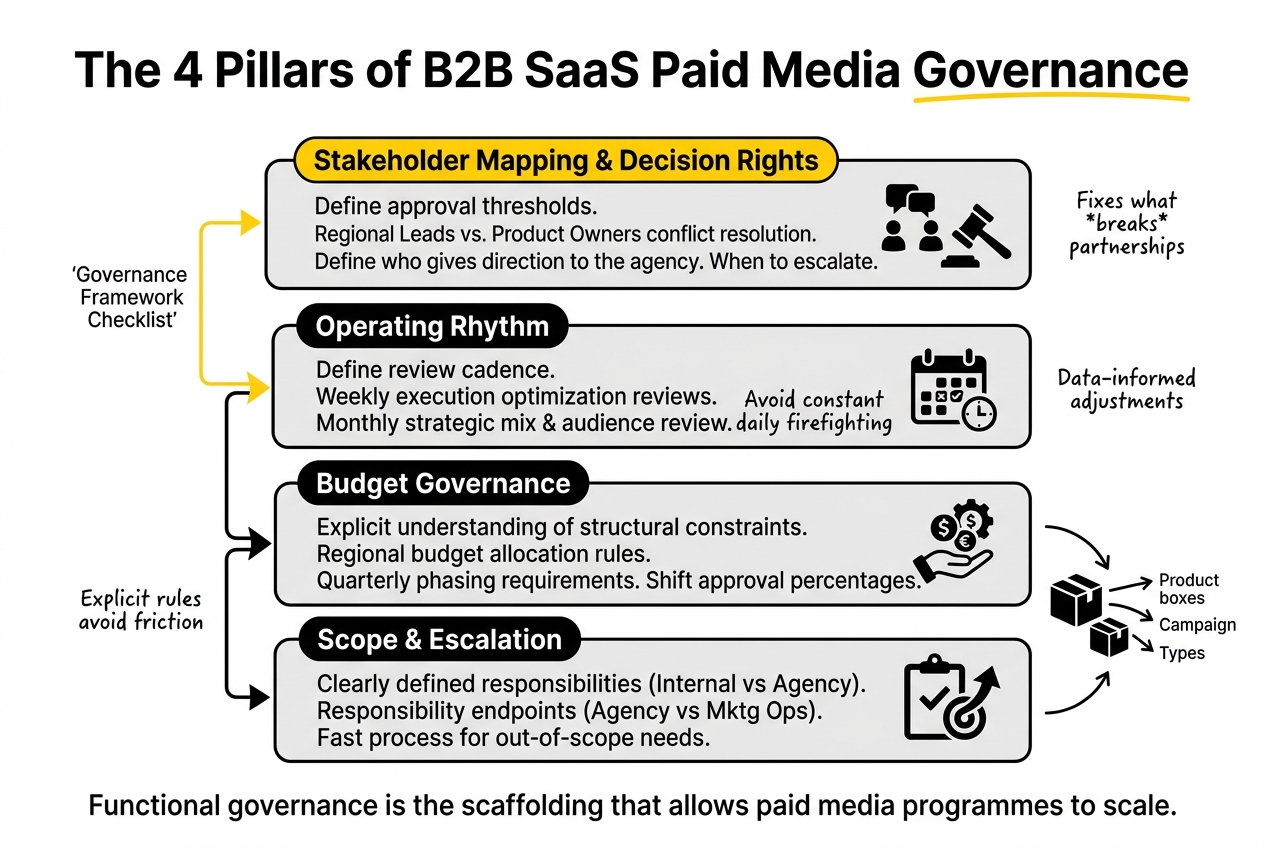
A functional governance framework for a mid-market SaaS paid media partnership covers four areas.
Stakeholder mapping and decision rights. Who approves what, and at what threshold? A regional marketing lead and a product owner will sometimes have conflicting views on campaign priorities. The governance model should define how those conflicts get resolved before they land in a weekly call. The agency should know who they take direction from, and when they need to escalate.
Operating rhythm. Daily stand-ups create noise. Monthly reviews are too slow. A weekly optimisation review plus a monthly strategic review tends to work well for mid-market programmes running across multiple channels. The weekly cadence keeps execution on track. The monthly session is where you look at what the data is saying about channel mix, audience performance, and ICP fit, and make adjustments with enough context to do it well.
Budget governance. Mid-market SaaS teams often manage budgets that sit across multiple cost centres or regions. The agency needs to understand not just the total budget but the structural constraints around it. Regional budgets that cannot be reallocated, quarterly phasing requirements, approval thresholds for budget shifts above a certain percentage. These constraints affect what the agency can do. Making them explicit upfront saves significant friction later.
Scope and escalation. What is in scope for the agency, and what is handled internally? Where does the agency’s responsibility end and the marketing ops team’s begin? When something outside the agreed scope comes up, how quickly can it be addressed? These sound like administrative details but they determine whether the partnership operates smoothly under pressure.
Reporting Strategies That Hold Up in Board Meetings
Attribution will never be perfect. The goal is consistent, directional data that points clearly toward what is driving pipeline and what is not.
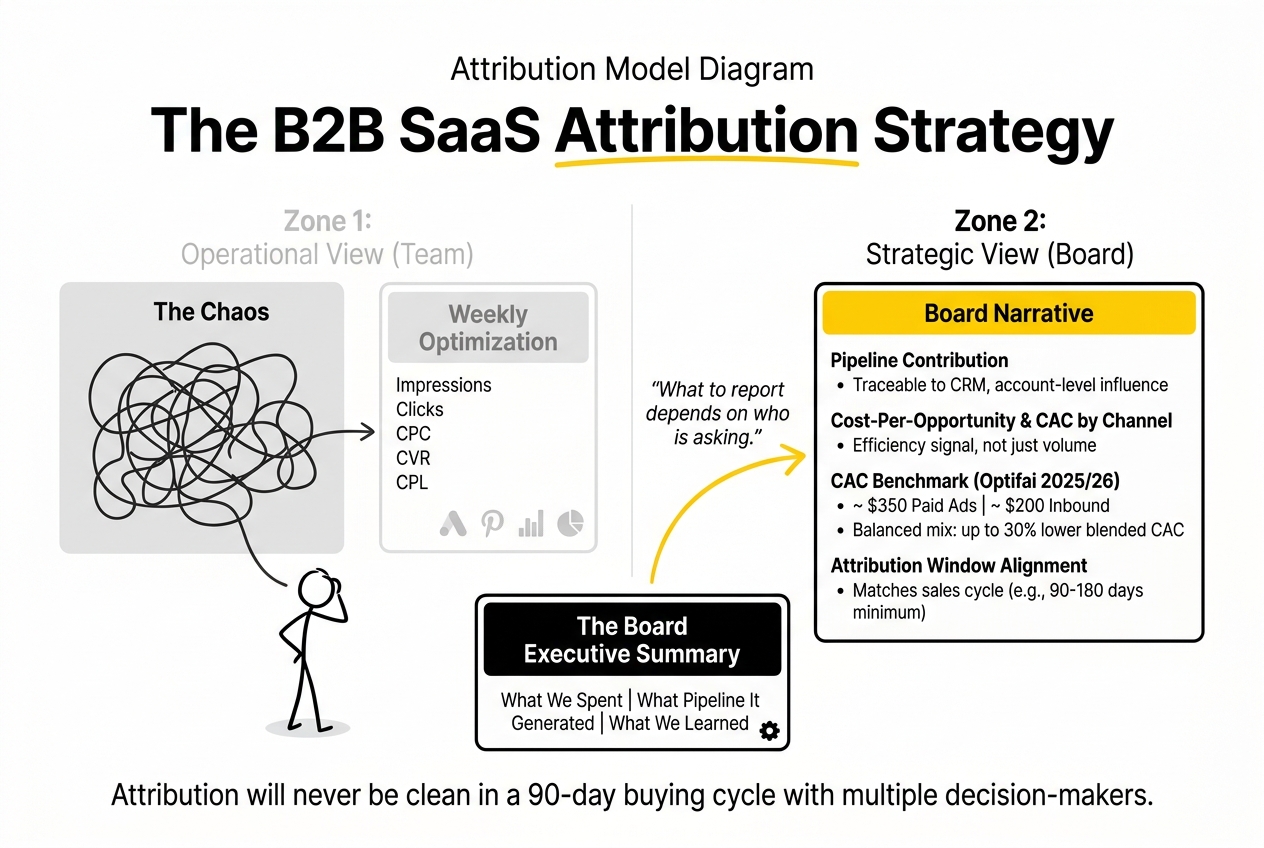
For a data-driven SaaS CMO managing a board relationship, reporting has two separate jobs. One is operational: giving the team the visibility to optimise campaigns week to week. The other is strategic: building the board-level narrative that links paid media investment to pipeline and revenue outcomes. These require different metrics and different cadences.
Most agencies default to operational reporting because it is what the platforms produce. Impressions, clicks, cost-per-click, conversion rates, cost-per-lead. These have their place in a weekly optimisation review. They should not be the primary lens for a board conversation.
Reporting strategies for SaaS marketing teams need to be built around the metrics that connect to business outcomes.
Pipeline contribution. How much of current sales pipeline can be traced back to paid media touchpoints? This requires CRM integration, not just platform data. For mid-market SaaS with deals that involve multiple stakeholders and a buying committee, this means tracking account-level influence, not just individual lead conversions.
Cost-per-opportunity and CAC by channel. Cost-per-lead is the wrong unit of measurement. It optimises for volume at the top of the funnel without any signal about downstream quality. Cost-per-opportunity connects paid media spend to sales-qualified pipeline. CAC by channel, calculated over a rolling window that respects your actual sales cycle length, tells you which channels are efficient and which are expensive. Research from Optifai’s 2025-2026 benchmark study across 939 B2B companies found that paid ads average approximately $350 CAC compared to inbound at $200, and that companies with a balanced channel mix see up to 30% lower blended CAC than those over-indexed on a single channel. These are directional benchmarks. What matters for your board narrative is your own trend data over time.
Attribution window alignment. A 30-day attribution window applied to a 90-day sales cycle produces nonsense data. You will see 10-15% of actual returns in the attribution report and conclude that paid media is underperforming, when in fact the pipeline is still in flight. Set your attribution windows to match your median sales cycle. For mid-market SaaS with ACV above $20,000, a 90-180 day window is typically the minimum required to capture a meaningful portion of influenced deals.
Board narrative structure. The board does not need the full attribution model. It needs three things: what we spent, what pipeline it generated, and what we learned. A simple three-line executive summary at the top of each board pack, followed by one page of supporting data, is more useful than a 40-slide deck that requires a PhD to interpret.
Channel Mix Optimisation for Mid-Market SaaS
Channel mix for mid-market SaaS is not a universal formula. It depends on your ACV, sales cycle, ICP, and the maturity of your demand capture versus demand creation capability. That said, there are patterns that consistently work and traps that consistently fail.
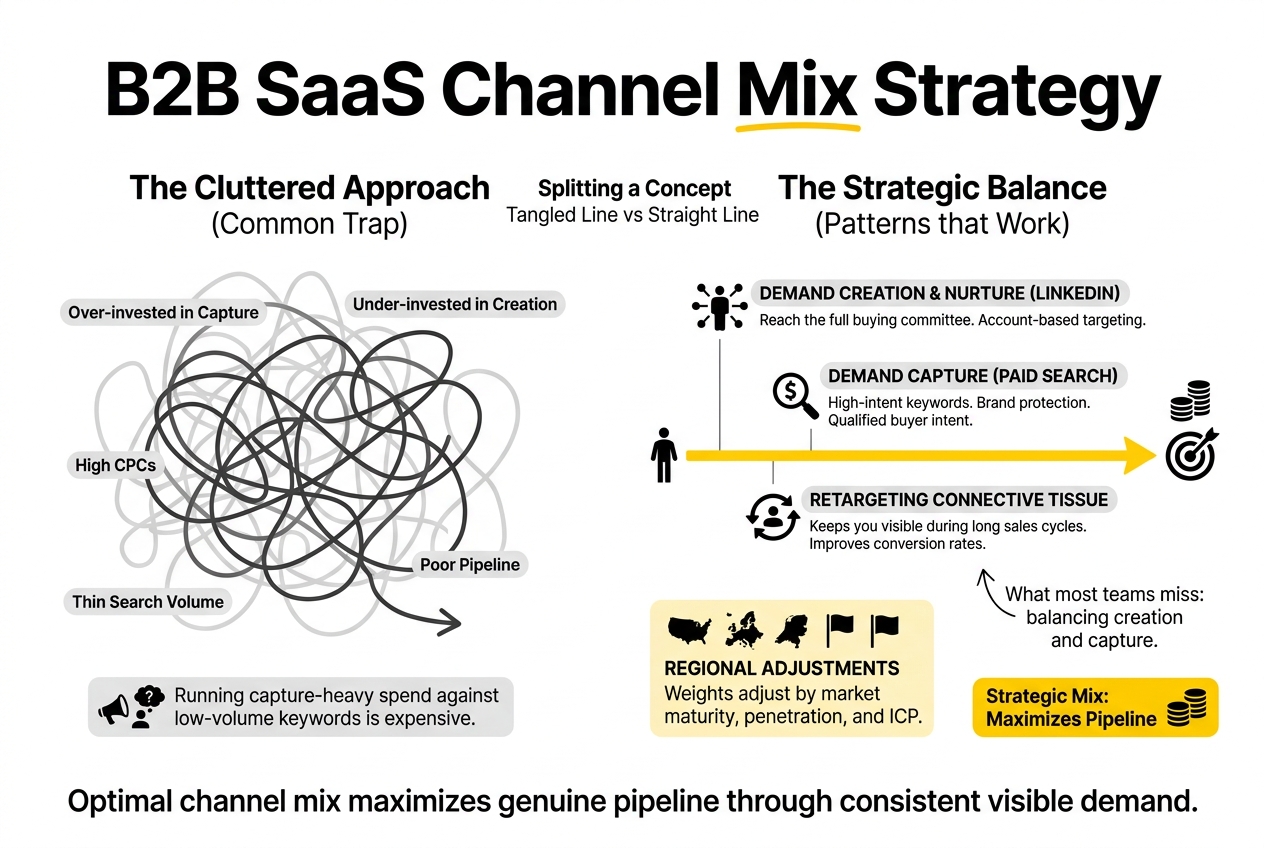
The capture-creation balance. The most common mistake at mid-market stage is over-investing in demand capture (paid search, high-intent keywords, competitor terms) while underinvesting in demand creation (LinkedIn, content amplification, upper-funnel brand). Capture works well when there is sufficient search demand for your category. For many mid-market SaaS products targeting a specific vertical or use case, that search volume is thin. Running capture-heavy spend against low-volume keywords drives up CPCs without generating meaningful pipeline. The paid media agency for complex teams needs to understand this dynamic and structure the channel mix accordingly.
LinkedIn for the buying committee. Mid-market B2B SaaS deals typically involve more than one decision-maker. LinkedIn advertising, used correctly, reaches multiple members of the buying committee through account-based targeting before and during an active opportunity. It also influences deals that are already in the sales cycle by keeping the company visible at the account level. Its weakness is direct attribution, precisely because it operates further up the funnel. An agency that dismisses LinkedIn because the CPA looks poor relative to paid search is measuring the wrong thing.
Paid search for high-intent and brand protection. Non-brand paid search is most effective when the category has sufficient search volume, the keywords align closely with qualified buyer intent, and the landing page converts. Brand search is almost always worth the investment: it protects against competitors bidding on your brand terms and ensures your own pipeline is not cannibalised by competitive ads. For mid-market SaaS, a typical channel allocation that functions well positions paid search as the demand capture mechanism and LinkedIn as the demand creation and nurture layer.
Retargeting as the connective tissue. With a 90-180 day sales cycle, buyers will visit your site, leave, and come back several times before converting. Retargeting, across both display and paid social, keeps you visible during that cycle. It is not a primary acquisition channel but it meaningfully improves conversion rates across the funnel.
Regional targeting in paid media. For mid-market SaaS companies with regional targets across multiple territories, channel mix often needs to vary by market. LinkedIn penetration, Google search volume, and ICP concentration differ significantly between, say, the US enterprise market and Northern European mid-market. A well-structured regional paid media strategy adjusts channel weighting, bid strategies, and creative to reflect these differences rather than applying a single global framework to all regions.
Managing Stakeholder Complexity Without Slowing Everything Down
Stakeholder complexity in SaaS is one of the least-discussed challenges in paid media management, and one of the most practically significant. A mid-market SaaS company with multiple product lines, a regional structure, and a matrix of product owners, regional leads, and a central marketing function is a genuinely difficult environment to run efficient paid media inside.
The agency’s job is to absorb some of that complexity and translate it into coherent campaign execution. A good paid media agency for complex teams builds this capacity deliberately, not as an add-on. Practically, this means a dedicated account lead with genuine seniority (not a junior account manager and a senior contact who appears once a quarter), a structured approach to brief intake that routes internal stakeholder requests through a consistent process, and clear communication protocols that do not require the CMO to act as a permanent intermediary.
What it does not mean is waiting for complete internal alignment before executing. Mid-market SaaS organisations move at pace. Campaigns need to run and optimise while internal conversations are still happening. The governance model needs to accommodate this: defining what the agency can act on independently, within agreed parameters, and what requires explicit approval before proceeding.
Digital advertising for mid-market SaaS is expensive enough that slow decision cycles cost money. CPC costs on non-brand paid search rose approximately 29% year-on-year through 2025 (per Upraw Media’s CAC benchmark analysis). Campaigns that sit in internal review for two weeks while budget accrues are a direct cost.
What Good Agency Accountability Looks Like
Performance metrics for SaaS marketing mean different things at different stages of a partnership. In the first 90 days, the right metrics are about setup quality: is CRM integration working, are conversion events firing correctly, is the channel architecture structured to support the attribution model? Optimising for pipeline contribution before the measurement foundation is solid produces misleading numbers.
From month four onwards, the accountability metrics shift to outcomes: cost-per-opportunity trend, pipeline contribution by channel, MQL-to-SQL ratio, and CAC payback. These should be reviewed monthly with the agency, not just received as a report. The review should include the agency’s own read on what is working and what needs to change, not just a retrospective on the numbers.
Accountability also means the agency being willing to flag performance problems before you find them. An agency that only surfaces positive data and hedges on why pipeline is not converting is not a functional partner. SaaS marketing agency best practices include proactive identification of issues: an honest assessment of what a campaign is not delivering, with a clear hypothesis and a proposed test to address it.
Aligning Brand and Performance in Complex Organisations
The brand-versus-performance tension is real in mid-market SaaS, and it gets more acute when you have multiple product lines with different competitive positions. Performance teams optimise for conversion. Brand teams optimise for perception. When they operate from separate briefs with separate budgets, you end up with paid media campaigns that actively contradict the company’s positioning.
The CMO’s job is to make sure the agency understands the brand positioning for each product line, not as a background document that gets filed and forgotten, but as a live input to creative direction, audience targeting, and messaging hierarchy. Strategic guidance for SaaS CMOs managing complex organisations means enforcing consistency at the positioning layer even as the performance layer optimises for conversion.
Practically, this means the agency receives a positioning brief for each product line before campaigns go live, creative approvals run through a process that checks for positioning consistency, and campaign messaging is reviewed at the monthly strategic session alongside the performance data.
Frequently Asked Questions
What should mid-market SaaS teams expect from their paid media agency partners?
Expect more than campaign execution. A functional paid media partner for mid-market SaaS should bring a governance framework for managing stakeholder complexity, reporting that connects spend to pipeline rather than just platform metrics, and an operating rhythm that keeps execution moving without requiring constant CMO involvement. The right agency understands long sales cycles and builds attribution and measurement infrastructure accordingly. If your agency cannot explain how they track pipeline contribution, that is the first conversation to have.
How can governance frameworks improve collaboration between SaaS teams and paid media agencies?
Governance removes the ambiguity that creates friction in complex organisations. A clear governance framework defines decision rights (who approves what), operating cadence (weekly tactical reviews plus monthly strategic sessions), budget protocols (thresholds, phasing, reallocation rules), and scope boundaries (what the agency owns versus what sits internally). With these in place, the agency can move faster and the internal team spends less time managing the relationship and more time on strategy.
What reporting metrics are essential for SaaS CMOs when working with paid media agencies?
The metrics that matter at the board level are cost-per-opportunity, pipeline contribution by channel, CAC by channel on a rolling window that matches your sales cycle, and MQL-to-SQL ratio. Impressions, CTR, and cost-per-lead belong in the weekly operational review, not the board pack. Insist on CRM-integrated reporting from the outset. Without it, the data your agency produces reflects platform conversions, not actual pipeline.
How does channel mix impact the performance of mid-market SaaS companies?
Channel mix determines whether paid media creates net-new demand or simply captures demand that already exists. Mid-market SaaS teams that over-index on paid search without sufficient demand creation (typically LinkedIn, content amplification, upper-funnel brand) hit a ceiling quickly. The addressable search volume for a specific SaaS category is often thinner than it appears. A channel mix that combines paid search for high-intent capture with LinkedIn for buying committee influence and retargeting to maintain visibility across the sales cycle tends to outperform single-channel approaches.
What are the unique challenges faced by data-driven CMOs in the SaaS sector?
The main challenges are attribution across long sales cycles, stakeholder complexity in matrixed organisations, and the tension between brand positioning and performance pressure. On attribution: a 30-day conversion window applied to a 90-day sales cycle systematically undervalues paid media and distorts channel mix decisions. On stakeholder complexity: multiple product lines and regional targets create competing priorities that an agency without strong governance support will struggle to navigate. On brand versus performance: without deliberate alignment at the positioning layer, paid media creative often diverges from brand positioning over time.
How can attribution be effectively managed in long sales cycles for SaaS products?
Set your attribution windows to match your median sales cycle. Use multi-touch attribution rather than last-click or first-touch models. Integrate your paid media platforms with your CRM so that offline conversions (demos, sales calls, opportunities) are fed back into bidding algorithms. Track pipeline and closed-won revenue as the primary attribution metrics, not form fills.
What role does stakeholder complexity play in selecting a paid media agency for SaaS?
It is one of the most important selection criteria and one of the least discussed. An agency that works well with a single stakeholder and a clear brief will struggle inside a matrixed organisation with competing priorities and multiple approval layers. When evaluating agencies, ask directly how they manage multi-stakeholder environments: what their intake process looks like, how they handle conflicting briefs from different internal teams, and what their escalation model is. The answer tells you more about operational fit than their case studies do.
How can a coherent narrative be developed for board reporting in SaaS companies?
Start with the business objective, not the campaign data. The board cares about pipeline and revenue, not impressions and CTR. Structure your board narrative around three questions: what did we invest, what pipeline did it generate, and what are we changing based on what we learned. One page of supporting data is sufficient. Resist the temptation to include every metric the agency produces. A focused narrative with three clear data points is more credible than a 40-slide deck that requires interpretation.
What strategies can help align brand positioning with performance metrics in paid media campaigns?
Provide the agency with a positioning brief for each product line before campaigns launch. Run creative through an approval process that checks for positioning consistency alongside conversion effectiveness. Review campaign messaging at the monthly strategic session alongside performance data. When performance optimisation is pushing creative in a direction that diverges from positioning, name the tension explicitly and make a deliberate decision about the trade-off rather than letting optimisation drift quietly override positioning.
How can mid-market SaaS companies ensure accountability from their paid media partners?
Define the accountability metrics before the engagement starts, not three months in. Insist on CRM integration and pipeline-based reporting from day one. Build a monthly strategic review into the operating model where the agency presents its own assessment of what is working and what needs to change. Flag proactively if the agency only surfaces positive data. A functional agency partner identifies performance problems before you find them and brings a clear hypothesis and test plan rather than a post-hoc rationalisation.
The right paid media agency for a mid-market SaaS team is not necessarily the one with the strongest technical capabilities. It is the one that can operate effectively inside a complex organisation, build reporting that serves a board-level audience, and hold itself accountable to pipeline outcomes rather than platform metrics.
If you are working through the governance and reporting side of an agency partnership, we are happy to take a look at your current setup and walk through what we have seen work in similar organisations.