LinkedIn vs Meta: Optimising Your SaaS Pipeline Strategy
How LinkedIn and Meta each fit into B2B SaaS pipeline creation, and how to split budget between them for demand generation.

It comes up in almost every demand gen budget meeting. LinkedIn clicks cost three to five times what Meta charges, the cost per lead looks brutal next to Meta's, and someone asks the obvious question: why are we not just running Meta?
The honest answer is not "LinkedIn is better" or "Meta is cheaper." It is that the two platforms do different jobs, and the cost comparison that makes Meta look like the easy choice is measuring the wrong thing. Pick between them on cost per lead alone and you will reach the wrong conclusion with great confidence.
This is a side-by-side look at LinkedIn vs Meta for SaaS demand generation: what each channel is actually for, where each fits in pipeline creation and educating buying committees, and how to split budget between them. The aim is to help you decide channel allocation on the evidence rather than on whichever platform posted the lower CPL last month. If you would rather hand the execution to specialists, our saas paid social agency work is built around this; if you are working through the strategy yourself, read on.
The core difference: precision versus reach
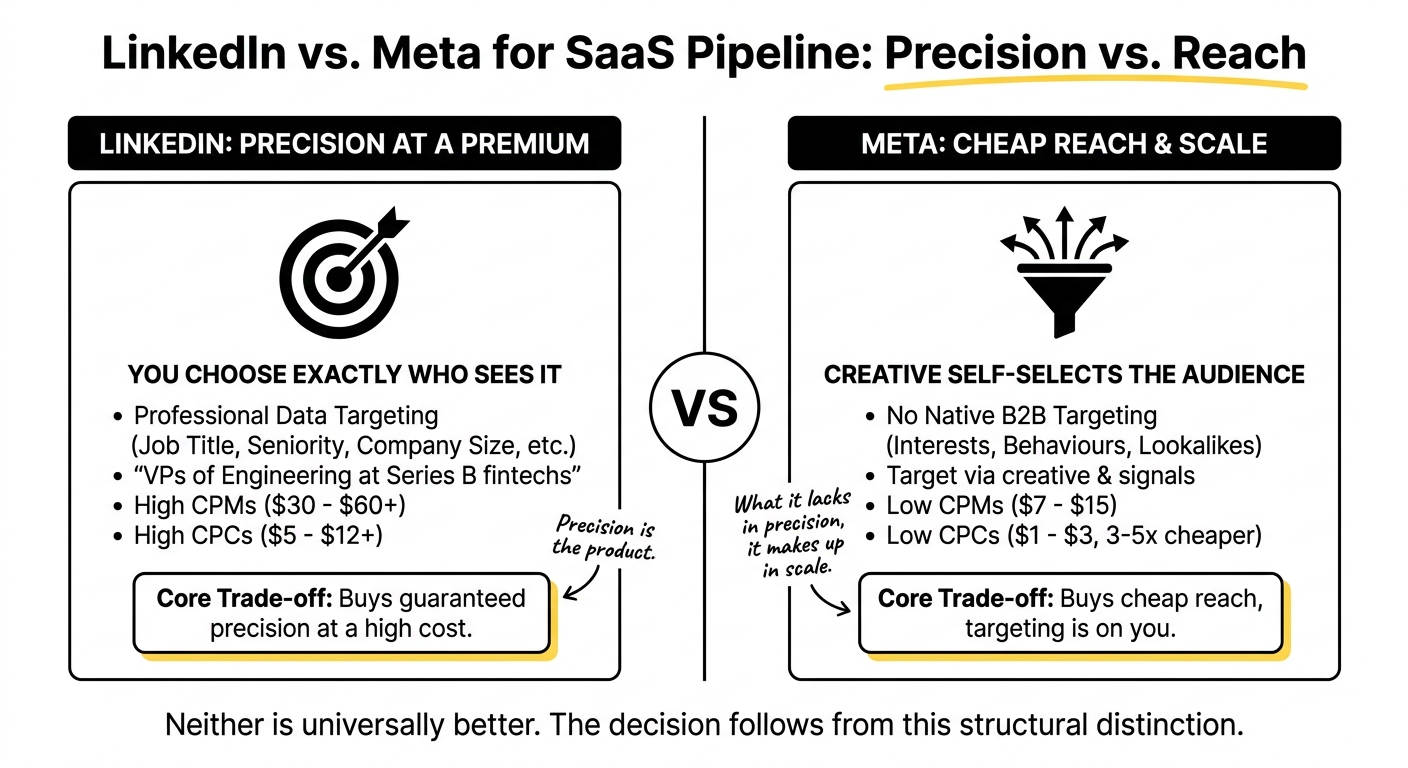
Comparing LinkedIn and Meta for SaaS pipeline starts with one structural distinction. LinkedIn lets you choose exactly who sees the ad. Meta makes you find your audience, but at a fraction of the price.
LinkedIn's targeting is built on professional data: job title, seniority, function, company, industry, and company size. You can put an ad in front of VPs of Engineering at Series B fintechs and almost no one else. That precision is the product, and you pay for it. LinkedIn CPMs typically run around $30 to $60 and CPCs around $5 to $12, climbing higher for C-suite targeting.
Meta has no real native B2B targeting. You reach people through interests, behaviours, lookalikes, and above all creative that self-selects the right audience. What Meta lacks in precision it makes up in cost and scale: CPMs around $7 to $15 and CPCs often in the $1 to $3 range, which is roughly three to five times cheaper per click and several times more reach per pound spent.
So the headline trade-off is simple. LinkedIn buys precision at a premium. Meta buys reach cheaply but leaves the targeting to your creative and your signals. Neither is universally better, and the rest of the decision follows from that.
Why cheaper leads can cost more
The Meta objection, that it delivers leads at a third of LinkedIn's cost, is real on the surface and misleading underneath. Cost per lead is not cost per customer, and in B2B SaaS the gap between the two is enormous.
Consider the arithmetic. Say a LinkedIn lead costs £150 and converts to a qualified opportunity at 20%. That is £750 per opportunity. A Meta lead at £50 that converts at 3% is over £1,650 per opportunity. The platform that looked three times cheaper is more than twice as expensive once you measure what actually matters. LinkedIn leads tend to convert from MQL to SQL at materially higher rates than paid social leads from broad targeting, precisely because the targeting pre-qualifies them.
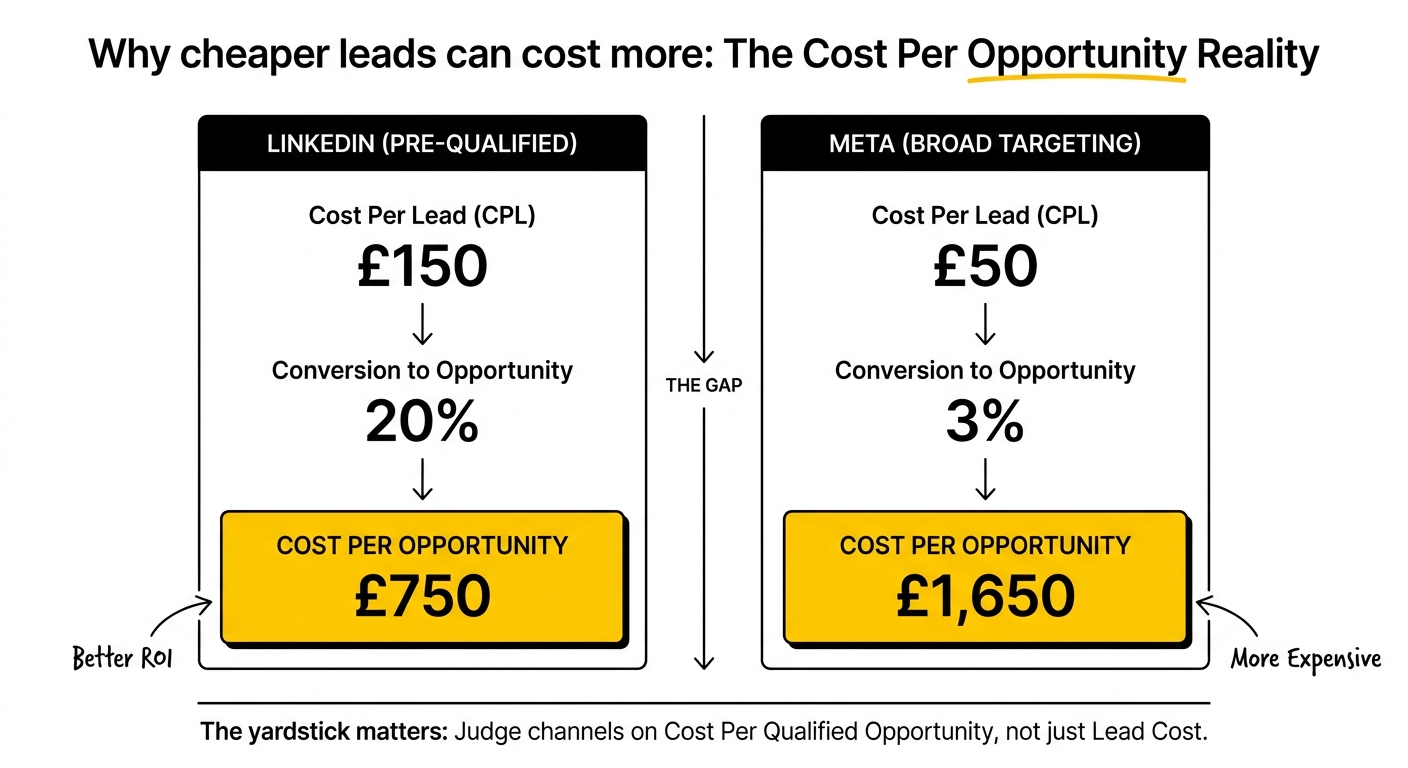
This is not an argument that Meta is bad. It is an argument that cost per lead is the wrong yardstick. Judge both channels on cost per qualified opportunity and influenced pipeline. On that basis, Dreamdata's 2026 benchmarks found LinkedIn to be the only major paid channel delivering positive return on a full-cycle revenue basis, at around 121% ROAS, well ahead of Google Search and roughly double Meta's. The catch in that finding is the phrase full-cycle, and it cuts in Meta's favour too, as the next sections explain.
Where LinkedIn fits: precision and pipeline creation
LinkedIn earns its premium when who sees the ad matters more than how many people see it. Its natural jobs in a SaaS demand generation strategy are:
- Reaching named decision-makers and buying committees. When your ICP is specific and your ACV is high, paying to reach exactly the right ten job titles at the right accounts is efficient, not expensive.
- Pipeline creation against a defined ICP. LinkedIn is where you create demand among the people who can actually buy, rather than among a broad audience you hope contains them.
- Account-based demand generation. For demand generation ABM against a named account list, LinkedIn's targeting is close to unmatched.
- Bottom-funnel conversion. Where precision justifies the cost, LinkedIn converts qualified decision-makers more reliably than cheaper, looser channels.
Formats matter here. Thought Leader Ads and Document Ads consistently outperform standard single-image Sponsored Content on engagement and cost, so a LinkedIn budget poured entirely into single-image ads is usually leaving efficiency on the table. Lead in with LinkedIn when you sell a high-ACV product to a well-defined ICP and need to reach specific roles.
Where Meta fits: reach, retargeting, and educating at scale
Meta's weakness in B2B is targeting precision. Its strengths are reach, cost, and the formats that educate a buying committee over time. Used for what it is good at, it is a genuinely valuable B2B channel rather than a cheaper substitute for LinkedIn.
- Retargeting is Meta's strongest B2B use case. Reaching your website visitors, video viewers, and lead-form openers again, at very low cost, is where Meta quietly outperforms. The audience is already warm, so the lack of native B2B targeting stops mattering.
- Cheap reach for awareness and education. Meta is an efficient place to build category understanding and brand familiarity at scale, the demand-creation work that pays off later as branded search and inbound.
- Video and Reels for thought leadership. Short video is cheaper per impression on Meta than almost anywhere and works well for the educational content that nurtures a committee across a long cycle.
- Lower-cost registrations. For webinars, guides, and other content offers, Meta frequently beats LinkedIn on cost per registration, which matters for top-of-funnel volume.
The honest weakness: cold prospecting to a precise B2B audience is not Meta's game. Without strong creative, good signals, and a retargeting layer, cold Meta spend for B2B leaks budget to the wrong people. Meta earns its place on warm audiences and creative-led reach, not on trying to imitate LinkedIn's targeting.
How to use LinkedIn and Meta together
The best channels for SaaS pipeline are rarely one or the other. The two work better as a layered, full-funnel pairing than as competing line items, because each covers the other's weakness.
A workable division of labour:
- Meta for cheap top-funnel reach and education, building brand familiarity and category understanding with video and content at a cost LinkedIn cannot match.
- Meta for retargeting across the funnel, re-engaging warm audiences, including people who engaged with your LinkedIn ads, at a fraction of LinkedIn's retargeting cost.
- LinkedIn for precise decision-maker targeting and ABM, reaching the specific roles and named accounts that broad targeting would miss.
- LinkedIn for bottom-funnel conversion, where reaching qualified buyers justifies the premium.
The sequencing writes itself: Meta creates cheap awareness and warms an audience, LinkedIn reaches and converts the decision-makers within it, and Meta retargets the engaged for far less than doing the same on LinkedIn. Set budgets by working backward from your pipeline target, not by chasing the lowest channel CPL.
If resource constraints mean you can only commit to one channel first, let ACV decide. High ACV with a tightly defined ICP points to LinkedIn first. Lower ACV, a broader audience, or a product-led motion lets Meta carry more of the load. Whichever you start with, run small, iterate fast on creative and audience, and judge results on downstream conversion rather than on the first week's cost per lead.
Measuring both channels honestly
The persona-level worry, that paid social is hard to attribute and justify, is well founded, and it applies to both platforms equally. LinkedIn and Meta are largely demand-creation channels, and demand creation does not convert on last click.
Dreamdata's 2026 data puts numbers on the problem: the average B2B journey runs to dozens of touchpoints across multiple channels and roughly ten stakeholders, and can take the better part of a year from first LinkedIn impression to closed revenue. Any short-window, last-click view will therefore underrate both channels, crediting the branded search or direct visit that closed the loop while ignoring the paid social that created the demand. This is the same MQL trap Refine Labs has long flagged: optimise to cheap leads and you hit your lead target while sales misses quota.
The fix is to measure both channels on influenced pipeline and cost per qualified opportunity over a realistic window, not on cost per lead in-month. We go deeper into the measurement mechanics in our companion pieces on attributing channel influence across long sales cycles and on measuring upper-funnel demand gen beyond last click.
A practical framework for channel selection
A sequence a demand gen team can run this quarter:

The teams that get the most from paid social are not the ones who picked the right platform. They are the ones who understood that LinkedIn and Meta do different jobs and funded each to do the job it is good at.
If you are weighing this up, deciding how to split a finite paid social budget across LinkedIn and Meta without wasting a quarter finding out, this is the kind of thing we work through with SaaS demand gen teams. Worth a conversation if you are at that point.
Frequently Asked Questions
What are the unique strengths of LinkedIn for B2B SaaS pipeline creation?
LinkedIn's strength is precision: targeting by job title, seniority, function, company, and industry, so you reach the exact decision-makers and buying committees that fit your ICP. That precision pre-qualifies leads, which is why they convert from MQL to SQL at higher rates than broadly targeted paid social. It is the strongest channel for account-based demand generation and for high-ACV products where reaching the right roles matters more than reaching many people.
How does Meta compare to LinkedIn in terms of retargeting capabilities for SaaS companies?
Retargeting is Meta's strongest B2B use case. It re-engages warm audiences, website visitors, video viewers, and lead-form openers, at a small fraction of LinkedIn's cost, and because the audience is already warm, Meta's lack of native B2B targeting stops being a problem. LinkedIn retargeting works too, but Meta usually delivers the same warm-audience touch far more cheaply, which makes it the more efficient retargeting layer for most SaaS teams.
What are the key challenges faced by demand generation leaders when using LinkedIn and Meta?
The main challenges are resource constraints, the pressure to iterate fast and show clear learnings, and the difficulty of connecting upper-funnel paid social to pipeline and revenue. Both channels create demand that converts much later through other channels, so last-click attribution underrates them, making ROI hard to prove and budget hard to defend without full-funnel measurement.
How can SaaS companies optimise their paid social strategies on LinkedIn?
Target by specific job titles and seniority rather than broad demographics, use exclusions to cut waste, and lean on higher-efficiency formats like Thought Leader Ads and Document Ads instead of defaulting to single-image ads. Most importantly, optimise toward qualified pipeline rather than cheap leads: integrate LinkedIn lead data with your CRM and judge campaigns on cost per qualified opportunity, not cost per form fill.
What are the best practices for using Meta to educate buying committees in the SaaS space?
Use Meta's cheap reach and video formats to deliver educational content that builds category understanding over time, and layer retargeting so engaged prospects keep seeing your message across the cycle. Lead with creative that self-selects your audience, since Meta's targeting is imprecise, and treat it as a demand-creation and nurture channel measured on downstream pipeline rather than on immediate conversions.
What metrics should SaaS companies track to measure the effectiveness of LinkedIn and Meta?
Track cost per qualified opportunity, influenced and sourced pipeline, and MQL-to-SQL conversion rate by channel, rather than cost per click or cost per lead. Because the B2B journey spans many touchpoints and months, measure over a window that matches your sales cycle and use multi-touch or influenced-pipeline attribution. CPC and CPL are useful diagnostics but poor success measures on their own.
How do LinkedIn and Meta differ in terms of audience targeting for B2B SaaS?
LinkedIn targets on professional data: job title, seniority, function, company, and industry, so you select your audience directly. Meta has no real native B2B targeting and instead reaches people through interests, behaviours, lookalikes, and creative that self-selects the right viewers. LinkedIn gives precision at a premium; Meta gives cheap reach and relies on your creative and retargeting signals to find the right people.
What are the potential weaknesses of using Meta for SaaS pipeline generation?
Meta's main weakness is targeting precision: cold prospecting to a specific B2B audience is unreliable without strong creative, good signals, and a retargeting layer, so cold spend can leak budget to the wrong people. It can also generate cheap leads that look efficient but convert poorly, which is why it works best for reach, education, and retargeting rather than precise decision-maker targeting.
How can demand generation managers effectively allocate budget between LinkedIn and Meta?
Allocate by the job each channel does, not by comparing CPLs. Use Meta for cheap top-funnel reach, education, and retargeting, and LinkedIn for precise decision-maker targeting, ABM, and bottom-funnel conversion. Set budgets by working backward from your pipeline target. If you can only fund one to start, let ACV decide: high ACV with a defined ICP favours LinkedIn, while broader or product-led motions let Meta carry more.
What actionable insights can be applied from successful SaaS campaigns on LinkedIn and Meta?
The consistent lessons: judge both channels on qualified opportunity and influenced pipeline, not cost per lead; use Meta for cheap reach and retargeting and LinkedIn for precision and conversion; lead with formats that perform (Thought Leader and Document Ads on LinkedIn, video and retargeting on Meta); and sequence them so Meta warms an audience that LinkedIn converts. Above all, measure over a window that matches the real sales cycle.