Optimising Paid Budget Allocation as SaaS Search Demand Saturates
Discover strategies for balancing high-intent search and upper-funnel education in B2B SaaS demand generation. Enhance lead quality and revenue outcomes.

Paid search is still working. CPCs are climbing, conversion rates are holding, and the pipeline looks fine on paper. Then, six months later, growth stalls. Not because the campaigns broke, but because you ran out of addressable demand to capture.
This is the saturation problem in SaaS paid media, and it arrives quietly. You have harvested the high-intent search volume in your category. You have retargeted your existing audience. You have matched or outbid competitors on every relevant keyword. And now, spending more on the same capture channels delivers diminishing returns rather than proportional pipeline growth.
The answer is not to abandon paid budget allocation for high-intent search. It is to understand what saturation signals look like, and to build a budget framework that responds to them by investing in the demand that does not yet exist in the auction.
What Search Demand Saturation Actually Looks Like
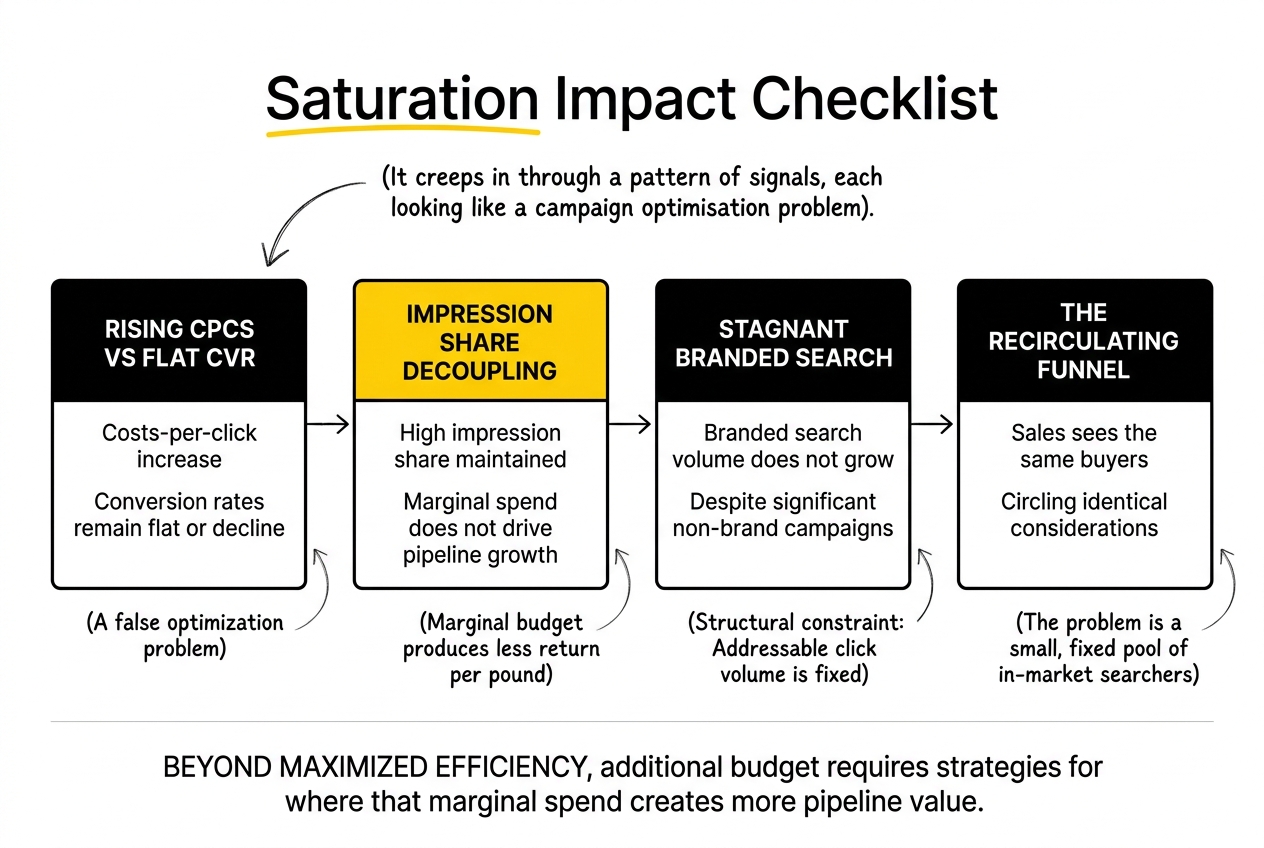
Search demand saturation is not a sudden cliff. It creeps in through a pattern of signals that, taken individually, each look like a campaign optimisation problem.
CPCs rise while conversion rates stay flat or decline. Your impression share is high, but incremental pipeline growth is not keeping pace with spend. Branded search volume is not growing even though you are running significant non-brand campaigns. And when you talk to sales, they are seeing the same buyers in the funnel, circling the same considerations.
The structural problem underneath these signals is a fixed pool. The number of people actively searching for your category of solution in any given month is finite. For most B2B SaaS categories, that in-market pool is small. Once your campaigns are efficiently capturing a large share of it, the only way to grow capture is to fight harder and more expensively for the same set of buyers.
This is not a SaaS-specific observation. SparkToro’s research with Datos found that only around 36% of US Google searches result in a click to the open web. The addressable click volume your paid search campaigns compete for is structurally constrained, independent of your campaign quality or budget.
The implication for paid budget allocation is direct: when you have maximised capture efficiency, additional budget in the same channel produces less return per pound spent. The question becomes where that marginal budget creates more pipeline value.
Why Most B2B SaaS Teams Reach Saturation Underprepared
The Forrester B2B Marketing Survey (2025) found that 74% of B2B marketing budgets go toward demand capture activities, with only 26% toward demand creation. That ratio is approximately the inverse of what the research suggests is optimal for sustained pipeline growth.
The reason teams end up in this position is rational in the short term. Capture channels are measurable. Last-click attribution ties spend directly to form fills, and form fills map to MQLs, and MQLs map to a pipeline number that appears in the board deck. Upper-funnel and educational initiatives do not produce the same clean attribution path, so they get deprioritised in favour of what is easy to defend.
The consequence is a programme that works well until the capture ceiling arrives, then stalls without any obvious lever to pull. Teams that have built only a capture programme cannot suddenly activate demand creation and expect near-term results. Demand creation compounds over months, not weeks. By the time saturation is obvious, the investment required to move the needle is larger and the timeline to impact is longer than if the work had started earlier.
Building demand creation capacity before you need it is the core budget allocation discipline. The teams that handle saturation well are the ones that started investing in upper-funnel education and long-cycle demand creation while capture was still performing.
A Framework for Budget Allocation as Saturation Sets In
There is no universal budget split that applies across every SaaS company, growth stage, or market position. What exists is a set of allocation principles that should govern how you respond to saturation signals, and a set of triggers that tell you when to act.
Start with a capture-weighted allocation, but build in structured review points.
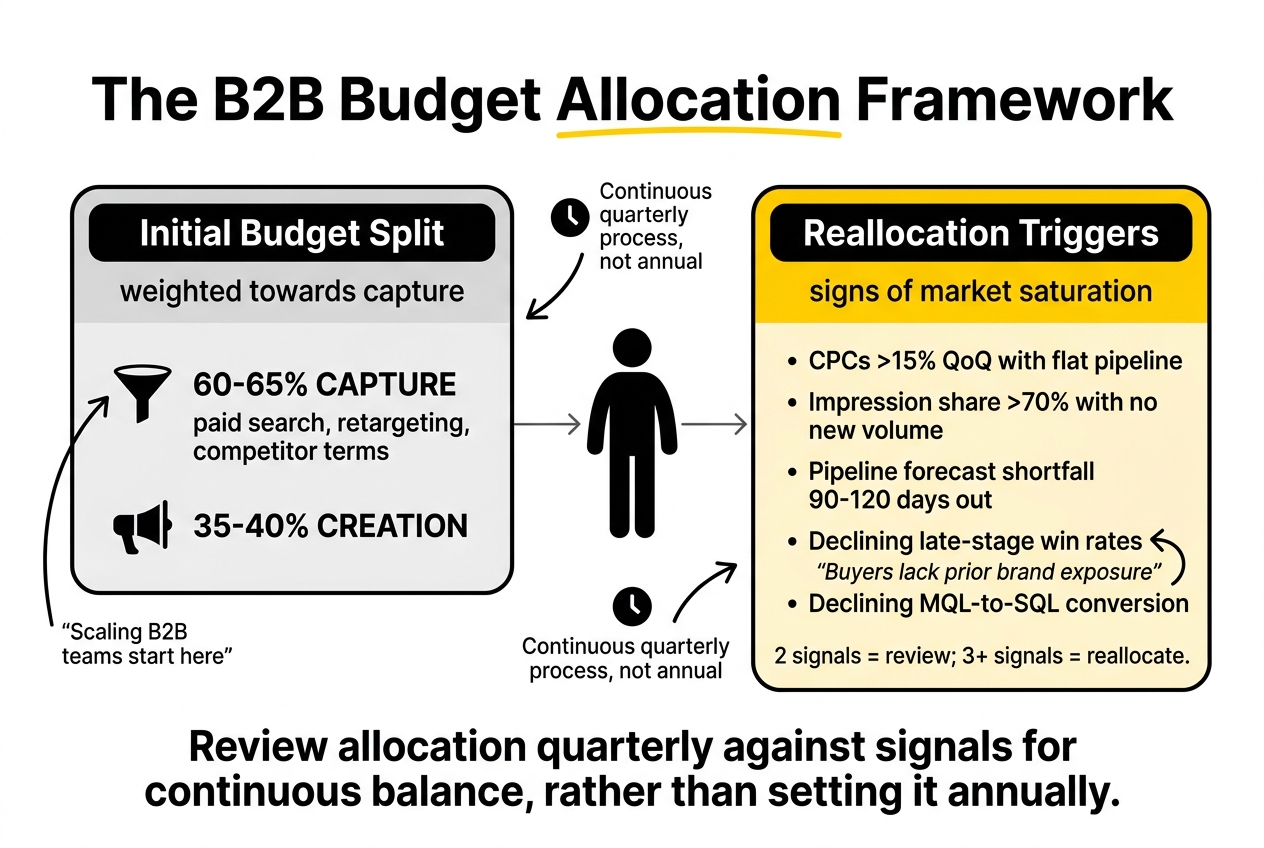
For most scaling B2B SaaS teams, the appropriate starting allocation is weighted toward capture: paid search, retargeting, and competitor-term campaigns that convert existing demand into pipeline. A reasonable starting position is 60 to 65% of paid budget in capture activity and 35 to 40% in demand creation and educational initiatives.
That starting ratio should shift over time as a function of two things: your saturation signals, and your stage of growth. A Series B company defending and expanding category ownership should expect to move toward a closer to 50/50 split, or even a creation-majority allocation in some competitive categories, as its capture campaigns approach full efficiency.
Use these signals to trigger a budget reallocation review:
- Paid search CPCs increasing more than 15% quarter-on-quarter while pipeline volume stays flat
- Impression share above 70% on core category terms with no meaningful volume left to capture
- Pipeline forecast shortfall appearing 90 to 120 days out without an obvious capture fix
- Win rates declining in late-stage deals, which suggests buyers are entering evaluation without sufficient prior brand exposure
- MQL-to-SQL conversion declining without changes to targeting or qualification criteria
Any two of these signals appearing simultaneously warrants a budget review. Three or more is a direct instruction to reallocate.
The reallocation is not a one-time event.
Budget allocation for b2b demand generation is a continuous process. Saturation pressure eases when new competitors enter and expand the total search volume in your category. It intensifies when your market matures and consolidates. Review allocation quarterly against these signals rather than setting it annually and hoping conditions hold.
What Upper-Funnel Education Actually Covers
Upper-funnel education is the paid investment that shapes buyer thinking before anyone opens a search tab. In practice, this means several distinct activities that demand generation leaders often underfund.
Paid social and content amplification. LinkedIn campaigns targeting your ICP by job title and company size, running educational content rather than product claims. The goal is not a form fill. It is brand exposure to buyers who are three to twelve months from an active evaluation, so that when they do search your category terms, your brand is in the consideration set before the first click.
Video and display prospecting. Google’s Demand Gen campaigns, running across YouTube, Discover, and Gmail, reach audiences that your paid search campaigns cannot. Google’s own data shows that 68% of Demand Gen conversions come from users who had not been exposed to the brand’s Search ads in the prior 30 days. This is incremental reach by design, not a substitute for search.
Thought leadership and gated research. Long-form content that answers the questions buyers are working through before they know your product exists. This differs from gated lead gen content because the goal is not an MQL. It is a future member of a buying committee who associates your brand with clarity and expertise in the category.
The measurement challenge is real. None of these activities produce the same clean attribution as a branded search campaign. The way to handle this is not to demand last-click proof from upper-funnel spend, but to track directional proxies: branded search volume growth, direct and dark social traffic trends, win rate trends on deals where buyers mention prior brand awareness, and pipeline forecast health at a 90 to 120 day lag.
Retargeting Strategy When Search Volume Saturates
Retargeting is often treated as a default allocation that receives spend automatically, without much active management. When search demand starts to saturate, retargeting deserves closer attention because its role in the budget changes.
In a growth phase where paid search is actively expanding your reach to new buyers, retargeting amplifies that reach by keeping your brand visible through the evaluation window. When capture is saturated, retargeting can become a recirculation machine: spending budget to reach the same pool of visitors repeatedly without generating incremental pipeline.
The discipline required is audience hygiene. Retargeting audiences should be segmented by recency and by behaviour signal. Visitors who landed on a pricing or comparison page in the last 14 days are high-intent and warrant more aggressive retargeting spend. Visitors who read a blog post six months ago and showed no further engagement are unlikely to respond, and including them inflates frequency without driving results.
At the point of saturation, a common reallocation move is to reduce retargeting budget applied to low-signal audiences and redirect it to paid social prospecting against net-new ICP accounts. This maintains pipeline velocity while expanding the top of funnel. The reallocation needs to be modelled against lag time: prospecting now builds pipeline in four to six months, not next quarter.
Connecting Demand Generation Budget to Revenue Outcomes
The hardest part of the upper-funnel investment conversation is attribution. Finance and leadership want to see which budget line produced which pipeline. Upper-funnel and educational spend resists that framing by design.
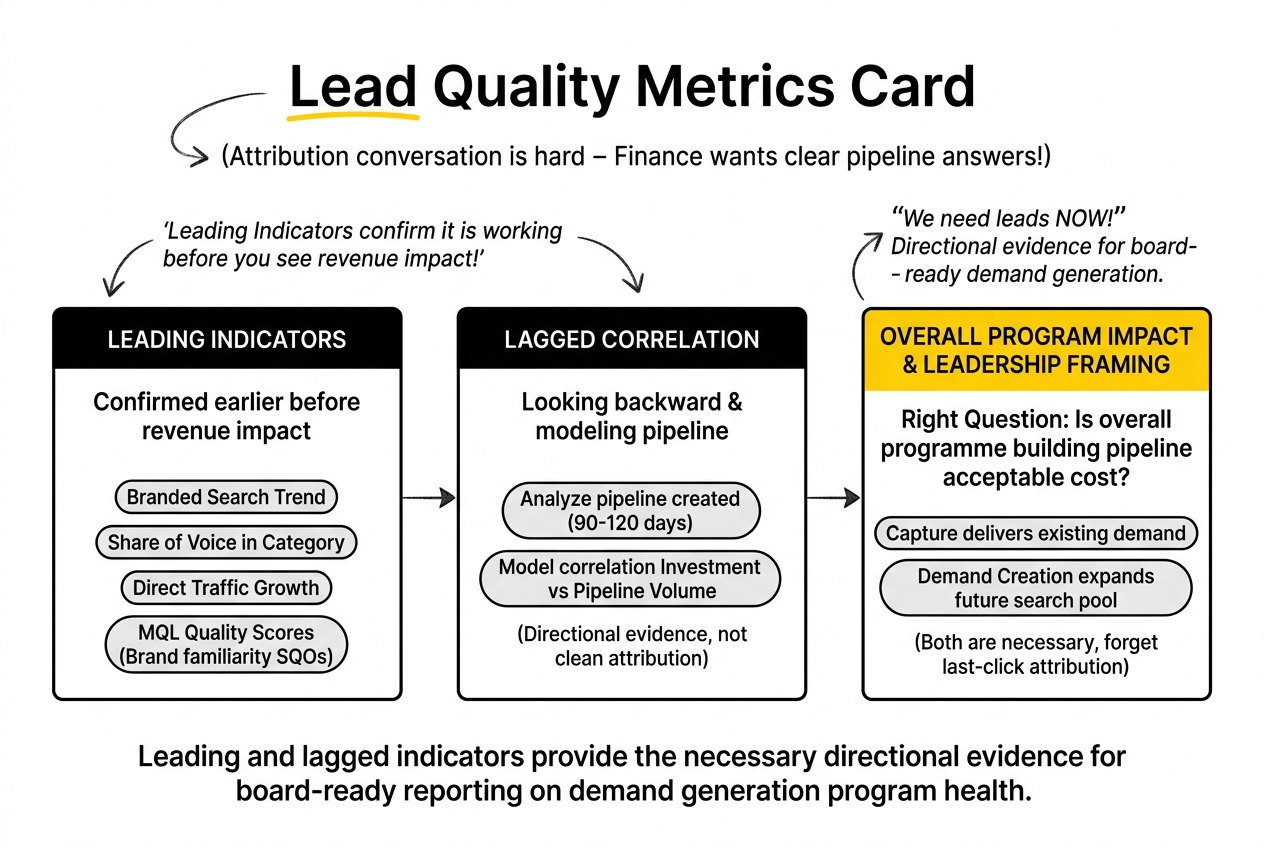
The most credible approach is a combination of leading indicators and lagged revenue correlation.
Leading indicators confirm the upper-funnel investment is working before you can see revenue impact. These include: branded search volume trend (are more people searching your brand name each month?), share of voice in category terms, direct traffic growth, and MQL quality scores from sales, specifically whether sales-qualified opportunities are coming in with greater prior brand familiarity.
Lagged pipeline correlation looks backward. When you model pipeline created 90 to 120 days after an upper-funnel campaign, can you identify a correlation between investment levels and pipeline volume that is not explained by capture activity alone? This is not clean attribution. It is directional evidence, and directional evidence is what board-ready reporting on demand generation actually requires.
The framing that holds up in board meetings is this: capture campaigns deliver pipeline from buyers who are already searching. Demand creation and upper-funnel education expand the pool of buyers who will eventually search. Both are necessary. The right question is not which channel produced the last click, but whether the overall programme is building pipeline at a cost that is acceptable against CAC payback targets.
For a deeper look at how to structure the demand generation side of this equation, our overview of saas demand generation covers the full-funnel programme structure in more detail.
Long-Cycle Demand Creation and the Compounding Argument
Long-cycle demand creation is the investment that most directly replaces organic search demand when the paid auction saturates. It operates on a different time horizon and requires a different budget justification.
The compounding argument is straightforward. A paid search campaign stops producing pipeline the moment you stop spending. A body of educational content, thought leadership, and community presence continues to generate awareness and pipeline contribution long after the initial investment. The longer you have been building it, the more efficient it becomes per pound of budget.
For Series B and later SaaS companies, this compounding dynamic is what separates teams that can weather paid search saturation from those that are structurally dependent on it. The B2B SaaS demand generation plan built entirely on capture spending has no hedge against auction inflation and no alternative pipeline source when the primary channel saturates.
The practical implication for demand generation budget adjustments: long-cycle demand creation should receive a protected allocation that is not subject to reallocation when capture campaigns underperform in a given quarter. If long-cycle spend is treated as discretionary, it will be cut every time short-term pipeline pressure arrives, which is precisely when you need the demand creation flywheel to be already in motion.
Practical Steps: Reviewing Your Budget Allocation Now
If you have read this far and the saturation signals described earlier are visible in your data, here is a structured approach to reviewing your allocation.
First, audit your capture efficiency. Pull impression share, search lost impression share, and CPC trend over the last six months by campaign type. If impression share on core terms is above 60% and CPCs are trending up with flat conversion rates, you are at or approaching saturation.
Second, map your pipeline source lag. Where is your pipeline coming from 90 to 120 days after upper-funnel activity? If almost all of it traces back to direct capture campaigns with minimal contribution from brand or educational content, your mix is unbalanced.
Third, identify your demand creation gap. What educational content exists for buyers at the problem-aware and solution-aware stages before they reach an active evaluation? If the honest answer is very little, that is the budget allocation gap.
Fourth, model the reallocation incrementally. A 10 to 15% shift of capture budget to demand creation and upper-funnel activity is a manageable test. Set a 90-day review point and measure leading indicators: branded search volume, direct traffic, and MQL quality scores from sales.
The goal is not to dismantle what is working. It is to build a budget allocation for paid advertising that does not become structurally dependent on a single channel with a finite ceiling.
Frequently Asked Questions
What are the best strategies for budget allocation in B2B SaaS demand generation?
The most effective budget allocation for B2B SaaS demand generation combines capture spending on high-intent search and competitor terms with a meaningful investment in upper-funnel education and long-cycle demand creation. The right split depends on growth stage and current saturation levels, but a 60/40 capture-to-creation starting point shifts toward parity as capture channels approach full efficiency. Review allocation quarterly against saturation signals rather than setting it annually.
How can demand generation leaders balance high-intent search activities with upper-funnel initiatives?
Use saturation signals as the primary guide. When CPCs are rising faster than pipeline is growing, impression share is high, or pipeline forecasts are softening 90 to 120 days out, it is time to shift marginal budget from capture toward upper-funnel education. Start with a 10 to 15% reallocation and measure branded search volume growth and MQL quality scores as leading indicators of impact.
What role does retargeting play in budget allocation for saturated search demand?
Retargeting should be actively managed rather than treated as an automatic allocation. When paid search is saturated, retargeting audiences need tighter segmentation by recency and behaviour signal. High-intent visitors from pricing and comparison pages warrant continued spend. Low-signal audiences should be dropped or shifted to exclusion lists, freeing budget for net-new prospecting campaigns that expand the top of funnel.
How can SaaS companies optimise their paid strategies to enhance lead quality?
Enhancing lead quality in a saturated market requires shifting optimisation focus from MQL volume to MQL-to-SQL conversion rate. This means tightening ICP targeting at the campaign level, improving landing page and ad message alignment for high-intent terms, and incorporating sales feedback on lead quality into campaign criteria. Enterprise B2B SaaS teams with tight sales and marketing alignment achieve 40% MQL-to-SQL conversion rates, compared to a 15 to 21% industry median.
What are the challenges faced by demand generation managers when search demand saturates?
The primary challenges are budget justification for channels that do not produce clean last-click attribution, managing the time lag between upper-funnel investment and pipeline impact, and maintaining executive alignment on a budget structure that includes significant spend on activity without immediate revenue proof. These challenges are compounded when teams have built reporting exclusively around capture metrics and do not have directional measurement for brand awareness and educational initiatives.
How can demand generation efforts be connected to revenue outcomes in a saturated market?
Use a combination of leading indicators (branded search volume trend, direct traffic growth, MQL quality scores) and lagged pipeline correlation (pipeline created 90 to 120 days after upper-funnel campaigns). The goal is not clean last-click attribution for demand creation spend. It is directional evidence that brand and educational investment is expanding the pool of buyers who eventually convert through capture channels.
What actionable insights can help B2B SaaS leaders make informed budget allocation decisions?
Map your impression share and CPC trends across core category terms to establish where you are in the saturation curve. Review your pipeline source breakdown with a 90 to 120 day lag to see what upper-funnel activity is actually contributing. Model a 10 to 15% budget reallocation from capture to creation as a structured test, and set specific leading indicators to evaluate before the next review point.
How do long-cycle demand creation strategies fit into budget allocation?
Long-cycle demand creation, including thought leadership, educational content, and community presence, should receive a protected budget allocation that is not subject to reallocation under short-term pipeline pressure. The value of this investment is its compounding effect over time. Cutting it when capture campaigns underperform removes the only alternative pipeline source at exactly the moment you need it most.
What metrics should be considered when evaluating the effectiveness of paid search marketing in a saturated environment?
Track impression share, search lost impression share (budget and rank), CPC trend, pipeline volume per pound of spend over time, and the pipeline forecast at 90 to 120 day lag. When all of these are trending in the wrong direction simultaneously despite continued optimisation, the issue is structural saturation rather than campaign execution.
How can educational initiatives complement paid search efforts in a saturated market?
Educational initiatives build the future demand that paid search eventually captures. LinkedIn-distributed thought leadership, ungated educational content, and video campaigns running against net-new ICP audiences create brand familiarity among buyers who are not yet in-market. When those buyers eventually search, higher brand recognition translates to better conversion rates on branded and category terms, reducing the effective CPC for your capture campaigns over time.
If you are working through a budget review and the saturation signals described here are showing up in your data, this is the kind of work we do with SaaS teams regularly. Worth a conversation if you are at that point.
.png)