Essential Onboarding Checklist for B2B SaaS PPC Agencies
A practical onboarding checklist for B2B SaaS PPC agencies covering data integrity, access permissions, and decision-making frameworks that need to be in place before campaigns launch.

The agency selection process is done. Contracts are signed. Then week one starts, and the new team's first request is for access to a CRM that has three different lead-status taxonomies depending on which sales rep you ask.
This is the moment a SaaS PPC agency onboarding checklist earns its place. Most onboarding failures don't come from the agency's strategy. They come from gaps in data, access, and decisions that nobody mapped out before day one, and that surface as reporting discrepancies, campaign delays, or a launch that stalls while someone tracks down a login. For a Marketing Operations Specialist, getting this right is the difference between a new agency shipping in week two and a new agency spending its first month untangling your MarTech stack.
Why SaaS PPC Agency Onboarding Breaks Down Before Campaigns Even Launch
Data silos are one of the most persistently documented problems in B2B marketing operations, and they don't disappear just because a new agency arrives. HubSpot's research into B2B marketing challenges has repeatedly pointed to incompatible software and a lack of cross-team communication as the reason data-sharing gaps stay wide even at companies that have invested heavily in their stack. A new agency inherits that gap on day one, whether anyone tells them about it or not.
The specific risk in SaaS: attribution models, lead definitions, and historical context live in the heads of people who were part of the previous engagement, not in a document anywhere. Without a structured onboarding guide for data, access, and decisions, the new agency spends its first few weeks reverse-engineering assumptions the last one made quietly. That's time not spent building campaigns.
Data: What to Get Right Before the Agency Touches a Single Campaign
Data integrity is the foundation everything else sits on. If the agency starts working from a CRM with inconsistent lead statuses or a tracking setup nobody has audited recently, every report that follows inherits that inconsistency.
Align CRM and lead definitions first
Before anything else, confirm how your CRM defines an MQL, an SQL, and an opportunity, and make sure that definition is documented, not just understood informally. Customer relationship management systems drift over time as different reps and tools touch them, and a new agency needs the current, accurate version, not the one from the original setup.
Hand over historical context, not just historical data
Raw performance exports tell an agency what happened. They don't tell an agency why. Document the campaigns that were paused and why, the audience segments that underperformed, and any pricing, product, or ICP changes that affected results in the last 12 months. This is the difference between an agency that repeats past mistakes and one that builds on what's already been learned.
Document tracking and attribution methodology
If your team uses a specific multi-touch attribution model, write down exactly how it's configured and what it excludes. Agencies inherit blind spots silently when this isn't documented, then get blamed months later for numbers that were never accurate to begin with.
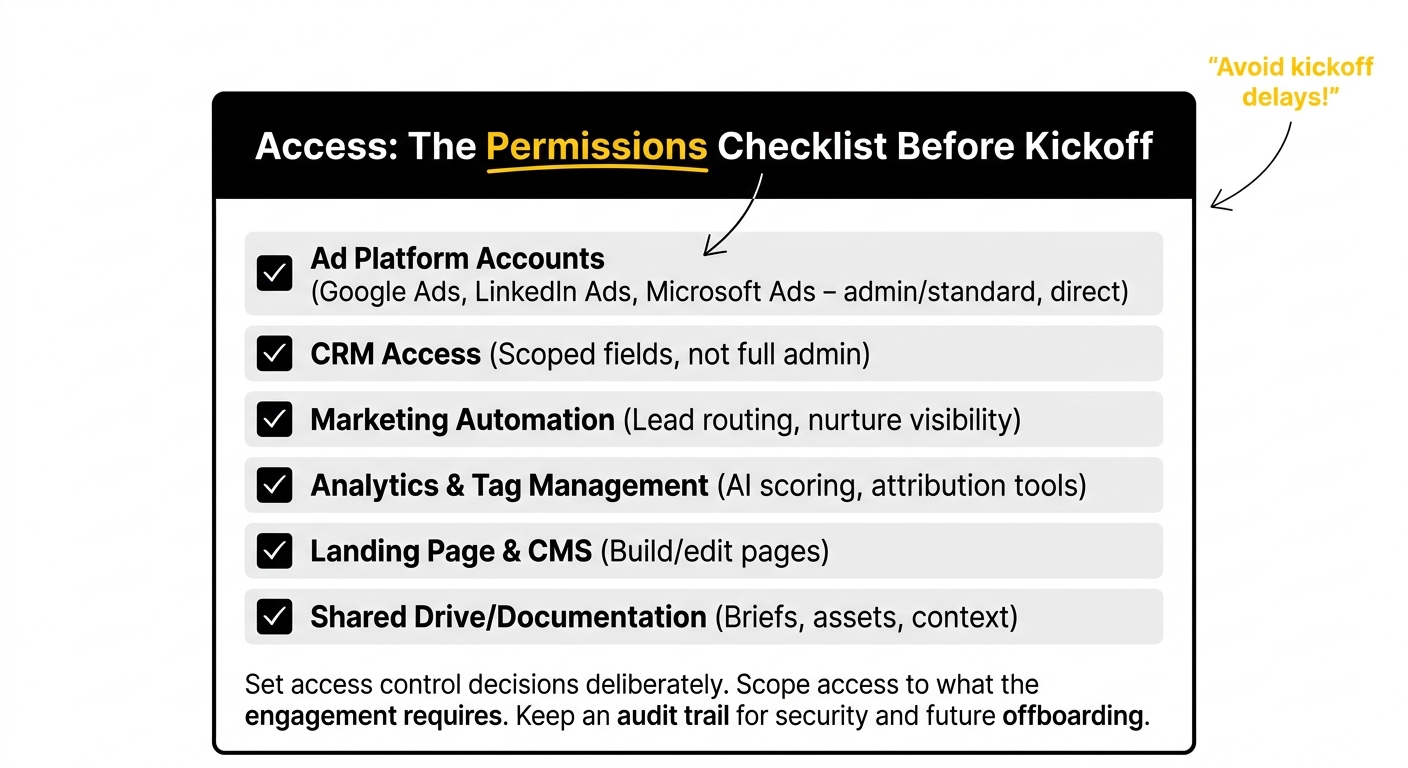
Access: The Permissions Checklist Before Kickoff
Access delays are one of the most common, and most avoidable, causes of a slow agency start. Build this list before the contract is signed, not after:
- Ad platform accounts (Google Ads, LinkedIn Ads, Microsoft Ads) with admin or standard access, granted directly rather than through a shared login
- CRM access scoped to the reporting and campaign-attribution fields the agency actually needs, not full administrative rights
- Marketing automation platform access for lead routing and nurture visibility
- Analytics and tag management access, including any AI-powered lead scoring or attribution tooling already in use
- Landing page and CMS access if the agency will be building or editing pages
- A shared drive or documentation space for briefs, brand assets, and the historical context gathered above
Set access control decisions deliberately rather than defaulting to “give them everything.” Scope access to what the engagement requires, and keep an audit trail of who granted what and when. This matters for security data governance internally, and it makes offboarding the next agency, whenever that happens, considerably less painful.
Decisions: Who Signs Off, and On What
Data and access solve the technical half of onboarding. The other half is knowing who in your organisation actually makes which call, and most onboarding delays that aren't technical come down to nobody having answered that question up front.
Identify key stakeholders before kickoff, not during it
Map out who approves budget changes, who signs off on creative and landing page copy, and who owns the final call on attribution methodology if there's a dispute. If this list only gets built reactively, the agency spends its first month learning your org chart by trial and error, usually right when a decision needs to move fast.
Build a decision framework for ongoing performance review
Beyond the initial sign-off list, agree on how often performance will be reviewed, what threshold triggers a strategy conversation versus a routine check-in, and who's in the room for each. This is different from the sign-off list above. It's the operating rhythm that governs the relationship after the first campaigns are live, and it's worth setting before you need it, not after a number comes in that nobody agreed how to react to.
Some organisations also need to account for how marketing data eventually feeds into enterprise resource planning systems for revenue reporting and renewals. If that handoff exists, identify who owns it early, so the agency isn't the last to find out that a number they're reporting also needs to reconcile somewhere else entirely.
.jpg)
PLG vs Sales-Led: Why This Checklist Isn't One-Size-Fits-All
A product-led growth motion and a sales-led motion need different versions of this checklist. PLG onboarding leans harder on product analytics access and self-serve conversion tracking, since the “lead” the agency cares about is often a free-trial signup rather than a form fill. Sales-led onboarding leans harder on CRM alignment and stakeholder sign-off, since every qualified lead eventually needs a human decision-maker to move it forward.
The mistake is running the same checklist regardless of motion. A sales-led onboarding process applied to a PLG company wastes time gathering stakeholder sign-offs nobody needs. A PLG checklist applied to a sales-led business misses the CRM and attribution depth a long buying cycle actually requires. Know which motion you're onboarding for before building the list.
Common Onboarding Pitfalls That Create Early Misalignment
A few patterns show up repeatedly across SaaS PPC agency onboarding, regardless of company size:
- Granting broad access “to save time,” then having no record of what was shared or with whom
- Treating historical context as optional because the raw data exports feel like enough
- Assuming the agency will ask for missing information, rather than proactively documenting it
- Skipping stakeholder mapping because “everyone already knows who decides what”
- Setting no review cadence, so the first real conversation about performance happens only when something looks wrong
Each of these is avoidable with an hour of preparation before kickoff. None of them are recoverable cheaply once the agency is three weeks in and working from bad assumptions.
A Worked Example: What a Rushed Handover Actually Costs
Take a hypothetical Series B project management SaaS switching agencies. The previous team leaves behind a data export but no context on why a major audience segment was cut from targeting two months prior, a decision that was never documented anywhere outside a now-deleted Slack channel.
The new agency, working from the export alone, reintroduces that segment in week three because the historical performance data looks reasonable in isolation. Spend increases against a segment already proven not to convert, and it takes another three weeks of underperformance before anyone traces the pattern back to a decision that was already made and never recorded.
None of this was a strategy failure. It was a five-minute documentation gap that turned into six weeks of wasted spend. This is the specific cost a structured onboarding checklist for data, access, and decisions is built to prevent.
The Full Onboarding Checklist
Bringing the sections above together, the essentials before a new SaaS PPC agency starts:
- CRM lead definitions documented and current
- Historical performance context, including what was tried and what changed
- Attribution methodology documented in writing
- Ad platform, CRM, automation, analytics, and CMS access granted and scoped appropriately
- An access audit trail in place
- Key stakeholders identified for budget, creative, and attribution decisions
- A performance review cadence agreed before launch
- Clarity on whether the motion is PLG, sales-led, or hybrid, and what that changes about the checklist
If a new agency can tick every item on this list before their first campaign goes live, the first month looks like campaign building, not information archaeology.
.jpg)
Frequently Asked Questions
What are the key components of a SaaS PPC agency onboarding checklist?
Documented CRM lead definitions, historical performance context, attribution methodology, scoped access across the MarTech stack, identified stakeholders, and an agreed review cadence. Missing any one of these tends to surface as a delay or a reporting discrepancy later.
How can data integrity impact the onboarding process for a SaaS PPC agency?
Inconsistent lead definitions or undocumented tracking changes get inherited silently by the new agency. Every report built on that foundation carries the same inconsistency, which usually isn't discovered until numbers stop reconciling weeks in.
What access permissions are necessary for a successful SaaS PPC agency onboarding?
Scoped access to ad platforms, CRM reporting fields, marketing automation, analytics and tag management, and any CMS the agency will touch. Grant direct access rather than shared logins, and keep a record of what was granted.
What decision-making processes should be established during onboarding?
Identify who approves budget changes, who signs off on creative, and who owns attribution disputes, before kickoff. Separately, agree on a review cadence so performance conversations have a defined rhythm rather than happening reactively.
How does CRM alignment contribute to the effectiveness of a SaaS PPC agency?
A CRM with consistent, documented lead definitions gives the agency an accurate baseline from day one. Without it, campaign optimisation decisions get made against numbers that don't mean what they appear to mean.
What tracking mechanisms are essential for a SaaS PPC agency onboarding?
Documented attribution methodology, confirmed conversion tracking across ad platforms and the CRM, and a clear record of any recent tracking changes. Undocumented tracking gaps are one of the most common sources of early reporting disputes.
Why is historical context important for a SaaS PPC agency's onboarding?
Raw data shows what happened. Context shows why campaigns were paused, why segments underperformed, or what changed in the product or ICP. Without it, an agency risks repeating decisions that were already tested and rejected.
How can stakeholder identification improve the onboarding experience?
Mapping who decides what before kickoff removes the guesswork that otherwise slows early decisions down. It also prevents the agency from learning your org chart through trial and error at the exact moments speed matters most.
What role does accurate attribution play in onboarding a SaaS PPC agency?
It sets the baseline the agency will be measured against. If attribution methodology isn't documented and agreed early, disputes about whether a campaign is working tend to become disputes about whose numbers are right.
How can seamless integration with existing MarTech stacks benefit onboarding?
It reduces the manual reconciliation work that eats into an agency's first weeks. When CRM, automation, and analytics platforms are already mapped and access is scoped correctly, the agency spends that time on strategy instead of stack archaeology.
If your team is preparing to bring in a new partner, this is exactly the kind of groundwork we walk through as part of fast onboarding a SaaS PPC agency. Worth working through before kickoff, not during it.