Optimising SaaS Google Ads Account Structures for Effective Lead Generation
Learn to structure SaaS Google Ads accounts around ICP, intent, and sales feedback to enhance lead quality and support your sales pipeline.

Your Google Ads account is generating leads. Sales is ignoring most of them. Platform metrics look healthy. Pipeline is flat. Sound familiar?
This is the most common pattern in B2B SaaS paid search, and account structure is usually at the root of it. Not because teams are running the wrong campaign types, but because the architecture of their account was designed to produce volume rather than quality. When structure reflects ICP, buying intent, and funnel stage, the same budget generates a fundamentally different outcome.
This guide covers how to build a scalable Google Ads account structure for SaaS teams that optimises for pipeline contribution, not just conversion count. If you’re working with a saas ppc agency or managing campaigns in-house, the principles are the same.
Why Most SaaS Google Ads Accounts Are Built Wrong
The default approach to account structure is campaign-first: brand, competitor, category, and maybe a retargeting layer. That structure makes sense for consumer products. For B2B SaaS, it misses the three variables that determine whether a lead has any value at all: who searched, what they intended, and where they sit in the buying journey.
B2B SaaS buying committees now average six to ten stakeholders per deal, according to Demandbase’s 2026 research. Sales cycles routinely run 60 to 180 days. In that environment, an account built around keyword themes alone will generate a mix of prospects, students, tire-kickers, and competitors, and Google’s algorithm will treat them all as equally valuable unless you tell it otherwise.
The accounts generating qualified pipeline in 2026 share one characteristic: they feed the right signals back to Google. Non-branded B2B SaaS CPCs now average $5.34, up 29% year on year. At that cost per click, generating leads that sales won’t touch is not a minor inefficiency. It is a significant operational problem. Structure is the first line of defence.
The Three Layers of a Scalable SaaS Google Ads Account Structure
A scalable Google Ads account structure for SaaS is built in three layers: campaign architecture that maps to the buyer journey, ad group organisation that maintains intent clarity, and conversion tracking that tells Google what a good outcome actually looks like. Each layer depends on the one below it.
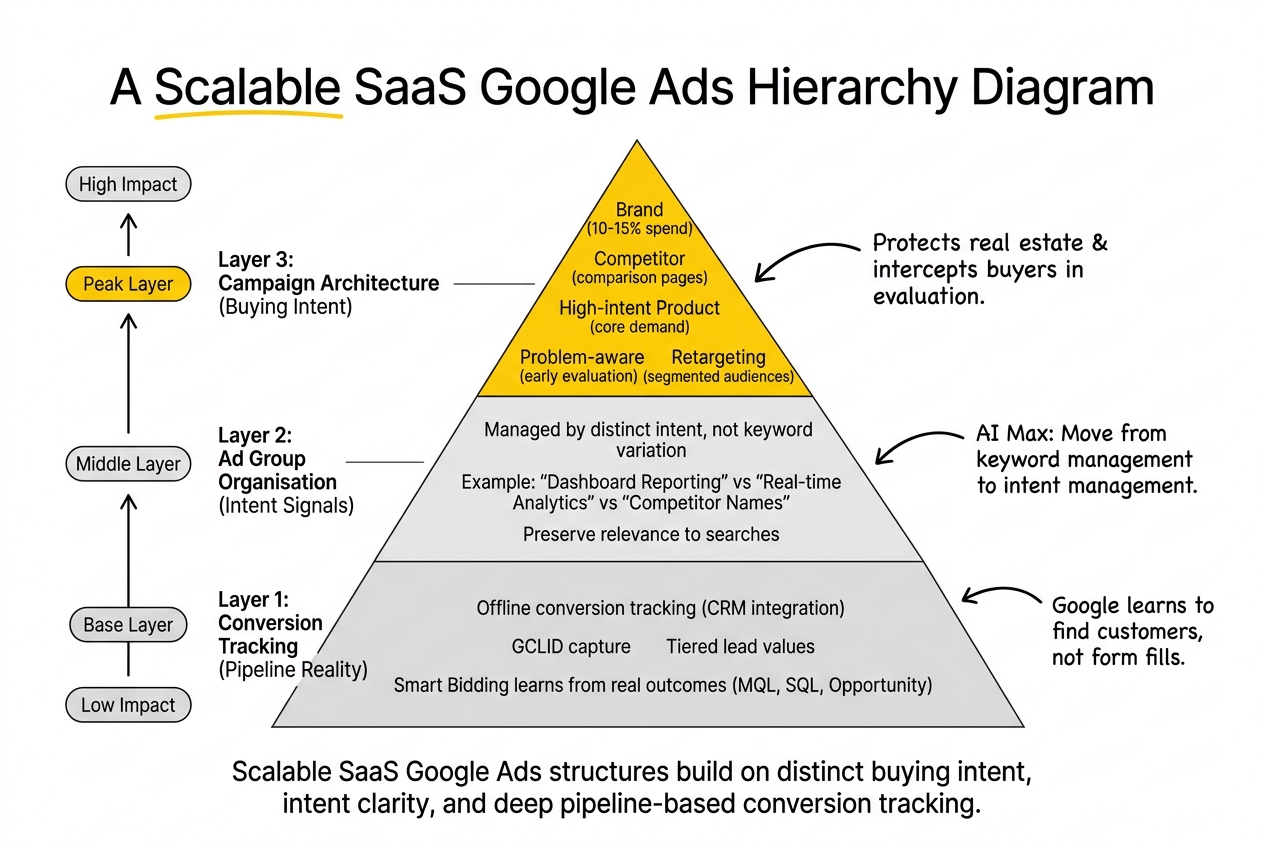
Layer 1: Campaign Architecture Built Around Buying Intent
The campaigns in a well-structured B2B SaaS account reflect distinct points in the decision process, not just keyword volume tiers.
Brand campaigns protect your own search real estate. These should be isolated from everything else, not because they are low priority, but because blending them with non-brand campaigns distorts performance data and obscures your true customer acquisition cost. Budget allocation typically sits at 10-15% of total spend.
Competitor campaigns intercept buyers who are already in evaluation mode. They convert differently from branded campaigns and need separate landing pages, specifically comparison pages that address the evaluation criteria the buyer is using. These only warrant budget if you have a clear differentiator and a page built to support that claim. Competitor traffic mixed into broader campaigns produces inflated volume with poor pipeline conversion rates.
High-intent product campaigns are your core demand capture layer. These target buyers searching for specific solutions, features, or use cases. They require tightly themed ad groups, dedicated landing pages, and strong match type discipline. This is where most of your non-brand budget belongs.
Problem-aware campaigns reach buyers earlier in evaluation, before they have landed on a specific solution category. CPCs are often lower here, but conversion rates are also lower. These campaigns earn their place in accounts where ICP fit at the top of the funnel matters as much as bottom-funnel volume.
Retargeting campaigns are non-negotiable in SaaS, given that most B2B buyers will visit a site several times before converting and that the average sales cycle extends well beyond any single visit. Segment retargeting audiences by behaviour rather than treating all prior visitors as equivalent. Someone who visited the pricing page twice is not the same prospect as someone who read a single blog post.
Layer 2: Ad Group Organisation That Preserves Intent Signals
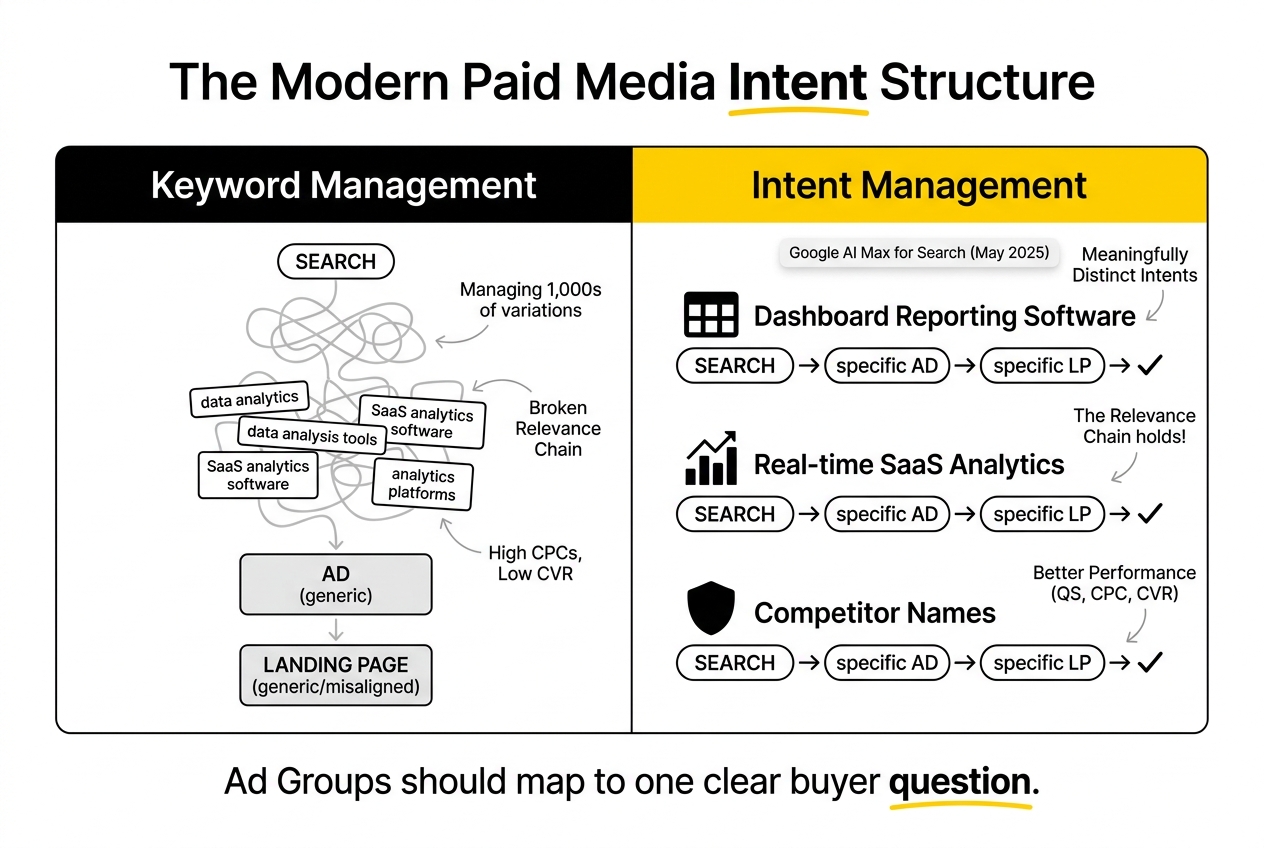
The function of ad group structure is to maintain relevance between what someone searches, what ad they see, and what page they land on. Where that chain breaks, Quality Scores fall, CPCs rise, and conversion rates suffer.
The days of single keyword ad groups (SKAGs) are largely behind us. Google’s AI, particularly AI Max for Search launched in May 2025, now handles a significant amount of query-to-intent matching automatically. The practical implication: you no longer need to create ad groups for every keyword variation. You do need to create ad groups for every meaningfully distinct intent.
A B2B analytics platform, for example, should have separate ad groups for buyers searching for “dashboard reporting software,” buyers searching for “real-time data analytics for SaaS,” and buyers searching for specific competitor names. The intent behind each is different, the ideal ad copy is different, and the landing page should be different. Grouping them together because they share a category keyword is a structural shortcut that costs performance.
Use the ad group as the unit of intent management, not the unit of keyword management. Each ad group should map to one clear buyer question or decision point.
Layer 3: Conversion Tracking That Reflects Pipeline Reality
This is where most SaaS accounts have the largest gap. If Google’s algorithm is optimising toward form fills, it will find people who fill in forms. If it is optimising toward sales-qualified leads, it will find people who become sales-qualified leads. The conversion events you feed it determine what it learns to produce.
Offline conversion tracking connects your CRM pipeline stages back to your Google Ads account. When a lead becomes an MQL, then an SQL, then an opportunity, those events are sent back to Google with tiered values that reflect their actual worth to your business. Google’s Smart Bidding then learns which keywords, audiences, and ad placements produce the outcomes that matter.
Accounts that implement offline conversion tracking and value-based bidding generate significantly more pipeline at lower cost per lead than accounts relying on form-fill conversion events alone. The setup requires CRM integration (HubSpot and Salesforce both have native paths), GCLID capture on your landing pages and forms, and a commitment to sending conversion data back at least daily. Set your attribution window to 60 to 90 days, not Google’s 30-day default, which misses most B2B conversions given typical sales cycle lengths.
Building Account Structure Around Your Ideal Customer Profile
The most important thing your account structure can do is make your ICP’s search behaviour legible to Google’s algorithm. An ICP definition that lives only in a Notion document or a sales deck does not affect ad performance. An ICP definition that is translated into audience signals, keyword exclusions, and conversion values does.
Start with your closed-won data. Look at the firmographic and behavioural patterns of customers who signed within a reasonable payback period and expanded their contract. That population defines your actual ICP. Build your account structure to attract and qualify more of them, not to maximise volume across the full addressable market.
The practical applications are:
- Keyword selection grounded in ICP language. The keywords your ICP searches are often different from the keywords that generate the most volume. A VP of Sales at a 200-person SaaS company searches differently from a marketing coordinator at a startup. Building campaigns around ICP search behaviour, rather than pure volume, filters out a significant proportion of low-quality traffic before it enters your account.
- Audience layering to reinforce ICP signals. Customer Match, RLSA (Remarketing Lists for Search Ads), and LinkedIn-sourced audience segments can all be applied to search campaigns to weight your bidding toward known ICP accounts or companies matching your target firmographic profile. This is particularly effective for high-intent campaigns where you want to apply stronger bids for searches from your ICP.
- Exclusion lists that remove noise. Job titles, company types, and behaviours that consistently produce leads that sales won’t touch should be systematically excluded. Negative keyword hygiene is the structural complement to audience targeting: you are narrowing the field from both directions.
Integrating Sales Feedback Into Account Management
The feedback loop between sales and the Google Ads account is the most underused optimisation lever in SaaS paid search. Most teams look at CPL and conversion rate. Sales feedback on lead quality is rarely formalised into account changes.
A structured sales feedback integration looks like this: a weekly or fortnightly review of leads generated from paid search, scored by sales against ICP criteria, with the output being specific account actions. Keywords producing high volume but consistently poor-quality leads get paused or moved to more restrictive match types. Ad copy that attracts the wrong search intent gets revised. Landing pages that do not pre-qualify effectively get updated.
This is not a one-off audit. It is an ongoing process that compounds over time. The accounts that improve fastest are those where sales and marketing share a definition of a qualified lead, and where the paid search team has a direct line to quality feedback within the same week that leads are generated.
The CRM is the mechanism. If GCLID is captured and pipeline stages are tracked, you can pull a report at any point showing which keywords and campaigns produced leads that reached SQL stage, and which produced leads that were rejected or did not progress. That data is the basis for structural decisions: splitting campaigns by intent, adjusting bids, consolidating ad groups that are producing junk.
Funnel Stage Optimisation: Mapping Structure to the Buying Journey
Funnel stage optimisation is not about having one campaign per funnel stage. It is about ensuring that the budget allocation, messaging, and bidding in your account reflects where in the decision process your highest-value prospects actually sit.
For most B2B SaaS products, the commercial intent search happens relatively late in a buying cycle that started somewhere else. Research from Wynter in 2026 found that 68% of B2B decision-makers now begin their vendor research with AI tools before reaching traditional search. By the time someone types a high-intent search query, they have often already formed a shortlist. Your Google Ads campaigns are primarily capturing demand that was created elsewhere, and your account structure should reflect that.
This has two structural implications.
First, bottom-of-funnel campaigns deserve disproportionate attention. These are the searches with the highest conversion likelihood: product-specific terms, comparison searches, pricing queries, and competitor alternatives. An account that under-invests here in favour of broader awareness terms is likely losing pipeline-ready buyers to competitors who are better positioned at the moment of intent.
Second, mid-funnel campaigns should be evaluated on pipeline contribution, not on CPL. A mid-funnel campaign that generates a higher CPL than a bottom-funnel campaign is not necessarily underperforming. If the MQL-to-SQL ratio is comparable and the eventual cost-per-opportunity is acceptable, the structure is working. Collapsing performance measurement to a single CPL metric makes it impossible to evaluate funnel stage campaigns accurately.
When to Split, Consolidate, or Rebuild Campaigns
A common question for scaling SaaS teams is when to add more campaigns versus when to simplify. The answer depends on data volume, not on campaign count preferences. Google’s Smart Bidding requires sufficient conversion data per campaign to learn effectively. A campaign generating fewer than 30 conversions per month will struggle to exit the learning phase and will produce erratic performance.
The decision framework:
- Split campaigns when you have a meaningful difference in objective, audience, or bidding strategy that would be masked by combining them. Brand and non-brand is the clearest example. High-intent product searches and broader problem-aware searches are often another.
- Consolidate campaigns when you are spreading data too thin across too many campaigns and none of them are generating enough conversions to learn effectively. Consolidation often improves Smart Bidding performance by giving the algorithm more signal, not less control.
- Rebuild campaigns when the account has accumulated structural debt: negative keyword lists that overlap, ad groups that have drifted from their original intent, conversion tracking that no longer reflects the business’s current qualification criteria. A clean rebuild with correct conversion setup often outperforms an optimised version of a poorly structured legacy account.
The Role of AI Max and Smart Bidding in Structural Decisions
Google’s AI Max for Search, launched globally in May 2025, changes some aspects of the structural calculus without changing the fundamentals. AI Max automatically expands query matching beyond your explicit keyword list, generates ad copy variations, and integrates with Smart Bidding to find converting audiences beyond your stated targeting. Google reports 14% more conversions at similar CPA on average for accounts using AI Max, rising to 27% for campaigns still primarily relying on exact and phrase match.
This does not reduce the importance of account structure. It raises the importance of conversion signal quality. AI Max amplifies whatever your conversion tracking is optimising toward. If that is form fills from a broad audience, AI Max will find more of them. If it is pipeline-stage events from ICP-fit accounts, AI Max will find more of those. The structure provides the guardrails; the algorithm operates within them.
The practical adjustment for SaaS accounts adopting AI Max is to ensure negative keyword lists are comprehensive and current. AI Max’s expanded matching will surface irrelevant queries that your existing negatives do not cover. A weekly search term audit is more important, not less, when AI Max is running.
Campaign-level negative keywords for Performance Max (introduced in 2025, with up to 10,000 per campaign) give SaaS advertisers the structural control that previously made PMax difficult to justify for lead generation. With these controls in place, and with offline conversion tracking feeding pipeline signals, PMax becomes a viable expansion channel for accounts that have their Search campaign foundation working.
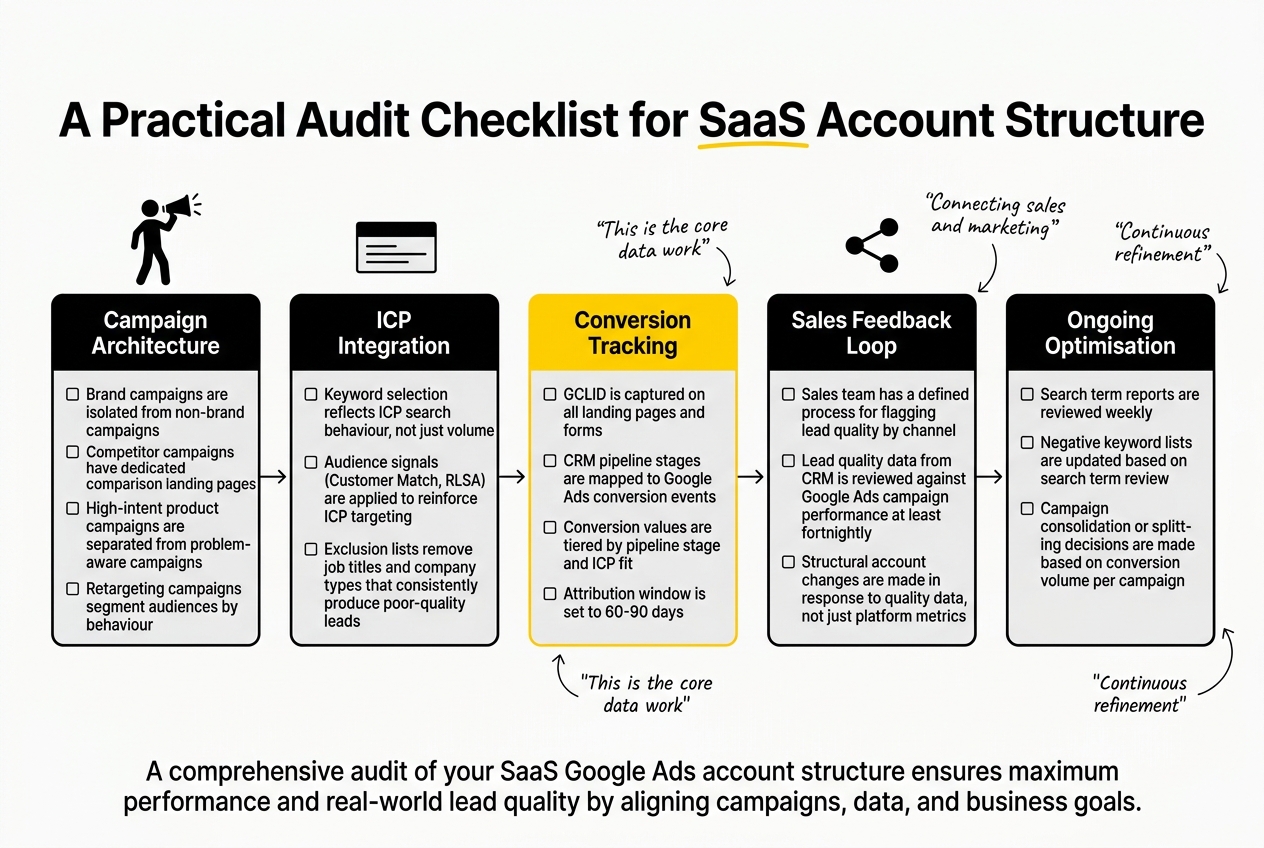
A Practical Audit Checklist for SaaS Account Structure
Use this checklist to assess whether your current account structure supports scalable lead generation.
Campaign architecture:
- Brand campaigns are isolated from non-brand campaigns
- Competitor campaigns have dedicated comparison landing pages
- High-intent product campaigns are separated from problem-aware campaigns
- Retargeting campaigns segment audiences by behaviour, not just prior visit
ICP integration:
- Keyword selection reflects ICP search behaviour, not just volume
- Audience signals (Customer Match, RLSA) are applied to reinforce ICP targeting
- Exclusion lists remove job titles and company types that consistently produce poor-quality leads
Conversion tracking:
- GCLID is captured on all landing pages and forms
- CRM pipeline stages are mapped to Google Ads conversion events
- Conversion values are tiered by pipeline stage and ICP fit
- Attribution window is set to 60-90 days
Sales feedback loop:
- Sales team has a defined process for flagging lead quality by channel
- Lead quality data from CRM is reviewed against Google Ads campaign performance at least fortnightly
- Structural account changes are made in response to quality data, not just platform metrics
Ongoing optimisation:
- Search term reports are reviewed weekly
- Negative keyword lists are updated based on search term review
- Campaign consolidation or splitting decisions are made based on conversion volume per campaign
Frequently Asked Questions
What is the correct hierarchy in a Google Ads account structure?
A Google Ads account is organised in three levels: campaigns, ad groups, and ads (plus keywords and landing pages). Campaigns control budget and targeting settings. Ad groups organise related keywords and ads around a shared intent. Ads are the individual creatives within each group. For B2B SaaS, an additional structural consideration is the conversion tracking layer, which determines what the algorithm learns to optimise toward at every level.
How do you scale a Google Ads campaign effectively?
Scale performance campaigns incrementally. Increase budgets by 15 to 20% every few days rather than making large jumps, which disrupts Smart Bidding learning. Before scaling budget, verify that your conversion tracking is capturing pipeline-stage events, not just form fills. Campaigns that are generating ICP-qualified leads at acceptable cost-per-opportunity are the right candidates for scaling. Campaigns generating volume at low CPL but poor SQL rates are not.
How to structure a Google Ads account for SaaS lead generation?
Structure campaigns around buyer intent: brand, competitor, high-intent product, problem-aware, and retargeting as separate campaigns with distinct budgets and bidding strategies. Build ad groups around specific search intents rather than keyword themes. Implement offline conversion tracking with CRM integration to feed pipeline signals back to Google’s algorithm. Use tiered conversion values that reflect ICP fit and deal stage.
What are the key elements to consider when structuring a Google Ads account for B2B SaaS?
The five key elements are: buyer journey alignment in campaign architecture, intent clarity in ad group organisation, ICP integration in keyword selection and audience targeting, offline conversion tracking that connects ad clicks to pipeline outcomes, and a sales feedback process that turns lead quality data into structural account decisions.
How can Ideal Customer Profile (ICP) influence Google Ads account structure?
ICP shapes which keywords you build campaigns around, which audience signals you layer on, which search terms you exclude, and how you assign conversion values. An ICP defined from closed-won CRM data and translated into campaign targeting parameters teaches Google’s algorithm what a qualified prospect looks like. An ICP that exists only as a document in a shared drive does not affect ad performance.
What role does buying intent play in Google Ads account architecture?
Buying intent determines which campaign tier a keyword belongs in, what landing page it points to, and how aggressively you bid on it. High-intent searches such as pricing queries, comparison searches, and specific product terms belong in dedicated campaigns with dedicated landing pages and higher bids. Problem-aware searches belong in separate campaigns with different messaging and often different conversion objectives. Mixing intent levels within the same campaign makes it impossible to evaluate or optimise them accurately.
How can sales feedback be integrated into Google Ads account management?
Set up CRM pipeline stage tracking connected to your Google Ads conversion events. Review which campaigns and keywords are generating leads that progress to SQL and beyond, and which are generating leads that sales rejects. Run a weekly or fortnightly review with sales to identify quality patterns. Translate those patterns into structural changes: pausing keywords that produce low-quality volume, tightening match types on campaigns with poor MQL-to-SQL ratios, and updating ad copy to attract the right search intent.
What strategies can enhance lead quality in Google Ads campaigns?
The highest-leverage strategies are: offline conversion tracking with CRM integration, tiered conversion values that reflect ICP fit and deal stage, audience layering with Customer Match and RLSA to weight bids toward known ICP accounts, comprehensive negative keyword management to exclude non-ICP searches, and landing pages that pre-qualify by addressing ICP-specific pain points rather than appealing to the broadest possible audience.
How can funnel stages be effectively represented in a Google Ads account structure?
Create separate campaigns for distinct funnel stages: brand and competitor campaigns for buyers in active evaluation, high-intent product campaigns for buyers comparing specific solutions, and problem-aware campaigns for buyers earlier in their research. Evaluate each campaign tier against funnel-appropriate metrics. Bottom-funnel campaigns should be measured primarily on cost-per-opportunity. Mid-funnel campaigns should be measured on MQL-to-SQL conversion rate, not just CPL.
What are the best practices for ongoing optimisation of Google Ads accounts in the SaaS sector?
Run weekly search term audits and update negative keyword lists. Review conversion data fortnightly against CRM pipeline data to identify which campaigns are generating qualified pipeline. Make campaign consolidation or splitting decisions based on conversion volume per campaign, not on a preference for complexity or simplicity. Revisit your ICP definition quarterly using fresh closed-won data and update audience signals and conversion values accordingly. Treat the account as a system that requires regular calibration, not a set of campaigns that can be left to run.
Building Structure Around Pipeline, Not Activity
The performance-obsessed B2B marketing manager knows the difference between an account that looks healthy and an account that is generating qualified pipeline. The two often look identical in a platform dashboard and completely different in a CRM.
A scalable Google Ads account structure for SaaS is not more complex than a standard structure. It is more intentional. Campaign architecture that maps to the buying journey, ad groups that preserve intent, and conversion tracking that connects clicks to pipeline outcomes: these are the three things that determine whether your account is a lead generation tool or a revenue generation tool.
If you are working through an account audit or a structural rebuild, we dig into this kind of challenge with SaaS teams regularly. Worth a conversation if you are at that point.