Effective Strategies to Reduce CAC for SaaS Without Budget Cuts
Five fixes to reduce SaaS CAC before cutting budget: tracking, targeting, conversion, offer, and sales feedback, plus how to make the board case.

When the board asks you to bring customer acquisition cost down, the fastest-looking lever is a budget cut. It is also the one most likely to backfire. Cutting spend treats CAC as a spending problem, when for most SaaS companies it is an efficiency problem. Trim the budget and you usually shrink pipeline faster than you shrink cost, so CAC holds or climbs a quarter later.
There is a better sequence to work through first. Before you cut a single pound, five fixes will reduce customer acquisition cost for SaaS by making the spend you already have work harder: tracking, targeting, conversion, offer, and sales feedback. Worked in that order, they lower CAC without touching the top line and give you a far stronger story for the board than spending less.
This is a tactical guide to those adjustments to consider before budget cuts, aimed at CMOs who need the numbers to move and need to explain why.
What CAC reduction actually means
CAC reduction is lowering the cost to acquire a customer. You can do that two ways: spend less, or convert more of what you already spend into customers. Budget cuts chase the first and often raise CAC in the process. The fixes below chase the second, which is where the durable gains are.
The benchmark backdrop matters for the board conversation. 2026 data puts the median SaaS company at around two pounds of sales and marketing spend for every pound of new ARR, up roughly 14 percent year on year as ad costs rise and sales cycles lengthen. A healthy LTV to CAC ratio sits at 3:1 or above, with the B2B SaaS median close to 3.2:1, and anything above 5:1 often signals underinvestment rather than excellence.
The number that stops budget cuts in their tracks is payback. A strong ratio built on a long payback is a cash trap, so CAC payback should stay under about twelve months, and it has been stretching industry-wide. That is the frame for the board: the goal is not the lowest spend, it is the shortest, most reliable path from spend to recovered cost.
The sequence of budget-friendly CAC reduction techniques for SaaS runs in this order:
- Fix tracking and attribution so you can see true cost by channel
- Tighten targeting so spend reaches in-profile buyers
- Improve conversion on the traffic you already pay for
- Optimise the offer so more of the right people say yes
- Close the sales feedback loop so the first four stay calibrated
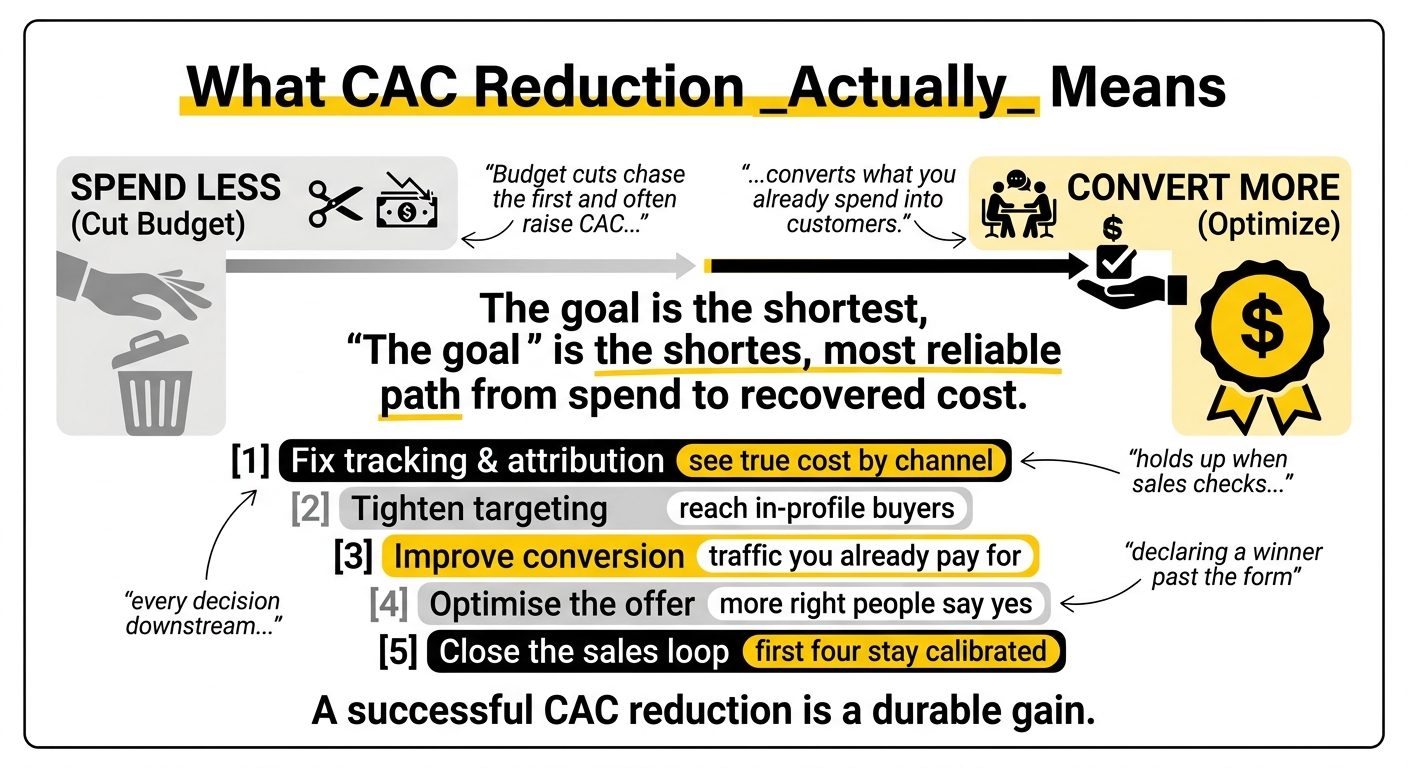
The order is deliberate. Each fix depends on the one before it, and tracking comes first because every decision downstream is only as good as the data under it.
The five fixes to try before cutting budget
1. Fix tracking and attribution first
You cannot reduce a cost you cannot see accurately. Most SaaS teams optimise against blended CAC, which averages cheap organic acquisition with expensive paid acquisition and hides the channel-level inefficiencies you actually need to fix. The first adjustment is to measure CAC by channel and, wherever possible, tie it through to closed revenue rather than to leads.
That means importing CRM outcomes into your ad platforms and reporting, so cost is measured against qualified pipeline and won deals, not form-fills. This single change to tracking and targeting improvements for SaaS often reveals that a small number of channels carry most of your efficient acquisition while others quietly inflate the blend. The paid-media-specific version of this problem, where efficiency looks real but is not, is covered in Avoiding False Efficiency Gains in SaaS Paid Media.
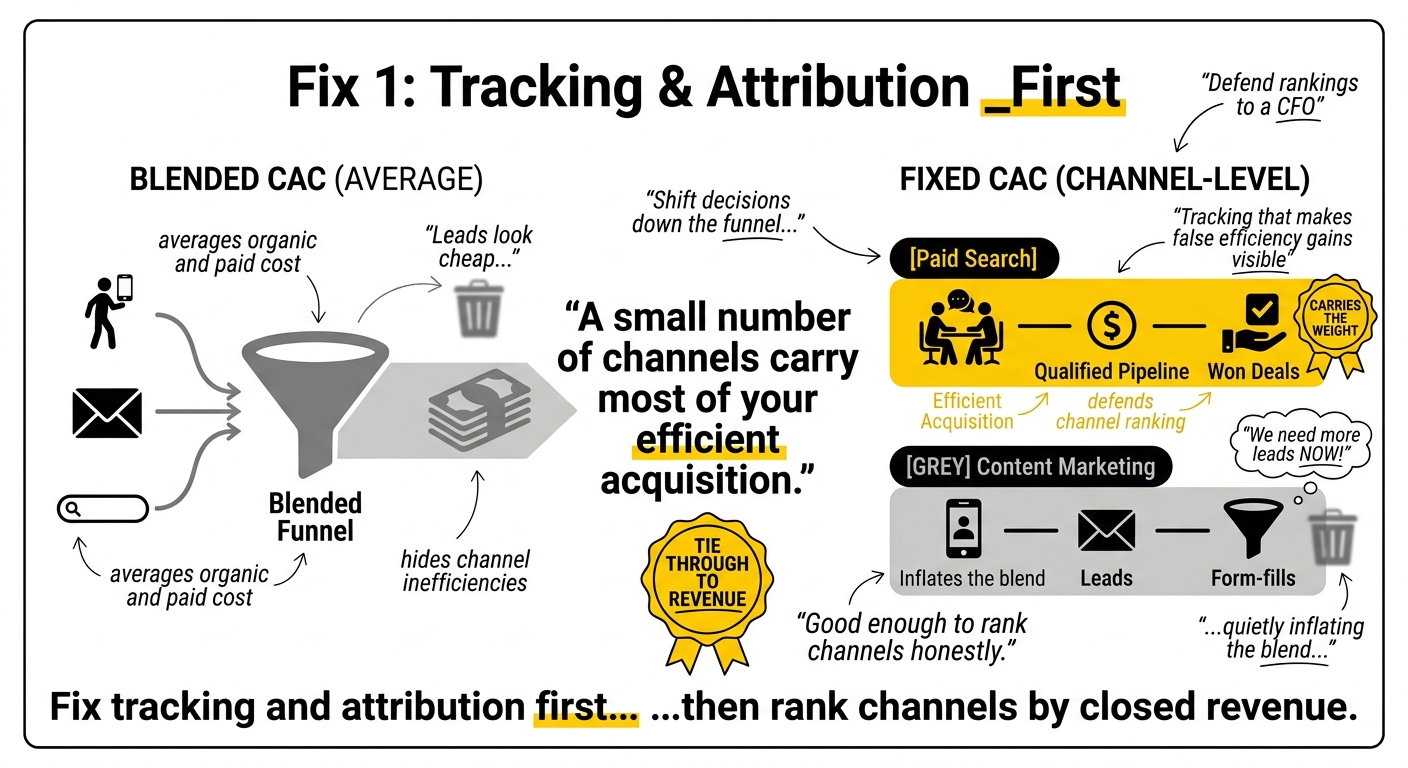
Attribution will never be perfect in a long, multi-touch B2B cycle. It does not need to be. It needs to be good enough to rank channels honestly and defend the ranking to a CFO.
2. Tighten targeting before you touch budget
Once you can see cost by channel, the next fix is who your spend reaches. A large share of wasted acquisition cost is spent on people who were never going to buy: wrong company size, wrong role, wrong market. Sharpening ICP definitions, keyword intent tiers, and audience exclusions removes that waste without removing budget.
This is targeting precision, not channel reallocation. You are not moving money between channels yet, you are making each channel spend it on better-fit prospects. Feeding qualified-lead signals back to the platforms so they optimise toward in-profile buyers compounds the effect, because the algorithms stop chasing the cheapest click and start chasing the closest match to your best customers.
3. Improve conversion on the traffic you already pay for
You have already paid for every visitor who lands and leaves. Lifting the rate at which the right ones convert lowers CAC directly, because the cost is spread across more customers with no extra spend. Landing page relevance, message match between ad and page, faster load, and clearer next steps all move the number.
The discipline here is to improve conversion for in-profile visitors rather than conversion in general. A looser form lifts raw conversion while letting in more low-fit leads, which raises real CAC once sales time is counted. Improving marketing efficiency for SaaS companies means converting more of the right people, not more people.
4. Optimise the offer, not just the ad
When conversion stalls despite good targeting and a clean page, the offer is usually the constraint. A demo request asks for a lot from someone early in their research. Offering a lighter, genuinely useful next step, an assessment, a benchmark, a tailored teardown, can lift conversion among serious buyers while filtering out the merely curious.
Offer optimisation is one of the most underused SaaS marketing strategies to reduce CAC, because it changes the value exchange rather than the media. Test offers against downstream quality, not just opt-in rate, so you are optimising for customers acquired rather than leads collected.
5. Close the sales feedback loop
The first four fixes decay without the fifth. A working sales feedback loop for SaaS growth is the mechanism that keeps tracking honest, targeting sharp, and offers relevant over time. Set a standing rhythm where sales reports which leads converted, which were disqualified, and why, then feed that straight back into targeting and scoring.
This loop is also what turns the whole exercise into data-driven strategies for SaaS CMOs can defend. When sales and marketing agree on what a good lead looks like and the data confirms it, CAC reduction stops being a marketing claim and becomes a shared, evidenced result.
Common pitfalls to avoid
A few moves consistently undo the gains above:
- Cutting budget before running the fixes. The reflex that this article exists to prevent. Cost falls, pipeline falls faster, CAC rebounds.
- Optimising on blended CAC. It hides the channel-level detail that every real fix depends on.
- Judging changes before the sales cycle completes. In SaaS the deal that proves a fix worked closes months later. Calling it early kills good changes.
- Chasing conversion rate in isolation. Cheaper leads that do not close raise the CAC you actually care about.
- Treating attribution as all-or-nothing. Waiting for perfect measurement is how teams justify doing nothing.
Making the board case for holding budget
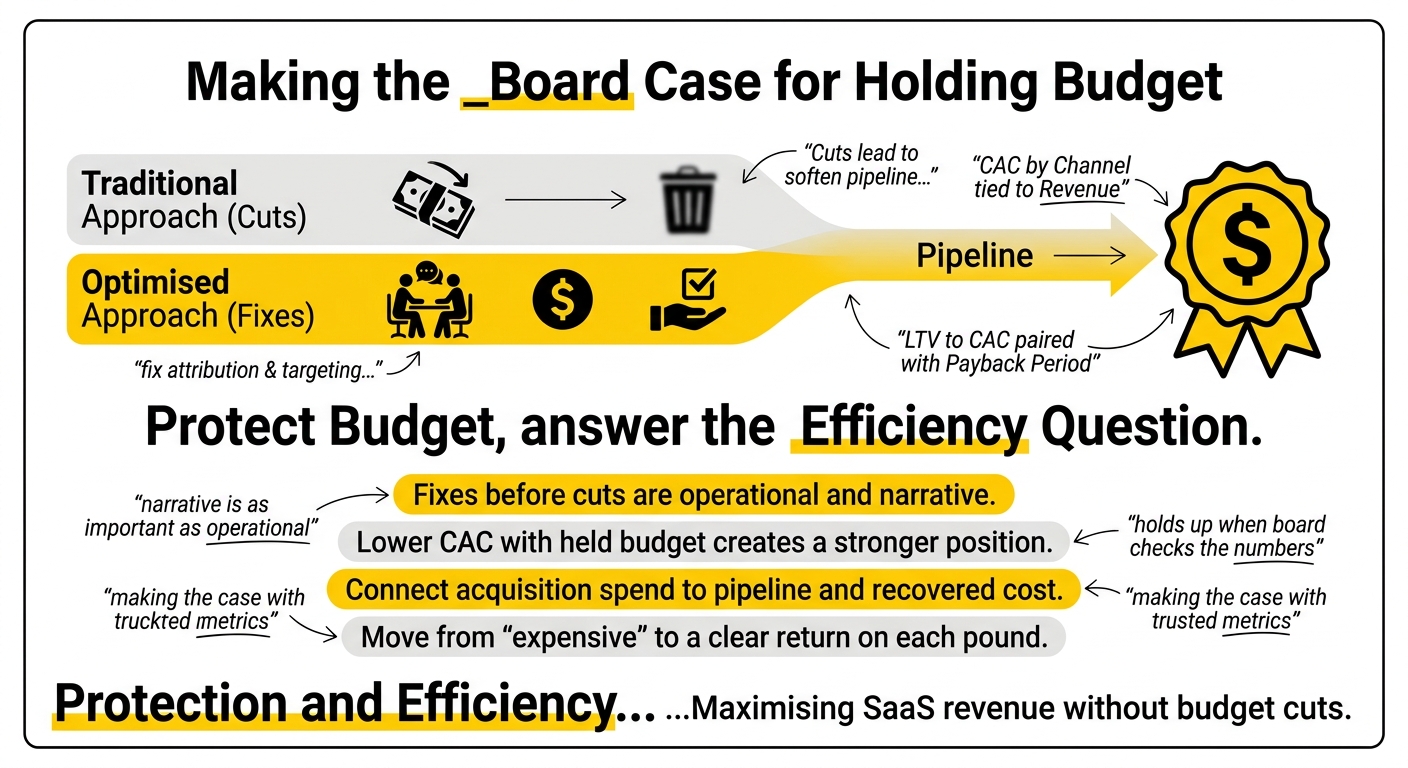
The reason to run fixes before cuts is not only operational, it is narrative. A CMO who arrives at the board with a held budget and a lower CAC, achieved by fixing attribution and targeting, is in a far stronger position than one who cut budget and watched pipeline soften.
Frame it around the metrics the board already trusts. Show CAC by channel tied to revenue, LTV to CAC paired with payback period, and the trajectory of each as the fixes land. Connect acquisition spend to pipeline and to recovered cost, so the conversation moves from marketing being expensive to a clear return on each pound and a plan to improve it. That link between acquisition effort and revenue is what lets you protect budget while still answering the efficiency question, and it is the heart of maximising SaaS revenue without budget cuts.
For a view of how these fixes fit a wider acquisition engine, our b2b saas growth marketing agency page sets out how the pieces connect.
Where to start
Pick the fix with the widest gap between effort and impact, which for most teams is tracking. Get CAC measured by channel and tied to revenue this month. That single view usually reframes the entire budget conversation, because it shows which spend is efficient and which is not, and it makes the case for holding the line while you work through targeting, conversion, and offer.
These SaaS growth strategies without budget reduction compound. Tracking sharpens targeting, targeting improves conversion, a better offer lifts it further, and the sales loop keeps all of it calibrated. The broader strategic view, including how lead quality and CAC move together, sits in Reducing SaaS CAC While Improving Lead Quality.
If you want a second read on which fix will move your numbers first, we are happy to take a look.
Frequently Asked Questions
What is a good CAC ratio for SaaS?
A healthy LTV to CAC ratio for SaaS is 3:1 or higher, with 3:1 to 5:1 the healthy band and the B2B SaaS median around 3.2:1. Below 3:1 usually means you are paying too much relative to a customer's lifetime value, while above 5:1 often signals underinvestment in growth. The ratio should never stand alone: pair it with a CAC payback period under about twelve months, because a strong ratio with a long payback is a cash-flow trap.
What does CAC reduction mean?
CAC reduction means lowering the cost to acquire a new customer. There are two routes: spend less, or convert more of your existing spend into customers. Cutting budget takes the first route and frequently raises CAC because pipeline shrinks faster than cost. Efficiency fixes take the second, lowering CAC by making the same spend produce more customers. The durable gains almost always come from the second route, which is why fixes should precede cuts.
What strategies can help reduce CAC without cutting the budget?
Work through five fixes in order: fix tracking so you can see true cost by channel, tighten targeting so spend reaches in-profile buyers, improve conversion on traffic you already pay for, optimise the offer to attract serious buyers, and close the sales feedback loop. Each lowers customer acquisition cost by improving efficiency rather than reducing spend, so pipeline holds while cost falls. This sequence is what makes CAC reduction sustainable rather than a one-quarter saving.
How can tracking and analytics improve CAC in SaaS?
Accurate tracking reveals where acquisition cost is actually efficient. Most teams optimise on blended CAC, which averages cheap organic with expensive paid acquisition and hides channel-level waste. Measuring CAC by channel and tying it to closed revenue rather than form-fills usually shows that a few channels carry most efficient acquisition while others inflate the blend. That visibility lets you reallocate effort and defend the decision to the board with data rather than assumption.
What role does targeting play in reducing CAC for SaaS companies?
Targeting determines who your spend reaches, and a large share of wasted CAC goes to prospects who were never going to buy. Sharpening ICP definitions, keyword intent tiers, and audience exclusions removes that waste without removing budget. Feeding qualified-lead signals back to ad platforms compounds the effect, because the algorithms optimise toward best-fit buyers instead of the cheapest click. Better targeting lowers CAC by improving who converts, not just how many.
How can optimising offers lead to lower CAC in SaaS?
The offer sets the value exchange, and a heavy ask like a demo request loses buyers who are early in their research. Offering a lighter, genuinely useful next step such as an assessment or a tailored teardown can lift conversion among serious prospects while filtering out the merely curious. Because more of the right people convert on the same spend, CAC falls. The key is to test offers against downstream quality, not just opt-in rate.
What feedback mechanisms should be in place to enhance CAC efficiency?
A standing sales feedback loop is the core mechanism. Sales reports which leads converted, which were disqualified, and why, and that data flows back into targeting and lead scoring. This keeps marketing optimising toward the prospects that actually close rather than the ones that merely fill forms. Over a quarter or two the loop improves sales acceptance and lowers effective CAC more than any single campaign change, because it corrects the definition of a good lead at the source.
How can CMOs present a compelling narrative about CAC reduction to the board?
Anchor the story in metrics the board already trusts. Show CAC by channel tied to revenue, LTV to CAC paired with payback period, and the trajectory of each as fixes land. The strongest narrative is holding spend while improving efficiency, which links acquisition effort directly to recovered cost and reframes marketing from a cost centre to a measurable return. Presenting the sequence of fixes and their evidenced impact turns a defensive budget conversation into a growth one.