Aligning Paid Acquisition Strategies with Your SaaS GTM Motion
Discover how to align your SaaS paid acquisition agency with your GTM motion. A practical guide for Series A marketing directors on ICP, PLG vs sales-led, and funnel handoff.

You get the agency onboarded. Campaigns go live. Google Ads clicks are climbing and LinkedIn is generating form fills. Three months later, sales says the pipeline is thin and the board wants to know why the numbers aren’t moving.
The campaigns weren’t the problem. The alignment was.
Most paid acquisition agency briefs start with channels, budgets, and target CPAs. The ones that actually drive revenue start somewhere different: with a clear GTM motion, a tightly defined ICP, and a shared understanding of what a qualified lead actually looks like before a single ad goes live.
For Series A marketing directors in the UK and EU, this alignment is the difference between paid media that feeds a sales team and paid media that creates noise a sales team has to explain away. This article covers how to approach it.
What SaaS GTM Actually Means (and Why It Shapes Everything Downstream)
SaaS GTM, or go-to-market, refers to the coordinated strategy a company uses to bring its product to market and acquire customers. It covers positioning, ICP definition, channel selection, and how sales and marketing work together to convert demand into revenue.
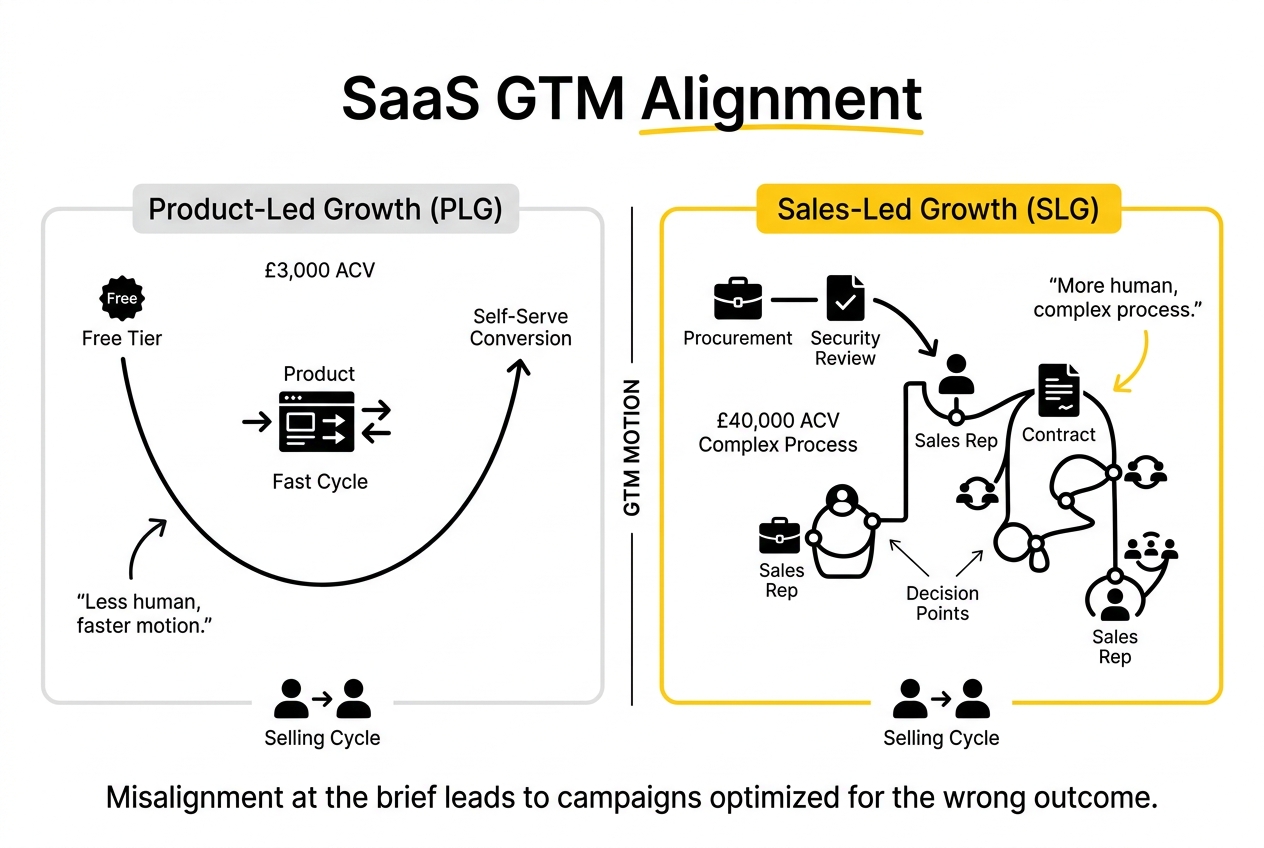
For B2B SaaS, GTM motion describes the specific mechanism through which customers discover, evaluate, and buy the product. That motion is almost never channel-neutral. A product with a £3,000 ACV and a self-serve free tier operates very differently from a product with a £40,000 ACV that requires a procurement process and a security review.
The GTM motion determines which acquisition channels make sense, what the conversion path looks like, and how much of the selling happens before someone talks to a human. Getting this wrong at the agency briefing stage means running campaigns optimised for the wrong outcome from day one.
The two primary motions in B2B SaaS are product-led growth and sales-led. Most companies at Series A are running one, the other, or an uneasy hybrid of both.
Product-Led Growth vs Sales-Led: Reading the Signals
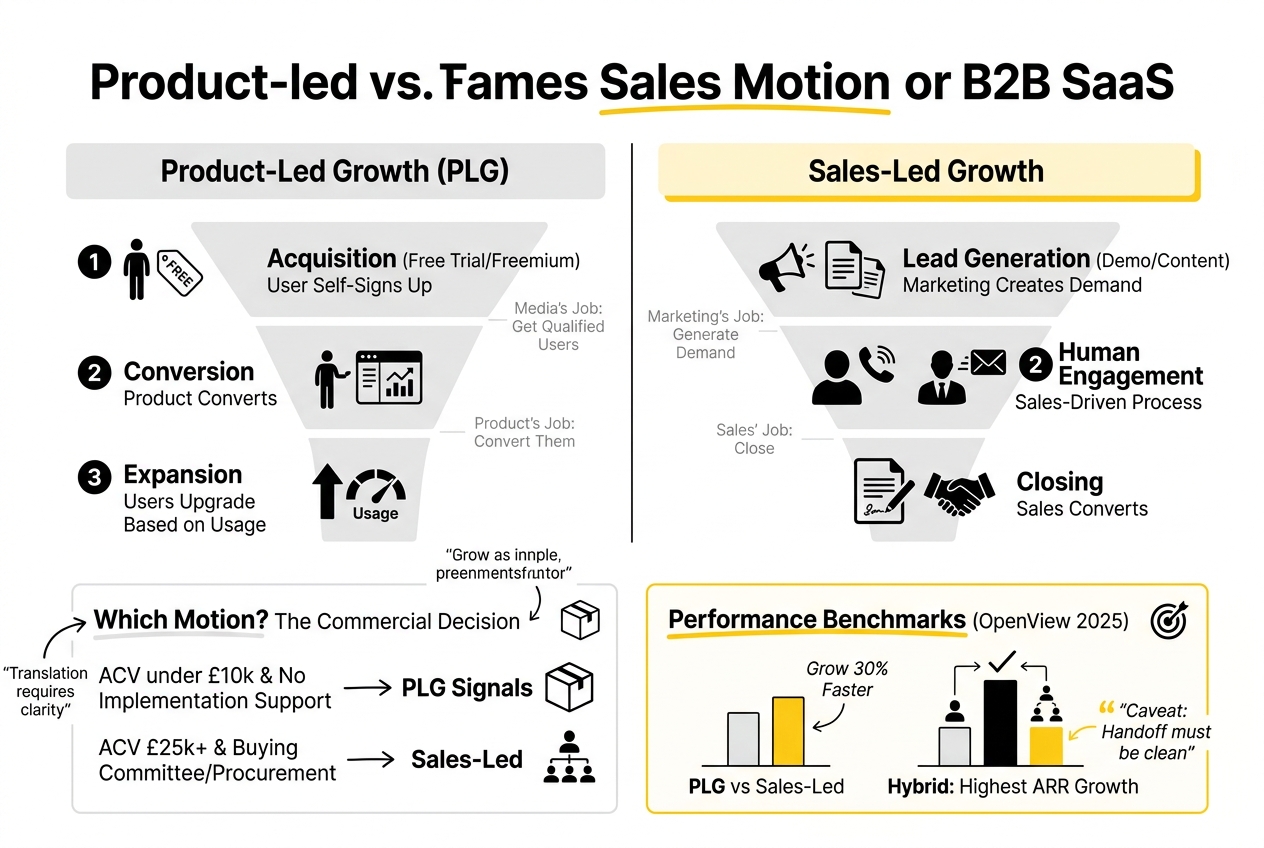
Product-led growth (PLG) is a GTM motion where the product itself drives acquisition, conversion, and expansion. Users self-sign-up, experience value directly, and upgrade based on usage. Paid acquisition in a PLG model typically drives traffic to a free trial or freemium tier. The job of media is to get qualified users into the product. The product’s job is to convert them.
Sales-led growth is the opposite architecture. Prospects are identified, engaged, and closed through a human-driven sales process. Marketing creates awareness and demand; sales converts it. Paid acquisition drives demo requests, content downloads, or gated assets that feed a sales team.
Understanding which motion your product is running is not a marketing strategy decision. It is a product and commercial decision that should already be made by the time you’re briefing a paid acquisition agency. The agency’s job is to translate that motion into channel strategy. Your job is to make sure they understand which motion they’re translating.
A useful heuristic: if your product ACV is under £10,000 and users can experience value in a trial without implementation support, PLG signals are present. If your ACV is above £25,000 or buying decisions involve a committee, procurement process, or integration evaluation, you are running a sales-led motion, and your acquisition strategy needs to reflect that.
According to the OpenView SaaS Benchmarks (2025), PLG companies grow 30% faster at the same revenue level compared to sales-led counterparts, but hybrid companies achieve the highest median ARR growth rates when both motions are run with discipline. The caveat matters: hybrid only outperforms if the handoff between marketing-generated pipeline and sales is clean. That handoff starts with how you define your ICP.
What Is an ICP in Business, and Why Does It Drive Paid Acquisition?
An ICP, or ideal customer profile, is a precise definition of the type of company most likely to buy your product, derive value from it, and renew or expand over time. In B2B SaaS, the ICP typically captures firmographic attributes (industry, headcount, revenue range, geography), technographic signals (what tools they already use), and behavioural indicators (where they are in a buying cycle, what problem they’re actively trying to solve).
The ICP buyer persona sits one level below: the individual within that company who will champion, approve, or block the purchase. Both matter for paid acquisition, and they shape different things. The ICP informs campaign targeting and budget allocation. The ICP buyer persona informs ad copy, landing page messaging, and the specific offer you lead with.
Most Series A SaaS teams have an ICP document of some kind. The question is whether it was built from actual closed-won data or from a best-guess exercise done during fundraising. These produce very different targeting briefs.
A customer profile template built from real data will include:
- The job titles that actually appear in closed deals (not aspirational ones)
- The company characteristics that correlate with short sales cycles and low churn
- The specific trigger events that prompt prospects to start evaluating solutions like yours
- The channels where those prospects are actually reachable
When this level of specificity feeds a paid acquisition brief, agency campaigns start with a meaningful targeting advantage. When it doesn’t, agencies fill the gap with assumptions, and those assumptions show up in the MQL-to-SQL ratio three months later.
PMF Readiness: The Prerequisite Agencies Won’t Ask About
PMF readiness refers to whether a product has demonstrated sufficient product-market fit to justify scaling paid acquisition. The question sounds obvious. It isn’t.
Many Series A companies have early traction. They have customers, NPS scores, and a handful of case studies. What they don’t always have is a repeatable pattern of acquisition, activation, and retention that holds across different ICP segments. That distinction matters more than any campaign structure an agency can design.
Scaling paid acquisition before PMF is confirmed for a specific ICP segment is one of the most reliable ways to inflate CAC without improving pipeline quality. The agency will optimise for the metrics you agreed on, usually leads or demo requests. But if the product isn’t consistently converting those leads into customers who stay, the pipeline numbers will tell one story and the renewal numbers will tell another.
A practical check before briefing an agency: look at your last 12 months of closed-won deals. Can you identify a cluster of 10 to 15 companies that share the same ICP characteristics, had similar sales cycles, and are showing good early retention? If yes, PMF is sufficiently confirmed in that segment to scale acquisition toward it. If the closed-won set is too varied to identify a clear pattern, more ICP discovery work comes before agency briefing, not after.
Funnel Ownership: Who Owns What, and Where Handoffs Break
Funnel ownership is the assignment of accountability across the stages from first touch to closed-won revenue. In most B2B SaaS companies, marketing owns the top of the funnel and sales owns the bottom. The middle is where deals die quietly and nobody claims responsibility.
For paid acquisition to connect to revenue outcomes, the ownership structure has to be explicit and agreed before campaigns launch. This covers three things:
MQL definition. What specific behaviours or attributes qualify a lead for handoff to sales? If marketing and sales are using different definitions, the pipeline numbers will always be contested. The agency needs this definition too. It determines what conversion events to optimise for.
Handoff mechanism. How does a marketing-qualified lead become a sales-qualified lead? What does the CRM state change look like? What SLA does sales have to follow up? Without a defined mechanism, high-intent leads generated by paid campaigns will sit in a queue and cool down.
Attribution agreement. What credit does paid search or paid social get for a deal that also involved SDR outreach, a content piece, and a G2 review? This doesn’t need to be perfect. It needs to be consistent. Multi-touch attribution across long B2B SaaS sales cycles is a genuine challenge, and the goal is directional accuracy, not forensic precision.
The agency you work with should be asking these questions before the campaign structure is finalised. If they’re not, it’s a signal that their reporting will optimise for campaign metrics rather than revenue outcomes.
Aligning Paid Search and Paid Social with Your Sales Motion
Paid search and paid social serve fundamentally different functions in a B2B SaaS GTM plan, and the GTM motion determines which deserves more budget.
Paid search captures existing demand. Someone is searching for a solution to a specific problem, evaluating options, or looking for a competitor alternative. The intent is present. The job of search is to intercept it efficiently. For sales-led GTM, bottom-of-funnel search terms (“best [category] software for [use case]”, competitor brand terms, integration-specific queries) are typically the highest-ROI allocation at Series A.
Paid social creates and accelerates demand. LinkedIn, in particular, is where B2B buying committees research categories before they start search activity. Paid social in a sales-led GTM is most effective as an ICP-targeted channel for building familiarity with the brand and problem frame, which shortens the sales cycle when prospects do engage.
A common mistake at Series A is running both channels with the same messaging and the same conversion goal. Paid social that leads with a demo request to cold ICP audiences will generate low conversion rates and expensive CPLs. The same budget allocated to content, category education, or short-form case study content, with retargeting to demo request pages, will typically produce better pipeline quality even if the top-line lead numbers look smaller.
The split between channels should reflect your ACV and sales cycle. As a starting point: for ACVs above £20,000 and sales cycles over 60 days, a higher allocation to paid social for demand creation and search for demand capture makes strategic sense. For lower ACV, higher velocity products, search will often deliver the better near-term CAC.
Budget allocation is not a one-time decision. A good agency will monitor the pipeline contribution of each channel monthly and adjust based on what’s closing, not just what’s converting to lead.
What to Look for When Selecting a SaaS GTM Paid Acquisition Agency
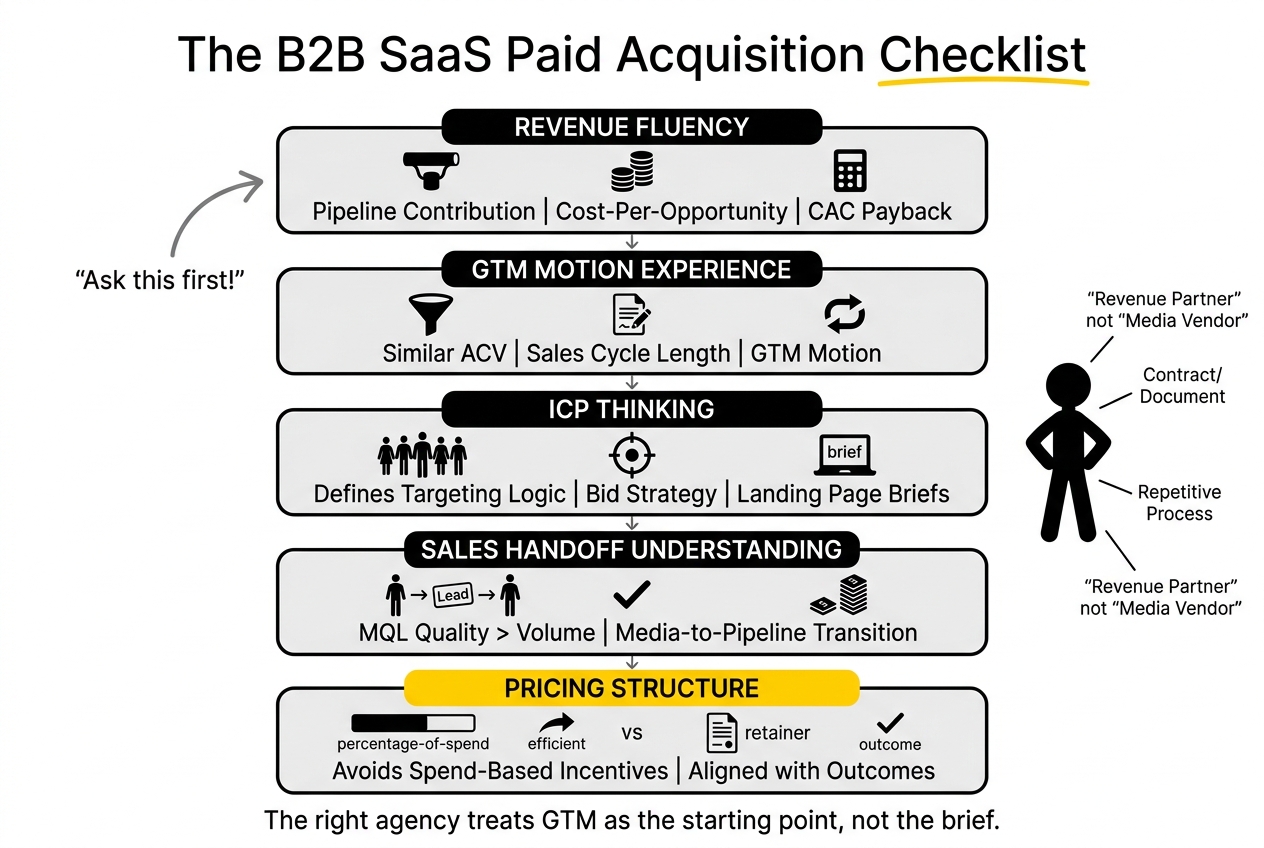
The most common selection mistake is evaluating agencies on tactical competence without assessing GTM alignment. Technical PPC and paid social skill is table stakes. The differentiating question is whether the agency can operate as a genuine revenue partner, not a media vendor.
Specific indicators to probe in agency conversations:
Revenue fluency. Can they speak to pipeline contribution, cost-per-opportunity, and CAC payback without prompting? Agencies that lead with clicks and impressions in initial conversations will lead with clicks and impressions in quarterly reviews.
GTM motion experience. Have they run campaigns for companies with a similar ACV, sales cycle length, and GTM motion? A case study from a £500 ACV self-serve SaaS tool is not strong evidence for a £30,000 ACV sales-led product, even if the channel mix is the same.
ICP thinking. Do they ask about your ICP in the discovery phase, or do they move straight to campaign structure? The agency’s ability to translate an ICP into targeting logic, bid strategy, and landing page brief is a meaningful signal of how they will actually operate.
Sales handoff understanding. Can they describe how they think about the media-to-pipeline transition? Do they talk about MQL quality, not just volume?
Pricing structure. Percentage-of-spend models create a structural incentive to increase budgets regardless of efficiency. Retainer models are generally better aligned with revenue outcomes, particularly at Series A where budget discipline is a commercial constraint.
The right SaaS paid acquisition agency for a Series A SaaS company is one that treats the GTM motion as the starting point, not the campaign brief. The campaign brief is downstream.
Frequently Asked Questions
What is SaaS GTM?
SaaS GTM, or go-to-market, is the coordinated strategy a SaaS company uses to bring its product to market and acquire customers. It covers ICP definition, positioning, channel selection, and how marketing and sales work together to convert demand into closed-won revenue. The GTM motion describes the specific mechanism, such as product-led growth or sales-led, through which customers discover and buy the product.
How can a paid acquisition agency align with a SaaS company’s go-to-market strategy?
Alignment starts before campaigns launch. The agency needs to understand the GTM motion (PLG, sales-led, or hybrid), the ICP, the MQL definition, and how the sales handoff works. An agency that treats these as downstream from campaign setup will optimise for the wrong outcomes. The right starting point is ICP and GTM motion, then channel strategy, then campaign structure.
What are the key elements of product-market fit (PMF) readiness for SaaS companies?
PMF readiness means having a repeatable pattern of acquisition, activation, and retention within a clearly defined ICP segment. It’s not just customer count or NPS. A practical indicator is whether 10 to 15 closed-won deals share enough ICP characteristics to define a targetable segment. If the closed-won set is too varied to identify a pattern, more ICP work is needed before scaling paid acquisition.
What are the differences between product-led growth (PLG) and sales-led strategies in SaaS?
PLG is a motion where the product drives acquisition and conversion through self-serve trial or freemium. Paid acquisition sends users into the product, and the product converts them. Sales-led growth relies on a human-driven sales process; marketing generates demand and sales converts it. The primary determinants are ACV, product complexity, and whether users can experience meaningful value independently. PLG fits lower ACV, simpler products; sales-led fits higher ACV, buying committee decisions.
How do you identify the ideal customer profile (ICP) for a SaaS product?
The most reliable method is analysing closed-won and retained customers for shared firmographic and behavioural characteristics. Look for patterns in industry, company size, the specific trigger event that prompted the purchase, and the job title of the main champion. An ICP built from this data produces more targetable acquisition campaigns than one built from assumptions about who the product could serve.
What role does funnel ownership play in the success of paid acquisition strategies?
Funnel ownership defines who is accountable for each stage from first ad touch to closed-won deal. Without clear ownership, the middle of the funnel becomes a gap where qualified leads go cold and nobody claims responsibility. Paid acquisition fails to produce pipeline not because the campaigns are bad, but because the leads they generate have no defined path through the sales process.
How can marketing directors ensure a seamless handoff from paid media to the sales pipeline?
Define the MQL criteria in advance and ensure they reflect actual buying intent, not just form completion. Establish a CRM-based handoff process with a clear SLA for sales follow-up. Agree on an attribution model that both marketing and sales accept, even if it’s imperfect. Review MQL-to-SQL conversion rate monthly. If it’s declining, the problem is usually lead quality or follow-up speed, not campaign targeting.
What metrics should be used to measure the effectiveness of paid search and social strategies in SaaS?
The metrics that hold up in board meetings are cost-per-opportunity, pipeline generated by paid media, and contribution to closed-won ARR. Supporting metrics include MQL-to-SQL ratio, cost-per-MQL by channel, and CAC payback period. Impressions, clicks, and CTR are useful for optimising campaigns internally but are not revenue metrics.
How can marketing leaders maintain accountability to revenue outcomes in their paid acquisition efforts?
Connect campaign reporting to CRM data so that pipeline and revenue attribution is visible alongside media metrics. Set OKRs around qualified pipeline and cost-per-opportunity rather than lead volume. Review these with the agency monthly, not quarterly. An agency that can’t connect their campaign performance to CRM pipeline data within 90 days of launch is not structured to be accountable to revenue outcomes.
What are the best practices for integrating paid search and paid social strategies in a SaaS GTM plan?
Use search to capture high-intent demand from prospects already searching for solutions in your category. Use paid social to build ICP familiarity and accelerate demand creation among prospects who are pre-search. Align messaging across both channels but calibrate the conversion goal to the channel: cold social audiences need education before a demo request; high-intent search audiences can be sent directly to a demo or trial page. Review channel contribution to pipeline quarterly and reallocate budget based on what’s closing.
Working Through This? We Can Help.
Getting the GTM alignment right before briefing a paid acquisition agency is the kind of work that significantly changes how campaigns perform. This is something we work through with SaaS teams regularly, from ICP validation through to channel strategy and sales handoff design. If you’re at that stage, we’re happy to take a look at your setup.