Effective Retargeting Strategies for SaaS Products
Discover how SaaS marketing agencies can optimise retargeting campaigns to enhance lead quality and drive pipeline outcomes.

You’re generating traffic. Awareness campaigns are running. Content is getting clicks. But when you look at your pipeline three months later, the numbers don’t add up, and the gap between site visitors and qualified opportunities keeps widening.
For most B2B SaaS teams, that gap is not a targeting problem. It’s a retargeting problem. More specifically, it’s a failure to treat retargeting as its own discipline, one that requires different audiences, different creative logic, different timing, and different measurement from everything else you’re running.
This article covers how SaaS marketing agencies approach retargeting ad campaigns for SaaS products: the strategy behind audience segmentation, where timing matters across the buying cycle, how to sequence creative without burning out your audience, what exclusion logic actually protects your budget, and how to measure whether retargeting is adding real pipeline value or just claiming credit for conversions that were already happening.
Why SaaS Marketing Agencies Need a Different Retargeting Approach
Retargeting in SaaS is not the same as retargeting in ecommerce. There is no abandoned cart. There is no single decision-maker clicking “add to basket.” The average B2B customer journey now takes over 200 days and involves multiple stakeholders, multiple sessions, and multiple channels before a deal closes.
That context changes everything. Your retargeting or remarketing strategy for SaaS cannot chase a single “warm visitor” with the same ad until they convert or go cold. It has to map to where a buying committee is in the evaluation process, what content they’ve already engaged with, and what they need to see next to move forward.
SaaS companies that run retargeting the same way ecommerce brands do tend to hit the same problems: high frequency on the wrong audiences, creative fatigue within two weeks, over-attribution in their reporting, and a creeping sense that the budget is going somewhere without producing anything useful in the pipeline.
The fix is not more budget. It is a properly structured retargeting programme that treats each stage of the SaaS buying journey as a distinct phase.
Audience Segmentation: The Foundation of Effective Retargeting
Most SaaS retargeting fails at the segmentation stage. Teams build a single “website visitors” audience, exclude recent converters, and call it a strategy. The result is a generic pool of people at wildly different points in their consideration, served the same message.
Segment by intent signal, not just session data. The visitor who read a comparison page and visited your pricing section twice is not the same as someone who bounced from your homepage after six seconds. Grouping them in the same audience wastes impression budget on the first person and over-invests in the second.
Effective audience segmentation for SaaS retargeting typically works across four layers:
- High-intent engagement: Pricing page visitors, demo page viewers, trial abandons, and anyone who spent 90 seconds or more on a product feature page. This is your tightest audience and your most valuable.
- Mid-funnel content consumers: People who have read case studies, watched webinars, or consumed two or more pieces of content. They are researching, not browsing.
- Early-stage visitors: Homepage bounces, single-page sessions, and people who have visited once but not returned. These warrant lighter-touch re-engagement, not demo requests.
- CRM-synced audiences: Contacts in your CRM who have not responded to sales outreach, or known opportunities that have gone cold. This is where retargeting ads can genuinely accelerate pipeline by creating brand presence around a stalled deal.
Segmenting audiences by behaviour rather than recency alone can increase click-through rates by over 70% compared with broad retargeting, according to 2025 benchmark data. The improvement is not primarily about ad relevance. It is about showing up at the right point in someone’s consideration with something that moves them forward, rather than something that repeats what they already know.
Timing Within the SaaS Sales Cycle
Retargeting timing is where many B2B SaaS campaigns waste the most money. Running the same ads continuously across a 180-day sales cycle without any refresh logic guarantees creative fatigue and diminishing returns.
The key is to map your retargeting cadence to how your buying cycle actually unfolds, not how you wish it would.
Early cycle (days 0 to 30): This window is about staying visible and building familiarity. Ads should drive to ungated educational content, thought leadership, or short explainer videos. The goal is not conversion. It is continued engagement. Pushing a “Book a Demo” CTA at someone who just discovered your product two weeks ago is a waste of impression.
Mid cycle (days 30 to 90): By this point, serious prospects have usually visited multiple pages and may have consumed a case study or watched a product walkthrough. Retargeting here can become more direct. Ads can reference the problem your product solves, use social proof, and include a soft conversion offer, a relevant guide, an ROI calculator, or an invitation to a relevant webinar.
Late cycle (days 90 and beyond): For enterprise SaaS with cycles of 90 days or more, this is where deal-acceleration retargeting earns its place. Ads should create urgency around evaluation milestones, offer comparison content against competitors the prospect is likely also evaluating, and put relevant proof in front of every stakeholder on the buying committee, not just the original contact.
Display retargeting ads served within the first 24 hours of a site visit consistently generate the highest click-through rates, often exceeding 1.2% according to 2025 data. That window matters, but it should be used to bring someone back into consideration, not to force a conversion that the relationship has not earned yet.
Creative Sequencing: Avoiding the Same Ad Trap
Running the same retargeting creative for three months is one of the most common budget leaks in SaaS paid media. After a certain number of exposures, the same ad stops creating lift and starts creating irritation. The audience stops clicking, the algorithm reads that as poor performance, and costs climb.
Creative sequencing is the practice of deliberately rotating what someone sees based on how many times they have been exposed to your ads and how they have engaged.
A basic sequencing structure for SaaS retargeting:
- Awareness sequence (exposures 1-3): Brand-led, problem-framing content. Short videos, conceptual animations, or thought leadership. No hard sell.
- Proof sequence (exposures 4-7): Case studies, customer outcomes, specific results. Start introducing your product as the solution.
- Evaluation sequence (exposures 8-12): Comparison content, feature-specific messaging, trial or demo offers. These are for warm audiences who have repeatedly engaged.
- Urgency sequence (exposures 13+): Limited-time offers, specific sales prompts, analyst recognition, or customer testimonials from companies similar to the prospect.
The rotation logic should also respond to engagement. Someone who clicked on your case study ad should not be re-served that same ad. They should advance to the next sequence, or be moved into a CRM-informed audience where sales outreach and ads can coordinate.
Creative sequencing is the difference between retargeting that builds a relationship over a long buying cycle and retargeting that burns budget until someone opts out.
Exclusion Logic: Protecting Your Budget
Exclusion logic is the unglamorous side of retargeting strategy, but it is where significant waste either gets caught or ignored.
Without clean exclusions, you will spend retargeting budget on people who already converted, employees researching your own platform, competitors scouting your positioning, and high-churn segments that drag down your pipeline quality metrics.
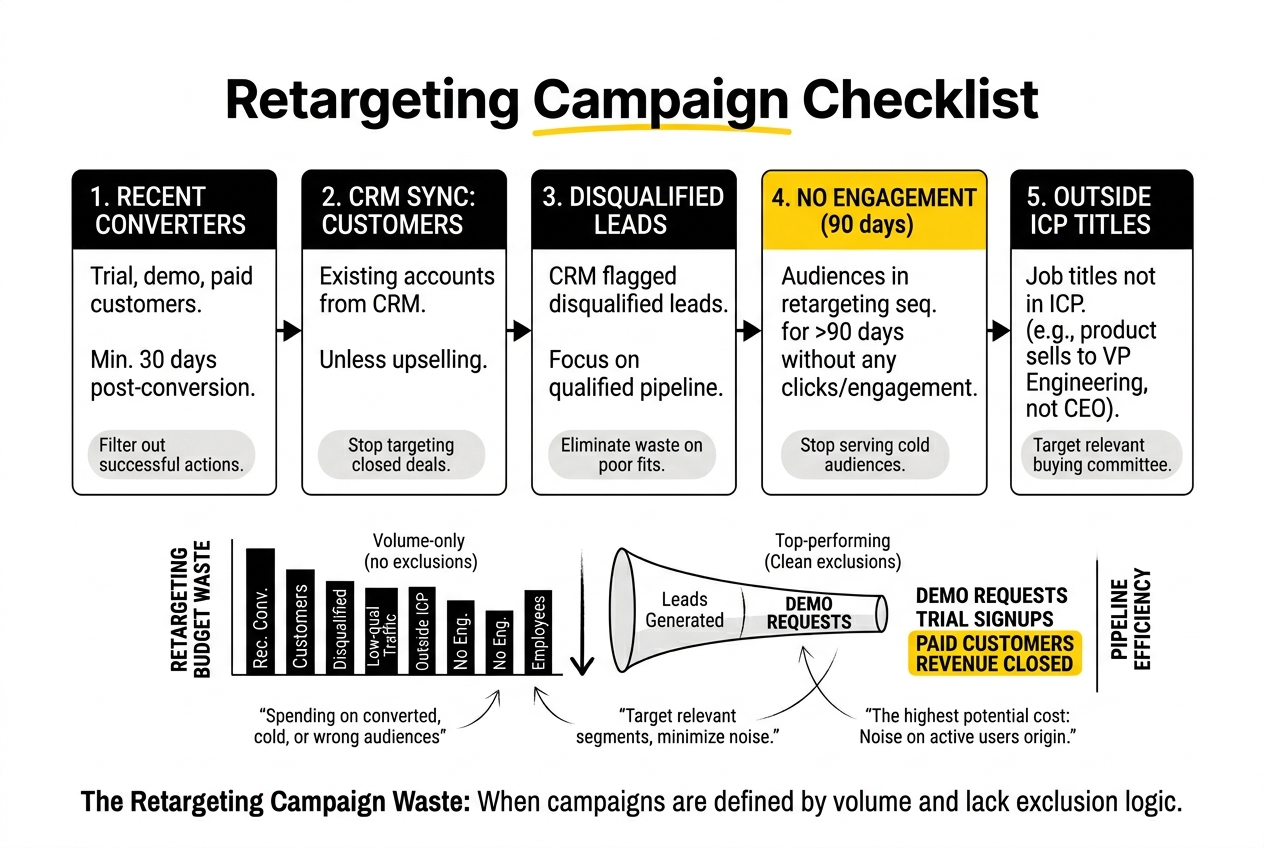
The standard exclusions every SaaS retargeting campaign needs:
- Recent converters (trial signups, demo requests, paid customers) for a minimum of 30 days post-conversion
- Existing customers synced from your CRM, unless you are running expansion or upsell campaigns
- Disqualified leads flagged in your CRM
- Your own IP range and employee email lists
- Low-quality traffic sources, such as sessions under 10 seconds with zero page depth
The exclusions most teams miss:
- Audiences who have been in a retargeting sequence for more than 90 days without any engagement. These are cold. Continuing to serve them at full frequency wastes spend on people who have effectively opted out with their behaviour.
- Job titles outside your ICP. If your product sells to VP of Engineering, serving retargeting ads to the CEO who clicked a LinkedIn thought leadership post once is unlikely to drive pipeline.
- Trial users who are already in an active onboarding sequence. Hitting them with paid ads at the same time as automated product emails creates noise, not momentum.
The strongest retargeting programmes treat exclusion logic as an ongoing operational discipline, not a setup task done once at campaign launch. Audiences shift. CRM data changes. Exclusion lists need the same review cadence as your bid strategy.
Measuring Incrementality in SaaS Retargeting
Incrementality measurement is where the most honest conversations about retargeting happen, and where most teams avoid looking too closely.
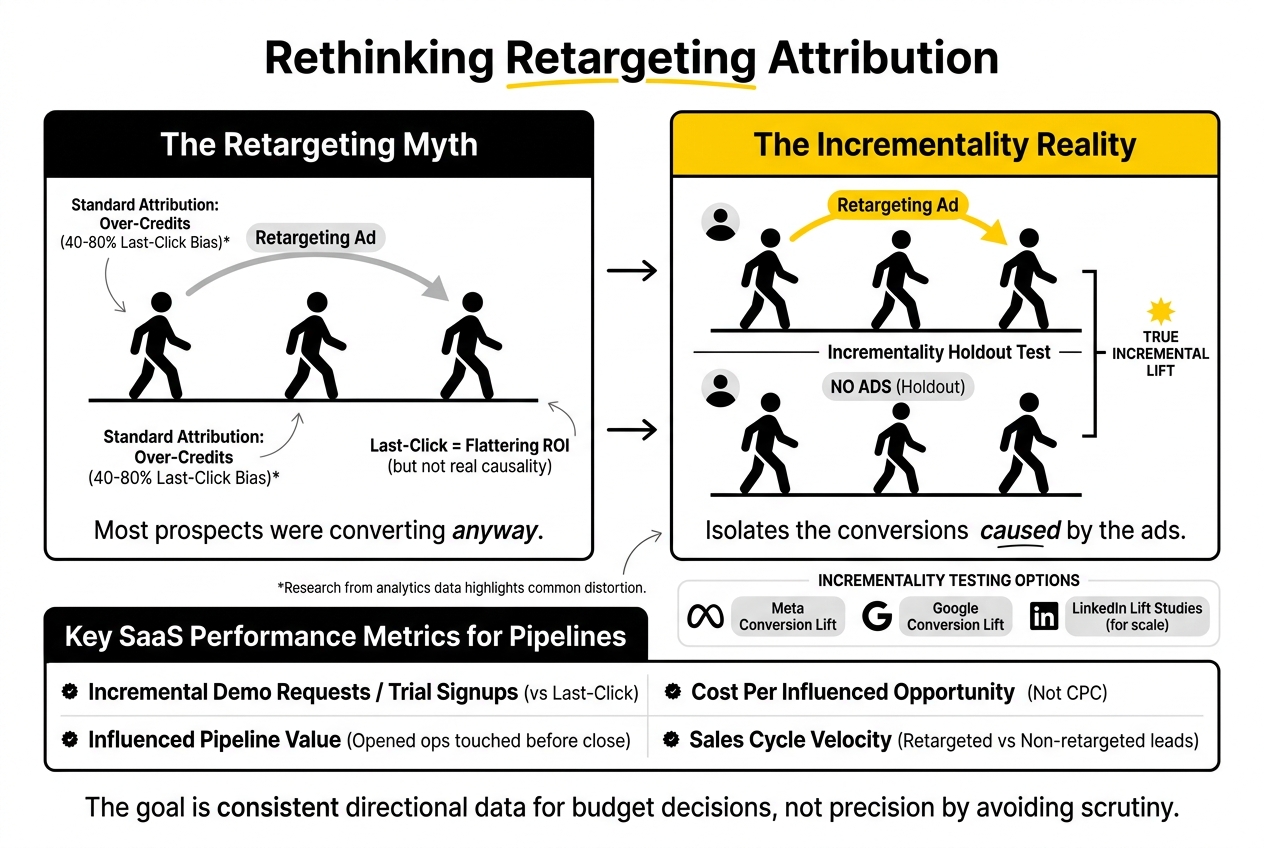
The core problem with standard retargeting attribution is that it over-credits conversions that were already happening. A prospect who was going to request a demo regardless of seeing your LinkedIn retargeting ad gets counted in the retargeting column anyway. Over time, this creates a flattering picture of retargeting ROI that does not reflect the reality of what the ads are actually causing.
Research from Improvado’s 2026 analytics data found that last-click attribution over-credits retargeting by 40 to 80% compared to models that account for incrementality. That is a significant distortion, and it leads directly to over-investment in retargeting at the expense of demand generation activity that might be doing more genuine work.
Incrementality testing for SaaS retargeting involves creating a holdout group: a segment of your audience that does not see your retargeting ads for a defined period, while a matched test group continues to receive them. The difference in conversion rate between the two groups is the true incremental lift your retargeting is generating.
Both Google Ads (via Conversion Lift experiments) and Meta (via its Conversion Lift study tool) offer native incrementality testing options. For teams running LinkedIn retargeting, LinkedIn’s Campaign Manager also supports lift studies, though the audience minimums make these more practical for larger SaaS businesses with substantial retargeting volumes.
For measuring retargeting campaign success in SaaS specifically, the metrics that hold up in pipeline conversations are:
- Incremental demo requests or trial signups attributed to the holdout test, not last-click
- Influenced pipeline value: how many open opportunities were touched by retargeting before closing
- Cost per influenced opportunity, not just cost per click
- Sales cycle velocity for retargeted vs non-retargeted leads: does retargeting genuinely shorten evaluation time?
Attribution will never be clean in a 90-day buying cycle with multiple decision-makers. The goal is directional data that is consistent enough to inform budget decisions, not precision that only looks credible because the methodology never gets questioned.
Aligning Retargeting with the Full-Funnel Paid Strategy
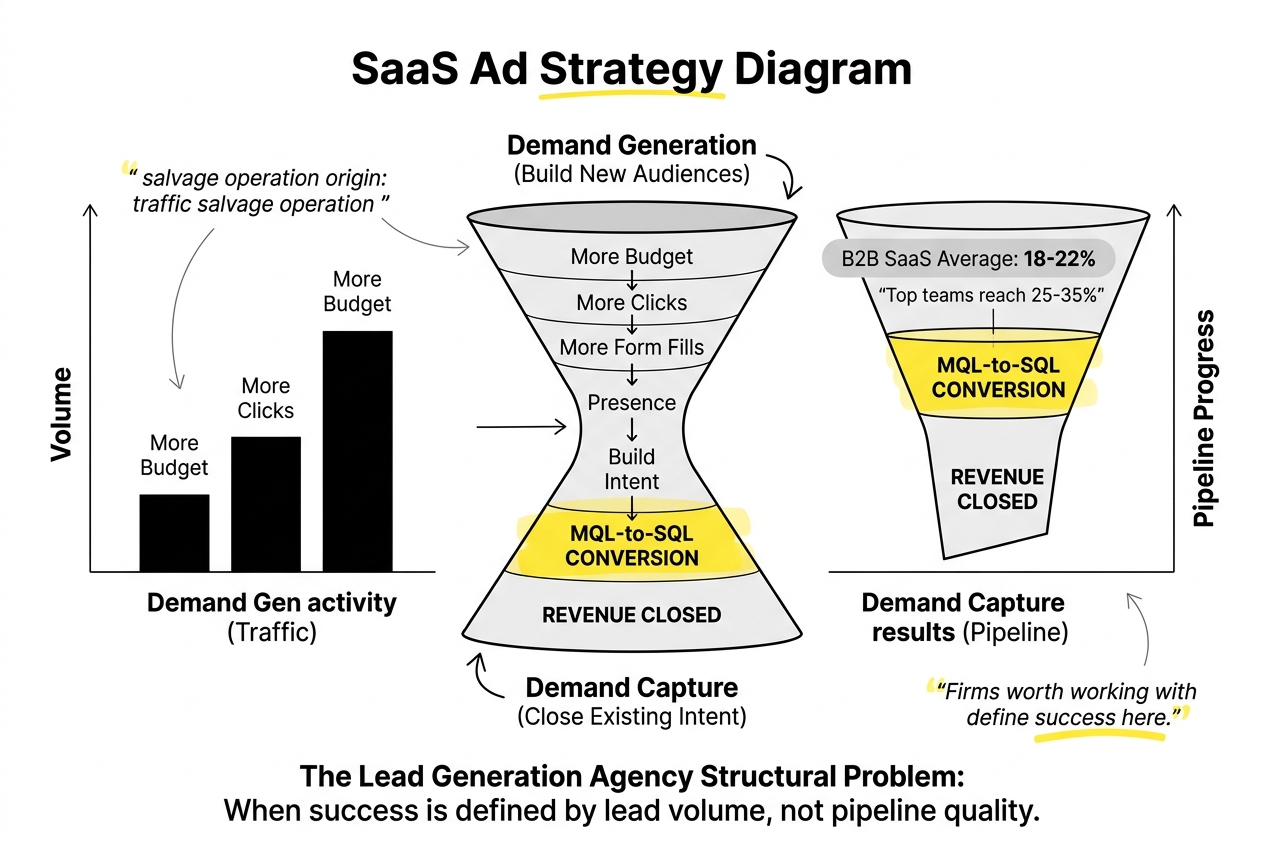
Retargeting does not function in isolation. It is the middle layer of a full-funnel retargeting strategy for SaaS, sitting between demand generation activity at the top and demand capture at the bottom.
The way these layers interact determines whether your retargeting budget creates genuine pipeline acceleration or simply recirculates traffic that demand capture would have converted anyway.
The most common structural problem is running retargeting as a salvage operation: a way to catch people who did not convert on first visit, treated as a standalone channel with its own budget and its own KPIs. That framing guarantees you will optimise retargeting in isolation rather than as part of a coordinated pipeline system.
A better framing is this: retargeting’s job is to maintain presence and build intent across the middle of the buying cycle, while demand gen keeps building the pool of new audiences and demand capture handles the people who are already looking to buy now.
When the three layers are coordinated with shared audience logic, consistent messaging, and shared measurement, retargeting becomes a multiplier on what the rest of the paid programme is doing, rather than a channel that competes with it for the same conversions.
For SaaS marketing agencies offering retargeting ad campaigns for SaaS products, this coordination is one of the clearer signals that separates a mature paid programme from one that is generating impressions without generating pipeline.
Frequently Asked Questions
What are the key components of a successful retargeting ad campaign for SaaS products?
Successful SaaS retargeting requires five working parts: intent-based audience segmentation that separates high-value signals from general traffic, timing logic mapped to your actual sales cycle length, creative sequencing that rotates messaging as prospects move through evaluation, clean exclusion logic to prevent wasted spend on existing customers and disqualified leads, and incrementality measurement to verify the campaigns are generating real pipeline lift rather than claiming credit for conversions that would have happened anyway.
How can audience segmentation improve the effectiveness of retargeting campaigns for SaaS companies?
Segmenting by intent signal, not just recency, allows retargeting to show the right message at the right stage. A prospect who visited your pricing page twice needs different creative from someone who bounced from your homepage after a few seconds. Grouping them together wastes budget on the first person and serves irrelevant ads to the second. Behaviour-based segmentation, including CRM-synced audiences for stalled deals, consistently outperforms broad retargeting pools on cost per qualified opportunity.
What role does timing play in retargeting ads within the SaaS sales cycle?
Timing determines whether retargeting accelerates a deal or creates friction. Early-cycle ads should drive to educational content, not demo requests. Mid-cycle ads can become more direct as intent signals strengthen. Late-cycle ads, for enterprise SaaS with 90-plus day cycles, should focus on deal acceleration: competitive comparison content, customer proof, and ensuring the right stakeholders on the buying committee have seen your message.
Running the same ad across all three phases signals a lack of strategy, not just inefficiency.
How can creative sequencing enhance the impact of retargeting ads for SaaS products?
Creative sequencing prevents the audience fatigue that kills most retargeting programmes within a few weeks. By rotating what someone sees based on exposure count and prior engagement, sequencing keeps ads relevant as prospects move through evaluation. A basic structure moves from problem-framing in early exposures to case study proof in the middle phase to conversion-focused creative for prospects who have repeatedly engaged but not yet converted.
What exclusion logic should be applied in retargeting campaigns to avoid wasting ad spend?
Standard exclusions include recent converters, existing customers, disqualified CRM leads, and your own employees. The exclusions most teams miss are audiences that have been in a retargeting pool for more than 90 days without any engagement, job titles outside your ICP, and current trial users already in onboarding sequences. Exclusion logic should be treated as an ongoing operational task, reviewed quarterly, not a one-time setup decision.
How can SaaS marketing agencies measure the incrementality of their retargeting efforts?
The most reliable method is a holdout test: a matched audience segment that does not receive retargeting ads for a defined period, compared against a test group that does. The conversion rate difference is the true incremental lift. Google Ads, Meta, and LinkedIn all offer native lift study tools. The output metrics that matter are incremental demo requests or trial signups from the test, influenced pipeline value, and sales cycle velocity for retargeted versus non-retargeted leads.
What best practices should SaaS marketing agencies follow when implementing retargeting ad campaigns for SaaS products?
Build audiences around intent signals, not just session data. Map your creative cadence to your actual sales cycle length. Coordinate retargeting with demand gen and demand capture so the three layers share audience logic and measurement. Run incrementality tests at least once per quarter. Review exclusion lists monthly. Treat creative refresh as a scheduled operational task, not a response to performance decline. And measure retargeting against pipeline outcomes, not click-through rates.
How can retargeting ads align with the SaaS buying journey to maximise ROI?
Alignment means treating different stages of the buying journey as distinct retargeting phases rather than one continuous pool. Early stage stays educational and light-touch. Mid-funnel introduces proof and narrows on specific problems your product solves. Late cycle focuses on the evaluation decision: comparisons, ROI, and stakeholder-specific messaging.
When retargeting creative, timing, and audience logic all map to where prospects actually are in their evaluation, cost per influenced opportunity falls and pipeline quality improves.
What challenges do demand generation leaders face when scaling retargeting campaigns for B2B SaaS?
The most common challenges are attribution distortion that over-credits retargeting at the expense of accurate budget decisions, creative fatigue from under-invested creative refresh cycles, audience overlap between retargeting and prospecting that inflates impression counts without adding coverage, and the difficulty of building meaningful exclusion logic when CRM data is incomplete or not integrated with ad platforms.
Scaling retargeting without solving the measurement problem first tends to compound all of these issues.
How can retargeting efforts drive better lead quality and pipeline outcomes for SaaS companies?
Better lead quality comes from tighter audience segmentation and exclusion logic working together. When retargeting only reaches prospects with genuine buying signals, and consistently excludes low-quality or irrelevant traffic, the leads that do convert are more aligned with your ICP.
Pipeline outcomes improve when retargeting is measured against influenced opportunity value rather than clicks, and when the programme is coordinated with sales outreach so ads and direct contact reinforce each other during active evaluations.
If you’re working through how to structure a retargeting programme that connects to pipeline rather than vanity metrics, this is the kind of problem we work through with SaaS teams regularly. Worth a conversation if you’re at that point.
For a broader view of how retargeting fits within a full paid media programme, see our work as a SaaS PPC agency.