Scaling Series B SaaS: Demands for Effective Paid Media Optimisation
Discover what Series B SaaS teams should expect from paid media partners to ensure efficient growth and demonstrate ROI.

You raise your Series B. The board wants to see revenue grow. The CFO wants to see efficiency hold. And suddenly the paid media setup that got you here, built under Series A constraints and a fraction of the current budget, is being asked to do something entirely different.
This is where most VP of Marketing roles get complicated. Scaling Series B SaaS paid media is not simply a matter of increasing spend. It requires a different level of operational rigour, a different kind of agency partnership, and a fundamentally different approach to proving that the budget decisions you’re making are the right ones.
If you’re evaluating a series b saas paid media optimisation agency, here is what that relationship needs to deliver.
Why Scaling Paid Media at Series B Is Different
Series A paid media is mostly about learning. You’re testing channels, building conversion infrastructure, and working out which ICPs respond to what messages. The agency brief is: help us find what works.
Series B is different. You already have a working motion. The question is whether you can scale it without the unit economics falling apart.
The data reflects how hard this has become. According to Benchmarkit’s 2025 SaaS Performance Metrics report, the median B2B SaaS company now spends £2 to acquire £1 of new ARR, and that figure is up 14% from the year before. Customer acquisition costs have risen 40, 60% since 2023. Paid channel CAC is running at 2.4x to 3.1x blended CAC across most B2B SaaS categories, according to analysis from ChartMogul and OpenView’s 2026 benchmarks.
This is not a channel problem. It is an efficiency problem. And it is exactly the kind of problem that separates agencies capable of operating at Series B from those running a scaled-up version of what worked at Series A.
The other factor that changes at this stage is scrutiny. Series B due diligence now treats CAC payback periods above 14 months as a yellow flag and above 18 months as a red flag. That means the metrics you are carrying into board and investor conversations have direct implications for your next raise. Your paid media partner needs to understand that context.
What Predictable Scaling Actually Requires
Predictable scaling is a phrase that gets used a lot in agency pitches. What it actually means is worth unpacking.
A paid media programme scales predictably when you can say: if we increase budget by X, we expect to see Y change in pipeline, with Z confidence level, based on the performance data we have. Most programmes cannot say that, because the measurement infrastructure is not in place to make the claim defensible.
The three components of predictable scaling for SaaS paid media:
Conversion data that goes beyond the form fill. Google’s automated bidding strategies will optimise toward whatever conversion event you give them. If you’re feeding them MQL completions, they will get you more form fills. They will not necessarily get you more sales-qualified pipeline. Setting up offline conversion imports so that closed-won deals and qualified opportunities flow back into the ad platforms is not optional at Series B. It is what makes budget expansion defensible.
Stable account structure before budget increases. Doubling budget into a fragmented campaign structure produces fragmented results. Campaigns need enough conversion volume per month to run automated bidding reliably before scale starts. As a practical threshold, Google’s own guidelines suggest at least 30, 50 conversions per campaign per month as a floor for smart bidding. If you are scaling into accounts that do not hit this, you are burning budget to fund the algorithm’s learning curve rather than generating qualified pipeline.
Channel ceilings that are understood and planned around. Every paid search programme hits a demand capture ceiling. The volume of people actively searching for your category in any given month is finite. A paid media optimisation agency that is only running paid search without a clear view of when that ceiling is approaching, and without a plan for what happens next, is not a scaling partner. It is a maintenance operation.
The Integration Demands Series B Teams Should Place on Partners
At Series A, loose CRM integration is survivable. At Series B, it is not.
The paid media stack needs to talk fluently to the revenue stack. That means bidirectional data flow between the ad platforms, your CRM (HubSpot, Salesforce, Pipedrive, or equivalent), and whatever attribution or analytics layer you are running. The agency managing your paid media needs to have built this type of integration before, and they need to be comfortable working within your existing setup rather than asking you to replace it.
The specific integrations that matter most at Series B:
- Offline conversion tracking: Qualified opportunities and closed-won deals fed back into Google Ads and LinkedIn Campaign Manager so bidding optimises against revenue signals, not proxy events.
- CRM-to-platform audience sync: Account lists, lead stages, and customer data pushed into ad platforms for exclusions, bid adjustments, and ABM targeting.
- GCLID and UTM persistence through forms: Ensuring that the click source can be matched to the CRM record when a lead converts, so that channel attribution does not break at the point of hand-off to sales.
If an agency cannot walk you through exactly how they would implement each of these in your specific tech stack, that is a capability gap. Not a future roadmap item. A gap.
This matters for optimising paid media for growth because the optimisation signal is only as good as the data it is based on. An agency optimising on cost-per-lead without closed-loop conversion data is flying on instrument readings that do not correspond to the actual terrain.
Tying Advertising Spend to Revenue Outcomes
B2B SaaS sales cycles are long. According to 2025 data from across the industry, the average B2B SaaS sales cycle now runs to 134 days. That is a four-and-a-half month gap between the click that starts a buyer’s journey and the signature that ends it.
Attribution across that window is not a solved problem. But the goal is not perfect attribution. The goal is consistent, directional data that allows you to make budget decisions with reasonable confidence.
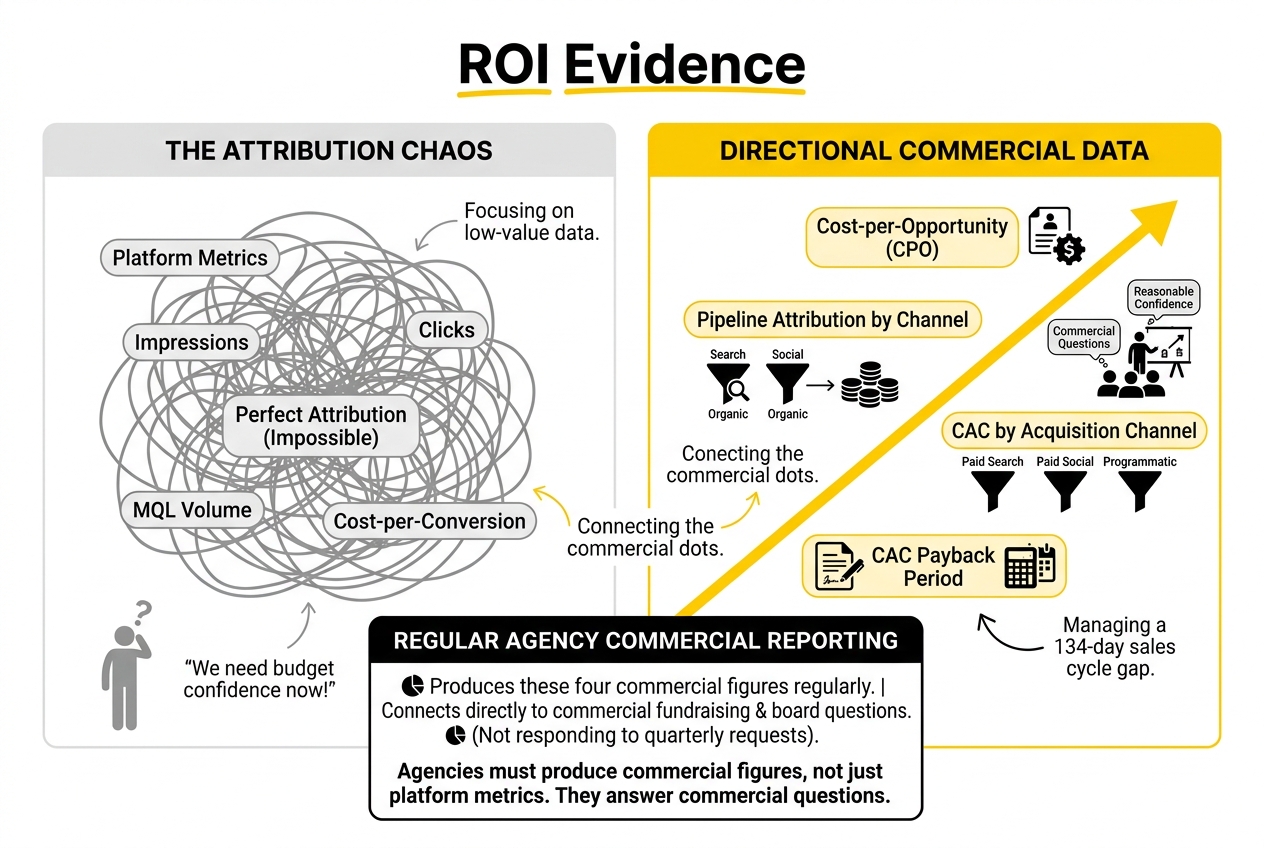
The metrics that hold up in board presentations at Series B are not MQL volumes or cost-per-lead. They are:
- Cost-per-opportunity (CPO): What does it cost to generate a sales-qualified opportunity from paid channels? This is the metric that bridges marketing spend and sales pipeline.
- Pipeline attribution by channel: What proportion of the current pipeline has a paid touchpoint in its history? And what is the shape of that attribution across channels?
- CAC by acquisition channel: Not blended CAC, but channel-level CAC that lets you compare the efficiency of paid search, paid social, and other programmatic channels against each other and against organic.
- CAC payback period: Given the contract values you are closing, how many months does it take to recoup the cost of acquiring a customer through each channel? This is what connects the paid media programme to fundraising and board conversations.
A paid media optimisation agency working at Series B should be producing these figures regularly, not in response to a quarterly request. If the reporting cadence only shows platform metrics like impressions, clicks, and cost-per-conversion, the data does not connect to the commercial questions your stakeholders are asking.
Granular Attribution in Long Sales Cycles
Attribution will never be perfect in a 134-day sales cycle with multiple stakeholders and touchpoints across channels you do and do not control. The practical approach is to set a consistent attribution framework, apply it uniformly, and use it directionally rather than as a precise measurement of cause and effect.
What granular attribution looks like in practice for B2B SaaS paid media:
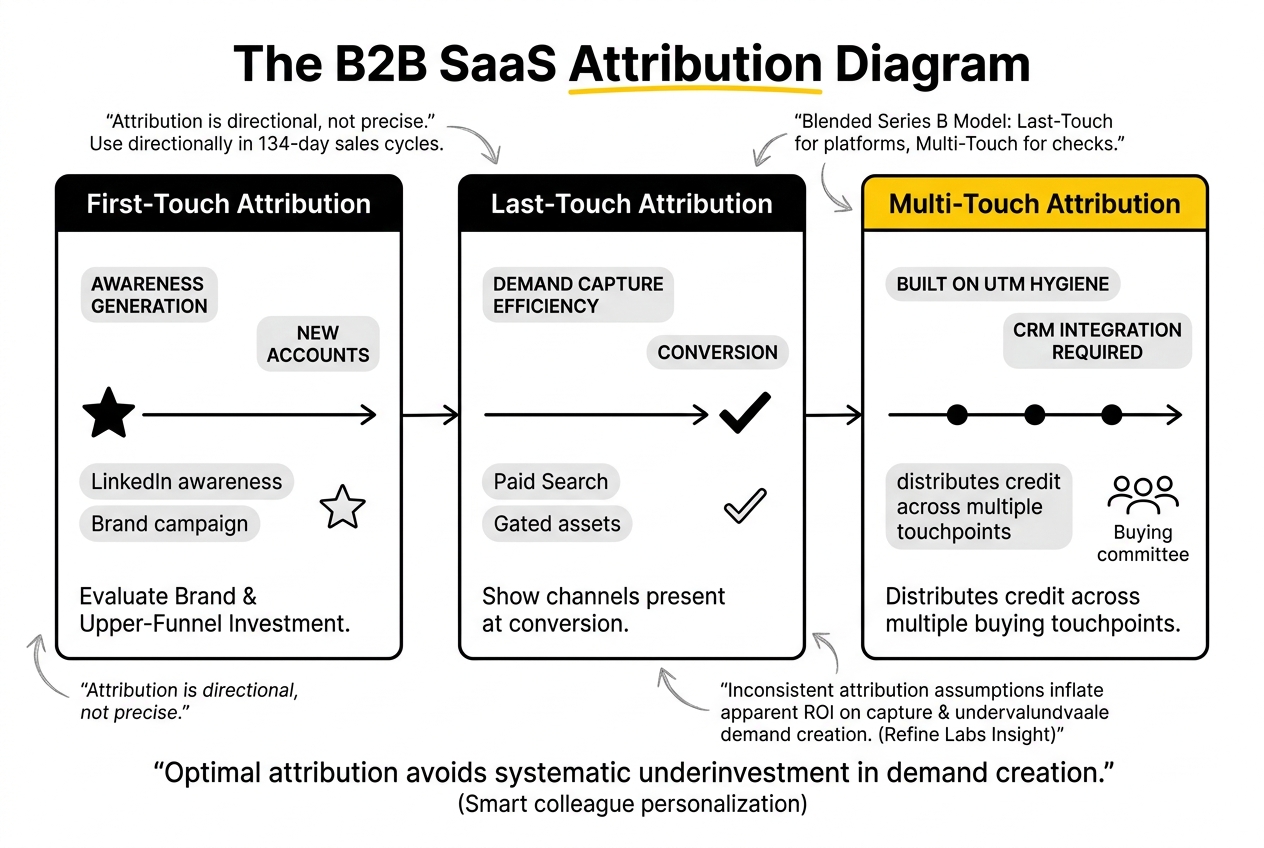
- First-touch attribution shows which channels are generating awareness and entering new accounts into the funnel. Useful for evaluating brand campaigns and upper-funnel investment.
- Last-touch attribution shows which channels are present at conversion. Useful for evaluating demand capture efficiency.
- Multi-touch attribution distributes credit across the touchpoints in a buying journey. More accurate for long-cycle B2B than either single-touch model, but requires consistent UTM hygiene and CRM integration to be meaningful.
The honest position for most Series B teams is that you are running a blended model: last-touch for platform reporting and budget decisions, multi-touch as a check on whether the last-touch picture is distorting your view of upper-funnel investment.
What matters more than the model you choose is the discipline with which you apply it. Changing attribution models quarter-on-quarter to explain performance makes the data unusable. Refine Labs has documented extensively how inconsistent attribution assumptions inflate apparent ROI on capture channels and undervalue demand creation. The long-term cost of that distortion is systematic underinvestment in the channels that actually build pipeline.
Informed Budget Reallocation at Scale
Budget reallocation decisions at Series B are not the same as at Series A. The stakes are higher, the amounts are larger, and the CFO is in the room.
The framework for making defensible reallocation decisions in SaaS paid media:
- Segment campaigns by function, not just channel. Within a paid search account, some campaigns are doing demand capture (bottom-funnel, branded, competitor terms) and others are doing demand creation (category-level awareness, problem-focused queries). These have different cost structures, different time-to-pipeline expectations, and should be evaluated on different metrics. Mixing them into a single budget line produces a muddied picture.
- Understand the floor before you reduce it. Paid search accounts operating near campaign-level conversion thresholds can fall off a performance cliff with a 20, 30% budget cut. If a campaign is running at 35 conversions per month and the smart bidding floor is 30, cutting budget by 25% may not proportionally reduce results. It may break the bidding model entirely and produce a disproportionate performance drop. The agency should model this before any reduction goes through.
- Tie reallocation to pipeline data, not platform performance. If a channel is showing strong platform metrics (low CPL, high CTR) but poor pipeline contribution, reallocating away from it is correct even if it looks counterintuitive in the ad platform. The only way to make this call confidently is to have the closed-loop data from the CRM.
- Build in lag time. The B2B SaaS sales cycle means that changes made in paid media this month will not be visible in closed-won pipeline for three to five months. Reallocation decisions need to be made with that lag in mind, or you will be optimising against stale signals.
What to Ask SaaS Specialists for in Case Studies
Case studies from a paid media agency are only useful if they are specific enough to be transferable. Vague descriptions of “scaled pipeline” or “improved ROI” are not case studies. They are marketing copy.
When evaluating a paid media optimisation agency for Series B SaaS, the case studies that are actually useful share some characteristics:
- The client is a B2B SaaS company at a comparable stage (Series A post-PMF through Series C).
- The specific metric challenge is named: not just “they wanted to grow”, but “they had a demand capture ceiling and needed to expand into upper-funnel channels”.
- The outcome is quantified in commercial terms: cost-per-opportunity improvement, CAC payback reduction, pipeline attribution shift, or ARR contribution from paid.
- The tech stack integration is described: if the agency delivered a result by implementing offline conversion tracking, that is a replicable methodology. If they just “optimised the account”, it is not.
The most credible indicator of agency capability at Series B is not the size of the clients they work with. It is the specificity with which they can describe how they diagnosed a problem and what they changed to solve it.
SaaS Marketing Best Practices for Scaling Efficiency
Across Series B SaaS teams that are scaling paid media without sacrificing efficiency, several practices recur.
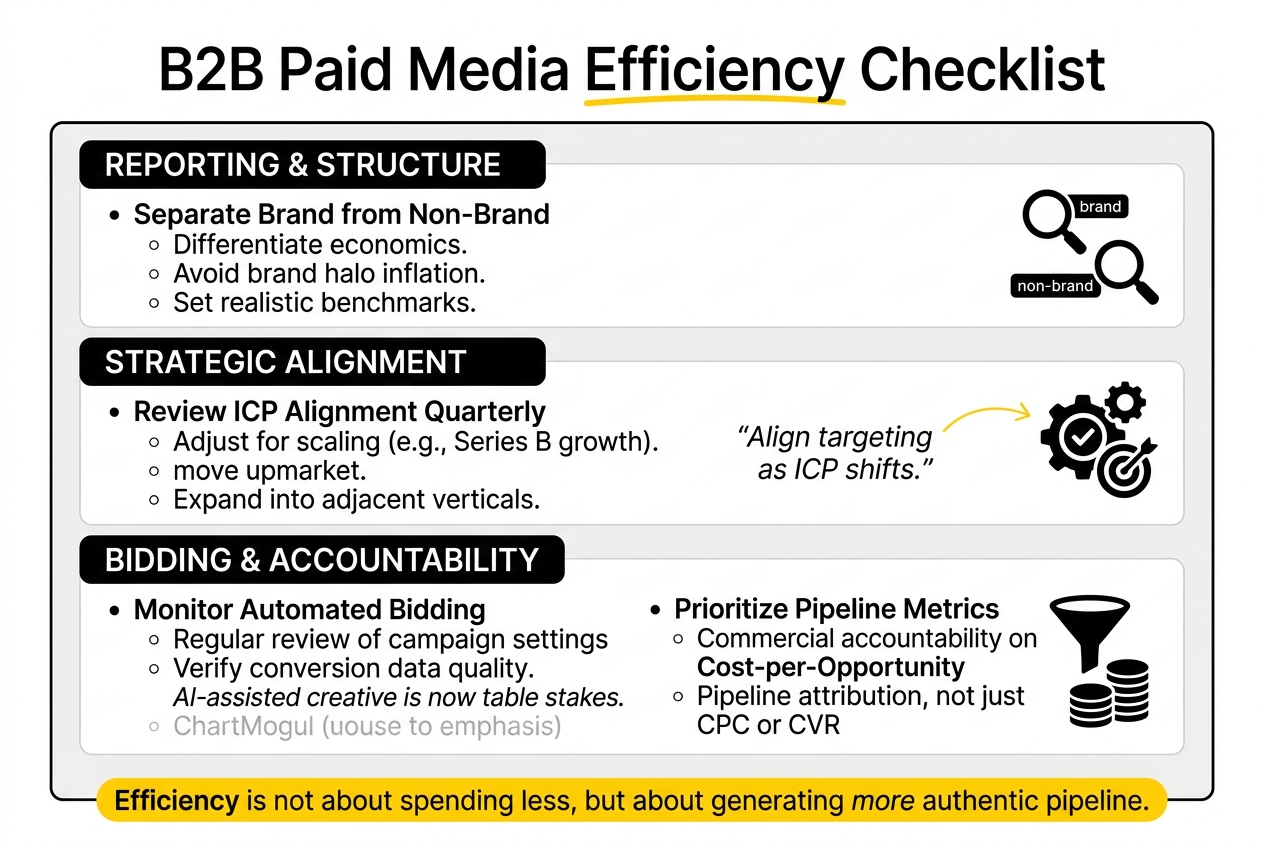
Separate brand from non-brand in reporting. Brand search campaigns have fundamentally different economics from non-brand. If they are reported together, the brand halo inflates apparent performance on non-brand campaigns and produces over-optimistic benchmarks.
Review ICP alignment quarterly. As a SaaS company scales, the ICP sometimes shifts. Series B growth often involves moving upmarket, targeting larger organisations, or expanding into adjacent verticals. Paid media targeting built for the Series A ICP may be generating pipeline that sales cannot close efficiently. The agency needs to be part of ICP conversations, not just executing the existing targeting.
Do not let automated bidding run without monitoring. Google’s Performance Max and Smart Bidding features can produce strong results in SaaS. They can also silently erode efficiency if conversion data quality degrades or if campaign settings are not regularly reviewed. Server-side measurement and AI-assisted creative are now table stakes for maintaining paid CAC efficiency. According to analysis from ChartMogul and OpenView’s 2026 benchmarks, brands with mature measurement infrastructure are paying 25, 45% less per acquired customer than those without it.
Hold the agency to pipeline metrics, not platform metrics. The paid media partner’s commercial accountability should be defined around cost-per-opportunity and pipeline attribution, not cost-per-click or conversion rate within the platform. What happens between a form fill and a closed deal is partly the responsibility of the agency. They set the targeting, the messaging, and the audience signals. If MQL volume is strong but sales conversion is poor, the agency needs to be part of that diagnostic conversation.
Frequently Asked Questions
What are the key challenges Series B SaaS companies face when scaling paid media?
Series B teams face three overlapping pressures when scaling paid media. First, demand capture ceilings: paid search volume for any given category is finite, and many teams hit this ceiling without a clear plan for what to do next. Second, attribution complexity: with average B2B SaaS sales cycles now running to 134 days, connecting ad spend to closed-won revenue requires deliberate measurement infrastructure that most teams have not built. Third, board-level accountability: at Series B, CAC payback periods above 14 months are a diligence concern. The paid media programme needs to produce metrics that hold up in those conversations.
How can a paid media optimisation agency help achieve predictable scaling for SaaS?
A specialist agency creates the conditions for predictable scaling by building closed-loop measurement between ad platforms and the CRM, ensuring bidding strategies are optimised against revenue signals rather than proxy events, and maintaining campaign structure that supports automated bidding at scale. Predictable scaling means being able to model what a budget increase will produce in pipeline, with confidence, based on historical conversion data across the full sales cycle.
What should Revenue-Accountable VPs of Marketing look for in a paid media partner?
Look for agencies that can demonstrate: closed-loop CRM integration in comparable tech stacks, reporting that reaches cost-per-opportunity rather than stopping at cost-per-lead, case studies with specific commercial outcomes rather than general performance improvement claims, and a clear view of how they distinguish demand capture from demand creation in account structure and budgeting. The most important signal is whether they understand your business metrics, not just the ad platform metrics.
How can SaaS companies ensure seamless integration of paid media with their tech stacks?
Integration requires offline conversion tracking so that qualified opportunities and closed-won deals feed back into ad platforms, CRM-audience syncing for exclusions and ABM targeting, and GCLID persistence through form submissions so that click source can be matched to CRM records. Any agency managing paid media at Series B should have a standard methodology for implementing each of these. If they cannot explain exactly how it would work in your specific CRM, that is a capability gap.
What metrics should connect advertising spend to revenue outcomes in SaaS?
The metrics that matter for connecting paid spend to revenue are: cost-per-opportunity (not cost-per-lead), pipeline attribution by channel showing paid media’s contribution to current pipeline, channel-level CAC (not blended), and CAC payback period. Platform metrics like impressions, CTR, and cost-per-conversion are operational signals for the agency. They are not the metrics that answer the question your CFO is asking.
What strategies support granular attribution across long B2B sales cycles?
The practical approach is to run a blended attribution framework: last-touch for platform-level budget decisions, multi-touch as a directional check on upper-funnel investment. Consistency matters more than model sophistication. Changing attribution assumptions to explain performance results in data that cannot be compared period over period. Whatever model you choose, apply it uniformly, document the assumptions, and use it directionally rather than as a precise causal claim.
How should marketing leaders make informed budget reallocations in paid media?
Separate campaigns by function (capture vs. creation) before making reallocation decisions. Understand the conversion volume floors that automated bidding requires before cutting budgets, since cuts below those thresholds can produce disproportionate performance drops. Always tie reallocation to pipeline data from the CRM, not platform metrics. And account for the B2B sales cycle lag: decisions made today will not be visible in closed-won pipeline for three to five months.
What role do case studies from SaaS specialists play in optimising paid media?
Case studies from comparable SaaS companies are the primary evidence that an agency’s methodology is transferable to your context. The useful ones name the specific challenge, describe the intervention, and quantify the outcome in commercial terms. Vague claims of growth are not case studies. Look for specificity about tech stack integration, attribution set-up, and the metric that actually changed. A case study that describes how an agency implemented offline conversion tracking and shifted bidding to cost-per-opportunity is more credible than one that describes “scaling paid media efficiency.”
What are best practices for optimising customer acquisition costs while scaling?
Separate brand from non-brand in reporting to get an accurate view of non-brand CAC. Review ICP targeting quarterly as the company’s target customer evolves. Maintain measurement maturity: server-side tracking and closed-loop CRM integration are now a measurable competitive advantage in controlling paid CAC. Hold the agency accountable to pipeline metrics, not platform metrics. And treat automated bidding as a tool that requires active oversight, not a set-and-forget optimisation layer.
How can Series B SaaS teams demonstrate ROI from paid media to stakeholders?
The clearest demonstration of paid media ROI at Series B is pipeline attribution data showing the percentage of current qualified pipeline that has a paid touchpoint, paired with cost-per-opportunity by channel and CAC payback period. These figures can be expressed in terms that connect directly to the business model. An agency that can produce these numbers consistently, and that can explain the assumptions behind them clearly, gives a VP of Marketing the data they need for board and CFO conversations.
A Final Note on Efficiency
Scaling SaaS marketing efficiency is not just a matter of spending more carefully. It is a matter of building the measurement infrastructure, the account structure, and the agency relationship that allows you to make budget decisions with evidence rather than intuition.
The teams that are outperforming on CAC right now are not running fundamentally different channels. They are running the same channels with better conversion data flowing back into the platforms, tighter ICP alignment, and clearer accountability from their paid media partners on the metrics that actually determine whether a growth model is sustainable.
If you are working through this stage and want to think through your current paid media setup, we are happy to take a look.