Choosing the Right SaaS Marketing Firm for Quality Lead Generation
Discover how to select SaaS marketing firms focused on lead quality, not just volume, with our comprehensive evaluation framework.

Your lead volume is up. The platform dashboards look healthy. Sales is still complaining.
This is the most common tension in B2B SaaS demand generation right now, and it has nothing to do with how many leads a firm can generate. It has everything to do with whether those leads turn into pipeline.
The market for top saas marketing firms specialising in lead generation has expanded significantly. There are more agencies making more promises about more channels than at any point before. The problem is that most of them are still optimising for metrics that feel good to report but do not show up in board decks: form fills, MQL volume, cost-per-lead.
Demand generation leaders who have been around this problem long enough know that the real question when evaluating a partner is not “how many leads can you generate?” It is “what happens to those leads after they enter the CRM?”
This guide gives you a framework for evaluating lead generation partners on the right criteria. Not lists, not shortcuts. A structured approach to separating firms that drive pipeline quality from those that drive volume.
Why Lead Volume Is the Wrong Metric to Optimise For
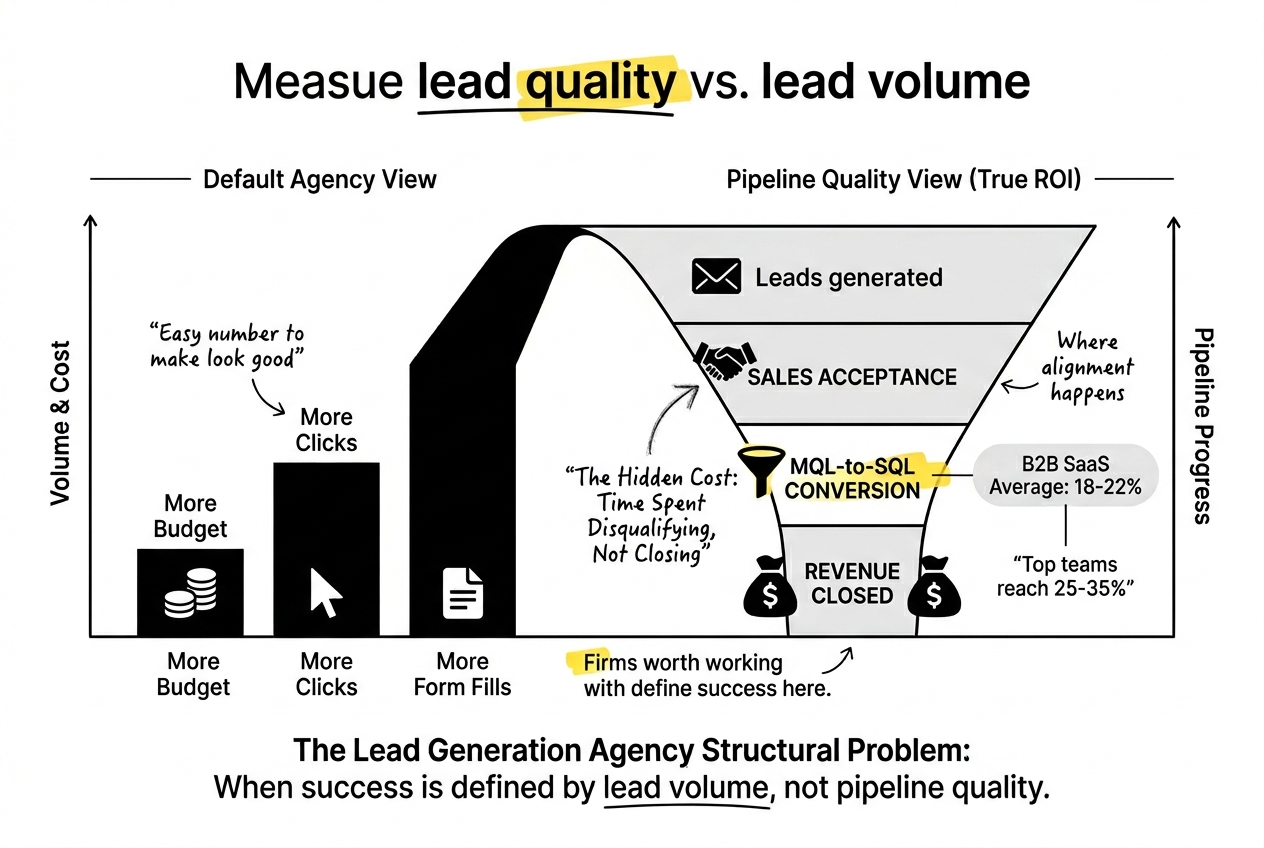
There is a structural reason why so many lead generation agencies default to volume reporting: it is the easiest number to make look good.
More budget means more clicks. More clicks mean more form fills. More form fills mean the agency can point to a graph going up and to the right. What the graph does not show is what happened next: whether sales accepted those leads, whether they progressed through the pipeline, whether any of them closed.
According to 2026 pipeline quality benchmarks, the average MQL-to-SQL conversion rate in B2B SaaS sits somewhere between 18 and 22%. Top-performing teams reach 25 to 35%. If you are working with a partner who is not tracking this number and reporting it back to you, you are likely in the bottom half of that range without knowing it.
The cost compounds. Teams working through low-quality lead pipelines spend the majority of their time disqualifying rather than closing. That is not a sales problem. It is a targeting and qualification problem, and it originates in how the lead generation partner defines success.
The firms worth working with define success at the pipeline level, not the lead level.
The Evaluation Framework: Five Factors That Separate Quality from Volume
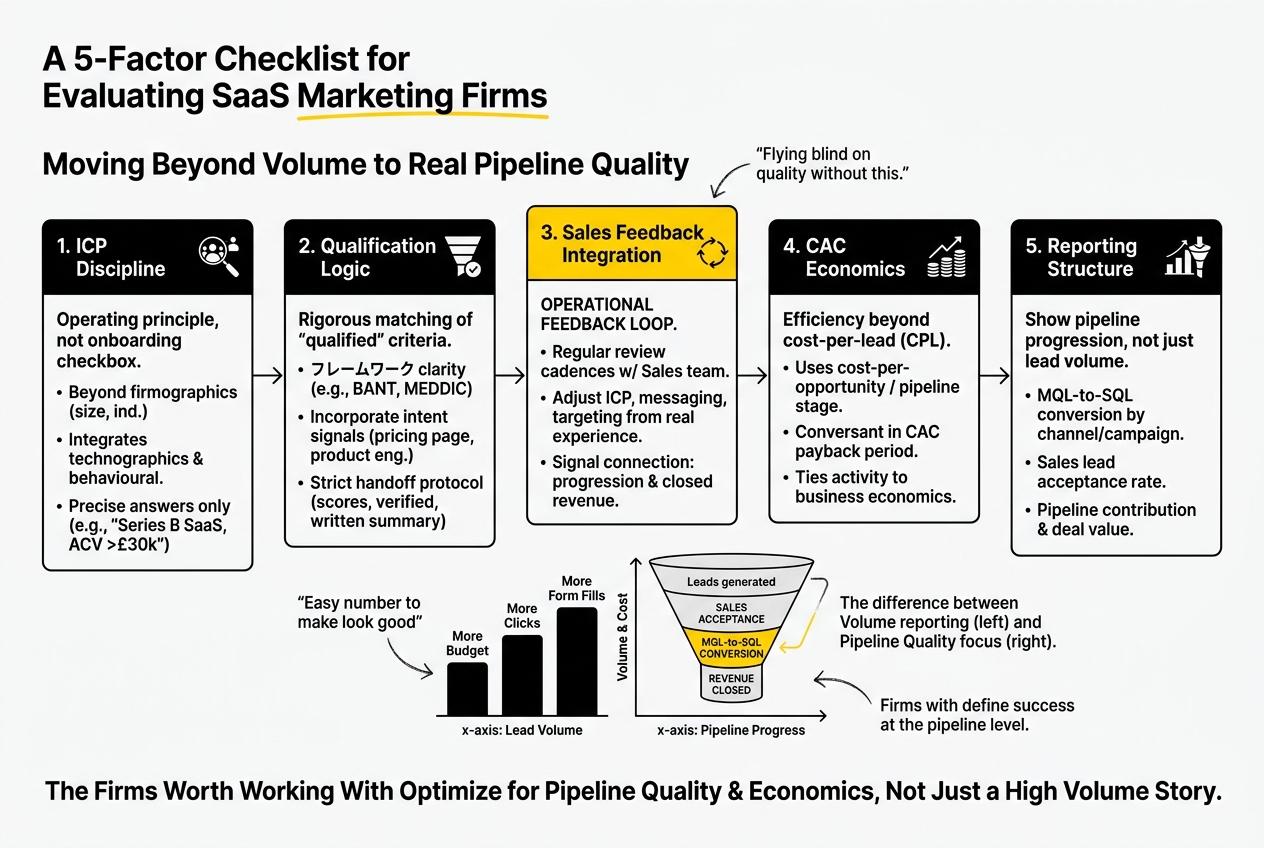
When assessing leading SaaS marketing agencies focused on lead generation, the following five factors reveal whether a firm is genuinely focused on pipeline quality or is building a volume story that sounds compelling in a pitch deck.
1. ICP Discipline: Do They Understand Who You Actually Sell To?
The ideal customer profile is not a box to tick during onboarding. It is the operating principle that should govern every targeting decision a lead generation partner makes on your behalf.
ICP discipline means a firm understands not just the firmographic layer of your target audience (company size, industry, geography) but the technographic and behavioural layers too. What does the tech stack tell us about buying readiness? What intent signals indicate an account is actively evaluating? Which job titles actually control budget in this buying committee?
When evaluating a potential partner, ask them to describe your ICP back to you after an initial briefing. Vague answers (“scaling SaaS companies with a need for your solution”) are a red flag. Precise answers (“Series B or C SaaS businesses with a dedicated sales team, existing HubSpot or Salesforce deployment, and an ACV above £30k”) indicate the kind of targeting rigour that produces qualified pipeline.
A clear ICP definition, grounded in firmographics and behavioural signals, can reduce unqualified leads by 40%, which means sales spends more time on opportunities that are likely to close.
2. Qualification Logic: How Do They Define a Lead Worth Passing to Sales?
Every firm has a qualification process. What separates the best from the rest is how rigorous that process is and how closely it matches the definition of “qualified” that your sales team actually uses.
Ask a prospective partner to walk you through their qualification framework in detail. Are they using BANT (Budget, Authority, Need, Timeline) or a more sophisticated model like MEDDIC for enterprise accounts? Are they incorporating intent signals such as pricing page visits, competitor research, or product engagement? Or are they defining a “qualified lead” as anyone who fills out a form with a business email address?
The handoff protocol matters too. A firm that passes leads to sales immediately upon form fill is not qualifying. A firm that scores leads against intent behaviour, verifies them against ICP criteria, and hands off with a written summary of why this contact is sales-ready is operating at a different level.
This is the point where most generic lead generation firms fail the test.
3. Sales Feedback Integration: Is There a Closed Loop?
Demand generation does not operate in isolation from sales. The best lead generation partners understand this and build a feedback mechanism into the engagement model from the start.
Sales feedback in lead generation matters for a simple reason: sales knows things about lead quality that marketing dashboards cannot capture. Which leads showed up to the discovery call having done real research? Which ones asked irrelevant questions that suggested they were never a genuine fit? Which contacts confirmed the messaging resonated?
A lead generation firm that does not have a formal process for collecting and acting on sales feedback is flying blind on quality. The signal they are optimising for (conversions, responses, engagement rates) is disconnected from the signal that matters (pipeline progression and closed revenue).
When evaluating firms, ask specifically how they incorporate sales feedback. Do they have regular review cadences with the sales team? Do they adjust ICP criteria, messaging, or targeting based on what sales is experiencing? If the answer is vague or framed as a one-off onboarding step, the feedback loop is likely not operational in practice.
4. Customer Acquisition Cost and How the Firm Accounts for It
Customer acquisition cost is the metric that connects lead generation activity to business economics. A firm generating 200 leads per month at £40 cost-per-lead looks efficient on the surface. A firm generating 50 leads per month at £120 cost-per-lead that convert to pipeline at 40% may be delivering significantly lower CAC per closed deal.
The distinction matters because volume-oriented firms almost always use cost-per-lead as their efficiency metric. Quality-oriented firms use cost-per-opportunity or cost-per-pipeline-stage as the measure that actually ties back to revenue.
When discussing economics with a prospective partner, push past CPL. Ask them how they measure cost-per-qualified-lead, cost-per-opportunity, and ideally CAC payback period. If they cannot speak to these numbers comfortably, their reporting framework is not aligned with how SaaS businesses actually evaluate performance.
5. Reporting Structure: Can They Show Pipeline Progression, Not Just Lead Volume?
The quality of a firm’s reporting reflects the quality of their thinking. Firms optimising for volume report on volume. Firms optimising for pipeline quality report on pipeline progression.
Ask a prospective partner to show you a sample report or walk you through what a standard monthly review looks like. Look for:
- MQL-to-SQL conversion rate by channel and campaign
- Lead acceptance rate from the sales team
- Pipeline contribution and deal value by lead source
- Attribution connecting specific campaigns to opportunities in the CRM
- Month-over-month trend data, not just absolute numbers
If the report leads with impressions, CPL, and total leads generated, the firm’s operating model is built around those numbers. If it leads with pipeline contribution, SQL acceptance rate, and cost-per-opportunity, the operating model is aligned with yours.
Common Pitfalls When Choosing a Lead Generation Partner
Even with a solid evaluation framework, there are patterns in how these decisions go wrong.
Optimising for the pitch, not the process. Agencies are good at presenting case studies that show dramatic results. The relevant question is not whether the case study is real, but whether the conditions that produced it match yours: same ICP, same ACV, same sales cycle length, same channel mix.
Treating qualification as a sales function. Some firms hand off leads and position qualification as the sales team’s responsibility. This creates volume without accountability. The lead generation partner and the sales team share responsibility for whether leads are worth the time they consume.
Skipping the sales alignment conversation. A lead generation engagement that begins without a structured conversation between the partner, the demand generation team, and the sales team is starting on the wrong foot. Shared definitions of qualified leads, agreed feedback cadences, and clarity on what “good” looks like in the CRM are prerequisites, not optional extras.
Evaluating cost-per-lead in isolation. As covered above, CPL is not the unit economics metric that matters. It is a useful signal for channel efficiency in the early stages, but it should never be the primary measure of whether a lead generation partner is delivering value.
Aligning Lead Generation with Your Sales Process and Lifecycle Stage
The evaluation criteria above apply broadly, but the weight you give each factor should reflect where your business is in its growth journey.
At Series A or early Series B, ICP discipline matters most. The ICP is still being validated through sales conversations, and a lead generation partner who can surface pattern data from campaigns, qualify rigorously, and feed that intelligence back into targeting is more valuable than one who can scale volume quickly.
At later Series B or Series C, pipeline efficiency becomes the dominant concern. The ICP is known. The question is whether the partner can operate at scale without degrading quality, and whether their reporting gives leadership the visibility to make resourcing decisions confidently.
In both cases, the underlying principle is the same: the partner’s success metrics should be indistinguishable from yours. Pipeline created, opportunities accepted by sales, CAC relative to ACV. Volume is a means to that end, not the end itself.
How to Run the Evaluation Process in Practice
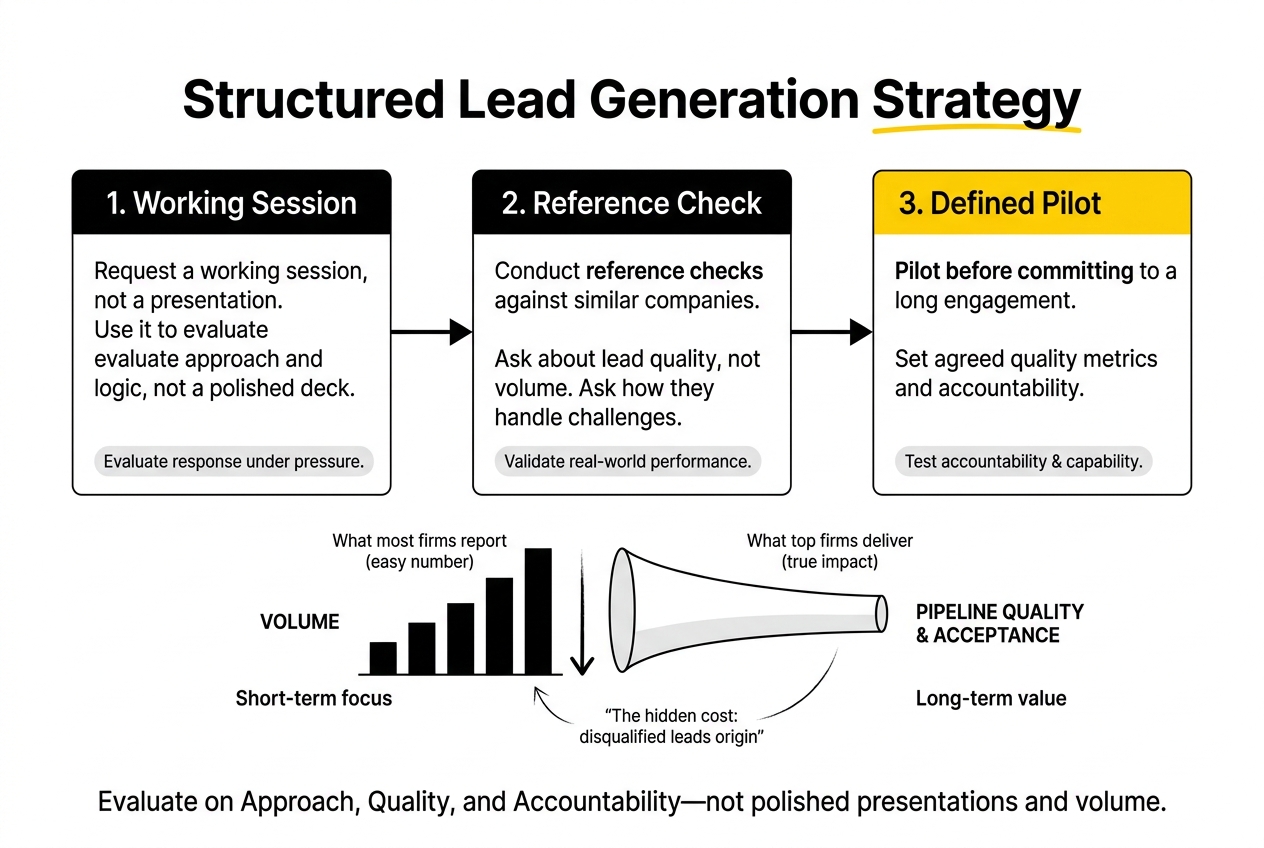
Once you have a shortlist of firms, the evaluation should be structured, not conversational.
Request a working session rather than a presentation. Ask the firm to come prepared to walk through how they would approach your ICP, define their qualification logic for your ACV and sales cycle, and describe their reporting framework. How they respond to specific questions under pressure tells you more than a polished deck.
Reference check against similar companies. Not just the testimonials on their website. Ask for direct introductions to clients with comparable company size, stage, and target market. Ask those clients specifically about lead quality, not just volume, and about how the firm handled periods where quality was below expectations.
Pilot before committing to a long engagement. Where possible, structure the initial engagement as a defined pilot with agreed quality metrics. An MQL-to-SQL target, a lead acceptance rate, a cost-per-opportunity ceiling. If the firm resists this framing, that tells you something important about how they manage accountability.
Frequently Asked Questions
What key factors should B2B SaaS teams consider when evaluating lead generation firms?
The five most important factors are ICP discipline, qualification logic, sales feedback integration, customer acquisition cost accountability, and reporting structure. Firms that report on pipeline progression and MQL-to-SQL conversion rate are operating at a different level to those reporting on lead volume and CPL. Evaluate against the metrics that matter to your sales team and your board, not the metrics that make agency reporting look clean.
How can demand generation leaders assess the quality of leads generated by a marketing firm?
Request access to attribution data that connects leads to pipeline stages in the CRM. A 2026 benchmark for healthy B2B SaaS performance is an MQL-to-SQL conversion rate of 25 to 35%. If a firm cannot report on this metric, or if their reporting does not include sales acceptance rates and cost-per-opportunity, the engagement is not structured around pipeline quality. Lead quality becomes visible only when you track what happens after the handoff.
What is the importance of the ideal customer profile in selecting a lead generation partner?
ICP discipline is the foundation of quality lead generation. A partner that does not have a precise, operationalised understanding of your ICP will generate leads that look right on paper but fail at the sales qualification stage. The ICP should include firmographics, technographics, behavioural signals, and buying committee roles. Partners who can describe your ICP with specificity, and demonstrate how it governs their targeting decisions, are the ones who generate leads that sales will actually work.
How does qualification logic impact the effectiveness of lead generation strategies?
Qualification logic determines what enters the pipeline. Firms using rigorous frameworks like MEDDIC for enterprise accounts, combined with intent data and behavioural scoring, produce leads that arrive with context: why this company, why now, what signals indicate readiness. Firms using basic form-fill criteria produce volume without signal. The gap in MQL-to-SQL conversion between these approaches is significant: intent-driven qualification can drive conversion rates of 15 to 40%, compared with industry averages below 10%.
What role does sales feedback play in evaluating lead generation firms?
Sales feedback closes the loop between what marketing generates and what sales can convert. Without it, lead generation partners optimise for the wrong signals. A formal feedback cadence, where sales communicates which leads were qualified in practice and which were not, allows the partner to refine ICP criteria, targeting, and messaging in real time. This feedback loop is what separates lead generation from a volume exercise and turns it into a continuous quality improvement programme.
How can customer acquisition cost influence the decision-making process for lead generation partnerships?
Cost-per-lead is a useful early-stage signal but is not the relevant unit economics metric for evaluating a lead generation partner. The correct measure is cost-per-opportunity, and ideally CAC payback period relative to ACV. A firm generating fewer, more qualified leads at a higher CPL may deliver a lower CAC per closed deal than one generating high volume at a low CPL. Partners who cannot engage with this level of economic analysis are not equipped to operate as strategic partners.
What are the best practices for ensuring alignment between lead generation efforts and sales processes?
Alignment starts before the engagement begins. Shared definitions of qualified leads, agreed feedback cadences, and a common understanding of what the CRM stages mean are prerequisites. Regular joint reviews between the lead generation partner, demand generation, and sales, with pipeline data as the primary reference point, prevent drift. The partner should be an active participant in resolving qualification disputes, not a passive supplier of leads.
How can B2B SaaS companies measure the success of their lead generation partnerships?
The core metrics are MQL-to-SQL conversion rate, lead acceptance rate from sales, pipeline contribution by source, and cost-per-opportunity. These should be agreed at the start of the engagement and reviewed monthly. Trend data matters as much as absolute numbers: a partner who is improving MQL-to-SQL conversion month-on-month is building towards something. One who is stable on volume but flat on conversion is not learning from the signal.
What are common pitfalls to avoid when choosing a lead generation firm for SaaS?
The most common pitfalls are optimising for the pitch rather than the process, treating lead qualification as a sales-only function, skipping the sales alignment conversation at the start of the engagement, and using cost-per-lead as the primary measure of partner effectiveness. Each of these errors shares the same root cause: evaluating a lead generation partner on the metrics that are easy to report rather than the metrics that connect to revenue.
How can demand generation managers report on lead quality and conversion rates effectively?
Effective reporting connects lead source to pipeline stage. This requires CRM integration that tracks leads from first touch through to opportunity, with stage progression data visible by source and campaign. Monthly reporting should lead with MQL-to-SQL conversion by channel, lead acceptance rate, and cost-per-opportunity. It should include trend data and a qualitative summary of what sales is observing about lead quality. The report should be readable by a revenue leader, not just a marketing operations analyst.
If you are in the middle of evaluating lead generation partners right now, or if existing partnerships are not translating to pipeline in the way you expected, we work through this kind of framework with SaaS teams regularly. Worth a conversation if you are at that stage.