Deciding When to Split, Consolidate, or Rebuild Your SaaS PPC Campaigns
Discover when to split, consolidate, or rebuild your SaaS PPC campaigns for optimal performance and data-driven decisions.

Your Google Ads account has grown with you. A campaign here for a new product tier, a separate one for a different region, another split off because the conversion data looked different. At some point, the account that made sense at Series A has become a maze you can no longer read clearly.
The question most SaaS marketing directors arrive at post-product-market fit is not “should we be running PPC?” It’s: “Is the way we’ve structured our campaigns actually helping us, or quietly working against us?” Splitting campaigns can sharpen targeting and budget control. Consolidating them can unlock algorithmic performance. Rebuilding is sometimes the only clean path forward. Each decision carries real risk, and none of them should be made by instinct.
This article gives you a framework for working through that decision in a structured way, tied to the metrics and signals that matter for SaaS performance at growth stage.
Why Campaign Structure Matters More Than It Used to
The way Google Ads works in 2026 is fundamentally different from even two or three years ago. Smart Bidding processes hundreds of real-time signals per auction and requires a minimum threshold of conversion volume to optimise effectively. Google’s own guidance benchmarks 15 conversions in 30 days as the minimum for a campaign to exit the learning phase and produce reliable results.
The implication for SaaS accounts is significant. B2B SaaS deals already involve long sales cycles and typically lower conversion volumes than e-commerce. If your account has been built on a granular, highly segmented structure inherited from an earlier era of manual bid management, the architecture itself may now be the bottleneck.
A campaign generating eight conversions a month does not give Smart Bidding enough signal to distinguish your best-converting query patterns from noise. Multiply that across twelve campaigns, and you have a data fragmentation problem, not a targeting advantage. According to Search Engine Journal’s reporting on Google’s own guidance from their Ads Decoded podcast, the argument is not that consolidation is the goal in itself. It is that the structure should support data density, not dilute it.
That said, this is not an argument for collapsing everything into one campaign. There are genuine business reasons to maintain campaign separation, and they are different from the structural reasons that made sense in 2020. The first step is knowing which situation you are actually in.
The Three Decisions and What Drives Each One
When SaaS PPC Campaigns Require Splitting
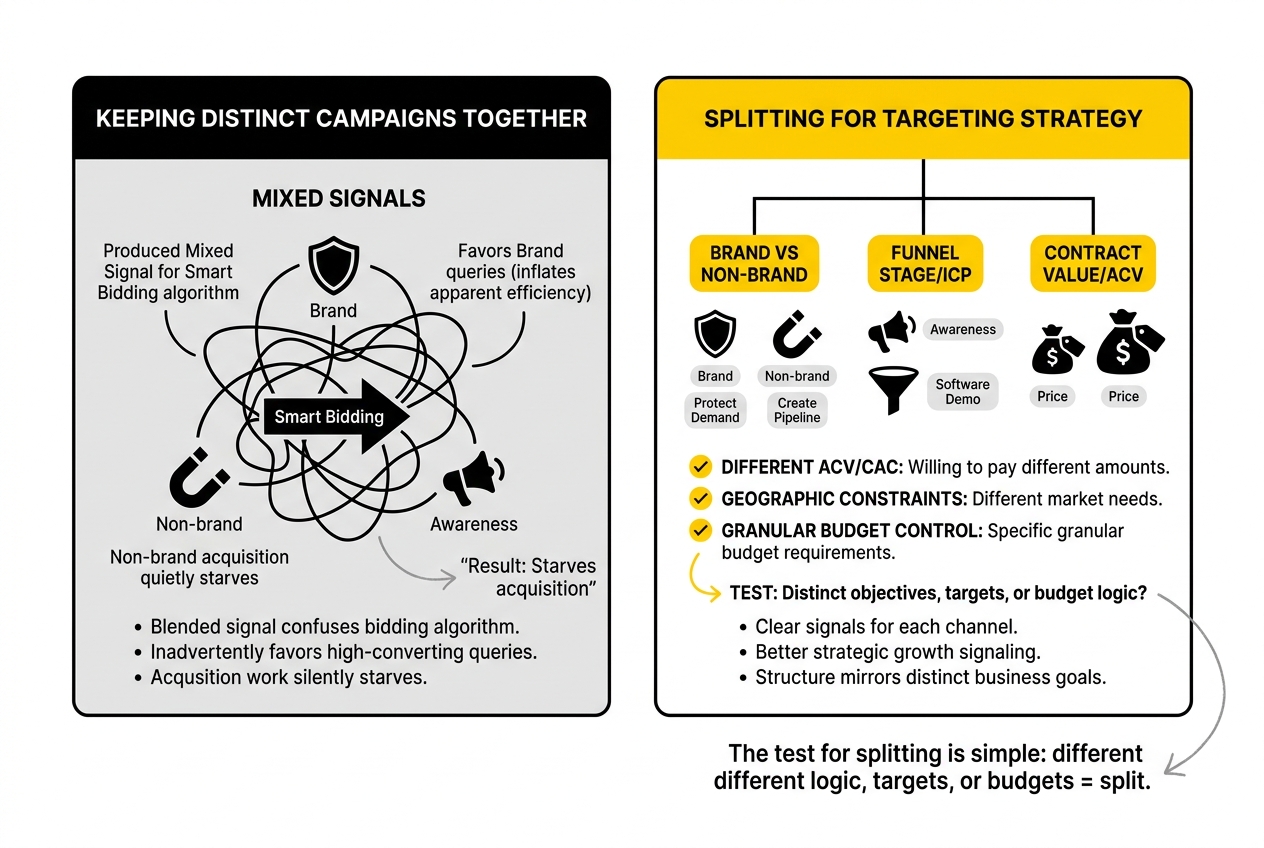
Splitting is the right move when campaigns with genuinely distinct business objectives, conversion goals, or budget constraints are being managed under the same roof.
The clearest case for splitting is brand versus non-brand traffic. These two campaign types have fundamentally different roles: brand campaigns protect existing demand from competitor conquesting, while non-brand campaigns create new pipeline. Blending them in a single campaign produces a mixed signal for Smart Bidding. The algorithm will naturally favour brand queries because they convert at a higher rate and lower cost, which inflates apparent efficiency while your non-brand acquisition work quietly starves.
The second case for splitting is separating campaigns targeting different funnel stages or ICP segments. A Series A analytics platform that is running awareness-stage campaigns targeting “what is data observability” alongside bottom-of-funnel campaigns targeting “data observability software demo” has a problem if those campaigns share a conversion goal and a budget. The intent signals are too different, the expected conversion rates are too different, and Smart Bidding cannot hold two contradictory objectives at once.
Other scenarios where splitting makes sense:
- Campaigns targeting segments with materially different average contract values, where you are willing to pay a different CAC for each.
- Campaigns with different geographic constraints or fundamentally different market education requirements.
- Campaigns where budget control at a granular level is a genuine business requirement, not a legacy preference.
The test for splitting is always: do these two groups of campaigns have different enough objectives, conversion targets, or budget logic that a single algorithm serving both would produce compromised results for at least one of them? If yes, split. If no, you probably have a fragmentation problem, not a targeting strategy.
Consolidating PPC Campaigns for SaaS
Consolidation is the right response when you have too many campaigns and not enough data in any of them.
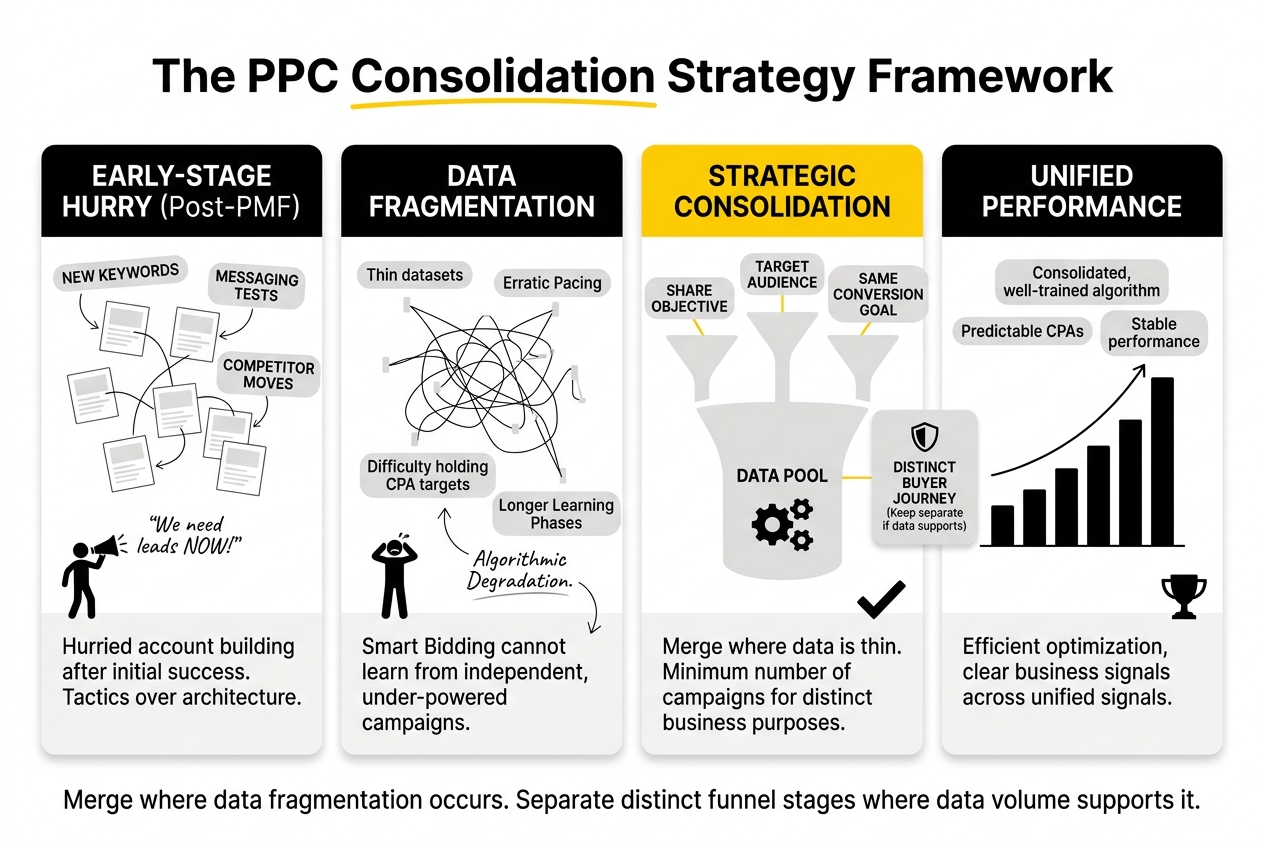
The signal to look for is conversion volume per campaign. If you have more than eight campaigns generating fewer than 30 conversions each per month, you have a data fragmentation problem that is degrading algorithmic performance across the account. Smart Bidding is trying to optimise independently across multiple thin datasets instead of learning from a unified pool of signal. The result is longer learning phases, erratic pacing, and CPA targets that are harder to hold.
This is a common post-PMF scenario. Early SaaS PPC accounts are often built in a hurry, with campaigns added to address new keywords, test new messaging, or respond to competitor moves. What looks like a well-organised account from the outside can be a fragmented set of under-powered campaigns from the algorithm’s perspective.
Consolidation is not the same as simplification for its own sake. The goal is to merge campaigns that share the same objective, the same target audience, and the same conversion goal, so that Smart Bidding has a sufficient data pool to train effectively. The architecture question is: what is the minimum number of campaigns that genuinely serves distinct business purposes? Everything above that minimum is contributing to fragmentation.
One important nuance for SaaS accounts: consolidation works well for campaigns targeting similar ICP segments with the same conversion action. It works poorly if you are trying to consolidate campaigns that have different conversion goals or that target distinct buyer journeys. Keep funnel-stage separation where the data volume supports it. Merge where it does not.
Rebuilding SaaS PPC Strategies
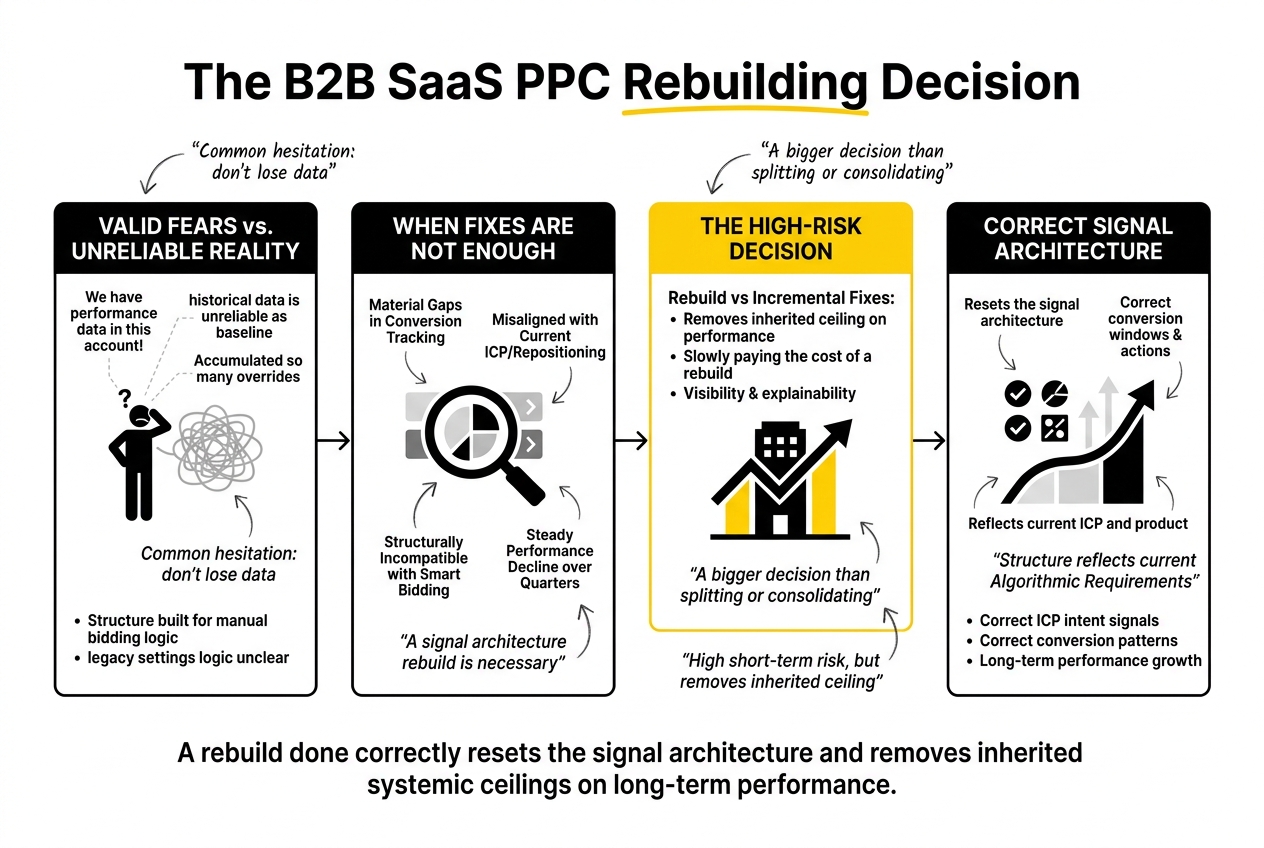
Rebuilding is a bigger decision than splitting or consolidating, and it is often avoided longer than it should be because it carries short-term risk. The common hesitation: “We have performance data in this account. If we rebuild, we lose all of that.”
That concern is valid, but it needs to be weighed against what you are actually working with. If the account was built before conversion tracking was properly configured, the historical data is unreliable as a baseline. If the campaign structure was designed around manual bidding logic that no longer reflects how Smart Bidding works, the structure itself is creating ceiling effects on performance. If the account has accumulated so many patches, overrides, and legacy settings that no one on the team can explain the current logic clearly, you are already paying the cost of a rebuild, just more slowly and with less visibility.
The signals that suggest a rebuild over incremental fixes:
- Conversion tracking has material gaps or inconsistencies. Smart Bidding trained on flawed conversion data is not fixable through bid adjustments. The signal architecture needs to be rebuilt from the ground up.
- The account was built for a product or ICP that no longer matches what you are selling. If you have repositioned since PMF, campaigns optimised for the previous ICP carry the wrong intent signals and conversion patterns.
- The campaign structure is fundamentally incompatible with Smart Bidding’s data requirements, and consolidating within the existing structure would still leave conversion volume too thin across too many objectives.
- Performance has declined steadily over multiple quarters and structural audits have not identified a discrete cause. This often points to systemic architecture issues rather than individual campaign problems.
A rebuild done correctly resets the signal architecture, configures conversion tracking to capture the right actions at the right conversion windows, and creates a campaign structure that reflects your current ICP, your current product, and the algorithmic requirements of 2026. It is a higher short-term risk, but it removes the ceiling that an inherited structure imposes on long-term performance.
A Framework for Making the Decision
Rather than treating these as three separate questions, a structured approach applies a small set of diagnostic checks to determine which path is appropriate.
Check 1: Conversion tracking integrity. Before anything else, verify that conversion tracking is accurate and complete. Pull your Google Ads conversion count and compare it against your CRM or GA4 for the same period. If the variance is above 15%, you have a tracking problem that affects every other diagnosis you might make. Fix tracking before making structural decisions.
Check 2: Conversion volume per campaign. Map out your conversion volume across each campaign over the last 30 days. Any campaign below 15 conversions is likely in a persistent learning phase or oscillating without stable optimisation. This is the primary indicator of fragmentation.
Check 3: Campaign objective alignment. For each campaign, identify the primary conversion action and the target audience. Are any campaigns serving audiences with fundamentally different CAC targets or funnel positions? Campaigns that do not share a clear objective are split candidates. Campaigns that share objectives but are too thin on volume are consolidation candidates.
Check 4: Historical data reliability. How long has the account been running with the current conversion tracking configuration? Has the ICP or product positioning shifted significantly since the account was built? If either is true, the historical data may be an unreliable guide and a rebuild warrants serious consideration.
Check 5: Account legibility. Can your team explain the logic of the current account structure clearly, including why each campaign exists as a separate entity? If the answer involves “that was set up before I joined” or “we’re not sure, but it seems to be working”, you are paying a hidden complexity tax.
Paid Search Strategies for SaaS: What to Do Before You Make the Move
Any structural change to an active SaaS PPC account should be preceded by a clean baseline snapshot. Document current campaign performance across the last 60 and 90 days, not just 30. B2B SaaS buying cycles are long, and 30-day windows misrepresent performance in accounts where leads take 60 or more days to reach a sales-qualified stage.
For consolidation, the practical approach is to use shared budgets and portfolio bid strategies as a first step. This lets you pool conversion data across campaigns without formally merging them, and gives you a read on how combined conversion volume affects algorithmic performance before committing to a structural merge.
For rebuilding, a staged approach works better than a complete cutover. Run the new structure in parallel with reduced budget, let it exit the learning phase on real conversion data, and migrate budget progressively once performance has stabilised. Cutting the old structure off immediately creates an attribution gap and removes the safety net if the new structure underperforms during the learning period.
Throughout any of these changes, resist the temptation to intervene during learning phases. Every significant edit to a campaign, including changing conversion targets, adjusting budgets dramatically, or pausing ad groups, resets the learning phase. The most common reason SaaS PPC accounts fail to exit the learning phase consistently is not poor structure; it is over-management during the period when the algorithm needs to be left alone.
PPC Performance Metrics to Track During a Structural Change
Structural changes can cause short-term performance fluctuations that are expected rather than alarming. The metrics to watch are:
- Conversions per campaign per week (learning phase indicator; below 15/month means the campaign is not yet able to optimise reliably)
- Cost per opportunity rather than cost per lead, since MQL-to-SQL ratio often shifts during rebuilds if the conversion tracking changes are more accurate than what existed before
- Search impression share (consolidation typically increases share within target segments; a decrease suggests audience or bidding misconfiguration)
- Average CPC trends (short-term CPC increases during learning phases are normal; sustained increases after stabilisation indicate a structural or quality score issue)
Evaluate structural changes on 60 to 90-day windows for B2B SaaS accounts, not 30-day ones. Setting performance expectations at 30 days with investors or leadership is a common cause of premature reversals that reset the learning cycle again.
Scaling SaaS Marketing Without Inheriting Structural Debt
The deeper issue for Series A SaaS marketing directors is not which of the three options to choose right now. It is how to make structural decisions consistently as the account scales, so that the fragmentation problem does not simply rebuild itself over the next 18 months.
A useful principle: every new campaign that is added should have a documented reason that could not have been achieved within an existing campaign structure. If the reason is “we wanted to test different messaging,” that is what ad group variants and responsive search ads are for. If the reason is “we need separate budget control for a distinct business objective,” that is a legitimate campaign-level decision.
Keeping the account structure deliberately lean is not a performance trade-off. In 2026, it is a performance requirement. The accounts that are outperforming on cost-per-opportunity metrics are not the most complex ones; they are the ones where the algorithm has consistent, high-quality signal to work with.
Frequently Asked Questions
When should SaaS PPC campaigns be split to improve performance?
Split campaigns when they serve genuinely distinct business objectives, conversion goals, or budget requirements. The clearest examples are brand versus non-brand campaigns, funnel-stage separation where conversion actions differ materially, and campaigns targeting segments with different CAC targets. Do not split for structural reasons that Smart Bidding already handles at the algorithm level, such as device type or match type segmentation.
What indicators suggest that a PPC campaign needs to be consolidated?
The primary indicator is conversion volume. If more than eight campaigns are generating fewer than 30 conversions each per month, data fragmentation is likely degrading algorithmic performance. Other signals include campaigns with persistent learning phase status, high CPA volatility across similarly structured campaigns, and an account where total conversion volume would comfortably support fewer, larger campaigns.
How can data analysis inform the decision to rebuild a PPC campaign?
Compare your Google Ads conversion counts against your CRM for the same period. A variance above 15% suggests tracking issues that undermine every other optimisation decision. If historical performance data was generated under flawed tracking or a significantly different ICP, a rebuild provides a clean signal foundation. Steady multi-quarter decline without a discrete structural cause identified in audits is also a strong rebuild indicator.
What are the benefits of separating campaigns with different marketing objectives?
Campaigns with different objectives will pull Smart Bidding in conflicting directions if managed together. Separating them lets each campaign train on a consistent conversion signal that reflects a specific business goal. This is especially relevant for SaaS accounts that run both pipeline development and brand protection campaigns, which have different expected conversion rates and very different acceptable cost structures.
How do you determine the right budget allocation across multiple PPC campaigns?
Start from a structure where budget allocation reflects campaign roles in the funnel. High-intent acquisition campaigns typically warrant the largest share, followed by pipeline-acceleration and ABM work, with a reserved test budget for new channels. Review allocation against actual conversion data quarterly rather than maintaining fixed annual splits. For B2B SaaS, use 60 to 90-day evaluation windows before shifting budget materially.
What metrics should be monitored to assess the effectiveness of PPC campaign structures?
Track conversions per campaign over 30 days to identify fragmentation, cost per opportunity rather than cost per lead to avoid MQL quality distortions, search impression share within target segments, and CPA stability after the learning phase. For structural changes, evaluate on 60 to 90-day windows. Single-month reads on B2B SaaS campaign changes are unreliable given typical sales cycle lengths.
How can marketing directors evaluate the performance impact of campaign complexity post-product-market fit?
Ask whether the account structure was designed for the product and ICP you have today. Post-PMF, SaaS teams often find that campaigns built during the market education phase carry the wrong intent signals for buyers who already understand the category. The structural question is whether complexity is serving distinct business logic or is simply the residue of an account that has been added to without being rationalised.
What role does A/B testing play in deciding whether to split or consolidate PPC campaigns?
A/B testing within campaigns, using responsive search ad variants and ad group-level tests, answers creative and messaging questions. It should not be the driver of campaign splitting decisions, which are structural. If the only reason for maintaining two campaigns is a messaging test, that test belongs at the ad group level, not the campaign level. Structural splits are justified by objective differences in conversion goals, audience, or budget logic.
How can marketing directors ensure accountability in their PPC strategies to leadership and investors?
Tie reporting to pipeline and revenue metrics rather than platform metrics. Cost per opportunity, MQL-to-SQL conversion rates, and CAC payback period are the numbers that hold up in board meetings. For structural changes specifically, set the evaluation window at 60 to 90 days and communicate that expectation upfront, so that short-term learning phase fluctuations are not misread as performance deterioration.
What are common pitfalls to avoid when managing multiple PPC campaigns in the SaaS sector?
The most consistent pitfall is over-managing campaigns during learning phases, including changing targets, adjusting budgets significantly, or pausing ad groups before the algorithm has stabilised. The second is treating account complexity as a proxy for account quality. The third is making structural decisions based on 30-day performance windows in B2B SaaS accounts where sales cycles run longer than that. Each of these reduces the stability of the conversion signal that Smart Bidding depends on.
If you’d like a second set of eyes on where your account sits against these criteria, our SaaS PPC management work covers exactly this kind of structural audit. Worth a conversation if the diagnosis is unclear or if you want to sense-check the direction before committing to a rebuild.