Key Questions to Ensure Senior Specialists Manage Your SaaS PPC Account
The specific questions that reveal whether senior specialists will actually manage your SaaS PPC account, or just show up for the pitch and the QBR.

In the pitch, you met the person who would run your account. Sharp, senior, fluent in your funnel and your sales cycle. Six weeks after signing, your weekly call is with someone you have never met, who joined the agency last year and is clearly working from a template.
That gap, between who sells the work and who does it, is the most common disappointment in SaaS PPC management. It is rarely dishonesty. It is economics. Senior specialists are scarce and expensive, so agencies deploy them where they win and keep business: new pitches, quarterly business reviews, and accounts that are about to churn. The day-to-day frequently falls to whoever has capacity.
Your job, before you sign, is to establish exactly who will touch your account each week and how often anyone senior will look at it. The questions below are built to reveal that. Just as useful is knowing what a straight answer sounds like against a rehearsed one. This is how to evaluate a PPC account team for SaaS before the contract, not after.
Why the pitch team is rarely the delivery team
Understanding the economics makes the questions sharper. A senior paid search specialist is one of an agency's most expensive and constrained resources. Putting that person in every weekly call for every account does not scale, so agencies concentrate senior time where it moves revenue for them, and lean on coordinators and junior managers to keep the lights on elsewhere.
This is not automatically a problem. The best model is often a senior strategist setting direction and reviewing the account regularly, with a capable executor handling the mechanics day to day. That structure works. What does not work is senior involvement that evaporates the moment the ink dries, leaving a junior to run a complex B2B SaaS account with no strategic oversight.
So the goal of your questions is not to demand that a senior runs every task. It is to confirm that a senior owns the thinking, reviews the work on a real cadence, and is accountable when performance moves. Senior specialist involvement means an experienced practitioner making and checking the strategic decisions on your account on an ongoing basis, not simply appearing at the pitch and the QBR.
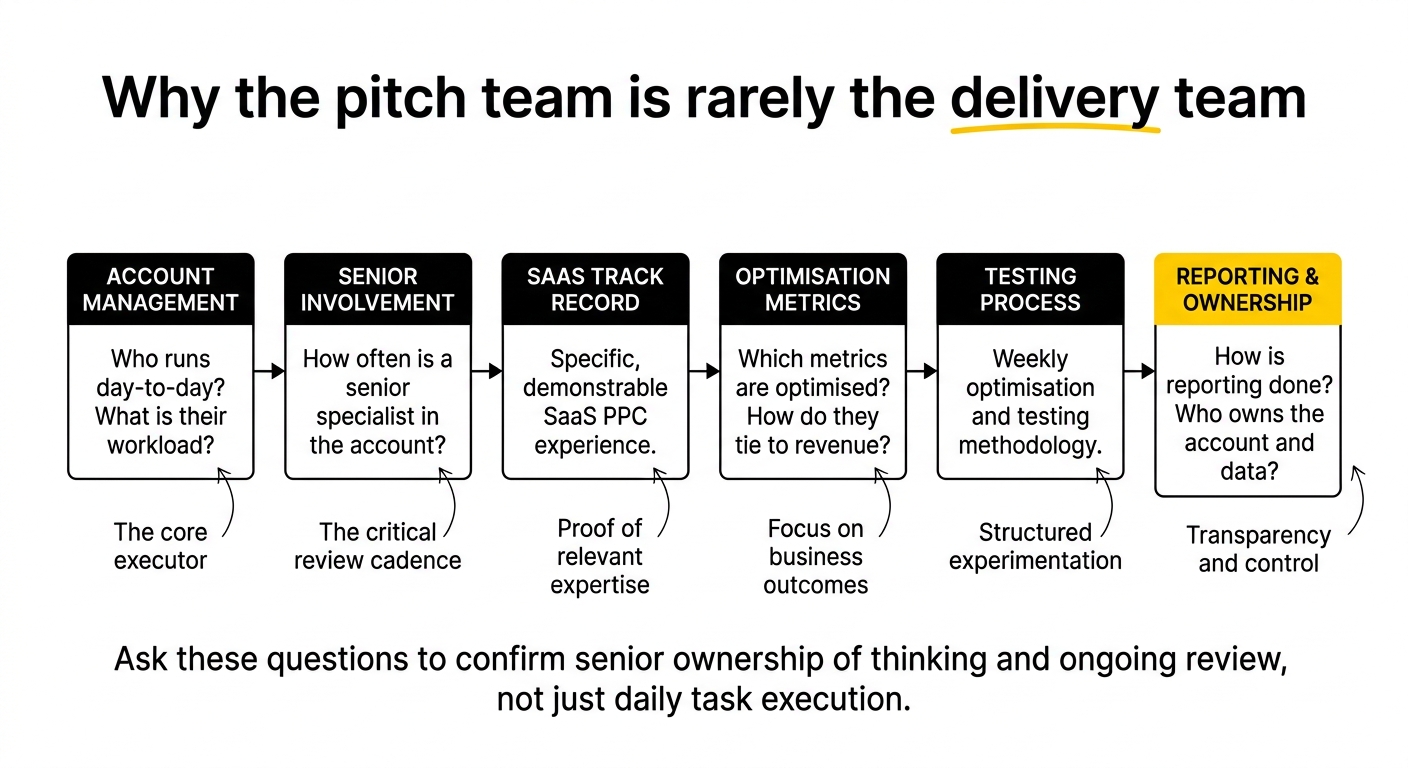
The questions that reveal the truth fall into six areas:
- Who runs the account day to day, and what else is on their plate
- How often a senior specialist is actually in the account
- Their specific, demonstrable SaaS PPC track record
- Which metrics they optimise to, and how those tie to revenue
- What their optimisation and testing process looks like week to week
- How they report, and who owns the account and its data
The questions that reveal who actually works on your account
1. Who will run this account day to day, and what else are they working on?
Ask for names, not roles. Then ask two follow-ups that cut through most rehearsed answers: how long has this person been managing paid search, and how many other accounts do they handle right now? Tenure under a couple of years or a book of a dozen-plus active accounts is a reliable signal that you are being assigned a junior with little time for yours.
A confident agency answers this plainly and introduces the actual day-to-day manager during evaluation, not just the pitch lead. Evasive answers stay abstract: our team, your dedicated pod, a specialist will be assigned. Vagueness here is the single clearest key indicator of an effective PPC team for SaaS, or the absence of one.
2. How often will a senior specialist actually be in the account?
There is a large difference between a senior who reviews your account weekly and one who reads a summary before the quarterly review. Ask directly: in a normal month, how many times does someone senior log into the account and make or approve changes, and what specifically do they do when they are in there?
Listen for a concrete cadence and concrete actions: weekly review of search terms and spend pacing, sign-off on structural changes, monthly strategic reset. A weak answer leans entirely on the QBR, which tells you the senior is a presenter, not an operator, on your account.
3. What is your specific SaaS PPC track record?
General PPC experience does not transfer cleanly to B2B SaaS, where sales cycles are long, deal values are high, and a form-fill is a long way from revenue. Ask for paid search examples from SaaS companies at a similar stage and motion to yours, and for the outcomes that mattered: pipeline and qualified leads, not clicks and impressions.
Ask what changed as a result of their work and how they knew. Strong agencies talk in terms of qualified pipeline, cost per opportunity, and revenue. Weaker ones reach for reach and CTR because the numbers that matter are not ones they influenced.
4. What metrics will you optimise to, and how do they tie to our revenue?
This question separates a genuine SaaS PPC partner from a generic Google Ads PPC agency. You want to hear that they optimise toward qualified pipeline and revenue, feeding your CRM outcomes back into the campaigns, rather than toward cost-per-lead or conversion volume in isolation.
If the answer centres on lead volume and CPL, the campaigns will generate leads your sales team does not want. A team built to generate qualified leads talks about lead quality, sales acceptance, and the path from spend to closed revenue without being prompted.
5. What does your optimisation and testing process look like week to week?
Ask them to walk you through a normal week on an account like yours, and to describe their approach to A/B testing. You are checking for an actual process rather than a reactive one: a cadence of hypotheses, tests structured around campaign, audience, and landing page, and enough discipline to let tests run through a long SaaS sales cycle before calling a winner.
A strong answer includes how they avoid the classic trap of declaring a variant the winner on cost-per-lead while it quietly produces worse pipeline. A weak answer describes ongoing optimisation with no structure, which usually means changes made in response to whoever shouted last.
6. How will you report, and who owns the account and data?
Ask what a monthly report contains and whether you can see the account live at any time. The answer reveals how much of their value is real. A report that is a dashboard export with the agency's logo on top is not analysis, it is decoration. You want reporting that ties spend to pipeline and explains what changed and why.
Then ask the question most buyers forget: who owns the ad account and the historical data if we part ways? Insist on retaining ownership of your Google Ads account and keeping admin access. Agencies that hold your account hostage inside their own manager account are protecting themselves, not you.
The red flags, in one place
If you are short on time, these are the answers that should give you pause:
- The agency will not name your day-to-day manager or introduce them before signing
- Senior involvement is described entirely through the quarterly review
- Case studies are about impressions, clicks, and CTR rather than pipeline and revenue
- The proposed metrics are cost-per-lead and lead volume, with no mention of quality or revenue
- Reporting is a branded export of the platform dashboard
- The agency wants to own your ad account rather than manage yours
.jpg)
Where this fits your agency evaluation
These inquiries to discover who will handle your SaaS PPC account effectively are one part of a wider decision, alongside pricing, cultural fit, and scope. But they are the part most buyers skip and later regret, because the calibre of the person in the account every week determines your results far more than the polish of the pitch.
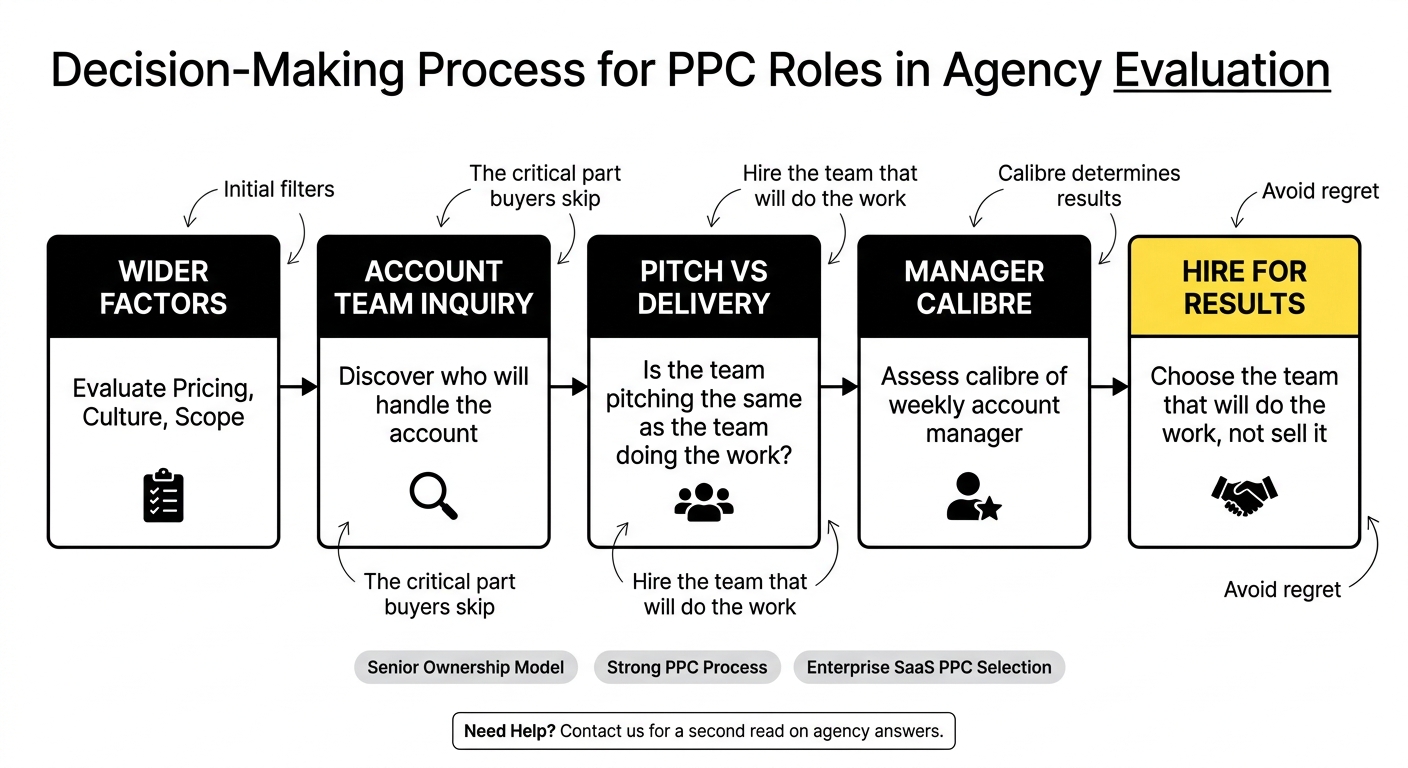
Whether you are comparing PPC management services in London or a remote partner, the same principle holds: hire the team that will do the work, not the team that shows up to sell it. For how we structure paid search partnerships around senior ownership, our b2b saas ppc agency page lays out the model. The mechanics of what good ongoing management actually involves are covered in Strong PPC Agency Process for SaaS Account Management, and the wider enterprise selection process across strategy, execution, and measurement is covered in Enterprise SaaS PPC Partner Selection Across Strategy, Execution and Measurement.
If you want a second read on the answers you are getting from agencies on your shortlist, we are happy to help you interpret them.
Frequently Asked Questions
How often should senior specialists be involved in day-to-day PPC management?
A senior specialist should review your account on a regular cadence, weekly for an active B2B SaaS account, not only at quarterly reviews. Day-to-day execution can sit with a capable manager, but the senior should own the strategy, sign off on structural changes, and be accountable when performance shifts. If senior involvement is described entirely through the QBR, the senior is presenting your account rather than managing it, which is a common gap in SaaS PPC management.
What experience should a SaaS PPC team have?
Look for demonstrable experience with B2B SaaS specifically, at a similar stage and sales motion to yours. General PPC experience does not transfer cleanly, because SaaS involves long sales cycles, high deal values, and a long path from form-fill to revenue. Ask for paid search examples from comparable SaaS companies and for the outcomes that mattered, framed in pipeline and qualified leads rather than clicks. Specific, relevant proof points are a key indicator of an effective PPC team for SaaS.
What metrics matter most when measuring SaaS PPC success?
The metrics that matter connect spend to revenue: qualified pipeline generated, cost per opportunity, sales acceptance rate, and ultimately customer acquisition cost and return. Cost-per-lead and conversion volume are useful diagnostics but misleading as goals, because they reward cheap leads that sales will not work. A strong PPC team optimises toward qualified pipeline by feeding CRM outcomes back into the campaigns, so the platforms learn to find buyers rather than form-fillers.
How should a PPC agency communicate campaign performance?
Reporting should tie spend to pipeline and explain what changed and why, not simply re-present the platform dashboard with agency branding. Expect a clear monthly narrative, live access to the account whenever you want it, and proactive flagging of issues rather than surprises at the review. The quality of communication is a reliable proxy for the quality of thinking, because a team that understands your account can explain it plainly.
What tools and technologies should a PPC agency use to manage SaaS campaigns?
The specific tools matter less than whether they connect paid search to your revenue data. At minimum you want conversion tracking tied to your CRM, offline conversion imports so the platforms optimise on qualified outcomes, and reporting that blends ad spend with pipeline. Fancy proprietary dashboards are worth little if they only reformat platform metrics. Ask how their tooling links a click to a closed deal, and whether you retain ownership of the accounts and data.
How should a PPC agency handle budget allocation and adjustments?
A strong agency allocates budget by the role each campaign and channel plays and by the qualified pipeline it produces, not by whichever channel shows the lowest cost-per-lead. Expect a clear rationale for how spend is distributed, a defined process for shifting budget as performance data arrives, and the discipline to let a long SaaS sales cycle complete before judging a channel. Reactive, unexplained budget swings are a sign of no underlying strategy.
What should a PPC agency's A/B testing approach look like?
Effective A/B testing in paid media is structured and patient. Expect a cadence of clear hypotheses, tests organised across campaign, audience, and landing page, and enough discipline to run each test through the sales cycle before declaring a winner. Critically, winners should be judged on downstream quality and pipeline, not on cost-per-lead alone, since a cheaper variant can produce worse leads. Ongoing optimisation with no structure usually means reactive tinkering.
How can you tell if senior specialists will actually work on your account?
Ask for the day-to-day manager by name and meet them during evaluation, then ask how long they have managed paid search and how many accounts they currently handle. Ask how often a senior logs into the account and what they do when they are there. Straight, specific answers with named people and concrete cadences indicate real senior involvement. Abstract answers about the team and reliance on the quarterly review indicate the senior you met will not be the one doing the work.

.png)