Effective Communication Rhythms for SaaS PPC Stakeholders

Your monthly report arrives on time. The charts look fine. Then a board member asks why spend is up while qualified leads are flat, and you cannot answer, because the last real conversation you had with your agency was six weeks ago.
The gap is rarely effort. It is rhythm. Effective communication rhythms for SaaS marketing are what keep a paid search relationship aligned in the weeks between the big monthly moments, and they are the difference between an agency that feels like part of your team and one you chase for answers. This guide covers the best practices for agency communication in SaaS: the cadence, the calls, the decision logs, and the internal updates that keep everyone pointing the same way.
It is written for the growth-focused marketing director at a Series A SaaS company in the UK or EU, the person who has to justify paid search spend to leadership every month while hitting quarterly growth targets. At that stage you do not have time for bureaucracy, but you cannot afford silence either. The answer is a light, repeatable operating rhythm.
Start with a communication charter in week one
Alignment problems are usually set in motion during onboarding, when nobody agreed how the relationship would actually run. Before the first campaign goes live, write a short communication charter with your agency. It does not need to be formal. It needs to be explicit.
Agree these things in writing:
- Channels. Which tool is used for what (more on this below).
- The decision-maker. Who on your side signs off on budget shifts and creative, so approvals do not stall.
- Cadence. Which meetings happen, how often, and who attends.
- Response times. What counts as urgent, and what can wait for the next scheduled touchpoint.
This is not administration for its own sake. A charter is what prevents the late-night why did nobody tell me message three months in. When both sides know the rhythm, nobody panics in the quiet between touchpoints, because they know exactly when the next update lands.
The four-tier communication rhythm
The most reliable structure for SaaS PPC agency communication is a tiered cadence. Each tier has a different job, and mixing them up is where most relationships go wrong. The rhythm we recommend looks like this:
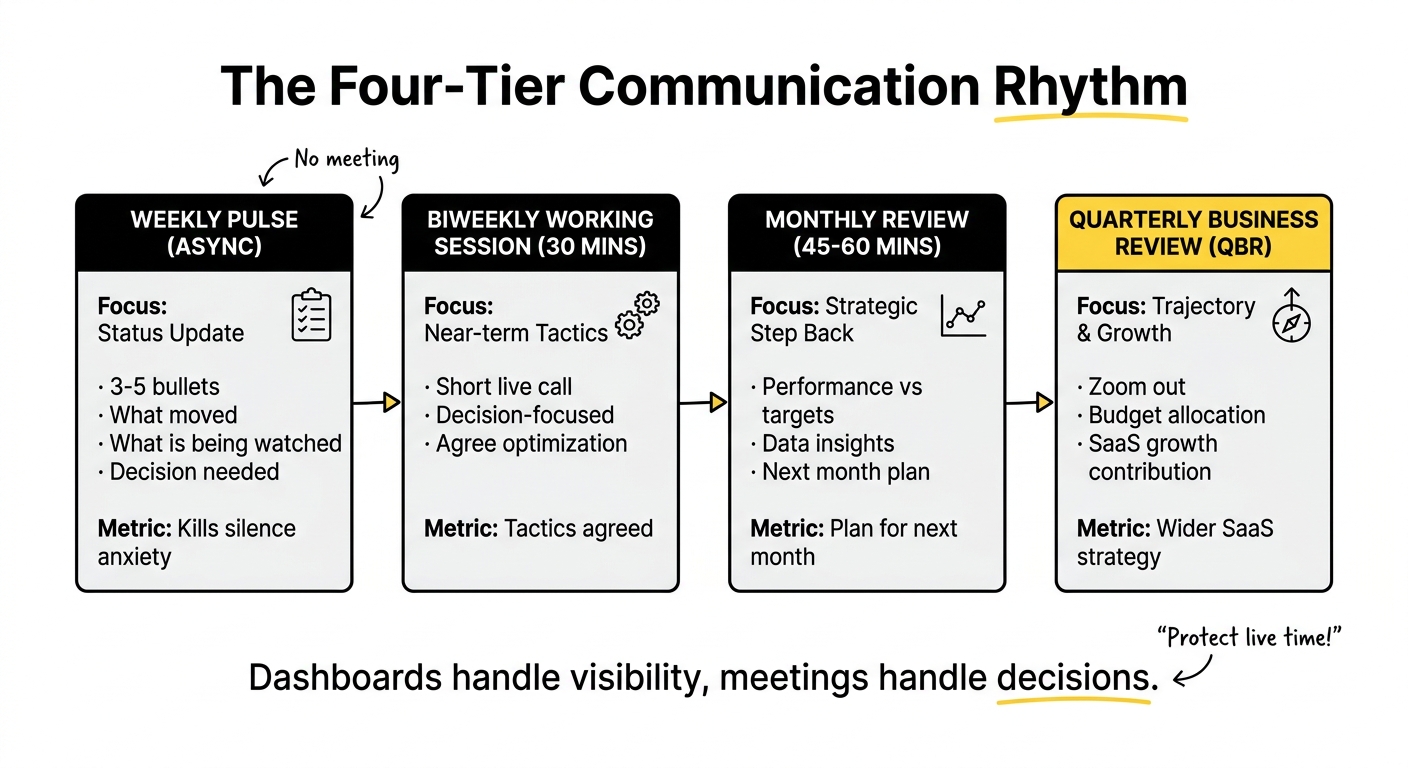
- Weekly pulse (async). Three to five bullets from the agency covering what moved, what is being watched, and anything that needs a decision. No meeting. This kills the anxiety of silence without eating anyone calendar.
- Biweekly working session (30 minutes). A short live call focused on near-term tactics and decisions. This is where ppc campaign optimization actually gets agreed, not just reported.
- Monthly review (45 to 60 minutes). The strategic step back: performance against targets, what the data is telling you, and the plan for the next month. What belongs inside that report is a separate question we cover elsewhere. Here, the point is the cadence and the conversation it prompts.
- Quarterly business review. Zoom out to trajectory, budget allocation, and how paid search is contributing to the wider SaaS growth strategies the board cares about.
The principle underneath all four tiers: dashboards handle visibility, meetings handle decisions. If a meeting is just someone reading numbers aloud that you could have seen in a dashboard, it should have been an email. Protect live time for analysis and choices.
What makes an agency call worth the time
A good call is built around decisions, not status. The status belongs in the weekly pulse and the dashboard. The call is where you resolve the things that need a human conversation.
A useful structure for the biweekly and monthly sessions is simple: what changed since last time, what we learned, what we are deciding today, and who owns each next step. End every call with the owners and dates confirmed out loud. A call that ends without clear ownership is a call that generates another call.
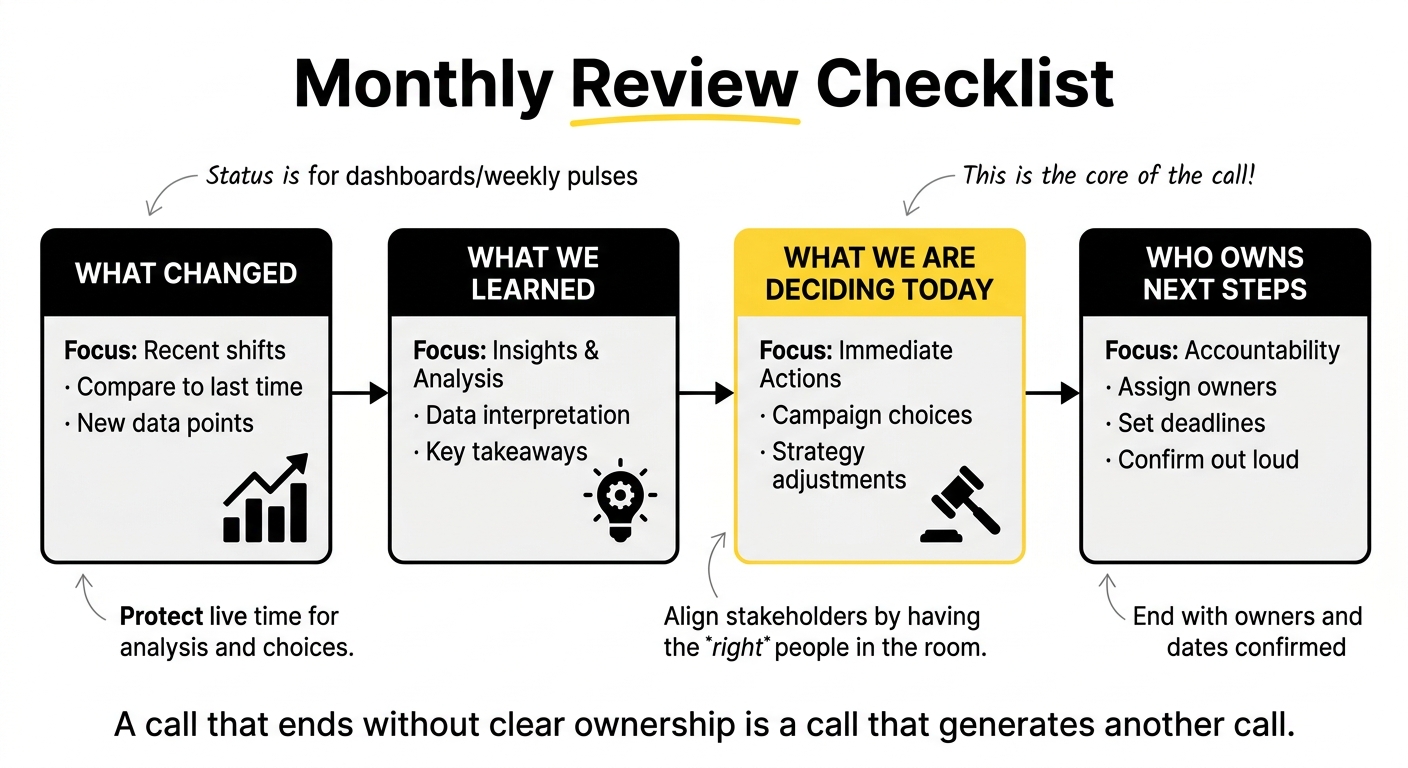
Keep the attendee list tight. At Series A, that is usually you, the agency lead, and whoever runs the account day to day. Aligning stakeholders in SaaS PPC campaigns does not mean everyone attends everything. It means the right people are in the room for the right tier, and everyone else reads the summary.
Decision logs: the accountability mechanism
The single highest-leverage habit in agency communication is a shared decision log. It is a running document, one line per decision: the date, what was decided, why, and what you expected to happen. Both sides can see it and add to it.
A decision log does three things. It removes the I thought we agreed something different conversation, because the agreement is written down. It creates accountability without a heavy governance process, because every decision has an owner and a rationale. And it builds an institutional memory of what you have already tried, so you are not relitigating the same test every quarter.
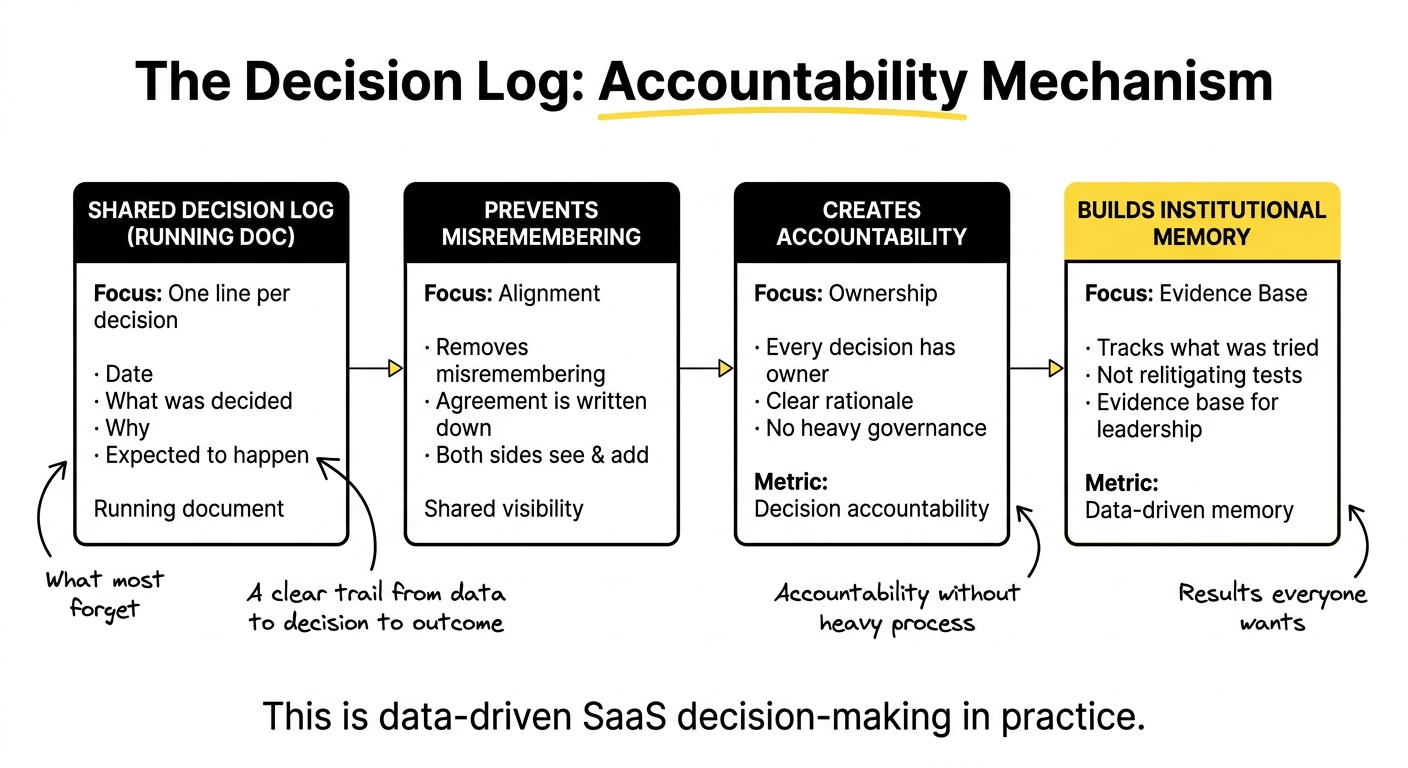
For a growth-focused marketing director, the log is also your evidence base. When leadership asks why the strategy shifted in March, the answer is one scroll away, with the reasoning intact. This is what data-driven SaaS decision-making looks like in practice: not more dashboards, but a clear trail from data to decision to outcome.
Testing protocols that keep decisions honest
Communication rhythm and experimentation rhythm are the same system. If tests are run ad hoc and reported inconsistently, the whole relationship drifts back toward opinion.
Agree a testing protocol up front and hold to it: one variable at a time, a defined minimum duration (often a full buying cycle rather than a few impatient days), and a threshold for what counts as a real result before you act on it. Search Engine Land contributors have made this point repeatedly, that a change without statistical significance behind it is a guess dressed as insight. Every test enters the decision log with a hypothesis and an outcome, which closes the feedback loop and stops the team from quietly abandoning experiments halfway.
This protects both sides. The agency is not pressured into premature calls to look responsive, and you get ppc campaign optimization grounded in evidence rather than the loudest voice on the call.
Channel discipline
Most communication breakdowns are not about frequency. They are about using every channel for everything. Separate them by job:
- Email or the decision log for anything you need to reference later: approvals, budget changes, and decisions with consequences.
- Slack or Teams for quick coordination: clarifications, links, same-day questions. Useful for speed, unreliable for sign-off, because decisions get buried in the scroll.
- Dashboards for live performance: always-on visibility, so nobody has to ask how are we doing between reports.
When a decision is made in a quick chat, it moves to the log or an email. If it only ever lives in Slack, it did not really happen.
Balancing short-term performance with long-term brand education
Series A creates a specific tension. Leadership wants pipeline this quarter, but the demand you can capture today was largely created by brand and category work months ago. Refine Labs has argued this point for years: teams that only measure and fund demand capture starve the demand creation that fills the pipeline later.
Communication rhythm is how you hold both. Use the biweekly session for the short-term performance levers, and reserve part of the quarterly review for the longer arc, what brand and education work is doing that a last-click report will never show. Naming the two horizons explicitly stops every conversation collapsing into this month cost per lead. It also gives you a more honest story to take to the board than a single number that hides half the picture.
Good marketing agency collaboration means the agency helps you tell that fuller story, rather than optimising only for the metric that is easiest to report.
Where communication rhythms break
A few failure modes recur, and all of them are preventable:
- Meeting inflation. Adding calls whenever something feels off, until delivery time disappears. Fix the pulse and the log instead.
- Status theatre. Live meetings spent reading numbers rather than deciding anything.
- No owner. Decisions made, nobody assigned, nothing happens, everyone frustrated by the next session.
- Channel chaos. Approvals lost across three tools with no traceable record.
If you recognise your current setup here, the fix is not more communication. It is better-structured communication. Working with a specialist b2b saas ppc agency that already runs a clear operating rhythm removes a lot of this friction, because the cadence comes built in rather than being something you have to impose.
What to do with this
Alignment is an operating system, not a personality trait. Write a communication charter in week one. Run the four-tier rhythm and keep the tiers doing their separate jobs. Anchor every call in decisions and owners. Keep a shared decision log. Hold a consistent testing protocol. Use each channel for one job. Do that, and the month-three surprise stops happening.
If you are setting up a new agency relationship, or trying to fix one that has drifted into silence and status calls, we are happy to share the cadence template we use with SaaS teams. It is a straightforward way to get the rhythm right before the misalignment sets in.
Frequently Asked Questions
What are the best practices for establishing effective communication rhythms with SaaS PPC agencies?
Start with a communication charter in week one covering channels, the decision-maker, cadence, and response times. Then run a tiered rhythm: an async weekly pulse, a biweekly working session for decisions, a monthly strategic review, and a quarterly business review. Keep dashboards for visibility and reserve live meetings for decisions. Maintain a shared decision log so accountability sits in the process rather than relying on memory or goodwill.
How often should marketing directors communicate with their SaaS PPC agency to ensure alignment?
More often than monthly, but not constantly. A weekly async pulse of three to five bullets keeps you informed without a meeting, a biweekly call handles near-term decisions, and a monthly review covers strategy and performance against targets. A quarterly business review addresses trajectory and budget. The aim is a predictable rhythm, so you are never surprised and never sitting in meetings that a dashboard could have replaced.
What are the key components of a successful agency call in the context of SaaS PPC?
A successful call is built around decisions, not status updates. Cover what changed, what you learned, what you are deciding now, and who owns each next step. Keep the attendee list tight, usually you, the agency lead, and the day-to-day account owner. End by confirming owners and dates aloud. Status belongs in the weekly pulse and the dashboard, so live time is protected for analysis and genuine choices.
How can decision logs improve accountability between marketing teams and PPC agencies?
A decision log is a shared running record, one line per decision, capturing the date, what was decided, the reasoning, and the expected outcome. It eliminates the we agreed something else dispute, gives every decision a clear owner, and builds a memory of what has already been tried. For a marketing director, it doubles as an evidence trail when leadership asks why the strategy changed, showing a clean line from data to decision.
What testing protocols should be in place to ensure data-driven decision-making in PPC campaigns?
Agree the protocol before testing starts: change one variable at a time, run each test for a defined minimum duration (often a full buying cycle), and set a threshold for what counts as a real result before acting. Log every test with a hypothesis and an outcome. This stops the team acting on statistically insignificant swings, prevents abandoned experiments, and closes the feedback loop so each test informs the next decision.
What reporting structures are most effective for keeping stakeholders informed about PPC performance?
Structure reporting by cadence and job rather than piling everything into one document. Use an always-on dashboard for live visibility, an async weekly pulse for movements, and a monthly report for strategic context and decisions. Match the depth to the tier, so quick updates stay short and strategic reviews get the narrative they need. The specific metrics and narrative that belong in each report are a separate topic; here the priority is a predictable, tiered structure.
How can internal stakeholder updates enhance collaboration between marketing teams and PPC agencies?
Internal updates translate agency activity into the language your leadership and board use, closing the loop between the people spending the budget and the people questioning it. When you relay a clear, consistent summary upward, you reduce reactive what is going on with PPC requests and buy the agency room to work. Pull these updates straight from the decision log and monthly review, so your internal story and your agency work never diverge.
How can communication help balance immediate pipeline performance with long-term brand education?
Name the two horizons explicitly and give each a home in the rhythm. Use biweekly sessions for short-term performance levers and reserve part of the quarterly review for the longer arc of brand and category work. Much of the demand you capture now was created months ago, so measuring only last-click performance starves future pipeline. A communication rhythm that discusses both stops every conversation collapsing into this month cost per lead.