How to Evaluate SaaS Marketing Agency Case Studies Effectively

A case study is not evidence. It is a marketing asset, built by the agency, using its best result, framed the way that flatters it most. The 300 percent increase on the slide is real, but it was chosen precisely because it looks impressive out of context. Your job as a CMO is to read it the way an auditor reads accounts, not the way a reader enjoys a story.
Evaluating SaaS marketing agency case studies well is a discipline, not a gut feel. Analysing SaaS marketing agency case studies beyond the basics means looking past the headline percentage to four things the slide usually leaves out: whether the client looked like you, where they started, whether the results can be trusted, and whether the outcome mattered commercially. Get underneath those four, and you can tell the difference between an agency that caused a result and one that was simply present while it happened.
This guide gives data-driven SaaS CMOs a structured way to assess that proof. Before you shortlist anyone, run every case study through these four lenses:
- ICP fit: was the client profile close enough to yours for the result to transfer?
- Starting conditions: what was the baseline, and how much of the growth was already in motion?
- Attribution quality: can the agency show its work actually drove the outcome?
- Commercial relevance: did the result move a number your board cares about?
The rest of this article works through each, plus the two cognitive traps that catch even experienced buyers.
Lens one: ICP fit
The first question is the simplest and the most overlooked. Did the agency get that result for a company like yours? A brilliant outcome for a self-serve, product-led tool at 10 dollars a month tells you very little about what the same team would do for an enterprise platform with a six-figure ACV and an eleven-month sales cycle. The motions are different, the buyers are different, and the levers that work in one rarely transfer cleanly to the other.
Assessing ICP fit in SaaS marketing means checking the specifics: company stage, deal size, sales motion, buying committee, and market. An agency that has only ever scaled bottom-up SaaS will apply that playbook to your enterprise motion whether it fits or not, because it is the playbook they know. Look for case studies from companies that share your structural reality, not just your logo colour or your vertical.
Watch for anonymised clients too. A leading SaaS company with no name, stage, or context is not something you can verify or map to your own situation. The best proof names the company or, at minimum, gives you enough detail to judge fit and offers a reference you can call.
Lens two: starting conditions
A result only means something relative to where it started. We grew pipeline 200 percent reads very differently if the client began at 50,000 pounds a month versus five million. Doubling a small base is a different achievement from moving a large one, and the case study almost never volunteers which it was.
Examine the starting conditions before you accept the outcome. What was the baseline? What else was happening at the company at the time? A funding round, a new product launch, a founder with a large personal audience, or a category suddenly in demand can all lift results independently of anything the agency did. This is the single most useful habit in assessing SaaS marketing agency case studies in depth: separate the growth the agency created from the growth it happened to stand next to.
Ask directly. What was the number before you started, what was it after, over what period, and what else changed in that window. An agency confident in its work will answer plainly. One that deflects is telling you something.
Lens three: attribution quality
This is where most SaaS case studies quietly fall apart, and where a data-driven CMO has the biggest advantage. The importance of attribution in SaaS marketing is not academic: it is the difference between a result you can trust and a number that was handed credit it did not earn.
The context matters. B2B SaaS journeys are long and crowded. Roughly two-thirds of B2B marketing teams still rely on last-touch attribution, which systematically undervalues the early-stage content that builds consideration across a long cycle. One HockeyStack analysis put the average at 266 tracked touchpoints to close a B2B SaaS deal, which alone shows the flaw in crediting a single click. When a case study attributes a whole revenue jump to one channel it managed, treat that as a claim to test, not a fact to accept.
.jpg)
Interrogating SaaS marketing attribution quality in a case study comes down to a few questions. Does the agency measure at the account level, reflecting the three to six people who actually make a B2B buying decision, or at the level of individual lead records? Does it tie results to pipeline and closed revenue, or stop at MQLs and form fills that may never convert? Can it explain which attribution model it used and why? Multi-touch attribution adoption reached only about 47 percent in 2026, so an agency running a credible multi-touch or account-level model is already ahead of most. An agency that cannot describe how it measured a result probably cannot reproduce it for you.
The strongest signal is candour about uncertainty. Attribution in a long, multi-stakeholder journey is never perfect, and an agency that acknowledges the limits of its own measurement is usually more trustworthy than one presenting a clean, singular cause.
Lens four: commercial relevance
The last lens asks the question your board will ask: so what? A result has commercial relevance in SaaS marketing when it moves a metric that matters to the business, revenue, pipeline, cost of acquisition, or payback, rather than a metric that only looks good on a slide.
Traffic, impressions, rankings, and raw lead counts almost always rise and rarely tie cleanly to revenue. A 300 percent traffic increase means little if you do not know what happened to qualified pipeline and closed deals. When you evaluate performance metrics in a case study, translate every headline into the currency your board speaks. If the case study cannot make that translation, the result may not have been commercially meaningful in the first place.
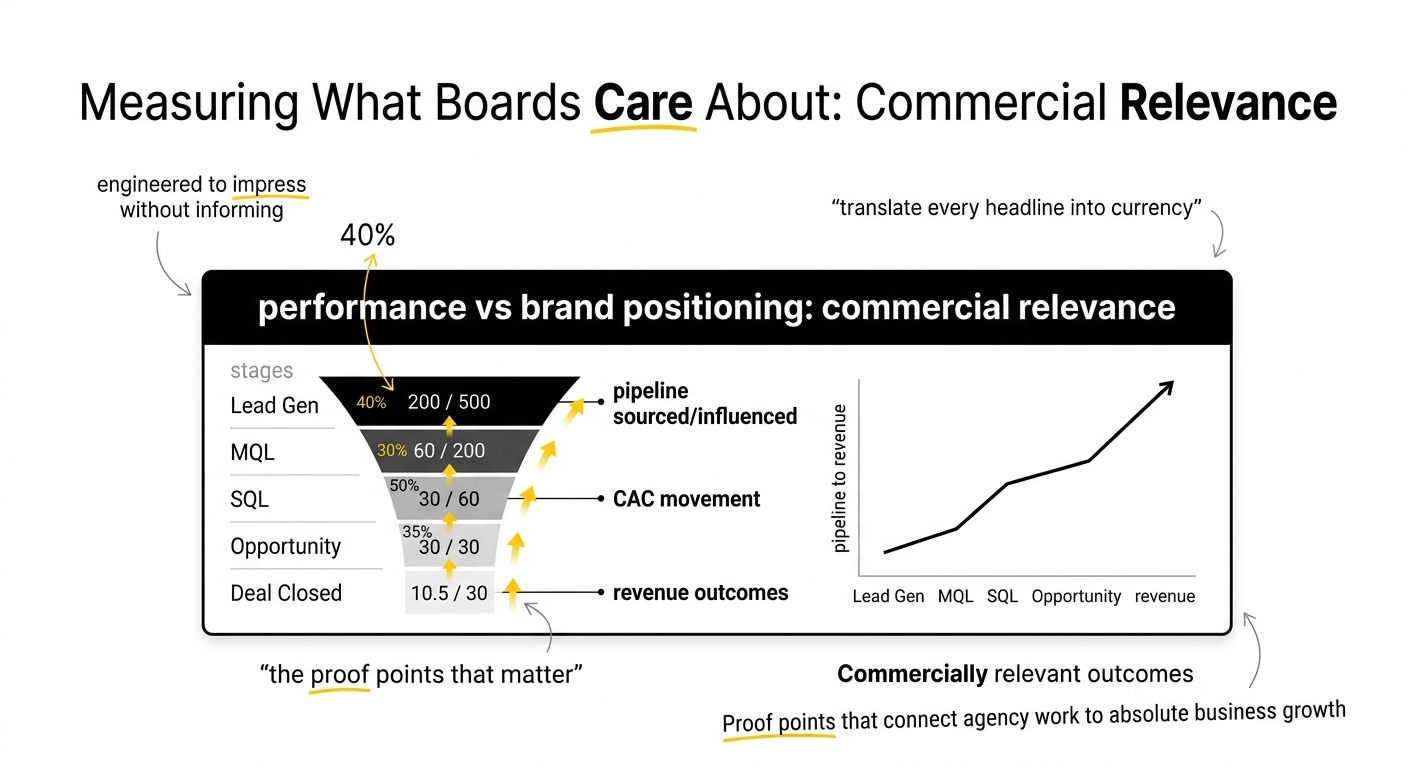
Be wary of percentages without absolute numbers. Improved conversion by 40 percent with no base rate, no volume, and no revenue figure is engineered to impress without informing. The proof points that matter connect the agency work to money: pipeline sourced or influenced, CAC movement, payback period, and revenue outcomes, ideally with the absolute numbers alongside the percentages.
The two traps: counterfactual and survivorship
Two cognitive traps catch even experienced buyers, and naming them is half the defence.
The first is the counterfactual problem. An agency being present while a company grew is not proof the agency caused the growth. Brand momentum, a product launch, a funding round, or the founder own network often run in parallel and do the heavy lifting. The right question is always: what specifically did you do, and what evidence connects your work to this outcome rather than to everything else happening at the same time?
The second is survivorship bias. Every agency shows its three best wins and none of its churned accounts. A wall of client logos tells you who signed, not who stayed or who succeeded. Counter it by asking how many clients they had in the same period, what their retention rate is, and whether you can speak to a client who left. The willingness to hand you a former client contact is one of the strongest green flags in the entire process.
A simple evaluation framework
You do not need a complicated scoring system. A SaaS CMO decision-making framework for case studies can be as simple as rating each study across the four lenses and refusing to be dazzled by any single number. For each case study, ask:
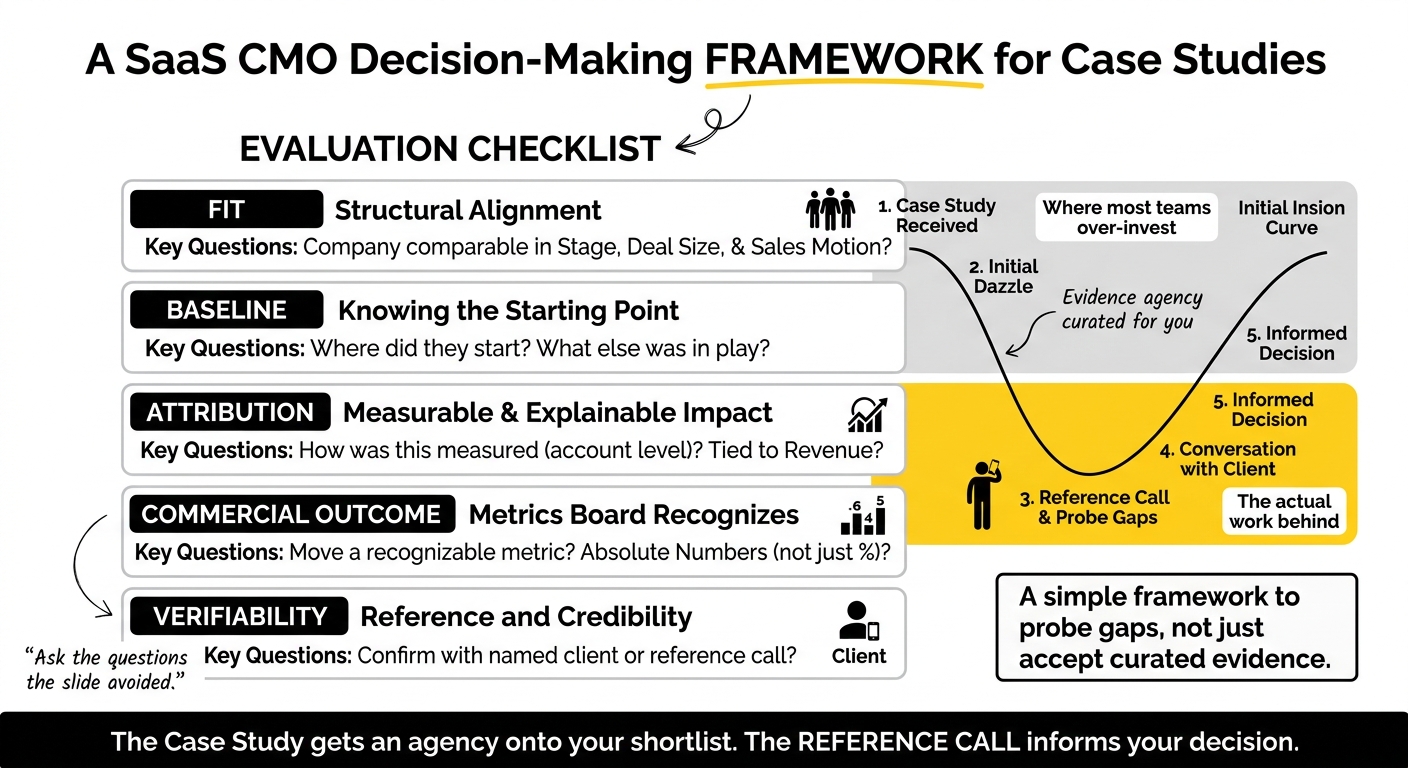
- Fit: Is this company structurally like mine, with a comparable stage, deal size, and sales motion?
- Baseline: Do I know where they started and what else was in play?
- Attribution: Can the agency explain how it measured this, at the account level and tied to revenue?
- Commercial outcome: Did this move a metric my board would recognise, with absolute numbers, not just percentages?
- Verifiability: Can I confirm this with a named client or a reference call?
A case study that passes all five is rare and valuable. Most will pass two or three, which is fine, as long as you know which ones they failed and you probe those gaps in the reference call rather than assuming the best.
This is also the moment to see the case study for what it is: a starting point for a conversation, not the conclusion of one. The document gets an agency onto your shortlist. The reference call, where you ask the former client the questions the slide avoided, is what should actually inform your decision. Choosing a SaaS marketing agency on case studies alone is choosing on the evidence the agency curated for you.
What to do with this
The best practices for evaluating SaaS agencies come down to reading their proof critically. Treat every case study as a claim, not a conclusion. Run it through ICP fit, starting conditions, attribution quality, and commercial relevance. Name the counterfactual and survivorship traps out loud. Then verify the ones that matter with a reference call before you shortlist. Data-driven SaaS marketing strategies start with data-driven vendor selection, and that begins with refusing to take a headline percentage at face value.
If you are working through a shortlist and want a second pair of eyes on the proof an agency has put in front of you, we are happy to help you pressure-test it. As a saas marketing agency ourselves, we would rather you ask hard questions of everyone you evaluate, including us.
Frequently Asked Questions
How do you analyse a marketing case study for SaaS?
Read it as a claim to be tested, not a fact to be accepted. Run it through four lenses: whether the client ICP resembles yours, what the starting baseline and surrounding context were, whether the attribution behind the result is credible, and whether the outcome moved a commercially meaningful metric. Then verify the strongest candidates through a reference call. The goal is to separate results the agency caused from results it was merely present for.
What key metrics should be evaluated in SaaS marketing agency case studies?
Prioritise metrics tied to revenue: pipeline sourced or influenced, cost of acquisition, payback period, and closed revenue. Treat traffic, impressions, rankings, and raw lead counts as context rather than proof, because they rise easily and rarely connect to the bottom line. Insist on absolute numbers alongside percentages, since a percentage with no base rate or volume is designed to impress without informing. If a result cannot be translated into a number your board recognises, discount it.
How do you assess ICP fit in case studies?
Compare the case study client to your own company on the factors that shape how marketing works: stage, deal size, sales motion, buying committee, and market. A result for a low-cost, self-serve product tells you little about an enterprise motion with a long, multi-stakeholder cycle, and vice versa. Be sceptical of anonymised clients you cannot map to a real context. The closer the structural fit, the more the result is likely to transfer to your situation.
What starting conditions should be considered when evaluating case studies?
Establish the baseline and the surrounding context before accepting any outcome. A 200 percent pipeline increase from a small base is a different achievement from moving a large one. Ask what the number was before the engagement, what it became, over what period, and what else changed at the company in that window. Funding rounds, product launches, founder audiences, and category timing can all lift results independently of the agency work.
How do you determine the quality of attribution in SaaS marketing case studies?
Check whether the agency measures at the account level, reflecting the several people involved in a B2B decision, rather than crediting individual lead records. Look for results tied to pipeline and closed revenue rather than MQLs, and ask which attribution model was used and why. Given how many touchpoints a SaaS deal involves, any case study crediting a whole outcome to one last click deserves scepticism. Candour about measurement limits is a good sign, not a weak one.
What role does commercial relevance play in evaluating case studies?
Commercial relevance is the test of whether a result actually mattered. A metric has it when it moves revenue, pipeline, acquisition cost, or payback, and lacks it when it only improves a vanity number. Boards fund outcomes, not activity, so a case study that cannot connect its work to a commercial result is describing effort rather than impact. Always translate the headline into the currency your leadership team cares about before giving it weight.
What are the common pitfalls in interpreting SaaS marketing agency case studies?
The two biggest are the counterfactual trap and survivorship bias. The counterfactual trap is assuming an agency caused growth simply because it was present during growth, when brand, product, or funding may have driven it. Survivorship bias is judging an agency by its handful of showcased wins while its churned clients stay invisible. Counter both by asking what specifically the agency did, what evidence links it to the outcome, and whether you can speak to a client who left.
What frameworks help CMOs make informed decisions based on case study analysis?
A lightweight scorecard works better than a complex model. Rate each case study on five criteria: ICP fit, known starting baseline, credible attribution, commercially relevant outcome, and verifiability through a named reference. A study passing all five is strong evidence; most pass two or three, which is acceptable as long as you probe the gaps rather than assume the best. The framework real value is discipline: it stops a single impressive percentage from carrying a decision it should not.