Structuring Full-Funnel Programmes for SaaS: Insights from Demand Generation Agencies
Discover how demand generation agencies create full-funnel programmes for SaaS, focusing on effective paid search strategies and lead generation.

You launch campaigns. Demos book in. Platform metrics look healthy. Three months later, the board wants to know where the pipeline is.
This is not a failure of execution. It is usually a failure of structure. Most SaaS demand generation programmes are built around one part of the funnel, most often the bottom, and treat the rest as someone else’s problem. A paid search agency runs capture campaigns. A content team publishes educational posts. Neither is talking to the other, and neither is responsible for what happens when a prospect falls between the two.
Demand generation agencies that work well with SaaS companies do not simply run campaigns. They build connected programmes across the full funnel, with each stage deliberately designed to feed the next. This article explains how those programmes are structured, where the key decisions sit, and what Series A marketing directors should look for when evaluating a potential partner.
The Core Problem: Too Much Capture, Not Enough Creation
Most SaaS teams over-invest in demand capture and starve the top of the funnel. The Forrester B2B Marketing Survey (2025) confirmed what many practitioners already suspected: 74% of B2B marketing budgets go toward demand capture activities, leaving only 26% for demand creation. That ratio is almost exactly the inverse of what the research suggests is optimal.
The consequence is a programme that works for a while, then hits a ceiling. You can only capture the demand that already exists. When you have harvested your addressable search volume and retargeted your existing audience enough times, growth stalls. Spending more on the same capture channels delivers diminishing returns.
The companies that build reliable pipeline growth do both simultaneously. They capture existing demand through paid search, category listings, and retargeting. And they create new demand through content, thought leadership, events, and the channels that shape buyer thinking before anyone opens a search tab.
A well-structured full-funnel demand generation programme is how you manage both without letting either collapse.
How Agencies Divide the Funnel: Three Zones, Not Three Stages
Most discussions of full-funnel marketing describe a tidy progression from awareness to consideration to decision. That is accurate enough as a model, but it obscures how agencies actually allocate budget, effort, and measurement across a real programme.
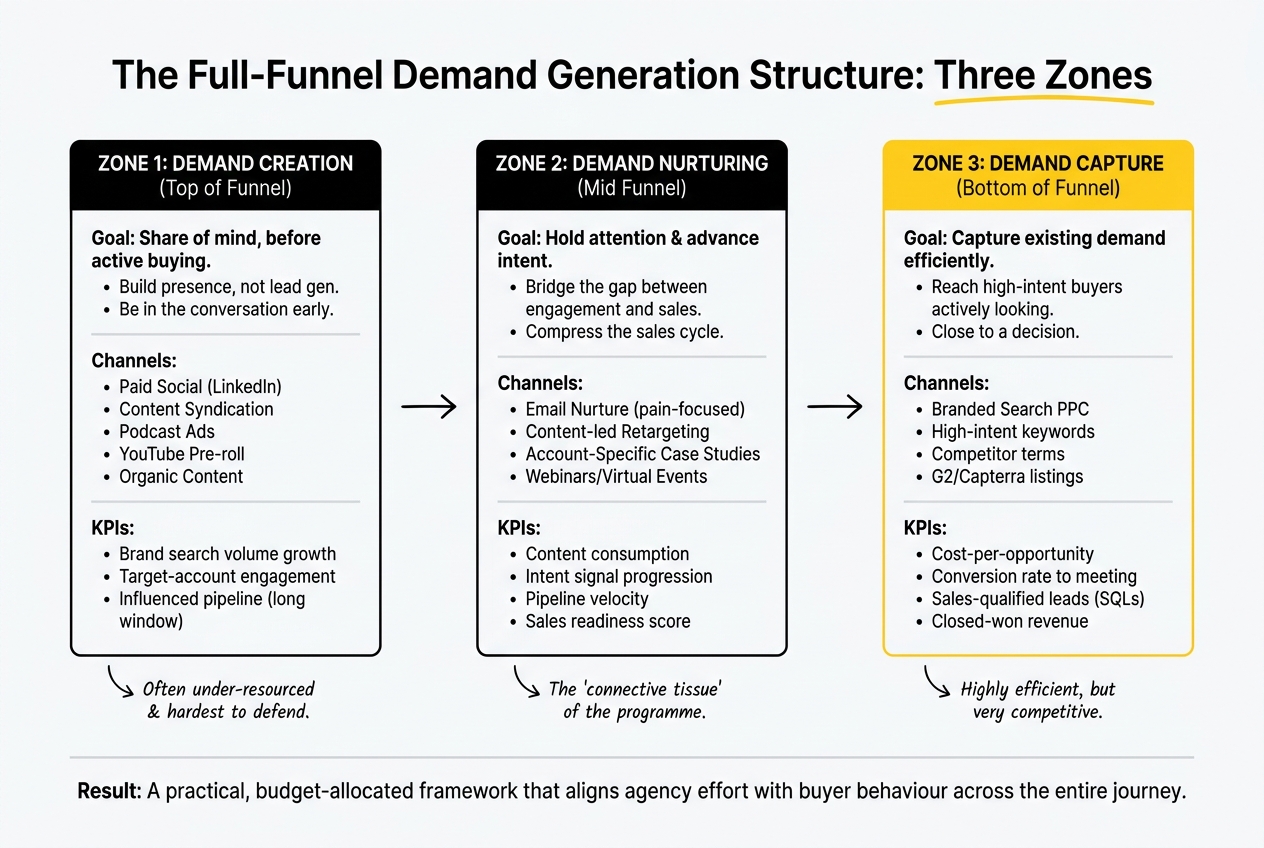
The practical division looks like this:
Zone 1: Demand Creation (Top of Funnel)
This is where you build presence in the market before buyers enter an active buying cycle. The goal is not lead generation. It is share of mind: being in the conversation when a VP of Engineering or Head of RevOps starts to articulate a problem that your product solves.
Channels used here include paid social (primarily LinkedIn for B2B SaaS), content syndication, podcast sponsorship, YouTube pre-roll, and organic content tied to the problems your ICP faces. The KPIs are not cost-per-lead. They are brand search volume growth, engagement rates from target-account audiences, and influenced pipeline over a longer attribution window.
This zone is the most commonly under-resourced in Series A SaaS. It is also the one that takes longest to show impact, which makes it difficult to defend in quarterly reviews. Agencies that are honest about this trade-off are worth listening to.
Zone 2: Demand Nurturing (Mid Funnel)
Buyers who have engaged with your brand at the top of the funnel do not move directly to a sales conversation. In B2B SaaS, the average sales cycle runs to around 84 days, and that is compressing the variation across deal sizes and market segments. During that period, buyers are consuming content, talking to peers, comparing options, and building internal consensus.
Mid-funnel activity is designed to hold attention and advance intent during that window. It includes email nurture sequences tied to specific pain categories, retargeting campaigns with content-led creative rather than direct response, case study assets served to accounts showing intent signals, and webinar or virtual event programmes targeted at in-market ICPs.
This zone often receives the least attention in agency engagements. It is harder to attribute than bottom-funnel capture and slower to show results than top-funnel reach. The agencies that structure it well treat it as the connective tissue of the programme, not an optional layer.
Zone 3: Demand Capture (Bottom of Funnel)
This is where PPC strategy is most commonly deployed: branded search, high-intent category keywords, competitor terms, and G2 or Capterra listings. These campaigns reach buyers who are actively looking for a solution and are close to a decision.
Capture is the highest-intent zone and typically the most efficient from a cost-per-opportunity perspective. It is also the most competitive. In crowded SaaS categories, branded competitors bid on your terms, CPCs on category keywords have risen sharply over the past several years, and the pool of actively searching buyers is smaller than most teams assume.
This is why bottom-funnel capture alone cannot be a growth strategy. It can be a highly efficient part of one.
How PPC Fits Across the Funnel, Not Just at the Bottom
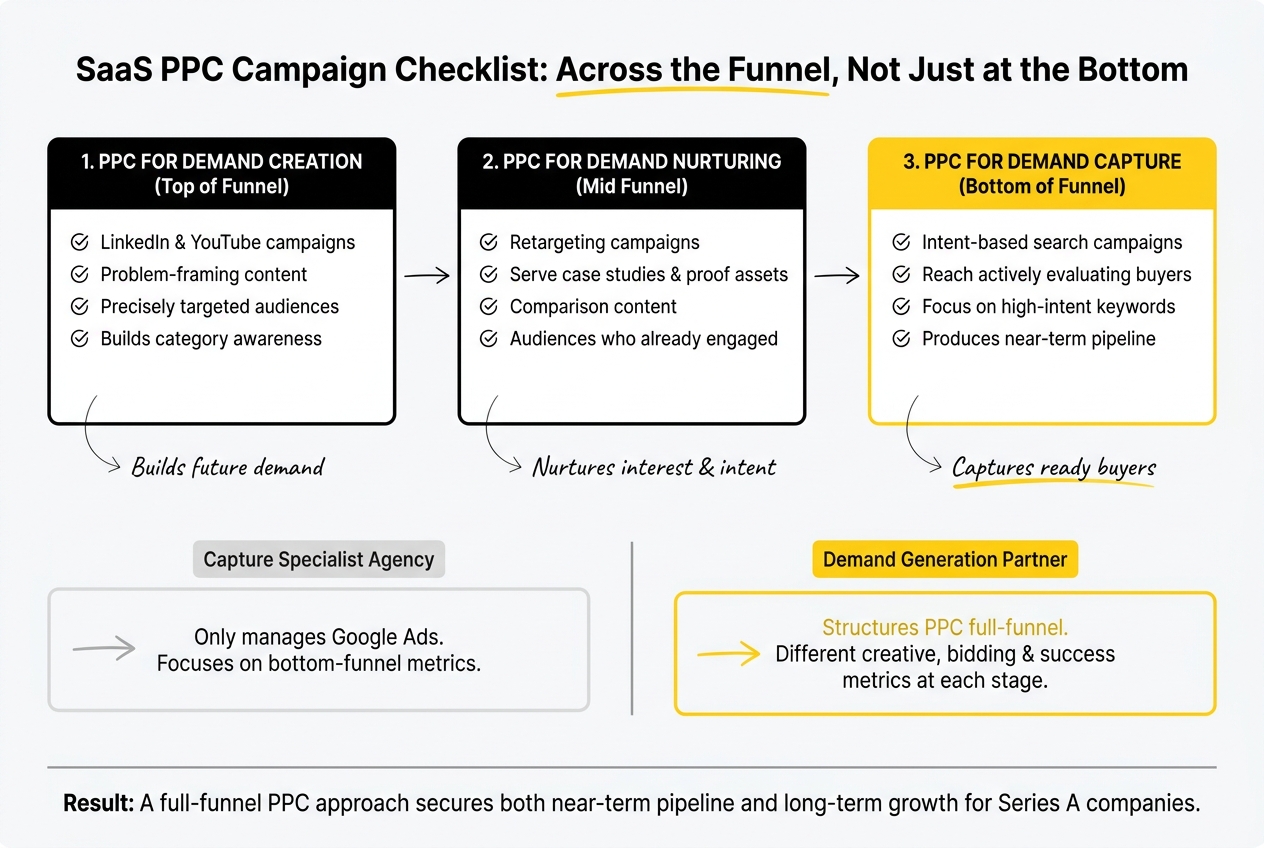
One of the most common misconceptions about SaaS PPC campaigns is that they belong exclusively in the capture zone. In a properly structured full-funnel programme, paid media plays a role at every stage.
At the top, LinkedIn and YouTube campaigns build category awareness with problem-framing content served to precisely targeted audiences. At the mid-funnel, retargeting campaigns serve case studies, comparison content, and proof assets to audiences who have already engaged with the brand. At the bottom, intent-based search campaigns reach buyers who are actively evaluating.
The distinction matters for how you evaluate a paid search agency. An agency that only manages your Google Ads account is a capture specialist. An agency that structures PPC across the full funnel, with different creative strategies, bidding approaches, and success metrics at each stage, is a demand generation partner.
If you are a Series A company with a short runway to demonstrate growth, you need both. The capture campaigns produce near-term pipeline. The upper-funnel paid activity builds the demand that keeps that capture pipeline full six months from now.
For a broader view of how to decide between building this capability in-house or partnering with a specialist, see our breakdown of Agency vs In-House: When to Bring in a SaaS Paid Media Specialist.
PLG vs. Sales-Led: The Structural Difference
Full-funnel programmes are not one-size-fits-all across SaaS GTM motions. The right structure depends heavily on whether your company is product-led, sales-led, or running a hybrid model.
In a product-led growth (PLG) business, the product itself is a demand generation channel. Free trials, freemium tiers, and self-serve onboarding bring buyers into the funnel directly. The role of paid media and content is to drive trial signups and reduce time-to-activation. The MQL looks different here: it is often a product-qualified lead (PQL) based on in-product behaviour, not a form fill.
Agencies working with PLG SaaS companies typically weight their programmes differently. Top-of-funnel content focuses on use cases and activation, not problem awareness. Mid-funnel retargeting targets trial users who have not reached activation milestones. And bottom-funnel capture serves users who have churned from trial or who are searching competitor alternatives.
In a sales-led business, the programme looks more like the three-zone model described above. The top funnel is building awareness among the buying committee. The mid funnel is nurturing individual stakeholders with content relevant to their specific concerns. The bottom funnel is capturing the inbound demand that has developed as a result of those earlier activities.
The strategic question for any Series A SaaS team is which motion they are actually running, and whether their current agency understands that distinction. Many do not.
Marketing and Sales Alignment: Where Full-Funnel Programmes Break Down
A full-funnel demand generation programme only works if sales and marketing are operating from the same definitions and data. This sounds obvious and is consistently where programmes fail.
The most common failure mode is the MQL-to-SQL gap. Marketing produces a volume of MQLs that looks healthy on a dashboard. Sales converts a fraction of them. The disconnect is usually one of three things: the MQL definition does not match what sales considers a real buying signal, the lead routing process is too slow, or the nurture handoff to sales does not include enough context for effective outreach.
Enterprise B2B SaaS companies with tight sales and marketing alignment achieve MQL-to-SQL conversion rates around 40%, according to 2025 funnel benchmark data. The industry median across B2B sectors sits at 15 to 21%. The gap between those figures is alignment, not campaign quality.
Agencies that structure full-funnel programmes well are actively involved in this alignment work. They do not just deliver MQLs to the CRM and consider their job done. They track what happens to leads after handoff, monitor SQL conversion rates from their campaigns, and adjust targeting and qualification criteria based on sales feedback.
If a demand generation agency you are evaluating does not ask how your sales team defines a qualified opportunity in the first conversation, that is a signal worth noting.
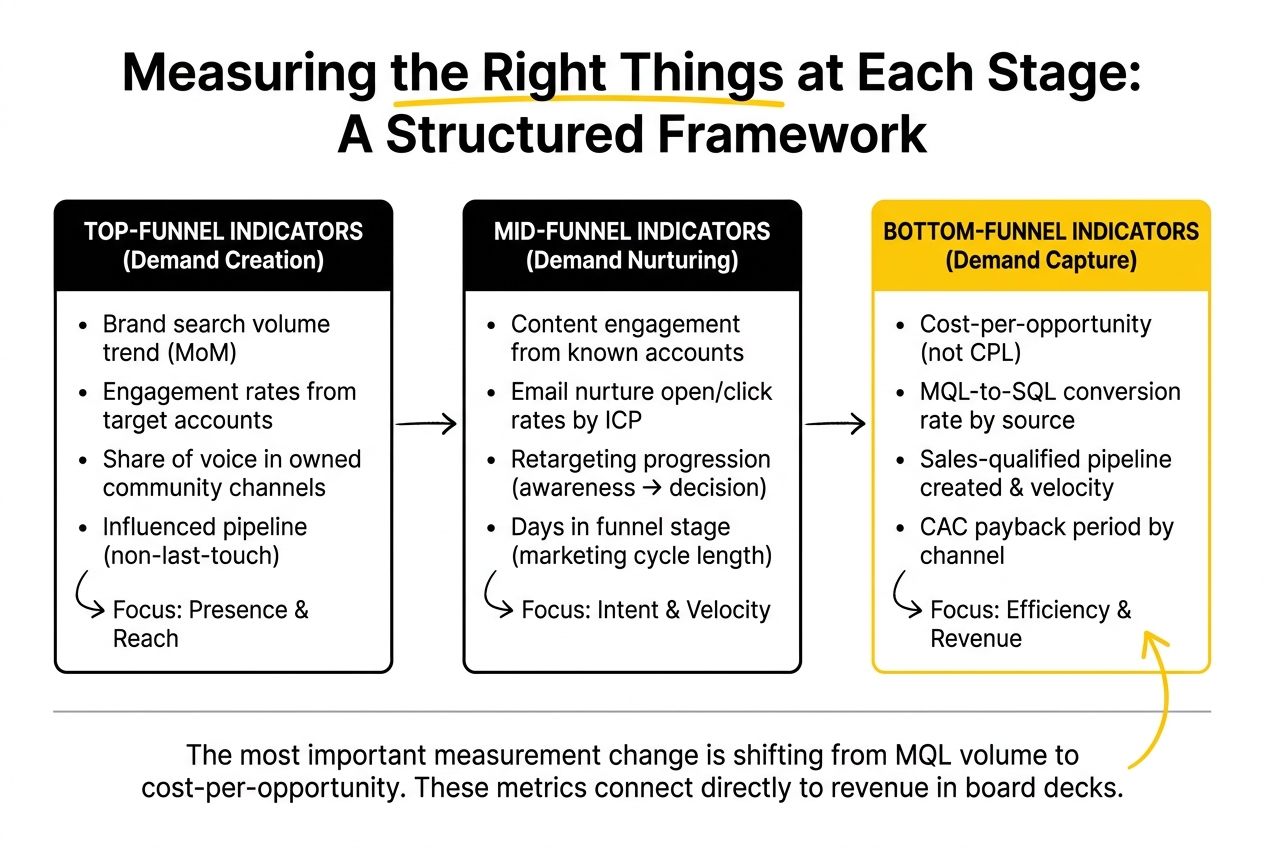
Measuring the Right Things at Each Stage
The KPIs for a full-funnel programme change depending on which zone you are measuring. Agencies that report the same metrics across the whole funnel, typically impressions, clicks, and MQL volume, are optimising for the wrong things.
A structured measurement framework looks like this:
Top-funnel indicators:
- Brand search volume trend (month-over-month)
- Engagement rates from target-account audiences (LinkedIn, YouTube)
- Share of voice in owned community channels
- Influenced pipeline from non-last-touch attribution
Mid-funnel indicators:
- Content engagement rates from known accounts
- Email nurture sequence open and click rates by ICP segment
- Retargeting progression (movement from awareness content to decision content)
- Days in funnel stage (marketing cycle length)
Bottom-funnel indicators:
- Cost-per-opportunity (not cost-per-lead)
- MQL-to-SQL conversion rate by campaign and lead source
- Sales-qualified pipeline created and pipeline velocity
- CAC payback period by channel
The shift from MQL volume to cost-per-opportunity is the most important measurement change a Series A marketing director can make. MQL volume is a marketing metric. Cost-per-opportunity, SQL conversion rate, and pipeline velocity are metrics that hold up in board decks because they connect directly to revenue.
A good PPC partner understands this distinction and builds their reporting around it from day one.
Common Challenges and How Agencies Address Them
The attribution problem. Long sales cycles and multi-touch buying journeys make clean attribution nearly impossible. The answer is not to find a perfect attribution model. It is to agree on a consistent, directional methodology and hold to it across time. Agencies that promise perfect attribution are selling something that does not exist.
The time-to-results pressure. Series A teams are under pressure to show results inside a quarter. A well-structured full-funnel programme will not deliver uniform results across all zones in that timeframe. Bottom-funnel capture can produce pipeline in weeks. Top-funnel demand creation takes months to show measurable impact. Agencies that are honest about this timeline are more valuable than those who claim otherwise.
The content dependency. Full-funnel demand generation requires content: educational content for the top funnel, proof content for the mid funnel, and conversion-focused content for the bottom. Many early-stage SaaS teams do not have the content infrastructure to support this. Agencies sometimes bridge this gap; more often they help teams prioritise which content investments will compound fastest.
The ICP drift problem. As a SaaS company scales, the ideal customer profile often shifts. A programme built for one ICP can gradually become misaligned if the agency and the internal team do not revisit targeting assumptions together. The agencies that avoid this run structured ICP review sessions quarterly, not just at onboarding.
Building a Scalable Framework
The goal of a full-funnel demand generation programme is not to run campaigns. It is to build a repeatable system for pipeline growth that can scale alongside the business.
Scalability requires three things: a clear channel architecture with defined roles at each funnel stage, a measurement framework that connects marketing activity to revenue outcomes, and a feedback loop between sales and marketing that allows the programme to improve over time.
An agency partner should be helping you build that system, not just managing the individual components. The test is whether the programme would function if the agency left. If the answer is no because all the knowledge lives with the agency team, that is a dependency, not a partnership.
The right engagement leaves the in-house team with better processes, cleaner data, and a clearer picture of what is working and why. That is what a well-structured full-funnel programme produces over 12 to 18 months of consistent execution.
If you are evaluating agencies for this type of engagement, our b2b saas digital marketing agency service page covers how Upraw approaches SaaS demand generation programmes specifically.
Frequently Asked Questions
How do demand generation agencies structure full-funnel programmes for SaaS companies?
Agencies divide the funnel into three functional zones: demand creation at the top (building awareness and category presence), demand nurturing in the middle (holding attention and advancing intent during long sales cycles), and demand capture at the bottom (reaching buyers who are actively searching for solutions). Each zone has distinct channels, creative approaches, and KPIs. The key structural decision is how budget is allocated across all three, not just the bottom-funnel capture activities that produce the most immediately visible results.
What are the key components of a successful PPC strategy for SaaS?
A full-funnel PPC strategy for SaaS includes paid social for top-of-funnel audience building (primarily LinkedIn for B2B), retargeting campaigns with content-led creative for mid-funnel nurturing, and intent-based paid search campaigns for bottom-funnel capture. Each layer uses different bidding strategies, creative formats, and success metrics. Agencies that run paid media only at the bottom of the funnel are capture specialists, not demand generation partners. The strongest programmes integrate all three layers with coordinated messaging and consistent audience targeting.
How can SaaS companies align their marketing goals with demand generation strategies?
Alignment starts with a shared definition of what constitutes a qualified lead and a clear SLA for how quickly sales follows up on inbound opportunities. Beyond that, it requires a feedback loop where sales informs marketing about lead quality by campaign and source, and where marketing adjusts targeting and qualification criteria based on that feedback. Marketing and sales should also align on the same core metrics, particularly cost-per-opportunity, MQL-to-SQL conversion rate, and pipeline velocity, rather than operating on separate dashboards.
How do demand generation agencies measure the success of full-funnel programmes?
At the top of the funnel, agencies track brand search volume growth, engagement rates from target-account audiences, and influenced pipeline via multi-touch attribution. In the mid funnel, they monitor content engagement from known accounts, nurture sequence performance by ICP segment, and time spent in each funnel stage. At the bottom, the primary metrics are cost-per-opportunity, MQL-to-SQL conversion rate, sales-qualified pipeline created, and CAC payback. The shift from MQL volume to pipeline-connected metrics is the most important measurement change a Series A marketing team can make.
What role does market education play in demand generation for SaaS?
Market education is the mechanism through which demand creation works. Most B2B SaaS buyers are not actively searching for a solution when they first encounter a product category. They are experiencing a problem they have not yet framed as solvable. Top-of-funnel content, thought leadership, events, and community participation shape how buyers understand their problem and which categories of solution they consider. Companies that invest in this education build a stronger inbound pull and a warmer pipeline, even if the attribution is harder to measure cleanly.
How can SaaS marketing directors select the right PPC partner?
Look for three things. First, does the agency understand your GTM motion (PLG, sales-led, or hybrid) and tailor their approach accordingly? Second, do they measure and report on pipeline outcomes, not just campaign metrics? An agency reporting on MQL volume and click-through rates is optimising for the wrong layer. Third, do they engage with your sales team? An agency that does not understand what happens to leads after the CRM handoff cannot improve the quality of what they are sending. Case studies showing month-on-month SQL improvement and pipeline growth from comparable SaaS businesses are more meaningful than broad performance claims.
How do demand generation agencies ensure pipeline growth for SaaS clients?
Pipeline growth comes from executing demand creation and demand capture in parallel, not in sequence. Agencies that only run capture campaigns produce pipeline that hits a ceiling once the addressable search volume is harvested. Agencies that build both engines simultaneously create a compounding effect: the top-funnel activity generates the demand that the bottom-funnel capture then converts. The measurement discipline to see this clearly requires multi-touch attribution and a consistent reporting framework maintained across multiple quarters.
What are the common challenges SaaS companies face in demand generation?
The most frequent challenges are attribution complexity across long sales cycles, pressure to show results within a single quarter from programmes that compound over six to twelve months, insufficient content infrastructure to support multi-zone demand generation, and ICP drift as the company scales beyond its initial target market. Most of these challenges have practical solutions, but they require a partner who is honest about the trade-offs rather than one who oversimplifies the timeline or over-promises early performance.
If you are working through how to structure a demand generation programme for a Series A SaaS company, this is the kind of problem we spend time on with clients regularly. Worth a conversation if you are at that stage.