A Comprehensive Guide to SaaS PPC Agency Pricing Models
A practical guide to comparing the three primary SaaS PPC agency pricing models: retainers, audits, and performance fees. Written for revenue-accountable VPs of Marketing at Series B+ companies who need to align spend with revenue outcomes and defend budget to the board.

Most VPs of Marketing compare PPC agency proposals on the wrong axis. The first column on the spreadsheet is the monthly fee. The second is the contract length. The third, if it appears at all, is the pricing model. In our experience, this should be reversed. The pricing model is the most consequential variable in the engagement, because it sets the incentive structure the agency will operate under for the next four to six quarters. The fee itself is a smaller decision.
This matters more in B2B SaaS than in most other verticals. The sales cycle is long, the conversion volume is low, and the attribution is messy enough that a misaligned incentive can run for two or three quarters before the data forces a conversation. By the time the board notices that paid spend has scaled faster than pipeline, the pricing model has been quietly directing the work for nine months.
This article is a practical guide to comparing the three primary pricing models used by SaaS PPC agencies in 2026: flat retainers (including the percentage-of-spend variant), one-off audits or project-based engagements, and performance-based fees. It is written for revenue-accountable VPs of Marketing at Series B+ B2B SaaS companies who need to defend budget allocation to the board and align spend with revenue outcomes. For the wider context on agency selection, the compare pricing models of SaaS PPC agencies hub page sets the broader frame. Once you have decided on the model, how to choose a UK Google Ads agency for your SaaS business covers the Google Ads selection layer, and what separates a scalable B2B SaaS paid media partner from a vendor covers the operational model that determines whether the engagement actually delivers. For the multi-channel CMO-level evaluation framework that sits above the pricing decision, evaluating the best SaaS advertising agencies for Series A+ teams covers six structural criteria.
The three primary pricing models
The labels overlap across agencies. One agency’s “retainer” is another’s “monthly fee.” One agency’s “performance bonus” is another’s “hybrid model.” What matters is the underlying mechanics, not the marketing language. The three structural models are:
Retainer (flat or percentage-of-spend variant)
A retainer is a recurring monthly fee for ongoing work. It comes in two main forms.
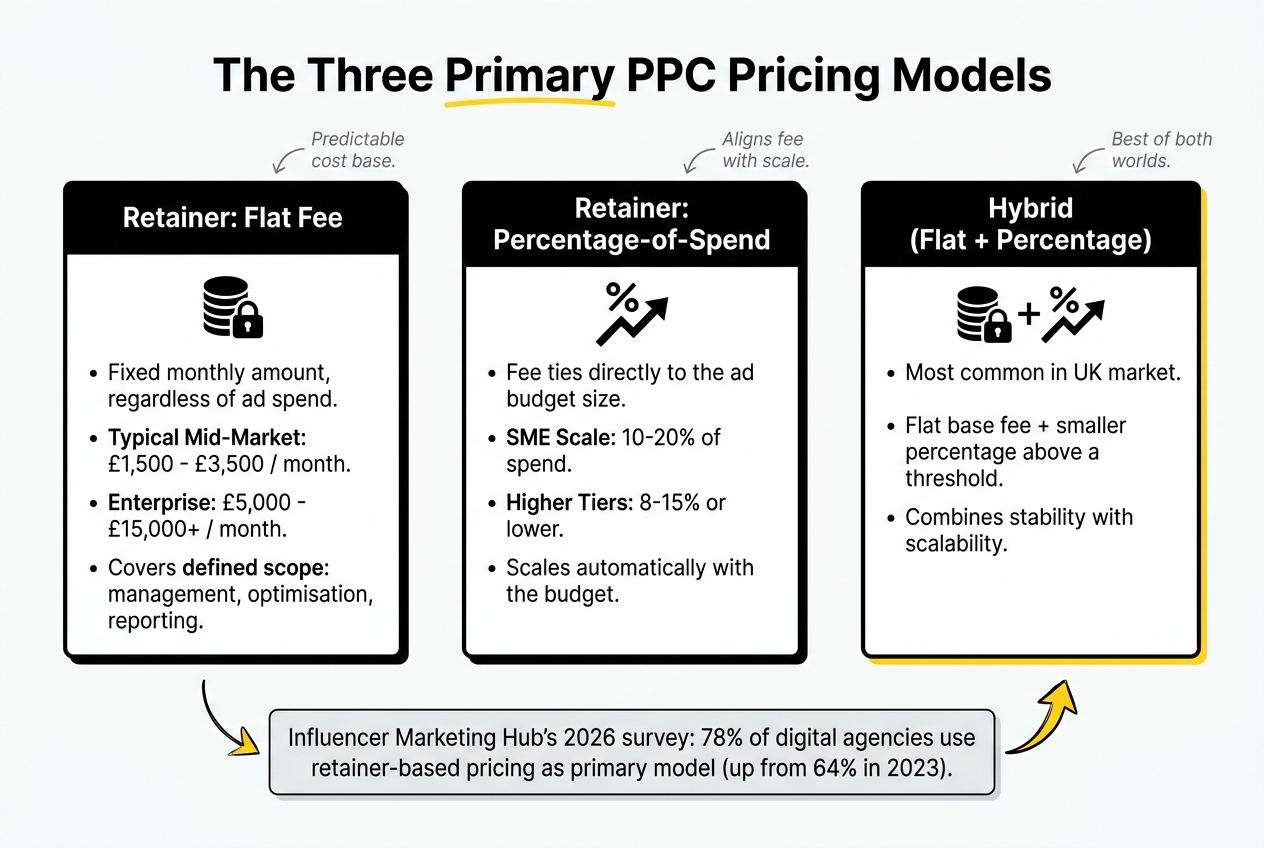
The flat retainer is a fixed monthly amount regardless of ad spend. Typical 2026 ranges in the UK SaaS market are £1,500-£3,500 per month for mid-market SaaS, scaling to £5,000-£15,000+ for enterprise. The fee covers a defined scope: account management, campaign optimisation, reporting, and an agreed level of strategic input.
The percentage-of-spend retainer ties the management fee to the size of the advertising budget, typically 10-20% for SME-scale accounts and dropping to 8-15% or lower at higher spend tiers. On £15,000 monthly ad spend at 12%, the agency fee is £1,800. The fee scales automatically with the budget.
Hybrid models combining the two are now the most common arrangement in the UK market, typically a flat base fee with a smaller percentage applied above a defined spend threshold. According to Influencer Marketing Hub’s 2026 survey, 78% of digital agencies use retainer-based pricing as their primary model, up from 64% in 2023.
Audit or project-based fee
An audit is a one-off engagement with a fixed scope and a fixed fee. The agency conducts a defined piece of diagnostic or strategic work, delivers an output (typically a written report plus a workshop or presentation), and the engagement ends. There is no ongoing commitment.
Typical UK 2026 pricing for a serious SaaS PPC audit is £3,000-£10,000 depending on scope, account size, and the depth of the deliverable. Some audits include implementation recommendations only. Others include the build of corrective campaigns or measurement infrastructure as part of the project fee.
Project-based pricing follows the same logic for any defined scope of work. A landing page CRO project. A measurement infrastructure rebuild. An account restructure. The fee is fixed against the scope, not against ongoing management.
Performance fee
A performance fee ties some portion of the agency’s compensation to outcomes rather than activity. The arrangements vary substantially.
The simplest version is a flat monthly retainer at a discount, with a performance bonus paid when defined KPI thresholds are met. A common structure for B2B SaaS in 2026 is a 70-80% base retainer plus a 20-30% bonus tied to cost per SQL, pipeline contribution, or qualified opportunity count.
More aggressive versions tie a larger portion of the fee directly to revenue or pipeline outcomes, sometimes with no base fee at all. These pure performance arrangements are rare in B2B SaaS because the attribution complexity is too high for the agency to accept the risk on a long sales cycle. Most performance fee arrangements at Series B+ are hybrid structures with a defined base.
The incentive structure each model creates
This is the analysis most procurement processes skip. Each model creates a different incentive for the agency, and the incentive shapes the work over months. The fee is the same. The behaviour is not.
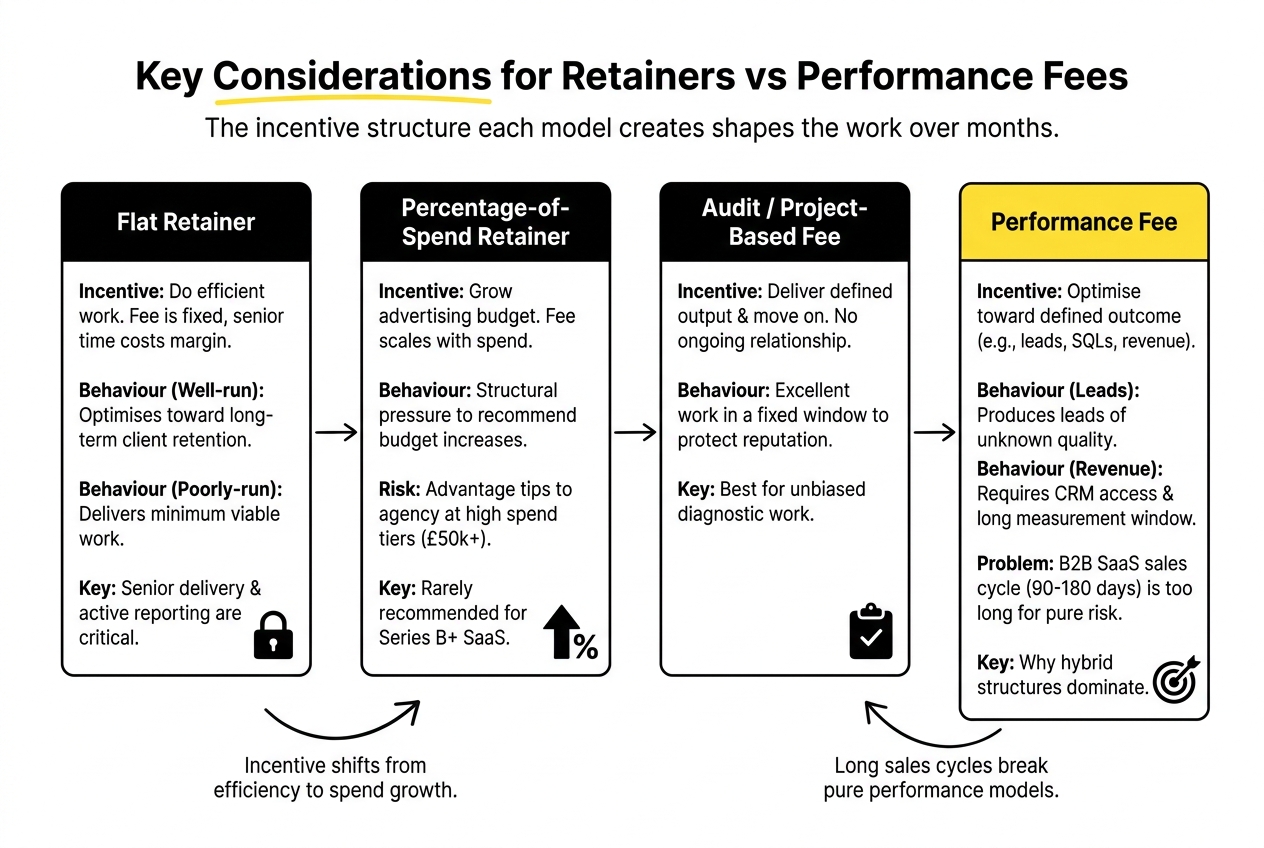
Flat retainer creates an incentive for the agency to do efficient work. The fee is fixed, so the marginal hour of senior time costs the agency margin. Well-run agencies on flat retainers optimise toward outcomes that retain the client across multiple renewal cycles, because revenue is locked in and the cost of replacing a client is high. The risk is that a poorly run agency on a flat retainer will deliver minimum viable work, knowing the fee comes in regardless. This is why senior delivery and active reporting matter more on flat retainer engagements than on any other model.
Percentage-of-spend retainer creates an incentive for the agency to grow your advertising budget. The fee scales with spend, so the agency earns more when you spend more. This is not inherently bad, the incentive aligns with growth, but it creates a structural pressure to recommend budget increases even when the data does not support them. At higher spend tiers (£50,000+ monthly), the structural advantage tips heavily toward the agency, since the management workload does not scale linearly with budget. We rarely recommend pure percentage-of-spend models for Series B+ SaaS accounts.
Audit / project-based fee creates an incentive for the agency to deliver a defined output and move on. There is no ongoing relationship to protect, no renewal to think about. This sounds negative but it is actually clean. The agency has every reason to do excellent work in a fixed window because the value of the audit is in the recommendations themselves, and a weak audit damages the agency’s reputation and pipeline. Audits are the best mechanism for unbiased diagnostic work, particularly when the alternative is asking the incumbent agency to audit their own performance.
Performance fee creates an incentive for the agency to optimise toward the defined outcome, whatever it is. This is where the structure matters enormously. A performance fee tied to “leads” will produce leads of unknown quality, often at the expense of pipeline. A performance fee tied to cost per SQL will produce SQLs. A performance fee tied to closed-won revenue will produce closed-won revenue, but only if the agency has CRM access, attribution clarity, and a long enough measurement window to actually influence the outcome. The structural problem with performance fees in B2B SaaS is that the cycle from click to closed-won is often 90-180 days, which is longer than the agency can afford to bear the risk on. This is why hybrid structures dominate.
When each model fits
There is no universally correct pricing model. The right choice depends on the stage of your engagement, the maturity of your measurement infrastructure, and what you are trying to achieve.
When to choose a retainer
A retainer is the right model for ongoing campaign management at Series B+ scale, when the marketing team needs a consistent operating partner integrated into the wider revenue function. Specifically, retainers fit when:
- The account requires continuous optimisation across multiple campaigns, audiences, and platforms.
- The agency needs to participate in regular planning conversations with marketing, sales, and product.
- Strategic ownership is part of the value, not just execution.
- The marketing team wants predictable monthly cost for budgeting and forecasting.
Within the retainer category, flat retainers are usually preferable to percentage-of-spend for Series B+ SaaS, because they remove the structural incentive to grow the ad budget regardless of return.
When to choose an audit
An audit is the right model when the engagement is diagnostic, not operational. Specifically, audits fit when:
- You suspect an incumbent agency is underperforming and need an unbiased view before deciding whether to switch.
- You have inherited an account and need a structured assessment before building a strategy.
- You are evaluating whether to bring PPC in-house and need an honest read on what good looks like.
- You have a defined strategic question (account restructure, measurement rebuild, new channel evaluation) that does not require an ongoing relationship to answer.
Audits are also useful as a low-risk first engagement with a new agency. A £5,000 audit with a clear scope tells you more about an agency’s quality of thinking than a £50,000 annual retainer ever will, and gives both parties a clean way to assess fit before a longer commitment.
When to choose a performance fee
A performance fee is the right model when the metric is unambiguous, the attribution is clean, and both parties have aligned on what success looks like. In B2B SaaS, this is rarely the case for closed-won revenue, but it can work for intermediate metrics. Specifically, performance fees fit when:
- The conversion event is well-defined and trackable end-to-end (typically SQL or qualified opportunity, not closed-won).
- Offline conversion infrastructure is already in place and accurate.
- Both parties have agreed on the attribution methodology in writing.
- The base retainer is enough to cover the agency’s cost of delivery, with the performance element as upside, not as the whole compensation.
Pure performance arrangements (no base retainer) almost always collapse within six months at B2B SaaS scale, because the cycle is too long and the data is too messy to support the agency taking that level of risk.
KPIs for evaluating pricing model effectiveness
The metrics that hold up in a board review are the same metrics that should be used to evaluate whether your pricing model is working. The most useful are:
MetricWhat it tells youCost per SQLWhether the spend is producing qualified pipeline, not just leadsCost per qualified opportunityThe cost of getting into a real sales conversation, by campaignPipeline contribution by campaignWhich campaigns generate revenue, which generate noiseCAC payback periodThe metric your CFO uses to evaluate growth spendManagement fee as % of pipelineThe fee in context of what it producedManagement fee as % of ad spendUseful for benchmarking against industry norms
The last two are the cleanest tests of whether the pricing model is working in your favour. A £3,500 monthly retainer that produces £40,000 in monthly pipeline contribution is 8.75% of pipeline, which is a structurally efficient ratio. The same retainer producing £8,000 in monthly pipeline contribution is 44% of pipeline, which signals the engagement is not commercially viable regardless of how the work looks. The pricing model question becomes secondary to whether the engagement should continue at all.
Common mistakes when selecting a pricing model
The patterns below show up regularly in agency selection conversations and tend to cost more than the fee difference they were intended to save:
- Optimising for the lowest management fee. The fee is rarely the largest cost in a paid programme. A 5% management fee saving on a £200,000 annual budget is £10,000. A 20% pipeline quality difference between two agencies on that budget could be worth £100,000 or more in influenced revenue. The pipeline quality difference usually comes from the underlying delivery model, whether the agency operates with senior, proactive operators in low-delegation mode or in a junior-execution-under-oversight structure matters more than any fee saving you might negotiate.
- Defaulting to percentage-of-spend at high ad budgets. At spend levels above £30,000-£50,000 per month, percentage-of-spend models structurally over-pay the agency. The management work does not scale linearly with budget, so the agency’s effective hourly rate climbs as your budget grows.
- Signing performance-fee arrangements without aligning the methodology. If the agency and the marketing team disagree on attribution by month three, the performance fee becomes a source of conflict rather than alignment. Agree the methodology in writing before contracting.
- Treating audits as expensive when they are diagnostic. A £6,000 audit that identifies £80,000 of annual wasted spend has paid for itself within a quarter. Most VPs of Marketing under-use audits because they look expensive on a per-hour basis and over-use retainers because they look predictable.
- Letting procurement run the comparison on price alone. Procurement is well placed to compare like-for-like fees. They are not well placed to evaluate which pricing model creates the right incentive structure for a Series B+ SaaS account. The model decision should sit with marketing.
Practical guidance: how to structure the engagement
For Series B+ B2B SaaS accounts in 2026, the engagement structure that produces the most consistent outcomes is a flat retainer with a defined scope, supplemented by audits for diagnostic work at six- or twelve-month intervals. Performance bonuses can be added as upside on the retainer, but only when the measurement infrastructure is mature enough to support them without creating ambiguity.
A practical framework for structuring the engagement:
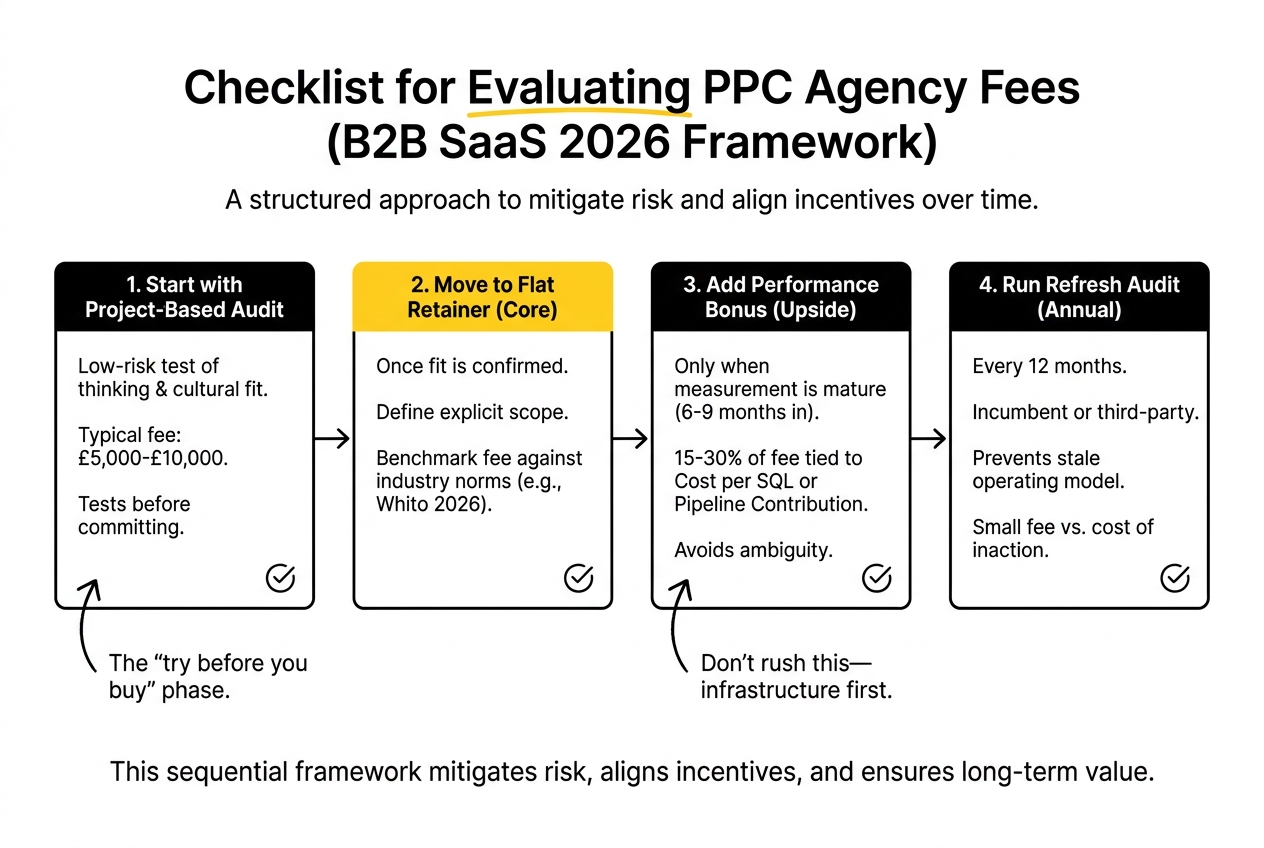
- Start with a project-based audit (£5,000-£10,000) before committing to a retainer with a new agency. This tests the quality of thinking and the cultural fit in a low-risk window.
- Move to a flat retainer once the audit confirms fit, with the scope defined explicitly and the management fee benchmarked against industry norms (the WordStream 2025 UK PPC benchmark report or the Whito 2026 retainer data are both useful reference points).
- Add a performance bonus structure (15-30% of fee tied to cost per SQL or pipeline contribution) once the measurement is mature, typically six to nine months in.
- Run a refresh audit every twelve months, either by the incumbent agency or by an independent third party. The audit fee is small compared to the cost of a stale operating model.
The Upraw view
Pricing model is more consequential than fee. The fee buys time. The model buys incentive. For Series B+ SaaS VPs of Marketing under pressure from the board to demonstrate ROI, the most valuable structural decision is not which agency to hire but which pricing model to operate them under, because that decision determines whether the agency is structurally aligned with revenue outcomes or with billable hours.
The agencies that produce the most reliable outcomes for SaaS clients tend to operate from flat-fee retainers with optional performance upside, supplemented by occasional audit engagements for diagnostic work. The agencies that struggle to demonstrate ROI tend to be on percentage-of-spend models at spend levels where the structural advantage has tipped heavily in their favour. Neither pattern is universal, but both are common enough to test for in evaluation.
If you are renewing an agency engagement and wondering whether the pricing model is still working in your favour, or if you are evaluating new agencies and want a second view on which structure fits your stage, we are happy to take a look.
Frequently Asked Questions
What are the key differences between retainers, audits, and performance fees in SaaS PPC agencies?
Retainers are recurring monthly fees for ongoing work, either flat or as a percentage of ad spend (typically 10-20%). Audits are one-off project fees for defined diagnostic or strategic work, typically £3,000-£10,000 in the UK SaaS market. Performance fees tie part or all of the agency’s compensation to defined outcomes, almost always paired with a base retainer in B2B SaaS because pure performance arrangements are too risky on long sales cycles. The structural difference is whether the agency is paid for time, output, or outcome.
How do retainers incentivize SaaS PPC agencies compared to performance fees?
Flat retainers incentivise efficient delivery and long-term retention, because the fee is fixed and the marginal hour costs the agency margin. Percentage-of-spend retainers incentivise budget growth, because the fee scales with ad spend. Performance fees incentivise the specific outcome they are tied to: leads, SQLs, opportunities, or revenue, depending on the structure. The incentive matches the metric, so the metric choice is the most consequential design decision in any performance arrangement.
What factors should VPs of Marketing consider when choosing between audits and retainers?
The decision rests on whether the engagement is diagnostic or operational. Audits suit one-off needs: assessing an incumbent agency, evaluating in-house alternatives, restructuring an account, or rebuilding measurement. Retainers suit continuous campaign management at scale, where ongoing optimisation and strategic input are needed. A useful pattern is to start with an audit before committing to a retainer with a new agency, since the audit tests quality of thinking in a low-risk window.
How can performance fees align the goals of SaaS PPC agencies with those of their clients?
By tying the agency’s compensation to outcomes the client cares about, specifically cost per SQL, cost per qualified opportunity, or pipeline contribution. The alignment depends entirely on choosing a metric that genuinely reflects revenue impact, not a proxy that is easier to manipulate. Performance fees tied to lead volume create misalignment because lead quality is the actual constraint. Performance fees tied to SQL or qualified opportunity create alignment because they require the agency to optimise toward what the sales team will actually engage with.
What are the advantages and disadvantages of each pricing model for SaaS companies?
Retainers offer predictability and ongoing strategic input but require active oversight to ensure the fixed fee is producing proportional value. Percentage-of-spend retainers offer scaling that matches budget growth but create a structural incentive to recommend higher spend. Audits offer unbiased diagnostic work at low risk but do not provide ongoing capability. Performance fees offer outcome alignment but require mature measurement and clear methodology to avoid conflict. The right choice depends on whether you need execution, insight, or accountability.
How do different pricing models impact the overall ROI of PPC campaigns?
The pricing model affects what the agency optimises for, which in turn affects ROI. Flat retainers tend to produce stable ROI when the agency is well-run and senior-led. Percentage-of-spend models tend to produce ROI compression at higher spend levels, because the management fee grows faster than the marginal return. Performance fees produce strong ROI on the metric they target, but can compress ROI on metrics outside the bonus structure. Audits produce the highest short-term ROI because they identify wasted spend and infrastructure gaps that compound.
What key performance indicators should be assessed when evaluating the effectiveness of each pricing model?
The KPIs that matter are cost per SQL, cost per qualified opportunity, pipeline contribution by campaign, CAC payback period, management fee as a percentage of pipeline contribution, and management fee as a percentage of ad spend. The last two are the cleanest tests of pricing model effectiveness. A retainer producing pipeline at less than 15% of fee value is efficient. A retainer producing pipeline at over 50% of fee value signals the engagement, or the pricing model, is not commercially viable.
In what scenarios would a SaaS company benefit more from an audit rather than a retainer?
When the engagement is diagnostic, not operational. Common scenarios include evaluating an incumbent agency before renewal, inheriting an account from a previous marketer or agency, considering an in-house build, rebuilding measurement infrastructure, or running an independent check on a high-confidence retainer that has not delivered in a quarter. Audits also suit one-off strategic questions: account restructure, new channel evaluation, or a competitive intelligence project. The pattern is fixed scope, clean ending, and unbiased output.
How can revenue-accountable marketing leaders use pricing models to justify PPC budgets to stakeholders?
By presenting the pricing model as part of the budget conversation, not separate from it. A flat retainer of £4,000 monthly producing £50,000 in monthly pipeline contribution is a structurally defensible 8% of pipeline. The same fee producing £10,000 in monthly pipeline contribution is 40% of pipeline and indefensible. Framing budget conversations around fee-as-percentage-of-pipeline rather than fee-in-isolation gives the CFO a clear lens for evaluating whether the engagement is working, regardless of the model.
What common challenges do marketing leaders face when selecting a pricing model for PPC services?
The most common challenges are optimising for the lowest fee rather than the right incentive structure, defaulting to percentage-of-spend at scales where it structurally over-pays the agency, signing performance arrangements without agreeing the attribution methodology in writing, treating audits as expensive when they are diagnostic, and letting procurement run the comparison on price alone. Each of these mistakes is structural, predictable, and avoidable with the framework above.