Evaluating the Best SaaS Advertising Agencies for Series A+ Teams
A six-criterion evaluation framework for Series A+ B2B SaaS CMOs shortlisting UK advertising agencies on category experience, paid search, paid social, attribution, onboarding and board-level communication.

By the time a SaaS CMO is evaluating agencies, the situation has usually narrowed. The board has set the next pipeline target. The previous agency cycle delivered activity rather than accountability. There is no appetite for another twelve months of polished reporting that never quite explains where the qualified pipeline came from.
This is the position most Series A+ B2B SaaS CMOs are in when shortlisting agencies in 2026. The market has moved. Generic digital agencies with a SaaS slide deck are no longer a viable shortlist entry. What is needed is a structured evaluation framework that filters for the specific capabilities that scale: real SaaS category experience, depth across paid search and paid social, a mature attribution practice, fast onboarding, and the ability to communicate with a board that has heard every paid media promise before.
This article is that framework. It is built for data-driven CMOs running mid-market or enterprise B2B SaaS, where the agency decision sits inside a wider growth narrative the CFO and CEO will see in the next quarterly review. If you are looking for a deeper dive on the Google Ads side specifically, our companion piece on choosing a UK SaaS Google Ads agency covers the pipeline-vs-clicks question in detail. For the parent view across the wider category, the top SaaS advertising agencies in the UK hub page sets the context.
What “evaluation” means at Series A+
Evaluation at this stage is not vendor shopping. A pre-seed founder picking their first agency is testing whether paid acquisition can work at all. A Series A+ CMO is solving a different problem: how to install a customer acquisition engine that will hold up over four to six quarters, survive a CFO review, and integrate cleanly with an existing martech stack and revenue operations function.
The implications change the shortlist criteria. You are no longer assessing whether an agency can run campaigns. You are assessing whether their operating model fits a company that already has internal marketers, defined ICPs, complex attribution, and a board that expects a clear connection between spend and ARR. Most agencies cannot pass that test even when they say they can.
The six-criterion framework below is what we use to filter agencies in conversation with mid-market and enterprise CMOs. Run any agency on your shortlist against all six.
The six-criterion evaluation framework
1. SaaS category experience
SaaS category experience is the easiest claim to make and the easiest one to over-rate. Every agency website has a SaaS section. The signal that matters is structural, not testimonial.
Genuine SaaS category experience shows up in three places: how the agency talks about unit economics in the pitch (CAC payback, MQL-to-SQL conversion, NRR contribution), the named SaaS clients still on the books rather than logos from three years ago, and whether the team understands product-led growth versus sales-led versus hybrid GTM motions without being prompted. Per ASP Marketing’s 2026 analysis, the agencies worth hiring “know your unit economics better than you do by month two.” That is the standard.
Ask for two or three current SaaS clients at your stage. Then ask to speak to one of them without it being a curated reference call. The agencies that can produce that within a week are operating in your space at scale. The ones that cannot are still building the practice on your account.
2. Paid search depth
Paid search depth is where most agency shortlists separate quickly. For B2B SaaS in 2026, depth means three things specifically: campaign structure that segments by buyer intent tier rather than by keyword theme, offline conversion imports from the CRM with tiered values for MQL, SQL, opportunity, and closed-won, and a clear answer on how the team handles the 90-day GCLID expiry that breaks attribution on longer enterprise cycles.
A test that surfaces this fast: ask the agency to walk through how they would restructure your existing Google Ads account from scratch in their first 30 days. If the answer is generic (“we’d audit it, then rebuild around best practice”), depth is shallow. If the answer references specific intent-tier segmentation, named bidding progression, and the offline conversion event plan, you are looking at a team that has done this work before at scale.
Paid search depth is not the same as Google Ads certification. Most agencies are certified. Few have built and managed multiple eight-figure SaaS accounts to revenue accountability.
3. Paid social capability
For B2B SaaS, paid social capability means LinkedIn first, then Meta, then YouTube and Reddit depending on the ICP. Each platform has structurally different requirements, and an agency that runs LinkedIn the way they run Meta is not going to deliver pipeline.
LinkedIn capability specifically requires the team to handle company-level frequency capping, super-title and seniority targeting that filters out junk roles, matched audience uploads from the CRM, and a clear position on how they sequence ABM-style campaigns with broader demand creation. Meta capability requires the team to handle B2B audience exclusions properly (job seekers, students, employees at non-ICP companies), creative production cadence on a platform that punishes low refresh rates, and conversion API integration to bypass the iOS measurement gap that still affects accounts in 2026.
Most agencies are stronger on one of these than the other. That is fine if it matches your channel mix. It is not fine if the team’s answer to “how do you run LinkedIn” is the same as their answer to “how do you run Meta.”
4. Attribution maturity
Attribution maturity is the single hardest criterion to assess from the outside, and the one most likely to predict performance over the long arc of the engagement. The default agency setup of last-click in Google Ads, plus a HubSpot dashboard, plus monthly reports that do not reconcile against each other is no longer acceptable at Series A+.
Mature attribution practice covers three areas. Multi-touch attribution across the full sales cycle, with explicit recognition that the average enterprise SaaS deal touches eight to twelve marketing surfaces before closing. CRM-linked revenue attribution that connects campaign spend to closed-won outcomes via a documented data flow. And honest treatment of dark social and self-reported attribution as supplementary signals rather than the primary measurement system.
Enterprise attribution challenges are real. GCLIDs expire after 90 days. Cross-device behaviour fragments without enhanced conversions. Dark social and zero-click research distort first-touch reporting. According to Fishkin’s SparkToro study with Datos, only 360 out of 1,000 US Google searches result in a click to the open web. The agency that pretends attribution is solved is either inexperienced or lying. The one that explains its limits, names the workarounds, and reports directionally with consistent methodology is doing the work properly.

5. Onboarding speed
Onboarding speed is the criterion most often ignored in shortlist conversations and the one that defines the first six months of the engagement. A Series A+ CMO does not have a quarter to lose to “discovery and audit.” If the first measurable pipeline impact lands in month four, the budget cycle has already moved on.
A capable agency commits to specific onboarding milestones in week one of the engagement: account access and audit complete by end of week two, campaign restructure plan signed off by end of week four, first new campaigns live by end of week six, offline conversion infrastructure built by end of week eight. The slower agencies treat onboarding as a buffer period. The faster ones treat it as the first sprint.
Onboarding speed is also a proxy for senior delivery. Agencies that move quickly tend to be the ones where the person who built the audit is also the one running the account. Agencies that need three months of “ramp” are usually the ones handing the account to a junior who is meeting your business for the first time. For Series A+ CMOs, the cost of slow onboarding is not delay, it is opportunity loss against the quarterly plan. What hands-on, low-delegation delivery actually looks like in practice, in operational signals observable by week four, is covered in choosing the right PPC agency for your SaaS business.
6. Board-level communication
Board-level communication is the final criterion and the one that separates an agency that runs campaigns from a partner that contributes to the wider growth narrative. A CMO at Series A+ is not just buying execution. They are buying the ability to present a coherent paid media story to a board that wants to see the connection between spend, pipeline, and ARR.
The signal to look for in evaluation is whether the agency can produce, on request, a sample monthly report with the client name redacted. A board-ready report leads with pipeline contribution by campaign, cost per qualified opportunity, CAC payback trajectory, and a short narrative on what changed and why. It uses platform metrics (impressions, CTR, CPC) as diagnostics in an appendix, not as the headline.
Agencies that cannot produce this in evaluation will not produce it in delivery. Agencies that share the report format proactively are signalling that they have done this work for CMOs at your stage before. That is what you are buying.

How to weight the six criteria
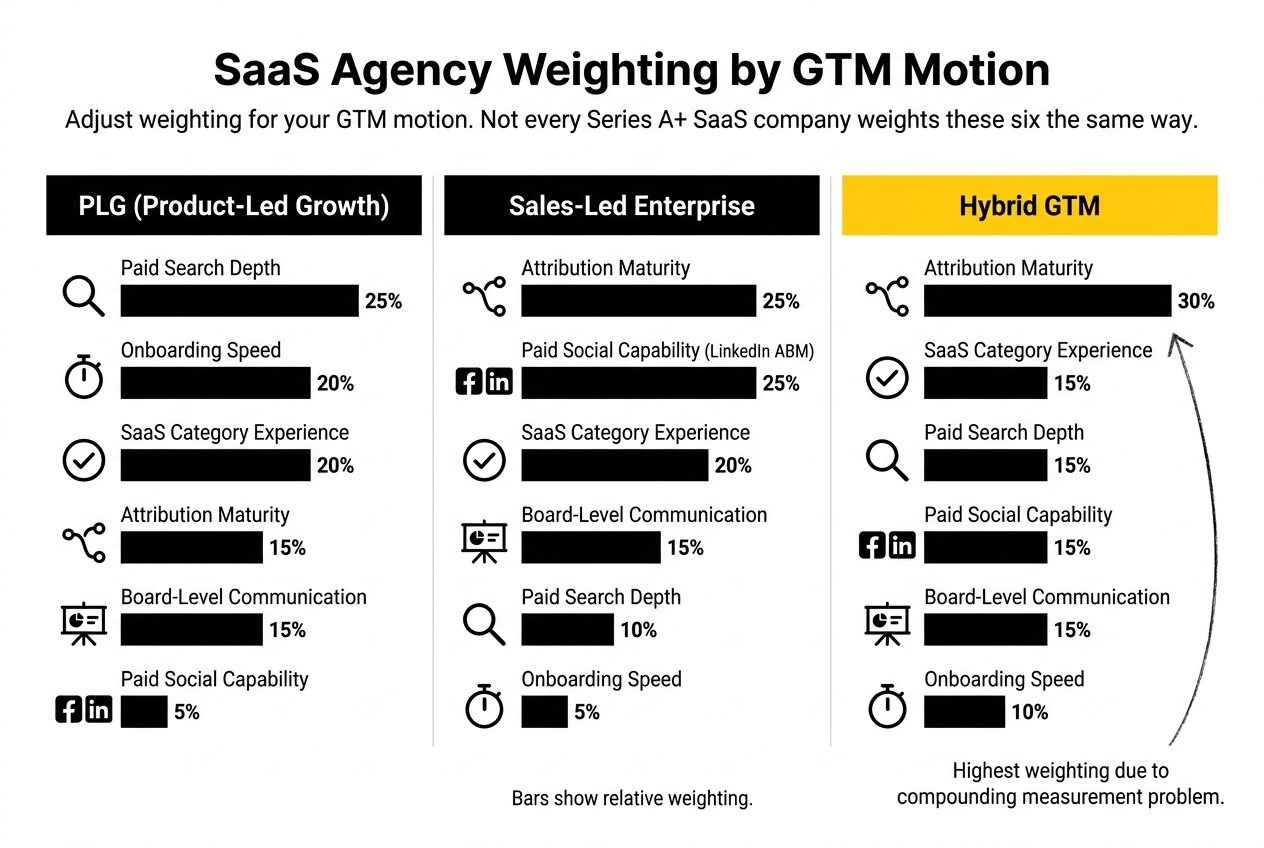
Not every Series A+ SaaS company weights these six the same way. A PLG-led platform with a self-serve motion will weight paid search depth and onboarding speed higher than a sales-led enterprise platform, which will weight paid social capability (specifically LinkedIn ABM) and attribution maturity higher.
A simple weighting that holds up across most Series A+ SaaS contexts:
CriterionDefault weightingSaaS category experience20%Paid search depth20%Paid social capability15%Attribution maturity20%Onboarding speed10%Board-level communication15%
Adjust the weighting for your GTM motion. PLG companies typically increase paid search and decrease paid social. Sales-led enterprise companies typically increase paid social and attribution maturity. Hybrid GTM companies need balance across all six and should weight attribution maturity highest because the measurement problem compounds with two motions running in parallel.
Common mistakes in the evaluation process
The patterns that lead to a bad agency selection are predictable. They cluster around four mistakes:
- Optimising the shortlist on testimonials rather than current client outcomes. A glowing testimonial from a client who left two years ago is a marketing asset, not evidence. Ask for current, named results from accounts still on the books.
- Letting procurement run the final decision. The lowest retainer is not the lowest cost. An agency that bills less but delivers less senior attention will cost the business more in lost quarters than the retainer difference saves. The wider question of which SaaS PPC agency pricing model creates the right incentive structure sits at the same level of importance as the retainer number itself.
- Skipping the senior delivery question. The pitch team is rarely the delivery team. If the agency cannot, or will not, name the person running the account from week one, the model is structurally junior-led even if the pitch is senior-led.
- Underestimating onboarding speed. A 90-day onboarding plan looks reasonable in the SOW. In a 12-month budget cycle, it is a quarter of the engagement spent on ramp. Evaluate onboarding speed as a primary criterion, not a footnote.
The Upraw view
For Series A+ SaaS CMOs, the agency selection is not really about agencies. It is about installing an operating model that will scale with the business through the next two or three quarters of board pressure. The six criteria above are not abstract. They are the specific operating capabilities that determine whether the engagement contributes to the growth narrative or sits as a line item the CFO questions every quarter.
The agencies that win Series A+ accounts and keep them tend to share three structural features: SaaS exclusivity, senior delivery without rotation, and an attribution practice mature enough to survive a board review. These features are what separates a scalable partner from a vendor in practice, observable in operating behaviour rather than in the pitch. Most agencies have one of the three. A few have two. The shortlist worth running through final-round conversations is the one where every entry has all three.
This is the work we do with SaaS CMOs every quarter. If you are running an agency evaluation now and want a second view on the shortlist, we are happy to take a look.
Frequently Asked Questions
What criteria should B2B SaaS CMOs consider when selecting an advertising agency?
The six criteria that matter at Series A+ are SaaS category experience, paid search depth, paid social capability, attribution maturity, onboarding speed, and board-level communication. Each is structurally distinct. An agency strong on three of the six is a poor fit at this stage, because the gaps compound across a 12-month engagement. Use the criteria as a shortlist filter before any retainer conversation.
How does SaaS category experience impact agency selection for CMOs?
It determines whether the agency understands the unit economics of your business before they touch a campaign. Genuine SaaS category experience shows up in how the team talks about CAC payback, MQL-to-SQL conversion, and NRR contribution in the pitch, and in the named current clients still on the books. Agencies without this experience apply ecommerce or generalist playbooks that misfire on long sales cycles and multi-stakeholder buying.
What role does paid search depth play in evaluating SaaS advertising agencies?
Paid search depth is where most agency shortlists separate quickly. Depth means buyer-intent campaign segmentation, offline conversion imports from the CRM with tiered values, and clear handling of GCLID expiry on longer cycles. Test for it by asking the agency to walk through how they would restructure your existing Google Ads account from scratch in 30 days. Specific answers indicate depth. Generic answers do not.
Why is paid social capability important for B2B SaaS advertising?
Because LinkedIn is the highest-leverage ABM and demand creation channel for most B2B SaaS, and Meta covers retargeting and lower-funnel volume that complements paid search. An agency that runs both platforms the same way is not going to deliver pipeline on either. Capability looks like platform-specific operating standards: company-level frequency capping on LinkedIn, B2B audience exclusions and conversion API on Meta, and a creative production cadence that fits each platform’s refresh requirements.
How can attribution maturity influence the effectiveness of an advertising agency?
Attribution maturity determines whether the agency can prove its work or just describe it. Mature practice covers multi-touch attribution across the full sales cycle, CRM-linked revenue attribution, and honest treatment of dark social and zero-click search as supplementary signals. Enterprise attribution challenges are real and should be acknowledged. An agency that pretends attribution is solved is signalling inexperience.
What factors contribute to onboarding speed when working with SaaS advertising agencies?
Specific named milestones in the first eight weeks: account access and audit by end of week two, campaign restructure plan signed off by end of week four, first new campaigns live by end of week six, offline conversion infrastructure built by end of week eight. Onboarding speed is also a proxy for senior delivery. Agencies that move quickly tend to have the pitch lead running the account. Agencies that need three months of ramp typically hand to a junior.
How should CMOs assess board-level communication capabilities of advertising agencies?
Ask for a sample monthly report with the client name redacted before contracting. A board-ready report leads with pipeline contribution by campaign, cost per qualified opportunity, and CAC payback trajectory. Platform metrics sit in an appendix as diagnostics, not as the headline. If the agency cannot produce this in evaluation, they will not produce it in delivery. If they produce it proactively, they have done this work for CMOs at your stage before.
What are the key performance metrics that CMOs should look for in advertising agencies?
The metrics that hold up in a board review are cost per SQL, cost per opportunity, pipeline contribution by campaign, CAC payback period, MQL-to-SQL conversion rate, and cohort ROAS at 90 and 180 days. Cost per lead and click-through rate are useful as diagnostics but should never be the primary measure of agency performance at Series A+. The reporting cadence matters as much as the metric selection.
How can advertising agencies help SaaS companies achieve predictable growth?
By installing an operating model that connects spend to pipeline reliably across multiple quarters, rather than running campaigns to monthly performance reviews. Predictable growth at Series A+ requires the agency to own attribution maturity, run a consistent measurement methodology even when the inputs are imperfect, and report monthly with the same metrics framework the board uses. Strategic guidance for SaaS at this stage is operational discipline, not big-bang strategy decks.
What challenges do CMOs face in enterprise attribution and how can agencies address them?
The core enterprise attribution challenges are GCLID expiry on cycles longer than 90 days, cross-device fragmentation, dark social and zero-click research that distort first-touch reporting, and inconsistent methodology across platforms. Agencies address them by implementing enhanced conversions for cross-device matching, treating self-reported attribution as a supplementary signal, and committing to a single measurement methodology applied consistently across the reporting period. Honest acknowledgment of the limits is part of the answer.