Choosing the Right PPC Agency for Your SaaS Business: Key Qualities to Consider
The five operational signals of senior, hands-on PPC delivery for B2B SaaS, observable by week four. Written for VPs of Marketing at Series B+ companies evaluating whether their PPC agency is genuinely running the account or just coordinating it.

Every agency website now claims senior, proactive operators. The phrase has joined “pipeline-focused” and “results-driven” in the standard B2B SaaS agency vocabulary. It means something, in principle. In practice, you discover whether it is true by watching how the engagement runs in week four, not by reading the pitch deck.
This is the gap most VPs of Marketing at Series B+ SaaS companies are working to close in 2026. The shortlist has narrowed. The pitches have all sounded similar. What remains is to identify the agency whose senior, proactive operator claim survives contact with the work, and whose hands-on delivery model actually reduces operational burden on the marketing team rather than adding to it.
This article is the framework for assessing that. It is operational, not strategic. We have covered the strategic side of agency selection elsewhere: how to choose a UK Google Ads agency for your SaaS business handles the pipeline-vs-clicks framing, evaluating the best SaaS advertising agencies for Series A+ teams covers the broader six-criterion framework, and what separates a scalable B2B SaaS paid media partner from a vendor addresses the partnership structure. The piece below assumes you have done that work and now need to evaluate what senior, hands-on PPC delivery actually looks like in practice, on a Tuesday afternoon in week three. For the parent landscape view, the top SaaS PPC agencies with senior, proactive hub page sets the wider context.
What “low-delegation delivery” actually means
Low-delegation delivery is the term we use for an engagement model where the senior practitioner who pitched the work is the one running the account. Not coordinating it. Running it. Building the campaigns, writing the ad copy, configuring the bidding, pulling the search query reports, sitting on the weekly call, responding to Slack messages.
In a high-delegation model, the senior is a coordinator. They attend the monthly review, get briefed by the junior account manager beforehand, present the slide deck, and disappear until the next monthly review. The work is done by a junior, sometimes a contractor, sometimes an offshore team. The senior’s role is essentially client relationship management.
The difference is structural and visible from week four onwards. In a low-delegation engagement, when you Slack a question on Tuesday afternoon, the person who replies is the same person who pitched. They reply with context, not with “let me check with the team.” When something needs to change, it changes that day. When a campaign needs rebuilding, the senior rebuilds it themselves.
This matters for SaaS specifically because the operational decisions in a paid programme require commercial judgement that a junior does not have. Whether to pause a campaign that is generating leads but no SQLs, whether to push budget into a new ICP segment, whether to accept the CFO’s CAC payback target as realistic for the channel mix, these are not technical decisions. They are operator decisions. A junior account manager juggling twelve accounts has neither the time nor the experience to make them well.
The five operational signals of senior, hands-on PPC delivery
The five signals below are how you assess whether an agency is operating in low-delegation mode in practice, not in claim. They are observable, mostly by week four, and they tend to correlate. An agency strong on one is usually strong on all five. An agency weak on one is usually weak on all five.
1. Strategic challenge in the first 30 days
A senior operator pushes back on something within the first 30 days of the engagement. Not adversarially. Constructively. The challenge might be on the conversion event definition, the audience targeting assumptions, the landing page conversion path, the bidding strategy choice, or the budget split across channels. The specific item matters less than the act of challenging.
A junior account manager does not challenge. They accept the brief as written, run the work, and report against the metrics that were defined at the start. This is because junior account managers are paid to deliver what was asked for, not to question whether what was asked for is the right thing.
The test for strategic challenge is to deliberately include something questionable in the onboarding brief, a target CPL that is implausibly low, an audience that is too narrow, a conversion event that is too top of funnel. A senior operator will flag it within the first two weeks. A junior will run with it for three months until the data forces the conversation.
2. Test quality over test quantity
The quality of an agency’s testing programme is a direct read on the seniority of the operator. Junior teams run a lot of tests. Senior operators run fewer tests, but the ones they run are designed to produce decisive answers, are properly powered statistically, and are documented before they launch.
The signal to look for in evaluation is whether the agency can describe their testing methodology specifically. Not “we A/B test everything.” That is what every agency says. Specifically: how do you choose what to test, how do you size the test, when do you conclude it, how do you document the result, and how does the conclusion feed into the next test. A senior operator answers all five concretely. A junior either gives a generic answer or defers to the senior on the call.
This matters for B2B SaaS because the testing surface area is wide and the signal density is low. SaaS accounts often have insufficient conversion volume to support the kind of broad A/B testing common in ecommerce. The agency that runs twenty tests a month in a SaaS account is mostly running underpowered tests that conclude nothing. The agency that runs three properly designed tests is actually learning.
3. Response times and unsolicited communication
The most reliable indicator of senior, hands-on engagement is the cadence of unsolicited communication. A senior operator who is running the account sends messages between scheduled reviews. They flag a search term anomaly on Wednesday. They surface a competitor insertion order on Monday. They notice a Quality Score drop on Friday and explain what they are doing about it.
A junior who is coordinating the account does not do this. They communicate on the scheduled cadence, in the agreed format. Between calls, the account runs on autopilot.
Response times are part of the same pattern. When you raise a question, how quickly does the actual operator (not the account manager, not the relationship lead) reply. Hours, in a senior engagement. Days, in a junior one. This is partly bandwidth and partly priority. A senior practitioner running five accounts can respond same-day. A junior running fifteen cannot.
4. Account knowledge that compounds
By month three, you should be able to ask the agency a granular question about your own account (“what’s our top-spending non-converting keyword over the last 30 days?”, “which audience segment in LinkedIn has the highest cost per opportunity?”) and get an answer in the same conversation, not as a follow-up the next day.
This is account knowledge. It is the accumulated context the operator has built up by spending time inside the account, week after week, looking at the data and remembering what they saw. A senior operator running the account has this knowledge. A junior who is coordinating the work and pulling reports from a template does not. They have to look it up.
Account knowledge compounds. The operator who has been in your account for six months knows things about it that no new agency would discover for another six months. This is why senior account leadership without rotation is structurally non-negotiable. Every rotation resets the knowledge clock to zero, and you pay the cost of that reset in the first ninety days of the new account lead’s tenure.
5. Hands-on execution, not just oversight
The cleanest test of low-delegation delivery is whether the senior practitioner is the one actually doing the work. Building the campaigns, writing the responsive search ad headlines, configuring the offline conversion event mappings, structuring the LinkedIn matched audiences.
In an oversight model, the senior reviews the work that was done by someone else. They catch the obvious errors, approve the deck for the monthly review, and ship the work. In a hands-on model, the senior does the work. The difference shows up in the quality of the underlying configuration, which is what determines performance over months.
The reason hands-on execution matters more in SaaS than in other verticals is that the configuration choices are commercially loaded. Whether to use phrase match or broad match on a competitor keyword has revenue implications. Whether to bid on a tCPA of £200 or £350 has revenue implications. These are not technical choices delegated to a junior. They are operator decisions and they need an operator making them.
What you observe by week four
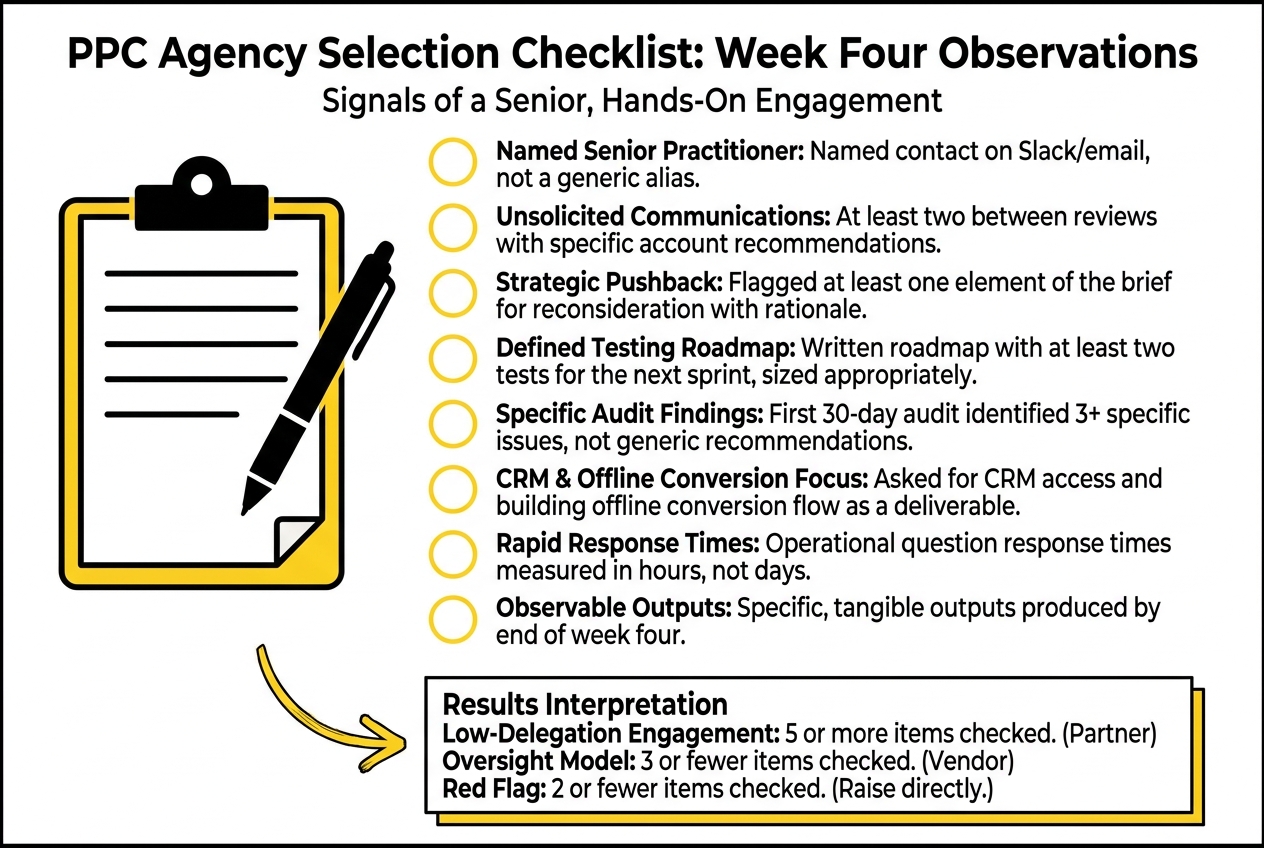
The signals above are abstract until you see them in operation. By the end of week four of a new engagement, a senior, hands-on agency has produced specific, observable outputs. Use this as a checklist when assessing whether your current or prospective agency is operating in low-delegation mode:
- The senior practitioner is the named contact on Slack or email, not a generic account manager alias.
- You have received at least two unsolicited communications between scheduled reviews, both of which contained specific account-level observations and recommendations.
- The agency has flagged at least one element of the original brief that they recommend reconsidering, with rationale.
- A testing roadmap exists in writing, with at least two tests defined for the next sprint, sized appropriately for your conversion volume.
- The first 30-day audit identified at least three specific issues in the existing account configuration, not just generic recommendations.
- The agency has asked for access to your CRM and is building the offline conversion event flow as a defined deliverable, not as a possible future addition.
- Response times to operational questions are measured in hours, not days.
Five or more of these by week four signals a low-delegation engagement. Three or fewer signals an oversight model with junior execution underneath. Two or fewer is a red flag worth raising directly.
Practical questions to ask in evaluation
The questions below surface the senior, proactive operator claim in evaluation. They are designed to be answered concretely. Vague answers indicate the agency is selling a senior model and delivering a coordinated one:
- Who specifically will be in my Google Ads account day-to-day, and how many other accounts are they currently in?
- What does your testing roadmap look like for a typical Series B+ SaaS client in the first 90 days? Can I see a redacted example?
- How do you handle the trade-off between test volume and test quality in SaaS accounts with limited conversion volume?
- When was the last time you challenged a client brief in the first 30 days of an engagement?
- What does your weekly cadence look like outside the scheduled call?
- How do you build account knowledge, and what happens to it if your named operator leaves?
- What is the lowest-tenure operator on any of your active SaaS accounts, and why are they the lead?
- Can I speak to a current client about response times and proactive communication specifically?
The last two are the most diagnostic. Agencies that operate in low-delegation mode answer them directly. Agencies that operate in oversight mode deflect, generalise, or change the subject.
The Upraw view
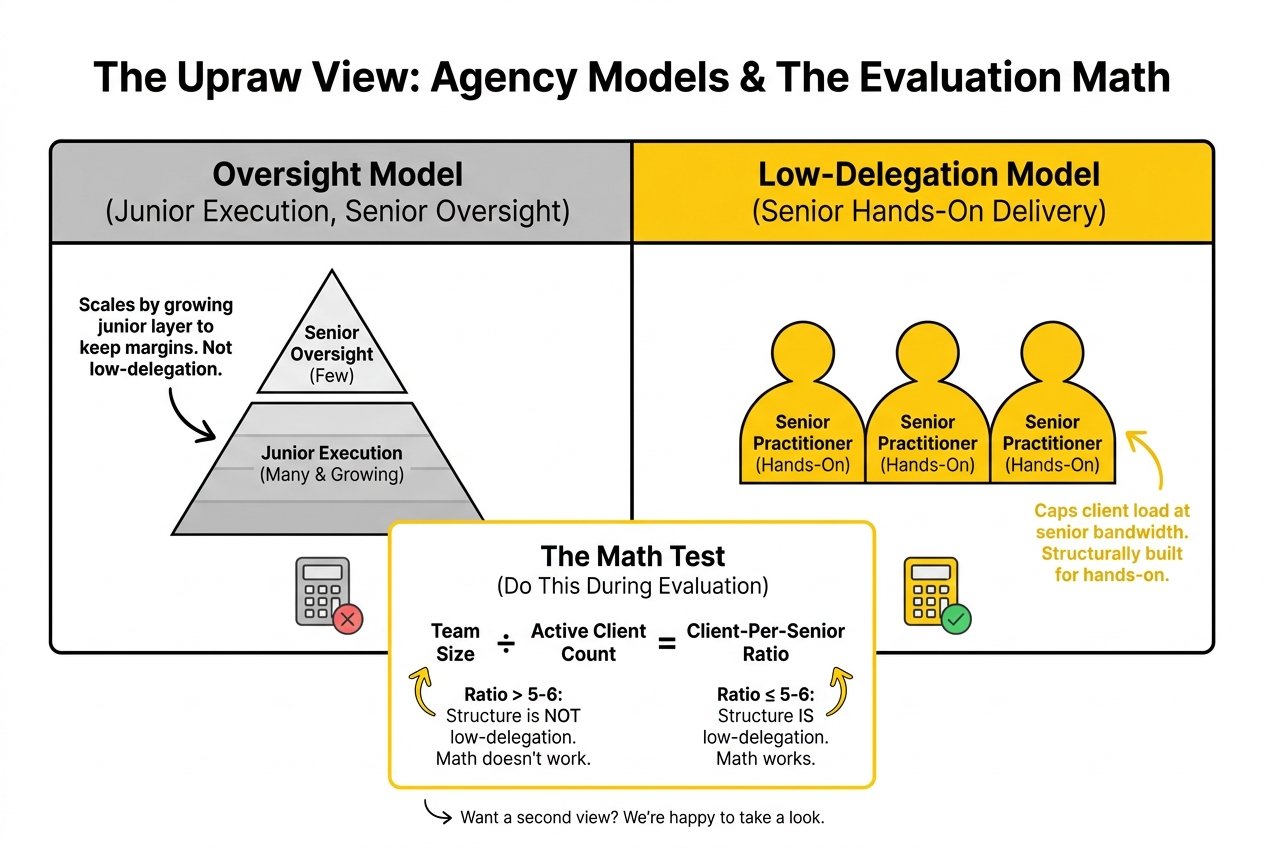
The shift from oversight model to hands-on delivery is not a minor preference, it is a structural decision about how an agency is built. Agencies that scale through junior execution under senior oversight have to keep growing the junior layer to keep margins. Agencies that operate in low-delegation mode cap their client load at the bandwidth of their senior practitioners. This structural reality also shapes how the agencies price their work, the deeper analysis on comparing SaaS PPC agency pricing models explains how each model creates a different incentive on the agency side.
This means the two models are not interchangeable. The agency you are evaluating is structurally one or the other. If they have a hundred clients and twelve people, the senior delivery claim is incompatible with the math. If they have twenty clients and twelve people, the math works.
For Series B+ SaaS VPs of Marketing, the practical implication is to do the math during evaluation. Ask for the team size and the active client count. Divide one by the other. If the resulting client-per-senior ratio is higher than five or six, the senior delivery model is structurally not what you are buying, regardless of what the pitch deck says.
If you are working through this evaluation now and want a second view, or if you are unsure whether your current agency is operating in low-delegation mode, we are happy to take a look.
Frequently Asked Questions
What qualities should you look for in a top PPC agency for SaaS?
The five operational qualities that signal senior, hands-on delivery are strategic challenge in the first 30 days, test quality over test quantity, fast response times with unsolicited communication between reviews, deep account knowledge that compounds over time, and the senior practitioner doing the actual execution rather than overseeing junior work. Agencies strong on all five operate in low-delegation mode. Agencies strong on two or fewer operate in an oversight model, regardless of how the pitch is framed.
How can VPs of Marketing evaluate the effectiveness of a PPC agency?
By month three, against pipeline outcomes rather than platform metrics. Effective PPC agencies report on cost per SQL, cost per qualified opportunity, MQL-to-SQL conversion rate, and pipeline contribution by campaign. Leading indicators in the first 60 days include Quality Score trends, MQL-to-SQL ratio improvement on existing campaigns, and CRM-linked offline conversion infrastructure in place. Effectiveness assessment requires the agency to have configured the measurement properly, which is the first test of seniority.
What are the key indicators of senior, proactive ownership in PPC management?
The clearest indicators are observable in the first four weeks. The named senior practitioner is the day-to-day contact. Unsolicited communications occur between scheduled reviews. The agency has challenged at least one element of the original brief. A testing roadmap exists in writing. The 30-day audit identified specific account-level issues, not generic recommendations. Response times to operational questions are measured in hours, not days. Five of these by week four signals senior, proactive ownership in practice.
How does low-delegation delivery impact PPC campaign success?
Low-delegation delivery means the senior practitioner is doing the actual configuration work, not reviewing work done by a junior. This matters because the configuration decisions in a SaaS PPC account are commercially loaded. Match-type choices, bidding strategy parameters, audience targeting, and conversion event definitions all have direct revenue implications. A senior operator makes these decisions with commercial judgement. A junior makes them with technical competence but limited commercial context. The performance difference compounds across months.
What strategic challenges should a PPC agency address for SaaS companies?
The strategic challenges specific to B2B SaaS PPC are long sales cycles that exceed the 90-day GCLID expiry, multi-stakeholder buying committees that fragment first-touch attribution, conversion volume too low to support the broad testing approach common in ecommerce, and the need to optimise toward pipeline outcomes rather than platform conversions. A capable agency addresses all four in the first 30 days of onboarding. An agency that does not raise them is applying a generic playbook to a specific operational context.
How important is account knowledge in PPC management for SaaS?
Account knowledge is the accumulated context the operator has built up by spending time inside the account week after week. By month three, a senior operator can answer granular questions about your account in real time, without looking them up. This knowledge compounds across the engagement and is the structural reason that senior account leadership without rotation matters. Every operator change resets the knowledge clock to zero, and the cost of that reset is paid in the first 90 days of the new operator’s tenure.
What role does test quality play in PPC campaign performance?
Test quality matters more than test quantity in B2B SaaS accounts because conversion volume is typically too low to support the broad A/B testing approach common in ecommerce. A senior operator runs fewer tests, but the ones they run are designed to produce decisive answers, are properly powered statistically, and are documented before they launch. An agency that claims to run twenty tests a month in a SaaS account is mostly running underpowered tests that conclude nothing. Three properly designed tests beat twenty noise tests every month.
How can PPC agencies support the B2B buying journey for SaaS companies?
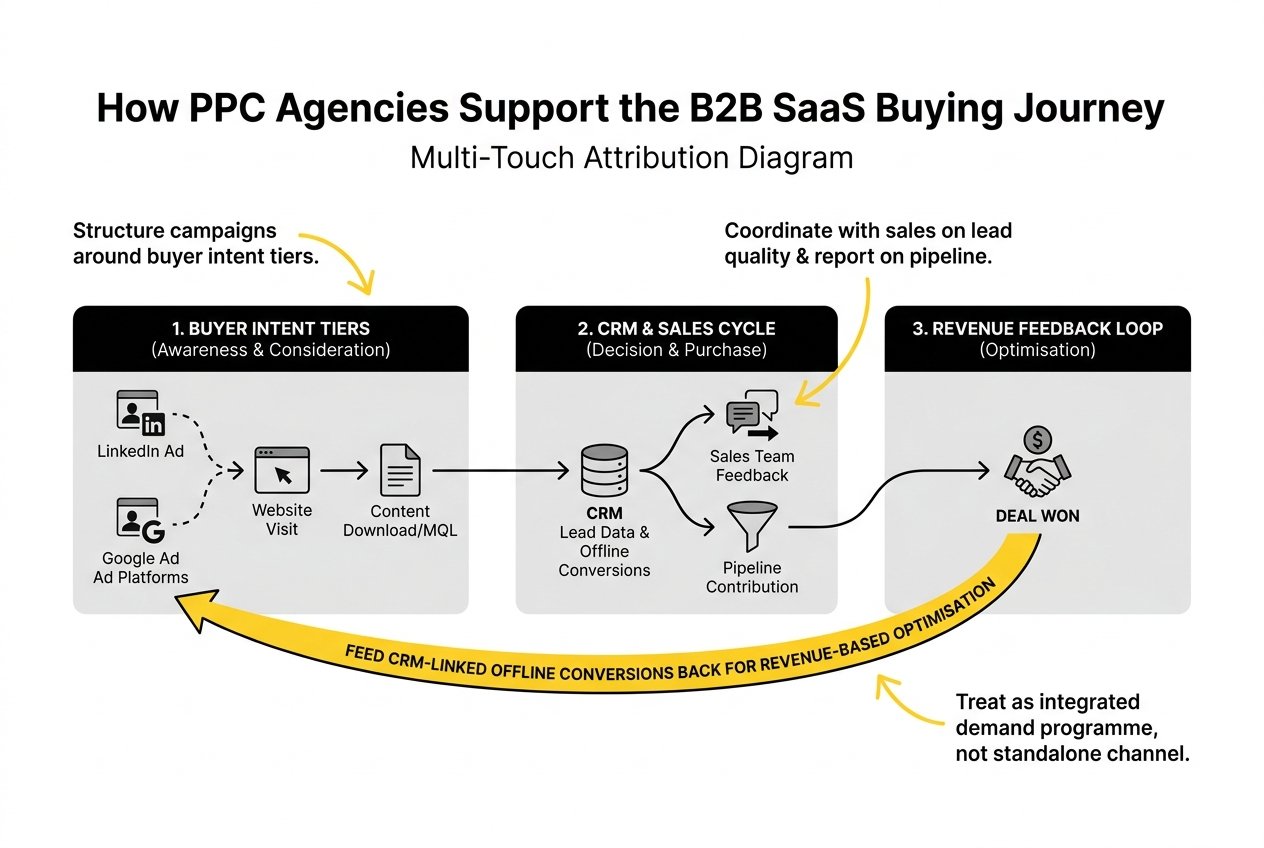
By treating PPC as part of an integrated demand programme rather than a standalone conversion channel. The buying journey for B2B SaaS spans multiple stakeholders, multiple touchpoints, and a sales cycle that frequently exceeds 90 days. PPC agencies support this journey by structuring campaigns around buyer intent tiers, feeding CRM-linked offline conversions back into the platform for revenue-based optimisation, coordinating with sales on lead quality feedback, and reporting on pipeline contribution rather than just platform conversions.
What metrics should SaaS companies track to measure PPC ROI?
The metrics that hold up in a board review are cost per SQL, cost per qualified opportunity, pipeline contribution by campaign, CAC payback period, MQL-to-SQL conversion rate, and cohort ROAS at 90 and 180 days. Cost per lead and click-through rate are useful as diagnostics but should never be the primary measure of PPC performance for a B2B SaaS account. The methodological consistency of the measurement across the engagement matters more than any single month’s result.
How can VPs of Marketing ensure their PPC efforts align with overall marketing strategy?
By integrating the agency into the wider revenue operations function rather than treating PPC as a separate channel. The agency needs CRM access, sales pipeline visibility, a regular forum with the sales team, and an attribution methodology that reconciles against the broader marketing measurement. Budget allocation across channels should be reviewed quarterly against the GTM motion. A senior operator participates in this work. A junior account manager runs PPC in isolation and reports against PPC metrics, which is the structural reason that integrated marketing strategy fails when the agency is operating in oversight mode.