What Separates a Scalable B2B SaaS Paid Media Partner from a Vendor
The six operational traits that separate a scalable B2B SaaS paid media partner from a vendor, written for VPs of Marketing at Series B+ companies evaluating whether their agency relationship will compound or stall.

In month one, agencies look identical. Polished pitch decks, named team members, a thoughtful audit, and a 90-day plan that sounds reasonable. The retainer numbers cluster within ten percent of each other. The references all check out.
The divergence emerges in month nine. By then, one agency is the reason your paid pipeline doubled and your CFO has stopped asking awkward questions in the quarterly review. The other has become a recurring line item your finance team flags every renewal, and the conversations with your marketing team carry an unspoken tension that something is not quite working.
The difference is rarely about competence in the platform. Both agencies probably know how to run Google Ads and LinkedIn. The difference is structural: one is operating as a partner, scaling with the business across quarters. The other is operating as a vendor, executing a fixed scope of work and waiting for the brief.
This article is for revenue-accountable VPs of Marketing at Series B+ B2B SaaS companies who have run an agency cycle before and need to understand the traits that signal a scalable partnership versus a vendor relationship. The two are not the same, and the cost of mistaking one for the other compounds across renewal cycles. If you have not yet shortlisted, the parent guide on best B2B SaaS paid media agency UK covers the broader landscape. For the deeper dive on Google Ads selection specifically, the companion piece on how to choose a UK Google Ads agency for your SaaS business covers the pipeline-vs-clicks question. For the multi-channel CMO-level evaluation framework, evaluating the best SaaS advertising agencies for Series A+ teams covers six structural criteria.
This article picks up where those leave off: once you have selected, what determines whether the engagement scales.
The vendor model and why it caps out
A vendor relationship is defined by its scope. The agency does what is in the SOW. They run the campaigns they were briefed to run, hit the metrics that were defined at the start, and report against the deliverables on the cadence agreed in onboarding. None of this is wrong. It is, in fact, what some clients want.
The problem is that the SaaS growth curve does not stay within a fixed scope. By month six, the product has shipped two new features. The ICP has shifted upmarket. A new competitor has entered the category. Sales has flagged that the mid-market segment is converting faster than enterprise. None of this was in the original SOW.
A vendor responds to these changes by waiting for the marketing team to update the brief. A partner responds by raising the changes proactively, reframing the strategy, and recommending where the budget should move. The difference looks small in month one. By month nine, it is the difference between an agency that compounds value and one that needs constant management to stay relevant.
The scalability question is whether the engagement can absorb growth without breaking. Vendor relationships break when the scope outgrows the SOW. Partner relationships flex.
The six traits of a scalable B2B SaaS paid media partner
The traits below are the operational signals that an agency is structured to scale with the business rather than execute against a brief. None of these are visible in a pitch deck. All of them are visible in how the agency operates in month four.
1. Strategic ownership, not just execution
A partner takes a position on the strategy. When you bring a question, they come back with a recommendation and a rationale, not three options for you to choose between. When the strategy needs to change, they raise it before you do. When something is not working, they say so in writing, with what they propose to do about it.
A vendor executes whatever direction comes from the client side. They are responsive, they hit deadlines, they ship the work. But the strategic locus sits inside your team, not theirs. Every direction change has to originate from you. This works at small scale. It does not work when the marketing team is also trying to ship a category repositioning, run a regional expansion, and prepare board materials for the next quarterly review.
The test for strategic ownership is simple: ask the agency, mid-engagement, what they would do differently if they were running your marketing function. A partner has a coherent answer. A vendor has a list of tactics.
2. Experimentation cadence, not “campaign goes live, runs forever”
Scalable paid media is built on a continuous experimentation cadence, not a launch-and-leave model. The partner runs testing across creative, audience, bidding, landing pages, and channel mix on a defined rhythm. They report what they tested, what won, what they are scaling, and what they are killing.
The cadence matters as much as the testing itself. A monthly experimentation review where two or three tests are concluded and four or five new ones launched is the operating standard for a scalable engagement. Quarterly reviews where everything is “running well” usually mean nothing has been tested. The agency is collecting the retainer for maintenance work.
For B2B SaaS specifically, the experimentation surface area is broader than ecommerce. Creative tests matter, but so do audience segmentation tests across LinkedIn matched audiences, intent-tier campaign restructures in Google Ads, landing page message-match tests, and offline conversion event recalibration as the CRM data matures. A partner runs across all five. A vendor runs across one.
3. Pipeline feedback loops, not click-to-conversion reporting
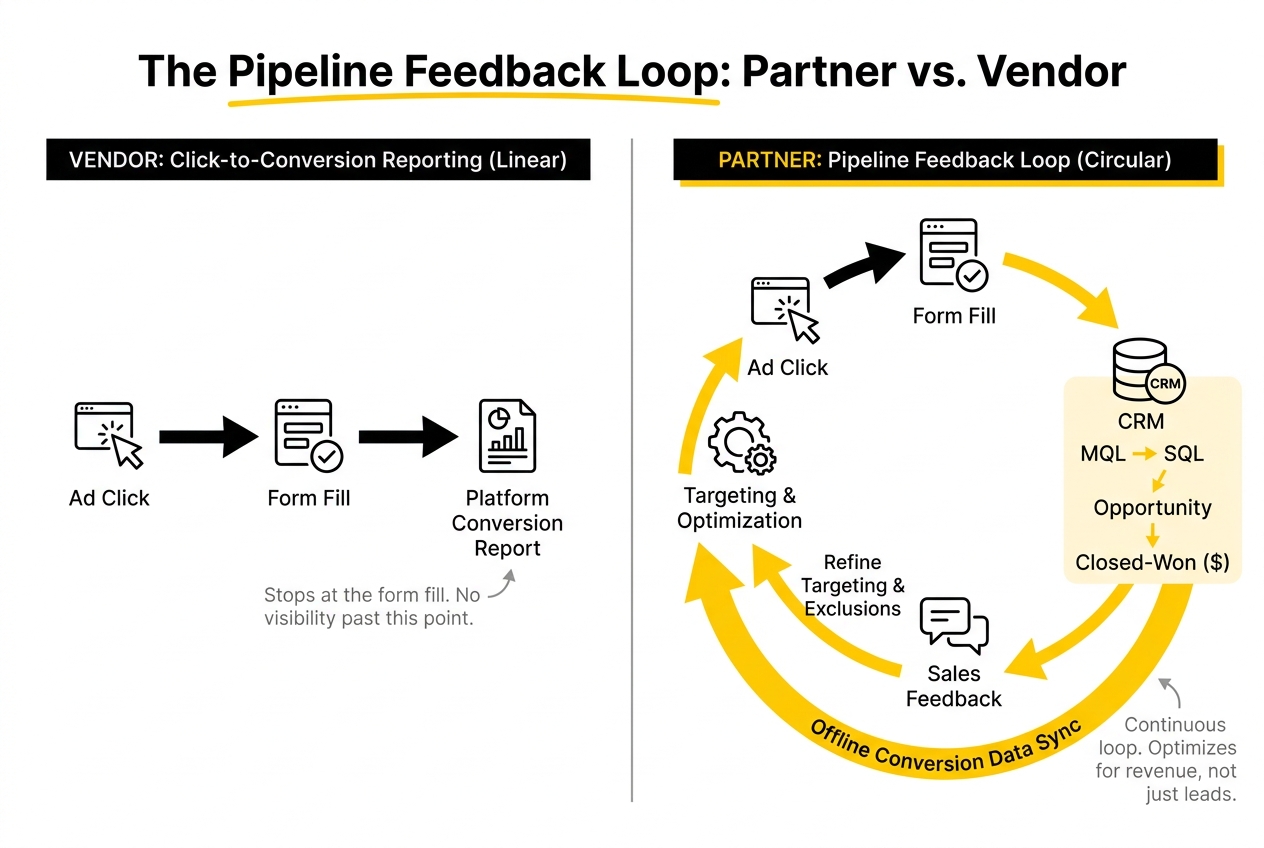
The single most important operational distinction between partner and vendor is whether the agency works the pipeline feedback loop or stops at the platform conversion. A vendor reports on Google Ads form fills and LinkedIn lead gen forms. A partner reports on what happened to those leads inside the CRM, what the MQL-to-SQL conversion rate looks like by campaign, which campaigns produced opportunities, and which produced closed-won.
This requires CRM access and offline conversion infrastructure, both of which a partner sets up in the first 30 days and operates as a permanent part of the reporting cadence. A vendor either does not set this up, sets it up and ignores it, or treats it as a separate paid project.
The pipeline feedback loop also flows the other way. Sales tells marketing which leads converted, which leads went cold, and why. A partner takes this information back into the targeting layer, refines negative keyword lists, and adjusts audience exclusions. A vendor does not have the conversation, because they do not have a forum to have it in.
4. Senior account leadership without rotation
The pitch-senior-deliver-junior problem is well-documented across B2B SaaS agency conversations in 2026. The pitch is run by an experienced strategist, the contract is signed, and within 60 days the account has been handed to a junior account manager who is meeting the business for the first time. The senior who pitched is now running new business development.
A scalable partner does not rotate. The person who built the audit and proposal runs the account from week one to year three. They have the time and the seniority to engage with sales on lead quality, to interrogate your CFO’s CAC payback math, and to push back on a brief that does not make commercial sense. A junior account manager juggling twelve accounts does none of these things, regardless of their technical competence.
The test for senior account leadership is whether the agency will commit, in writing, to the named person running your account, their current client load, and what happens if they leave. Partners answer the question directly. Vendors hedge. For the operational signals that confirm whether senior delivery is actually happening day-to-day, the companion piece on choosing the right PPC agency for your SaaS business covers what hands-on delivery looks like by week four.
5. Creative collaboration, not “send us the brief”
For B2B SaaS, creative collaboration is no longer optional. The product is technical, the value proposition is nuanced, and the audience is sophisticated enough to dismiss generic SaaS creative within two seconds of seeing it in feed. An agency that asks you to send the brief and produces three banner variations against it is not a creative partner. They are a production house.
A scalable creative collaboration looks structurally different. The agency engages with product marketing on positioning, with sales on the objections that come up in demos, and with customer success on the language existing customers use. They develop creative themes that map to the buying journey, not just to the next campaign launch. They iterate on copy and visual based on performance data, and they push back when a campaign brief is unlikely to perform.
This trait is the hardest to assess in evaluation, because every agency claims it. The signal that confirms or denies the claim is whether the agency, mid-engagement, brings creative concepts to the table proactively, or only ships against what was asked for.
6. Transparent recommendations, including “stop spending on this”
The cleanest test of partner versus vendor is whether the agency has ever recommended that you spend less. Vendors do not recommend spending less, because their retainer is tied to spend or because reducing scope reduces revenue. Partners do, regularly, because the long-term relationship depends on the budget being spent where it produces revenue.
Transparent recommendations also cover the harder conversations. The campaign that the marketing team championed is underperforming. The channel that the CEO wants to try does not fit the ICP. The audience size for the new segment is too small to support the bid strategy. A partner raises all three. A vendor lets the data tell the story over six months while quietly billing for the work.
The framing matters. A partner does not bury the bad news in the appendix of a monthly report. They flag it directly, with a recommended next step, and they make the recommendation in writing so there is a record.

The vendor red flags
Some signals are clearer than others. The patterns below tend to surface within the first six months of an engagement and predict whether the relationship will scale or stall:
- Monthly reports that lead with platform metrics. Impressions, CTR, and CPC at the top of the report indicate the agency is reporting on what they did, not on what the spend produced. Pipeline contribution, cost per SQL, and CAC payback should lead.
- No proactive communication outside the monthly call. If the only contact you have with the agency is the scheduled report and an email when an invoice is due, the relationship is transactional. Partners send unsolicited recommendations.
- The agency has never asked to speak to your sales team. Without that conversation, the targeting is built on assumptions. Partners ask in week one.
- Creative is produced by whoever is available, not assigned consistently. Brand and message consistency across channels requires the same creative team owning the work for multiple quarters.
- The retainer scales with spend, not with scope. A percentage-of-spend pricing model creates a structural incentive for the agency to recommend spending more, even when the data suggests spending less. The detailed analysis of how different SaaS PPC agency pricing models create different incentive structures is worth working through during evaluation.
- No experimentation roadmap. If you cannot see what the agency is testing this month, what they tested last month, and what they plan to test next quarter, there is no testing programme.
Spotting two or three of these in the first six months is normal in a vendor relationship. Spotting them in a partnership engagement is a signal that the relationship is drifting and needs to be reset directly.
Practical questions to ask in evaluation
The questions below surface the partner-versus-vendor distinction during the agency evaluation process. They are diagnostic rather than confirmatory, and a confident partner can answer all of them within a 30-minute conversation:
- Walk me through a recent campaign you recommended pausing. Why, and what happened?
- What does your monthly reporting actually lead with, and can I see a redacted example?
- Who specifically would run my account from week one, and how many other accounts are they on?
- What is your experimentation cadence and what does the testing roadmap look like for a typical Series B+ client in the first 90 days?
- How do you handle creative when our brief is unclear or when our team disagrees on direction?
- What feedback mechanism do you set up between marketing and sales on lead quality, and who owns it?
- When was the last time you recommended a client reduce their paid budget?
The last question is the most diagnostic. Partners answer it with a specific recent example. Vendors deflect.
The Upraw view
For Series B+ SaaS VPs of Marketing, the agency decision is rarely about whether a particular team can run Google Ads or LinkedIn. Most of the shortlist can. The decision that matters is whether the engagement will scale across the next four to six quarters, absorb the GTM changes that are coming, and contribute to the growth narrative rather than sitting outside it.
The traits above are not abstract. They are the specific operational behaviours that distinguish a partner from a vendor in practice, not in the pitch. In our experience working with SaaS marketing leaders across UK and EU markets, the agencies that scale tend to operate from three structural commitments: senior delivery without rotation, transparent recommendations including the uncomfortable ones, and a pipeline feedback loop that survives the inevitable sales reorganisation in year two.
Most agencies have one of the three. A few have two. The partner worth committing to is the one that demonstrates all three by month four.
If you are working through a renewal decision or evaluating whether your current relationship is structured as a partnership or a vendor arrangement, we are happy to take a look.

Frequently Asked Questions
What key traits should a scalable B2B SaaS paid media agency possess?
The six traits that signal scalability are strategic ownership rather than pure execution, a structured experimentation cadence, pipeline feedback loops connecting campaigns to CRM outcomes, senior account leadership without rotation, creative collaboration that is proactive rather than reactive, and transparent recommendations including the uncomfortable ones. Agencies strong on three or four are common. Agencies that demonstrate all six are the ones that scale across multiple quarters.
How can a marketing leader identify a true partner versus a vendor in paid media?
By month four of the engagement. Partners raise strategic changes proactively, run a visible experimentation roadmap, report on pipeline outcomes rather than platform metrics, and have recommended at least one reduction in scope or spend by that point. Vendors execute against the SOW, report on what they did, and wait for the next brief. The signals are observable in operating behaviour, not in the pitch.
What role does strategic ownership play in a successful B2B SaaS paid media partnership?
It defines whether the agency contributes to the strategy or simply executes what comes from the client side. SaaS growth involves regular shifts in ICP, messaging, channel mix, and budget allocation. A partner anticipates these and brings recommendations forward. A vendor waits for direction. At Series B+, the cost of strategic ownership sitting entirely inside the marketing team is operational overload, particularly when the team is also handling other GTM initiatives.
How important is experimentation cadence in optimizing paid media campaigns for SaaS companies?
It is the single biggest operational difference between accounts that compound performance and accounts that plateau. A scalable engagement runs continuous tests across creative, audience, bidding, landing pages, and channel mix on a defined monthly rhythm, with explicit conclusions and next tests documented. Quarterly reviews where nothing has been tested usually mean the agency is performing maintenance, not optimisation, and the account performance will reflect that within two quarters.
What feedback mechanisms should a B2B SaaS company establish with their paid media agency?
A two-way feedback loop covering pipeline data and qualitative sales intelligence. Pipeline data flows from CRM to Google Ads and LinkedIn via offline conversion imports, refreshed daily. Qualitative intelligence flows in a structured monthly conversation between the agency and your sales team on lead quality, deal velocity, and competitive intelligence. Without both, the agency optimises blind. Partners set this up in the first 30 days. Vendors do not set it up at all.
Why is senior account leadership crucial in a B2B SaaS paid media agency?
Because Series B+ SaaS accounts require commercial judgement on top of technical competence. A senior practitioner has the credibility to push back on a brief that does not work, the experience to spot when the data is misleading, and the bandwidth to engage with sales and product marketing on the wider context. A junior account manager juggling twelve accounts has technical competence but no time and no credibility to do any of these. The structural difference compounds across the engagement.
How can creative collaboration enhance the effectiveness of paid media strategies?
By making the creative responsive to performance data, customer language, and the buying journey, rather than to a static brief. SaaS audiences dismiss generic creative within two seconds. The creative that performs is the creative that reflects how existing customers describe the product, what sales hears as the top objections, and where the prospect is in the buying journey. A creative-collaboration partner engages with product marketing, sales, and customer success directly. A production-house vendor takes the brief and ships variants against it.
What are the best practices for demonstrating ROI in paid media for B2B SaaS companies?
Lead with pipeline contribution and cost per qualified opportunity by campaign. Include CAC payback trajectory and MQL-to-SQL conversion rate. Use platform metrics (impressions, CTR, CPC) as diagnostics in an appendix, not as the headline. Reconcile against CRM data monthly. Report consistently against the same metrics across the engagement, even when individual months are weak. ROI demonstration in B2B SaaS is about methodological consistency over time, not impressive monthly numbers.
How can a B2B SaaS company manage complex sales cycles with the help of a paid media agency?
By treating the agency as part of the revenue operations function rather than a separate execution layer. The agency needs CRM access, sales pipeline visibility, and a regular forum with the sales team. The attribution model needs to be honest about the limits of platform reporting on cycles longer than 90 days. Budget allocation needs to flex as the sales motion evolves. A partner participates in this work. A vendor sits outside it.
What questions should VPs of Marketing ask potential paid media partners during the selection process?
The most diagnostic questions surface partner versus vendor distinctions: walk me through a campaign you recommended pausing and why, can I see a redacted monthly report, who runs my account day-to-day and how many other accounts are they on, what does your experimentation cadence look like, how do you handle feedback between marketing and sales, and when did you last recommend a client reduce their paid budget. The final question is the cleanest test. Partners answer it with a specific example. Vendors deflect.