Enhancing Demand Generation: Strategic Partnerships Between Consultants and Paid Media Agencies
Discover how growth consultants can extend capacity and improve pipeline by partnering with specialist paid media agencies for B2B SaaS demand generation.

Lead Gen vs Demand Gen: Why the Distinction Matters
Before getting into how the partnership works, it’s worth being precise about what demand generation actually is, because most teams are running something closer to lead generation and calling it demand gen.
Lead generation is transactional: capture the hand-raise, pass the MQL to sales, report the number. Demand generation is structural: build awareness in your ICP, educate buyers before they reach out, and create the conditions where people arrive with genuine intent.
Most scaling SaaS teams run both, but they conflate them in their reporting. Hitting 100% of your MQL target while falling 40% short on pipeline is a sign the two are misaligned, not just underperforming. The average MQL-to-SQL conversion rate across B2B sits at around 13%, according to HubSpot’s 2026 State of Marketing benchmarks. That means 87 out of every 100 leads deemed marketing-qualified are not ready for a sales conversation. That gap is usually a targeting and measurement problem before it’s a channel problem.
Understanding where your programme sits on that spectrum changes what you need from a specialist partner and from a consultant.
What Strategic Growth Consultants Actually Bring to the Table
Growth consultants operate at the strategy layer. Their job is to translate company GTM goals into a demand framework, identify where paid media fits across the full funnel, and ensure that activity connects back to pipeline outcomes.
What they bring:
- ICP clarity: Before any campaign runs, who are you actually trying to reach, in which companies, at which buying stage? Consultants define these parameters in a way that most in-house teams, stretched across multiple workstreams, don’t have the time to do rigorously.
- Sales alignment: Consultants typically sit closer to the revenue conversation than an agency does. They can translate what sales needs from marketing in terms that directly inform channel targeting and creative direction.
- Strategic oversight: The ability to step back and assess whether the overall programme is working, not just whether individual campaigns are hitting platform KPIs.
What consultants typically cannot do at scale: execute across multiple paid platforms simultaneously, manage channel-specific optimisation depth, and run structured A/B tests across creative, copy, and landing pages week over week. That’s where a B2B SaaS marketing agency adds the execution capacity a consultant doesn’t carry.
Together, they form a layered operating model. The consultant owns the demand framework. The agency owns the execution within it.
How to Collaborate with Paid Media Agencies Effectively
The biggest risk in a consultant-plus-agency model is that the two work in parallel rather than together. Strategy produced in one room, campaigns built in another, reporting shared with neither.
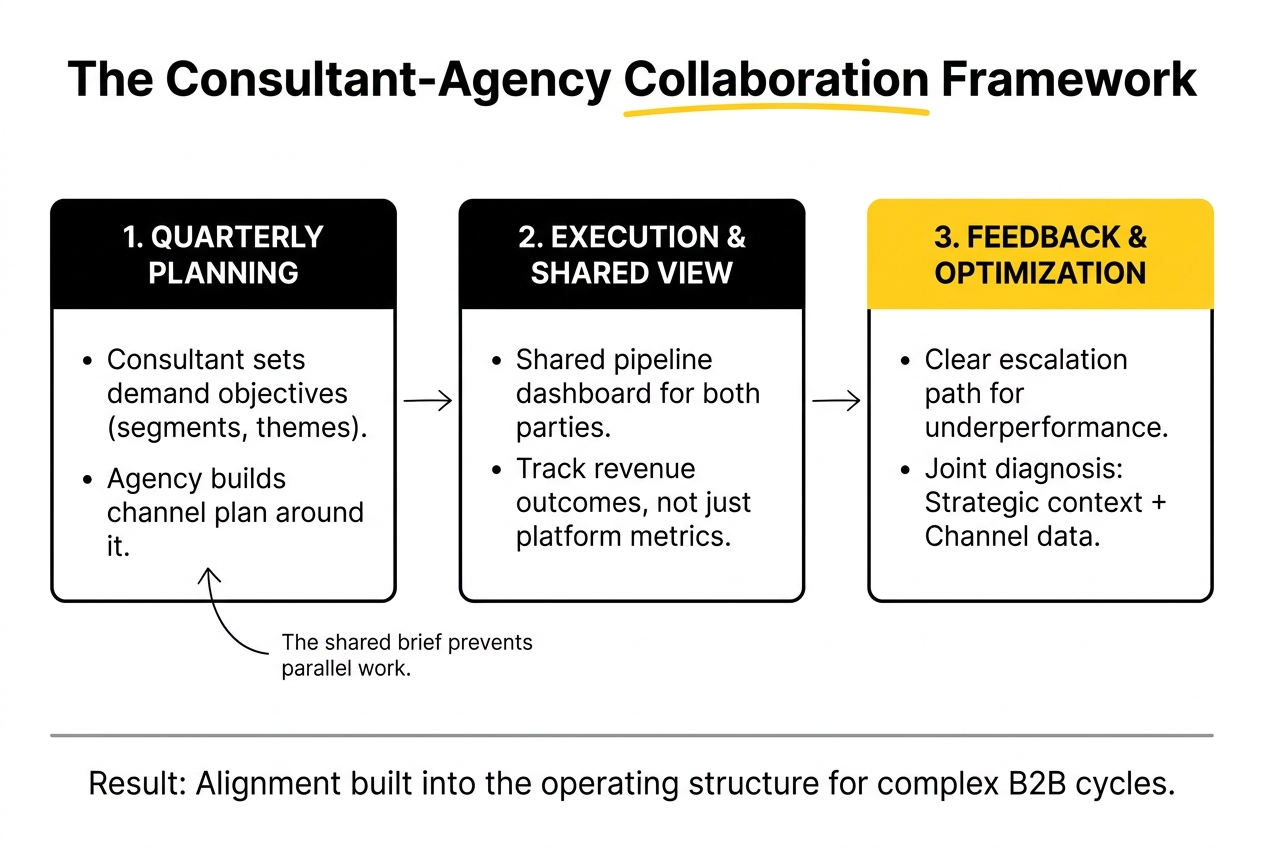
Alignment has to be built into the operating structure from the start. That means a shared brief before any campaign goes live, a common definition of what success looks like in pipeline terms, and regular touchpoints where agency performance data feeds back into strategic decisions.
In practice, this looks like:
- A quarterly planning session where the consultant sets the demand objectives (target segments, content themes, funnel stage focus) and the agency builds the channel plan around it.
- A shared pipeline dashboard where both parties can see how activity is performing against revenue outcomes, not just platform metrics like CTR or CPL.
- A clear escalation path when a campaign underperforms. The consultant provides the strategic context; the agency provides the channel-level diagnosis. Neither decision gets made in isolation.
This alignment is especially important for B2B SaaS teams with complex or multi-stakeholder sales cycles. According to Forrester, B2B buying decisions now involve an average of 27 interactions across four or more stakeholders. Demand generation that educates a buying committee looks structurally different from demand capture targeting a single decision-maker, and the paid media agency needs the strategic brief to run the right programme for the right audience.
Integrating Paid Media Campaigns with Sales Team Objectives
Sales alignment is where most demand generation programmes fall short. Marketing runs campaigns. Sales works inbound. The two rarely inform each other in real time.
A consultant who sits at the intersection of both can close this gap. By understanding which accounts sales is actively pursuing, which messages are resonating in discovery calls, and what objections are recurring in demos, they can brief the paid media agency on what creative and targeting needs to reinforce the sales motion.
This is not a one-time exercise. It needs to be a recurring loop. Sales insights should flow into paid media strategy at a minimum every quarter. As deals progress, the agency should know which campaigns influenced closed-won business and which attracted the leads that sales teams are not following up on.
The output is a paid media programme that does not just generate volume. It generates the right accounts, at the right stage of awareness, with the context to have a productive sales conversation when they do engage.
Building a Structured Test Roadmap for Paid Media
One of the clearest value-adds a consultant brings to a paid media agency relationship is the ability to design and interpret a structured test roadmap. Without that strategic layer, agencies tend to optimise within the brief they’re given: improve CTR, reduce CPL, test creative variants. These are useful, but they address execution rather than strategy. If the brief itself is wrong, the optimisations compound the problem.
A structured test roadmap starts with hypotheses tied to pipeline outcomes:
- If we shift budget from capture campaigns to educational content at the top of the funnel, does the quality of leads improve over the following quarter?
- Does a LinkedIn Thought Leader Ads approach for target accounts shorten time-to-opportunity for mid-market ICP companies?
- Does tightening our firmographic targeting reduce MQL volume but improve the MQL-to-SQL ratio enough to justify the change?
Each test in the actionable roadmap should answer:
- Hypothesis: What are we testing and why?
- Channel and format: Where will this run and in what format?
- Success metric: Which pipeline indicator will we use to evaluate it, not which platform metric?
- Duration: How long before we can draw a directional conclusion?
- Next step: If the hypothesis holds, how do we scale? If it doesn’t, what does that tell us about the broader demand strategy?
The consultant owns the hypothesis and the evaluation. The agency owns the execution and channel-level data. Together they produce learnings that actually feed into the next planning cycle, rather than staying inside a campaign dashboard.
How the Partnership Improves Lead Quality
Lead quality is nearly always a targeting problem before it is a volume problem.
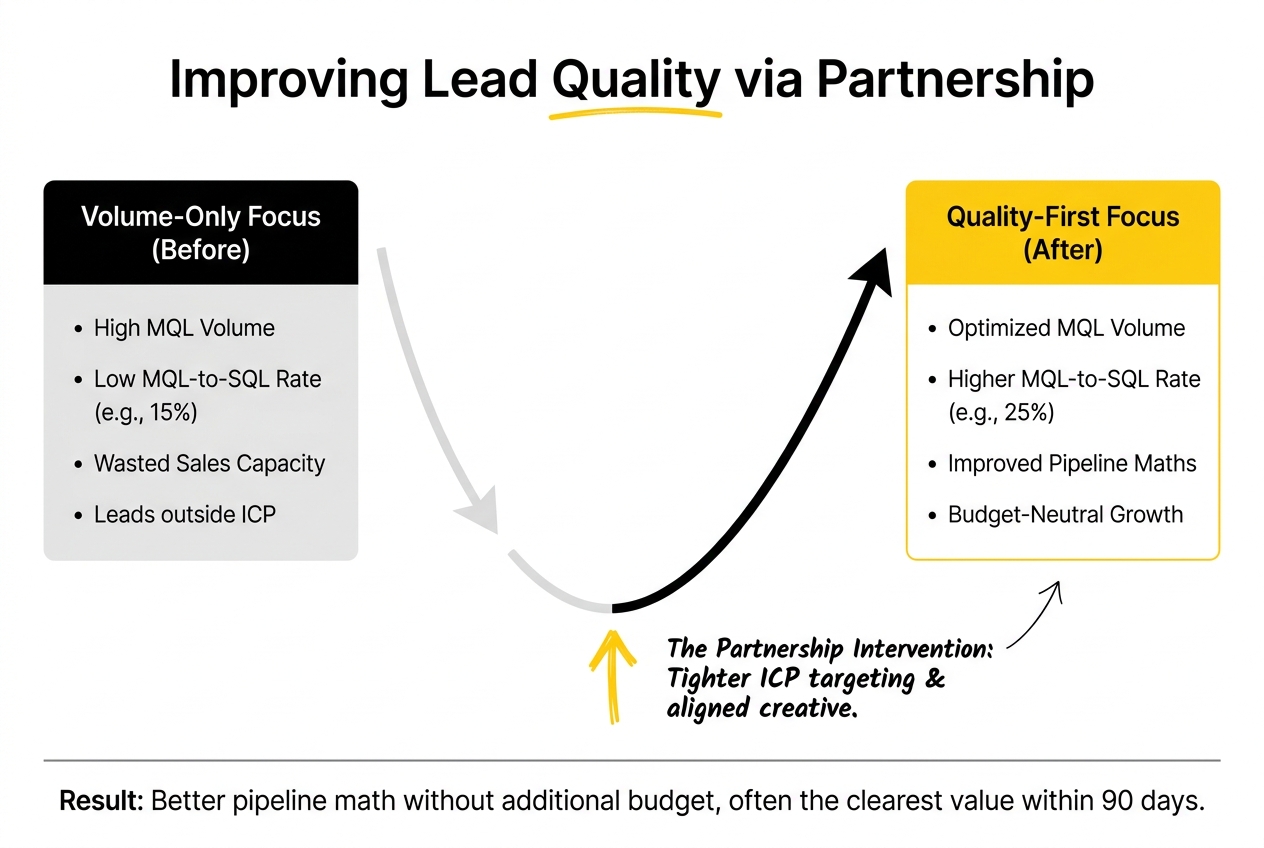
When MQL-to-SQL rates are low, the instinct is to increase volume. But if the leads coming in don’t match the ICP, more volume means more wasted sales capacity. The right intervention is upstream: tighten targeting, refine messaging, and ensure that paid campaigns are reaching buyers who have the budget, the problem, and enough awareness to be worth a sales conversation.
A consultant working alongside a paid media agency pushes that clarity into the channel brief. ICP-aligned targeting criteria, firmographic filters, intent signals, and job title exclusions: these are strategic decisions that should come from the consultant, informed by sales feedback, and then translated into campaign execution by the agency.
The improvement in lead quality typically shows up not in MQL volume but in the MQL-to-SQL ratio. Moving that rate from 15% to 25% across a programme changes the downstream pipeline maths considerably, without requiring additional budget. Consultants working with specialist agencies report that this ratio improvement, driven by tighter ICP targeting and aligned creative, is often the clearest evidence of partnership value in the first 90 days.
Measuring Success: The Metrics That Hold Up
Paid media agencies naturally report on channel metrics: impressions, clicks, CTR, CPL, return on ad spend. These are the signals available to them at the platform level. But none of those metrics answer the question a Head of Demand Generation needs to take to the board: is this programme contributing to qualified pipeline?
Translating platform metrics into pipeline contribution requires a shared measurement infrastructure. That means CRM integration, agreed attribution logic, and a definition of marketing-influenced pipeline that both marketing and sales accept before any campaign runs.
The consultant’s role is to own that measurement framework and ensure reporting lands at the right level of abstraction for each audience.
For senior leadership and the board: cost-per-opportunity, marketing-sourced pipeline, and CAC payback period.
For the internal demand generation team: MQL-to-SQL rate, campaign-level pipeline contribution, and conversion velocity by segment.
For the paid media agency: the same metrics, alongside the channel-level data they need to optimise execution.
When all three reporting layers exist, the partnership has a shared language. When only the agency’s platform metrics are available, strategic decisions get made on the wrong signals.
Common Challenges in Consultant-Agency Partnerships (and How to Navigate Them)
Unclear ownership. When the consultant and the agency both have strong opinions on campaign strategy, decisions slow down. Define this clearly from the start: the consultant sets the strategic brief; the agency executes within it. Neither should override the other on their respective domain without a structured discussion.
Misaligned planning cadences. Consultants often think in quarterly cycles; agencies operate week-to-week. Making the cadence explicit prevents both sides working to a different clock. Quarterly strategy reviews, monthly performance reviews, weekly execution check-ins.
Reporting that goes to different places. If the agency reports on platform metrics and the consultant reports on strategy, neither is accountable for pipeline. A shared dashboard with agreed KPIs closes this gap.
Consultant sign-off becoming a bottleneck. One advantage of having a specialist paid media agency is that they can move quickly on tactical optimisations. The consultant’s strategic layer should not create bottlenecks on day-to-day execution decisions that the agency should be empowered to make independently. Define which decisions require consultant input and which the agency can own outright.
Evaluating the Right Paid Media Agency Partner
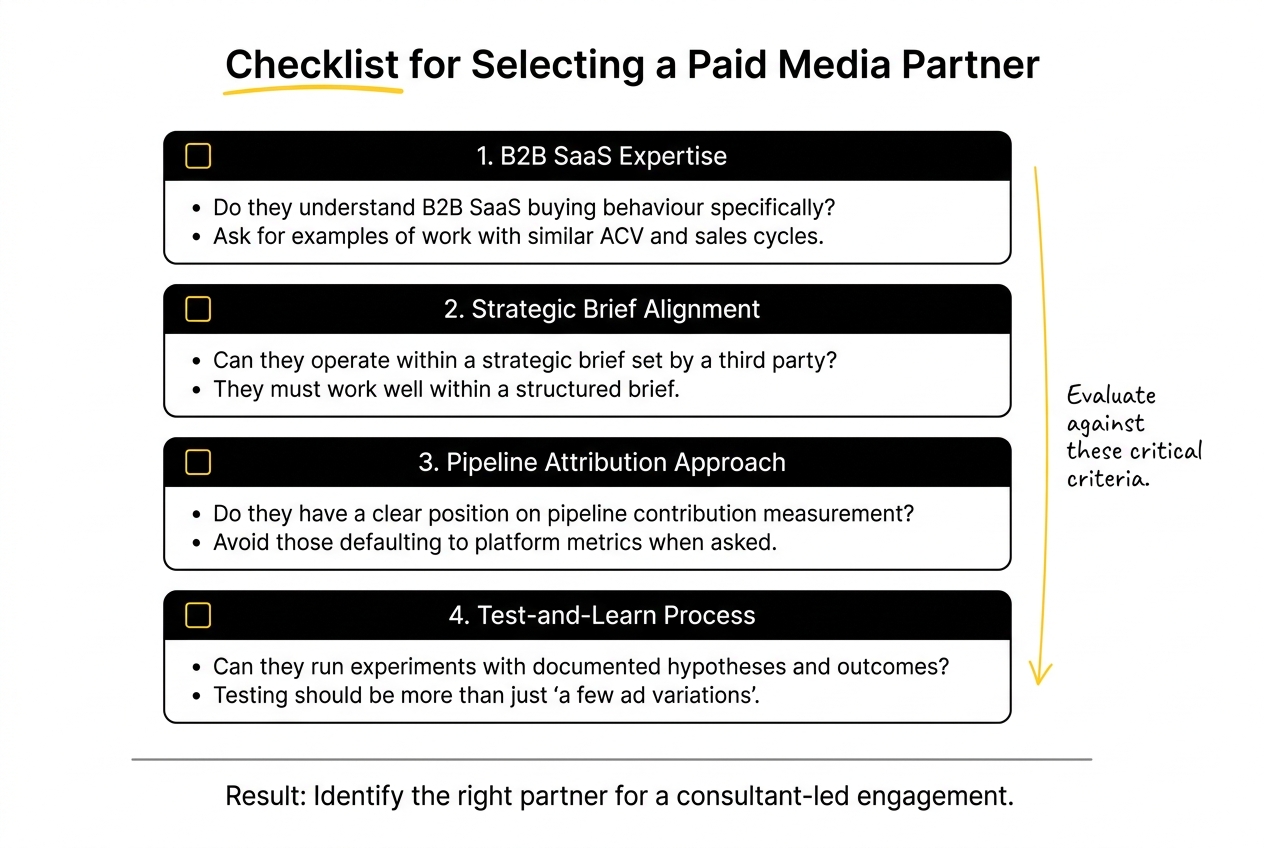
Not every paid media agency is the right fit for a consultant-led engagement. A few criteria worth evaluating before committing to a partnership:
- Do they understand B2B SaaS buying behaviour specifically, or do they apply the same approach across sectors? Ask for examples of work with companies in a similar ACV range and sales cycle length.
- Can they operate within a strategic brief set by a third party? Some agencies require a direct relationship with the client to function effectively. Others work well within a structured brief. The model you’re building requires the latter.
- How do they handle attribution? Do they have a clear position on what pipeline contribution measurement looks like, or do they default to platform metrics when asked?
- What does their test-and-learn process actually look like? Can they run experiments with documented hypotheses and outcomes, or do they describe testing as “we tried a few ad variations”?
What This Means in Practice
A few things worth doing before you introduce a paid media agency into a consultant-led engagement:
- Ensure the consultant has clarified ICP, funnel stage focus, and pipeline KPIs before the agency builds anything. If that work hasn’t been done, you’re giving the agency too much room to fill with their own assumptions.
- Run a shared planning session at the start of each quarter. Consultant sets the strategy; agency builds the channel execution plan. Both agree on the success metrics before anything goes live.
- Build CRM integration into the agency onboarding. Without pipeline visibility, you’re optimising on platform proxies and reporting on activity rather than demand generation performance.
- Design a structured test roadmap for the first 90 days. Agree on the hypotheses, the channels, and the pipeline metrics that will tell you whether the approach is working.
- Create a regular sales feedback loop. Monthly at minimum. What converted? What is the sales team not following up on, and why? That answer changes the next brief.
A Note on the Broader Context
B2B customer acquisition costs have risen 60% over the past five years, according to HubSpot’s 2026 State of Marketing data, pushing the median SaaS CAC to around two dollars for every dollar of new ARR. The consultants and demand generation leaders who navigate that environment best are not the ones who add more channels. They are the ones who build tighter operating models, cleaner measurement, and better alignment between what marketing produces and what sales can close.
A well-structured partnership between a growth consultant and a specialist paid media agency is one way to get there. It is not a simple relationship to manage, and it does not produce results overnight. But when the strategic and execution layers are genuinely integrated, it changes what the demand generation function can deliver.
If you are working through how to structure this kind of partnership for your team, it is something Upraw works on with SaaS demand generation leaders regularly. Worth a conversation if you are at that point.
Frequently Asked Questions
How can strategic growth consultants benefit from partnering with specialist paid media agencies?
Growth consultants benefit by extending their execution capacity without adding headcount. A consultant can set the demand strategy, define ICP targeting, and own the measurement framework, while the agency runs the channel execution at scale. The result is a programme that delivers both strategic coherence and the kind of week-to-week optimisation depth that a consultant operating alone typically cannot sustain across multiple clients.
What are the key advantages of collaborating with a paid media agency for B2B SaaS companies?
Specialist paid media agencies bring B2B SaaS-specific channel expertise, access to platform-level optimisation tools, and the capacity to run structured tests across creative and targeting simultaneously. For SaaS companies with lean marketing teams and pipeline pressure, an agency partnership extends what the in-house function can execute without the cost or lead time of hiring senior paid media talent directly.
How do growth consultants and paid media agencies align their strategies to enhance demand generation?
Alignment typically happens through a shared planning cadence, a common measurement framework, and a clear division of ownership. The consultant sets quarterly demand objectives and defines what success looks like in pipeline terms. The agency builds the channel execution plan within that brief. Both parties review pipeline contribution data together, not just platform metrics, at regular intervals.
What are effective ways for consultants to integrate paid media campaigns with sales team objectives?
Consultants should run regular feedback loops with sales to understand which accounts are active, which messages are landing in discovery calls, and what objections are recurring. That information should feed directly into the paid media brief, shaping targeting criteria, ad creative, and landing page messaging. The goal is a paid programme that supports active sales conversations rather than running in parallel to them.
What structured test roadmaps should be implemented to optimise paid media efforts?
A structured test roadmap should define the hypothesis being tested, the channel and format, the pipeline metric used to evaluate it (not platform proxies), the duration of the test, and the decision criteria for scaling or abandoning the approach. Hypotheses should connect to pipeline outcomes, not just engagement metrics. Running one clear test at a time, with documented outcomes, produces more useful learnings than running multiple simultaneous variants without a coherent evaluation framework.
How can consultants provide actionable insights that resonate with senior leadership in demand generation?
Senior leadership cares about pipeline, CAC payback, and whether the marketing investment is generating revenue. Consultants should structure reporting around cost-per-opportunity, marketing-sourced pipeline contribution, and conversion velocity rather than channel metrics. The framing should answer the question the board is actually asking: is this programme producing qualified pipeline that sales can close?
What metrics should be used to measure the success of campaigns run by growth consultants and media agencies?
The core pipeline metrics are MQL-to-SQL conversion rate, cost-per-opportunity, marketing-sourced pipeline volume, and CAC payback period. These should sit alongside, not replace, channel-level data such as CPL, CTR, and conversion rate by campaign. Platform metrics explain what is happening inside the channel; pipeline metrics explain whether the programme is working at the business level.
How can the partnership between growth consultants and paid media agencies improve lead quality?
By ensuring that campaign targeting is derived from a rigorous ICP definition rather than platform defaults or broad demographic targeting. Consultants drive the ICP brief; agencies translate it into firmographic filters, exclusion lists, intent signals, and creative tailored to a specific buyer profile. The impact shows up in the MQL-to-SQL ratio rather than MQL volume, which is the right place to look for lead quality improvement.
What challenges do growth consultants face when working with paid media agencies, and how can they overcome them?
The most common challenge is unclear ownership: who decides when strategy and execution disagree? Define this upfront. Consultants own the brief and the measurement framework. Agencies own channel execution and optimisation within that brief. Regular structured reviews prevent either party operating in isolation and ensure that platform-level decisions are grounded in strategic context.
How can strategic partnerships with paid media agencies help consultants navigate resource constraints in demand generation?
Consultants operating with lean client teams can extend the scope of what the demand generation function delivers by routing execution to an agency that already has the tooling, platform expertise, and testing infrastructure in place. Rather than the consultant needing to hire or manage channel specialists directly, the agency carries the execution layer. The consultant focuses on the work that requires strategic judgement and sales alignment, which is where their time generates the most value.