How to Choose the Right UK Google Ads Agency for Your SaaS Business
A practical evaluation framework for VPs of Marketing at Series B+ UK SaaS companies choosing a Google Ads agency that delivers pipeline, not just clicks.

You launch the campaigns your last agency promised. Demos come in. Platform dashboards look healthy. Three months later, the board asks where the qualified pipeline is, and you do not have a clean answer.
This is the gap that defines paid search for B2B SaaS in 2026. Click volume is easy to buy. Pipeline that converts is not. Choosing a UK SaaS Google Ads agency that understands the difference, and can prove it, is the single most consequential paid media decision a Series B+ marketing leader makes this year.
This guide is written for revenue-accountable VPs of Marketing who have already been through one agency cycle, lost a quarter to it, and now need a sharper evaluation framework. We will cover what a pipeline-focused engagement actually looks like, the CRM and senior delivery signals that separate a real SaaS PPC partner from a generalist running a templated playbook, and the specific questions that surface fit during evaluation. If you want the broader context on what a UK SaaS Google Ads agency should do across the full programme, our parent guide covers the operating model in detail. For the CMO-level evaluation framework that works across paid search, paid social, and attribution together, the companion piece on evaluating the best SaaS advertising agencies for Series A+ teams covers six structural criteria.
What “pipeline-focused” actually means in SaaS Google Ads
“Pipeline-focused” is now the default agency tagline. Almost every UK Google Ads agency claims it. The problem is that it means very different things in practice, and the way to test which version you are buying is to look at how the agency structures the account and what data flows back into it.
A pipeline-focused agency optimises for cost per qualified opportunity and closed-won revenue. A click-focused agency optimises for cost per form fill, then reports CPL as if it were a business outcome. The structural differences show up in five places:
- Campaign segmentation by intent tier, not by keyword theme. High-intent terms (competitor, pricing, alternatives, demo) sit in their own campaign with their own bidding strategy, separate from research and category-level terms.
- Offline conversion imports from the CRM, with tiered values assigned to MQL, SQL, opportunity, and closed-won stages, so Google’s algorithm learns which clicks generate revenue, not which clicks generate forms.
- Bidding strategy progression that starts with maximise conversions and only moves to target ROAS once the CRM feedback loop is mature, typically four to six months in.
- Reporting that leads with cost per SQL and pipeline contribution, with cost per lead included only as a diagnostic.
- Attribution windows set to match the sales cycle, typically 60 to 90 days minimum for SaaS, not Google’s 30-day default.
If an agency’s onboarding plan does not name all five, it is selling click volume with pipeline language wrapped around it.
CRM feedback loops are the dividing line
If there is one single criterion that separates a real SaaS PPC partner from a competent generalist, it is whether they treat CRM integration as the foundation of the engagement or as an optional add-on at month six.
Google’s bidding algorithm only knows what you tell it. If the only conversion event you send is a form fill, Google will optimise for whoever fills out forms most cheaply. That is almost never your ICP. According to data published across multiple B2B SaaS agency case studies in 2026, accounts running PMax without CRM-linked conversions deliver MQL-to-SQL rates of three to five percent, compared with 18 to 25 percent for properly configured search campaigns. The form-fill volume looks great. The pipeline does not exist.
A proper CRM feedback loop captures the Google Click ID (GCLID) at form submission, stores it against the lead record in HubSpot, Salesforce, or Pipedrive, and pushes lifecycle stage transitions back to Google Ads as offline conversions on a daily sync. Each stage carries an assigned value: MQL might be worth a small amount, SQL more, an opportunity more again, and closed-won the actual deal value. Google then learns to find the keywords, audiences, and creatives that produce revenue, not the ones that produce noise.
There is one technical wrinkle to ask about directly. GCLIDs expire after 90 days. If your enterprise sales cycle runs longer than that, your agency needs a workaround. Enhanced conversions for leads, which pass hashed email at form submission, bridge the gap for cross-device and longer-cycle matching. Any agency that cannot explain how they handle GCLID expiry is not ready to manage a Series B+ SaaS account.
This is also the area where crm feedback loops stops being marketing language and starts being an engineering question. Ask to see a sample CRM-to-Google-Ads data flow diagram during the pitch. If the agency cannot produce one, they have not built this before.

Senior delivery in marketing: what to look for
The most consistent complaint from VPs of Marketing who have been through multiple agencies is the pitch-senior-deliver-junior model. A senior strategist runs the pitch and the audit. Once the contract is signed, the account moves to a junior account manager who is learning SaaS PPC on your budget, juggling 12 to 15 other accounts, and escalating anything complicated to a manager who is too busy to engage.
This is not a UK-specific problem, but it is acute in the UK market because agency hiring norms have squeezed margins on senior practitioners. The result is a structural mismatch between what the buyer sees in the pitch and what they get in delivery.
The fix is to ask two questions during evaluation:
- Who will run my account day-to-day, by name, by title, and how many other accounts are they currently managing?
- Is the person who built my audit and proposal the same person who will run the account from week one?
An account manager handling more than eight active accounts is not doing meaningful strategic work on any of them. They are processing tickets. A senior practitioner running three to five accounts has the time to dig into Search Console queries, build negative keyword lists, audit the landing page conversion path, and engage with your sales team on lead quality feedback.
Senior delivery is not a job title. It is bandwidth. The agencies that deliver it tend to be smaller, more deliberately structured, and willing to cap client load explicitly. The agencies that do not deliver it tend to be larger, growth-stage themselves, and structurally dependent on junior labour to make the unit economics work.
For a deeper look at what hands-on senior delivery actually looks like day-to-day, the companion piece on choosing the right PPC agency for your SaaS business covers the five operational signals you can observe by week four. The wider question of whether the engagement is structured as a scalable partnership or a vendor relationship sits one level up from delivery model.
The metrics that matter, and the ones that do not
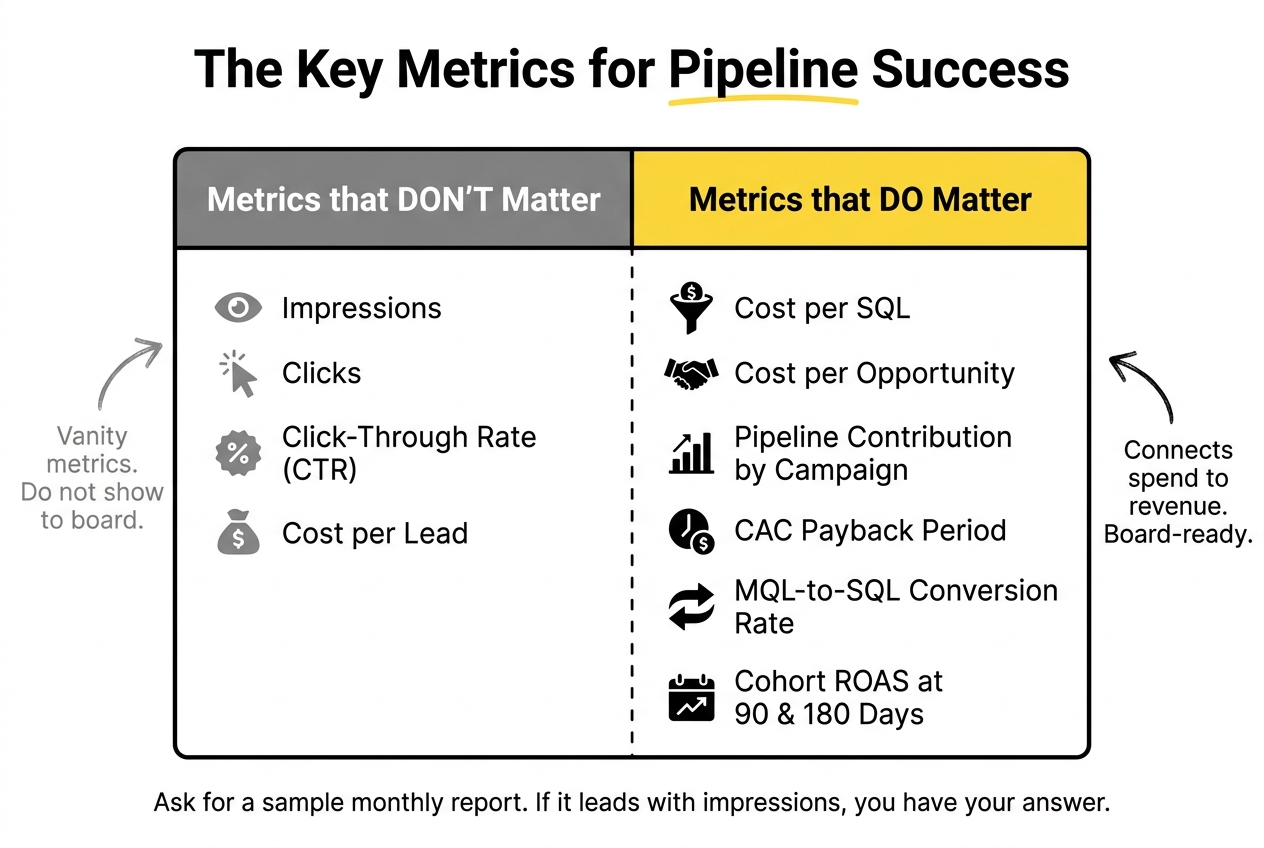
Most agency monthly reports lead with impressions, clicks, click-through rate, and cost per lead. Almost none of those metrics show up in board decks. None of them tell you whether the spend is generating revenue.
The metrics that hold up in board meetings are different:
MetricWhy it mattersCost per SQLThe first metric that connects spend to genuine sales engagementCost per opportunityThe actual cost of getting into a real evaluation, by campaignPipeline contribution by campaignWhich campaigns generate revenue, not which generate formsCAC payback periodThe metric your CFO uses to evaluate growth spendMQL-to-SQL conversion rateThe cleanest leading indicator of lead qualityCohort ROAS at 90 and 180 daysThe honest measure of campaign return on long cycles
A capable agency reports against these monthly. A click-focused agency reports against them quarterly, if at all, and usually only when the client asks. Ask for a sample monthly report during evaluation. If it leads with impressions and CTR, you have your answer.
Refine Labs has built much of its public commentary around the gap between platform-reported leads and revenue-qualified pipeline. The argument holds: MQL counts inflate when no one is checking whether sales will touch the leads. Your agency’s reporting cadence either closes that gap or hides it. There is no middle position.
Questions to ask during the evaluation process
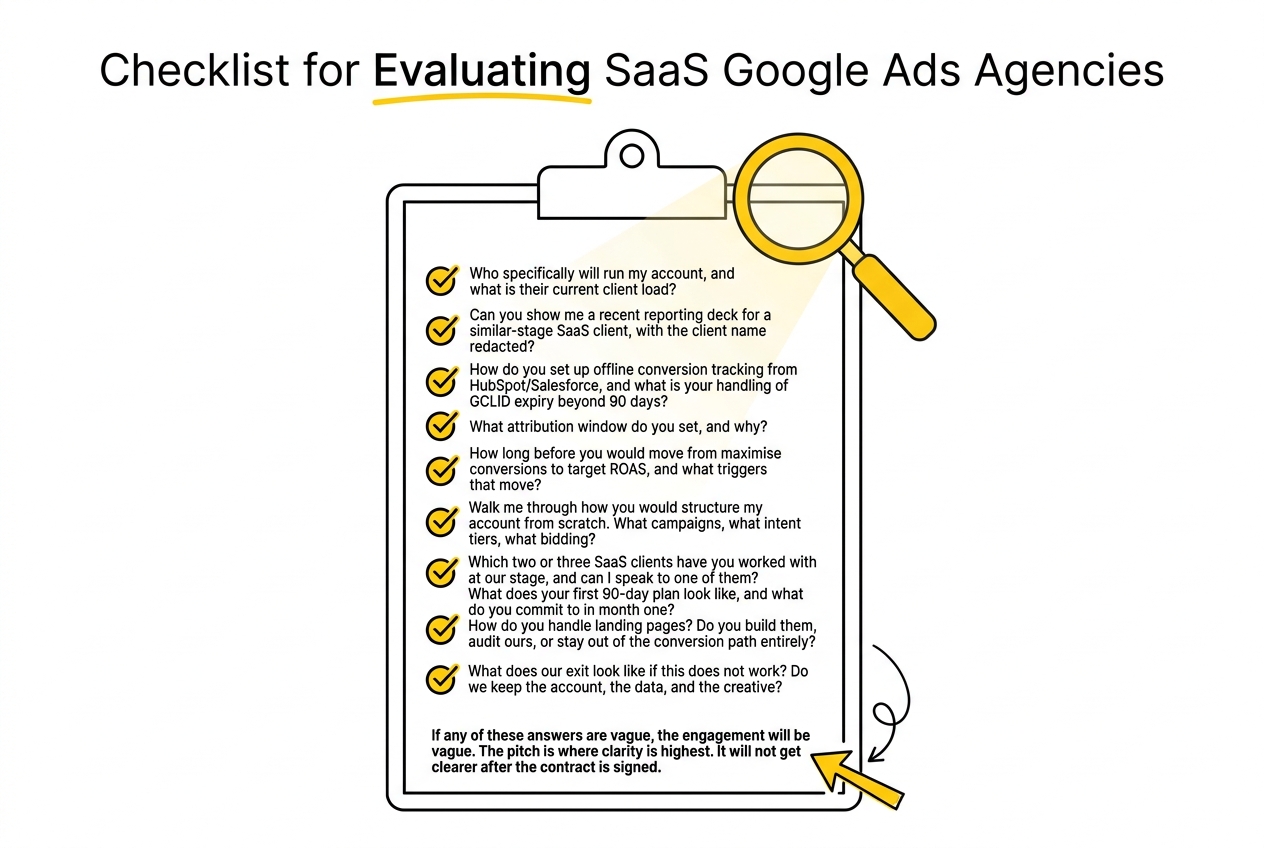
A useful evaluation conversation surfaces three things: how the agency thinks, what their default playbook looks like, and whether their model can carry a Series B+ SaaS account at scale. Use this list during the pitch:
- Who specifically will run my account, and what is their current client load?
- Can you show me a recent reporting deck for a similar-stage SaaS client, with the client name redacted?
- How do you set up offline conversion tracking from HubSpot or Salesforce to Google Ads, and what is your handling of GCLID expiry beyond 90 days?
- What attribution window do you set, and why?
- How long before you would move from maximise conversions to target ROAS, and what triggers that move?
- Walk me through how you would structure my account from scratch. What campaigns, what intent tiers, what bidding?
- Which two or three SaaS clients have you worked with at our stage, and can I speak to one of them?
- What does your first 90-day plan look like, and what do you commit to in month one?
- How do you handle landing pages? Do you build them, audit ours, or stay out of the conversion path entirely?
- What does our exit look like if this does not work? Do we keep the account, the data, and the creative?
If any of these answers are vague, the engagement will be vague. The pitch is where clarity is highest. It will not get clearer after the contract is signed.
Common pitfalls in selecting a UK SaaS Google Ads agency
The mistakes that lead to a failed agency engagement are predictable. They cluster around five patterns:
- Choosing the agency that promised the lowest CPL. Cost per lead is the wrong primary metric. A 30 percent CPL reduction with a 70 percent drop in SQL conversion is a worse outcome at higher absolute cost.
- Hiring a multi-vertical agency with a SaaS case study. A generalist agency with one or two SaaS logos in the portfolio is not a SaaS agency. The depth shows up in week four when a campaign needs rebuilding around buyer-stage targeting.
- Skipping the reference call. The reference an agency volunteers is curated. The reference you ask for from a current client at your stage and ACV is the one that tells you what the engagement actually looks like.
- Signing a 12-month minimum. A confident agency does not need a long lock-in. A three-month notice period is reasonable. Anything longer is a structural admission that they expect performance issues. The pricing model matters as much as the contract length here, the deeper analysis of comparing SaaS PPC agency pricing models covers retainers, audits, and performance fees in detail.
- Accepting the pitch team as the delivery team without verification. Confirm in writing who runs the account, what their tenure is, and what the escalation path is when performance drifts.
There is a sixth, more subtle pitfall: choosing an agency that cannot articulate a position on Performance Max. PMax is now central to Google Ads strategy in 2026, and the right answer for B2B SaaS is nuanced. It works as a supplement to Search, with CRM-linked conversions, brand exclusions configured, and an audience signal of at least 100 Customer Match records. An agency that says “we run PMax for everyone” without those guardrails is going to feed your budget to the cheapest form-fill sources Google can find.
The Upraw view
The single highest-leverage decision in a SaaS Google Ads engagement is the one made before any campaign launches: build the CRM feedback loop first, then build the account on top of it. Most agencies reverse the order. They launch search campaigns to “get data flowing,” then promise to integrate the CRM in month three, by which point the algorithm has already been trained on form-fill noise.
Reversing this is hard. The agency that builds offline conversion tracking in week one, before a single new ad runs, is rare. The ones that do it tend to be the same ones that operate a senior-delivery model and report monthly on cost per SQL. There is a reason these correlate. They are different expressions of the same underlying choice: optimise for pipeline, or optimise for things that look like pipeline.
Choose the agency whose default unit of analysis is closed-won revenue. Everything else (the account structure, the bidding strategy, the cadence, the seniority of the people on your account) follows from that one choice.
Practical takeaways
If you are working through agency evaluation right now, three actions sharpen the decision:
- Ask for a sample monthly report and a sample CRM-to-Google-Ads data flow diagram from each shortlisted agency. The agencies that have these ready are the ones that have done this work before.
- Get the name, title, and current client load of the person who will run your account, in writing, before contracting.
- Run a 90-day review checkpoint into the agreement, with named leading indicators (Quality Score trend, MQL-to-SQL ratio, cost per SQL trajectory) that the agency commits to.
This is the kind of decision we run with SaaS marketing leaders regularly. If you are working through it and want a second view on the shortlist, we are happy to take a look.
Frequently Asked Questions
How do I choose the right Google Ads agency for my SaaS company?
Choose on three criteria: pipeline-focus over click-focus, CRM integration as the foundation of the account rather than an add-on, and senior delivery rather than the pitch-senior-deliver-junior model. Validate each criterion with specific questions during the pitch (who runs the account, what does their reporting lead with, how do they handle offline conversion imports), not with marketing claims.
What should I look for in a Google Ads agency partner?
Look for SaaS specialism rather than generalist agencies with a SaaS case study, monthly reporting that leads with cost per SQL and pipeline contribution, a named senior practitioner managing your account with capped client load, and a structured CRM feedback loop in place from week one. References from current clients at your stage and ACV matter more than published case studies.
How can I evaluate the effectiveness of a Google Ads agency for pipeline growth?
Evaluate on leading indicators in the first 60 to 90 days, then on cohort ROAS at 90 and 180 days. Leading indicators include MQL-to-SQL conversion rate trends, cost per SQL trajectory, and Quality Score improvement on high-intent keywords. Avoid evaluating on cost per lead alone, which can fall while qualified pipeline simultaneously deteriorates.
What are the key metrics to assess when selecting a Google Ads agency?
The metrics that matter are cost per SQL, cost per opportunity, pipeline contribution by campaign, CAC payback period, MQL-to-SQL ratio, and cohort ROAS at 90 and 180 days. Cost per lead and click-through rate are useful diagnostics but should never be the primary metric of agency performance for a B2B SaaS account.
How important is CRM integration when choosing a Google Ads agency?
It is the single most important technical capability to verify. Without offline conversion imports from your CRM, Google’s algorithm optimises for the cheapest form fills, which are rarely your ICP. Agencies that treat CRM integration as optional are running click-volume playbooks with pipeline language. Ask to see a sample data flow diagram during evaluation.
What role does senior delivery play in a Google Ads agency's effectiveness?
Senior delivery is bandwidth, not job title. A senior practitioner running four to five accounts has the time to engage with your sales team on lead quality, audit landing page conversion paths, and adjust strategy in response to pipeline data. A junior managing 12 to 15 accounts is processing tickets. The structural difference shows up in week six and compounds from there.
How can I ensure my Google Ads agency understands the SaaS sales process?
Test their understanding directly. Ask how they handle 90-day GCLID expiry on longer enterprise cycles, what attribution window they use and why, how they structure bidding around long sales cycles, and how they coordinate with your sales team on lead quality feedback. Vague answers indicate ecommerce or generalist origins. Specific, technical answers indicate genuine SaaS experience.
What questions should I ask potential Google Ads agencies during the evaluation process?
The most diagnostic questions are: who runs my account day-to-day and how many other accounts do they manage, how do you set up offline conversion tracking, what attribution window do you set, can I speak to a current client at our stage, and what does your first 90-day plan look like with named milestones. The clarity of answers in the pitch predicts the clarity of delivery.
How can a Google Ads agency demonstrate clear ROI for my SaaS business?
Through monthly reporting that connects spend to pipeline stages, cohort ROAS analysis at 90 and 180 days, named pipeline contribution by campaign, and a documented MQL-to-SQL conversion path. Ask for a redacted sample report from a similar-stage SaaS client. If the report leads with platform metrics, the agency cannot demonstrate ROI in the form your CFO needs to see it.
What are the common pitfalls to avoid when selecting a Google Ads agency for SaaS?
Choosing on cost per lead alone, accepting the pitch team as the delivery team without verification, signing a 12-month lock-in, hiring a generalist agency with one SaaS logo in the portfolio, and skipping the reference call with a current client at your stage. A sixth pitfall: choosing an agency without a clear position on Performance Max for B2B SaaS, which is now central to Google Ads strategy and easy to set up badly.