Unlocking LinkedIn Paid Social: A B2B SaaS Strategy Blueprint
Actionable strategies for B2B SaaS marketers to optimise LinkedIn paid social for demand generation, lead quality, and transparent CAC tracking.

LinkedIn campaigns go live. Leads come in. Cost-per-lead looks manageable. Then the quarter ends and sales can’t find any pipeline in what was submitted. The MQL-to-SQL ratio is quietly terrible, and nobody has a clear answer why.
This is the most common version of LinkedIn failing for B2B SaaS, and it almost never has anything to do with the platform itself. It has to do with how the campaign was built, who it was targeting, and what it was asking those people to do.
LinkedIn paid social for B2B SaaS works. But it works as a precision instrument, not a spray-and-pray channel. This blueprint covers how to build audience targeting that holds up, what offer types actually convert buying committees, how to structure your measurement so you can track CAC honestly, and how to run A/B testing that produces decisions rather than inconclusive data.
Why LinkedIn Is Worth the Premium for B2B SaaS
LinkedIn CPCs are high. Anyone who has run campaigns on both LinkedIn and Meta knows this immediately. Before committing budget, it is worth understanding what you are actually paying for.
The targeting is the answer. LinkedIn lets you reach people based on job title, seniority, company size, company growth rate, skills, and the industry they work in, all from first-party professional profile data that users actively maintain. For B2B SaaS companies targeting buying committees at specific company types, that specificity is not available anywhere else at scale.
The Edelman-LinkedIn B2B Thought Leadership Impact Report has consistently shown that senior B2B decision-makers engage with thought leadership content on LinkedIn at higher rates than on any other platform. When your ICP is a VP of Engineering at a 200-person SaaS company, LinkedIn is where they are.
The premium is real. The precision justifies it, if you use it correctly.
Building the Audience Before You Build the Campaign
Most LinkedIn campaigns underperform because the targeting feels right but is functionally too broad. “Marketing Directors at software companies with 50-500 employees” sounds specific. It is not. That audience might contain hundreds of thousands of people, including many who will never be in a position to buy your product.
Tighten it to the point where it feels almost too narrow, then test for scale.
Start with your ICP, not LinkedIn’s categories. Pull your ten best closed-won accounts from the CRM. Look at company size, industry, tech stack, geography, growth stage, and the title of the person who championed the deal internally. Build your LinkedIn audience from that profile, not from a general category.
Layer exclusions deliberately. Exclude company sizes outside your typical deal range. Exclude categories where your product does not fit operationally. Exclude existing customers. If you are targeting Series B SaaS companies, exclude companies below 50 employees and above 1,000. If your product requires a Salesforce integration, consider targeting people with Salesforce in their skills.
Use Matched Audiences for your warmest segments. Upload your CRM contact list to target known prospects with paid content. Use LinkedIn’s website retargeting to serve ads to people who visited your pricing page or demo request page. These audiences are smaller but convert at a meaningfully different rate. Treat them as separate campaigns, not mixed into your cold prospecting.
For account-based approaches targeting enterprise clients, the ABM layer deserves its own dedicated strategy rather than being tagged onto a broad prospecting campaign. The audience-building principles above apply equally; what changes is the account list itself.
Offer Types That Work for B2B SaaS Buying Committees
The failure mode on LinkedIn offers is asking for too much too soon. A cold prospect who has never heard of your product is not going to request a demo from a single Sponsored Content ad. The deal that closes six months later rarely starts with a demo form.
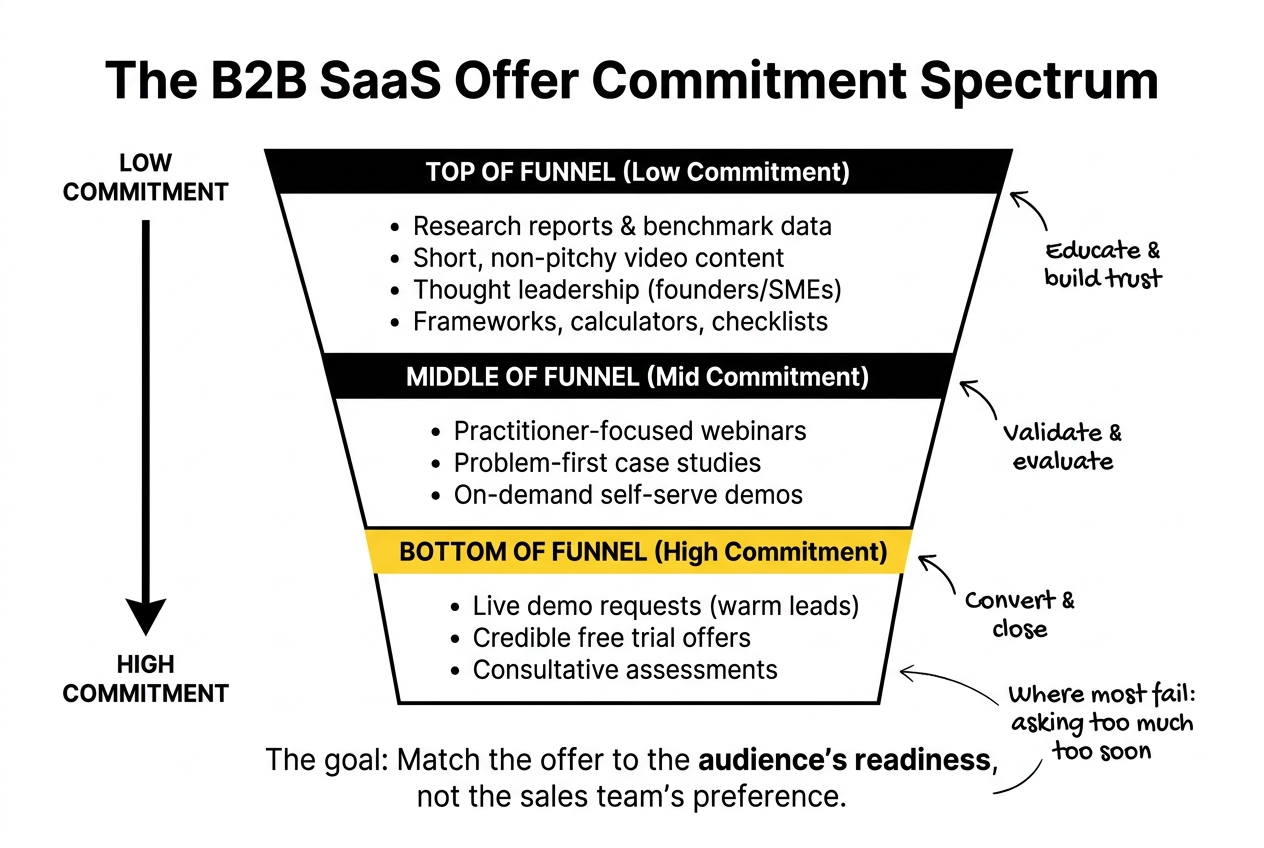
LinkedIn ad offers exist on a spectrum from low to high commitment. The channel works when you match the offer to where the person is in their buying journey.
Low-commitment offers (top of funnel):
- Research reports or benchmark data specific to your buyer’s industry
- Short video content that demonstrates a problem your product solves, without pitching
- Thought leadership content from your founders or subject-matter experts
- Original frameworks or diagnostic tools (a calculator, a self-assessment, a checklist)
Mid-commitment offers (middle of funnel):
- Webinars with a specific, practitioner-focused topic, not a product tour
- Case studies that lead with the customer’s problem and the business outcome, not your feature list
- On-demand demos that let prospects self-educate before speaking to sales
High-commitment offers (retargeting and warm audiences):
- Live demo requests from people who have already engaged with multiple content pieces
- Free trial offers where your product has a credible self-serve path
- Consultative assessment offers that position your team as experts, not sellers
What matters at the campaign level is that your offer matches your audience’s readiness, not just your sales team’s preference for bottom-funnel volume.
Optimising LinkedIn Ads for B2B Software Companies: Campaign Structure
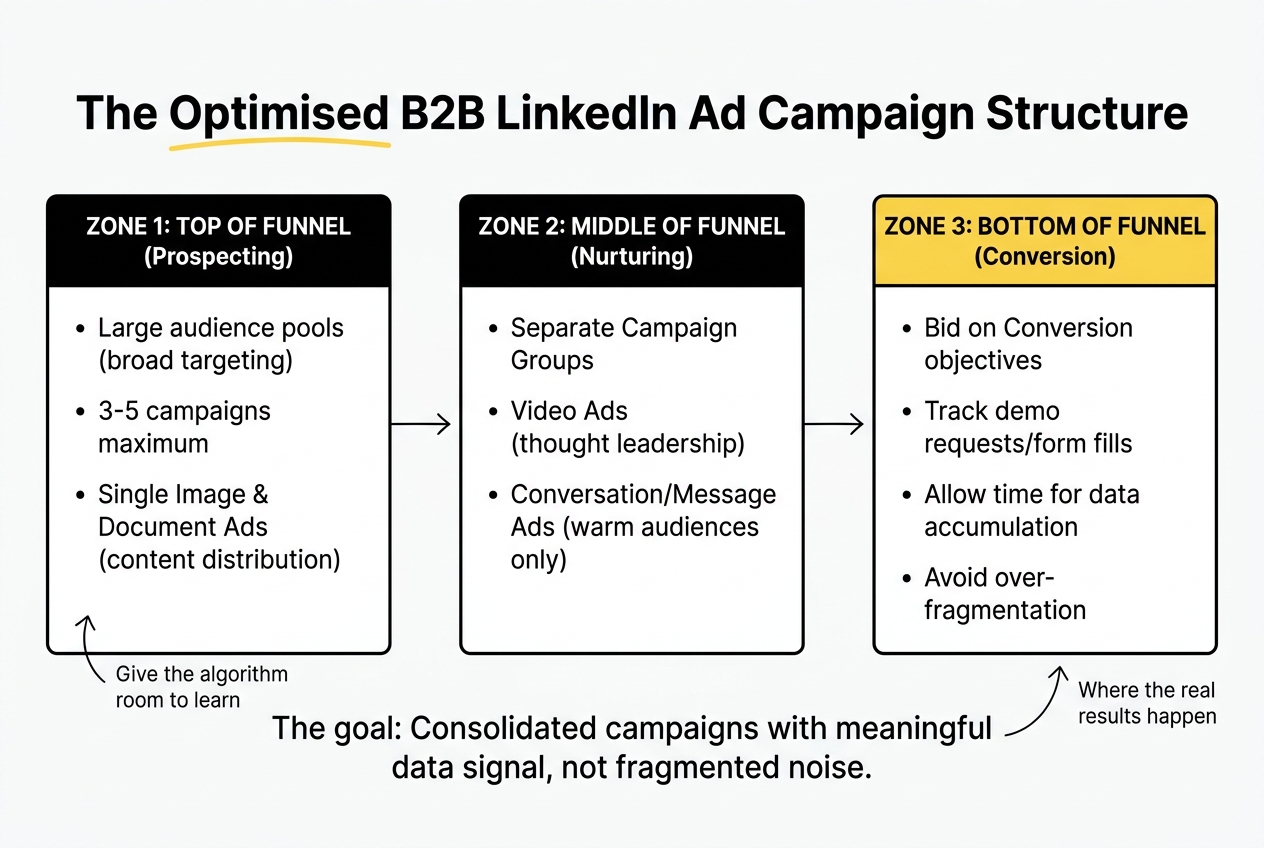
Good audience targeting and the right offer will not produce results if the campaign structure works against you. LinkedIn’s algorithm needs room to learn. Overly fragmented campaigns starve it of data.
Run fewer campaigns with larger audience pools. The instinct to segment by every variable produces campaigns that never accumulate enough data to exit the learning phase. Start with three to five campaigns maximum. Build in enough audience size for each to generate meaningful signal before you start making changes.
Use Campaign Groups to separate funnel stages, not audiences. Group your prospecting campaigns separately from your retargeting campaigns. This makes budget management cleaner and prevents retargeting audiences (which will always convert at higher rates) from inflating your prospecting metrics.
Match the ad format to the funnel stage. Single Image Ads and Document Ads work well for content distribution at the top of the funnel. Conversation Ads and Message Ads can work for warm audiences where you have enough signal that the outreach will not feel cold. Video Ads for short-form thought leadership are underused by most B2B SaaS teams and often produce stronger engagement-to-demo-request ratios than static image ads when the production quality is reasonable.
Bid on Conversion objectives, not Clicks. If you are tracking form submissions and demo requests as conversion events, tell LinkedIn’s algorithm to optimise for those events rather than just for clicks or impressions. This requires giving the algorithm time and data to work, which is another reason to avoid over-fragmentation.
A/B Testing for LinkedIn Ads: What Actually Produces Decisions
Most LinkedIn A/B testing produces inconclusive data. The reason is almost always insufficient scale. Two variants running against audiences of 5,000 people with a budget of £50 a day will not reach statistical significance in any timeframe that is useful for making decisions.
A/B testing on LinkedIn works when you test one variable at a time with enough scale to produce real signal.
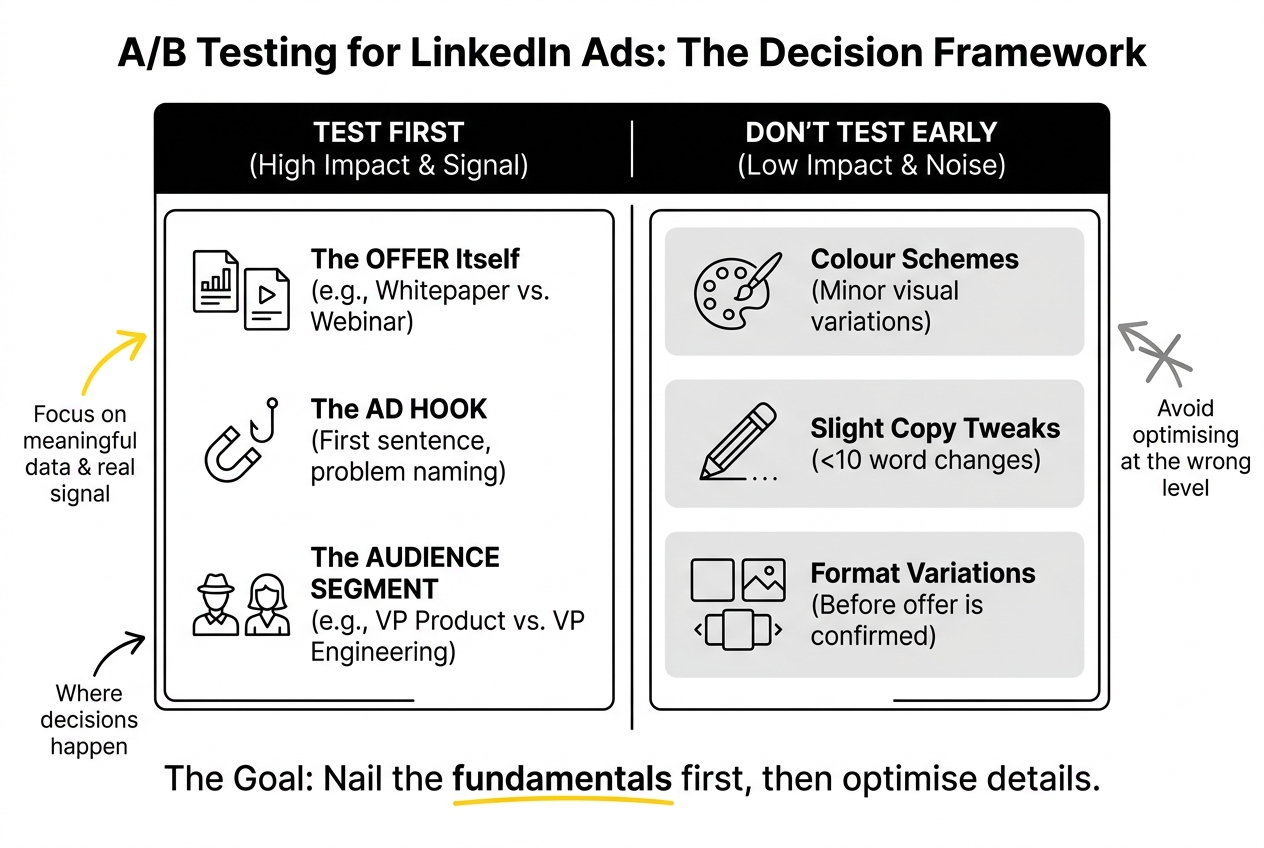
What to test first:
- The offer itself, not the creative. If you are running a whitepaper against a webinar registration to the same audience, that tells you something meaningful about what your ICP values. Testing two headlines for the same whitepaper tells you something much smaller.
- The hook in your ad copy. The first sentence of your LinkedIn ad is doing most of the work. Test different ways to name the problem your product solves.
- The audience segment. A VP of Product and a VP of Engineering might respond very differently to the same ad. Understanding which segment engages and converts at better rates is worth a structured test.
What not to waste tests on early in a campaign:
- Colour schemes or minor visual variations
- Slight copy tweaks that change fewer than ten words
- Format variations before you have found an offer that works
Testing creative details before you have confirmed the offer and audience is optimising at the wrong level. Nail the fundamentals first.
Tracking Customer Acquisition Cost Honestly on LinkedIn
LinkedIn attribution is imperfect. Last-touch attribution will undercount LinkedIn’s influence on deals that close weeks or months after the first touchpoint. Accepting this upfront changes how you measure the channel. Building a Scale-Ready SaaS PPC Engine After PMF: From Ad-Hoc to Operating System, also on this blog, takes this further.
The goal is consistent, directional data, not perfect attribution. Set up your tracking to capture what LinkedIn can reliably measure, and complement it with data from your CRM that LinkedIn cannot see.
What to set up as conversion events:
- Demo requests
- Free trial signups
- Webinar registrations (tracked separately from demo requests)
- High-intent page visits (pricing page, integration pages) via LinkedIn Insight Tag
What to track in your CRM alongside LinkedIn spend:
- First-touch and multi-touch attribution across all channels for leads that came through LinkedIn campaigns
- MQL-to-SQL conversion rates for LinkedIn-sourced leads, compared against other channel sources
- Cost-per-opportunity (not just cost-per-lead) for LinkedIn-sourced pipeline
CAC tracking requires connecting your LinkedIn spend to closed-won revenue in the CRM. If a marketing-qualified lead from LinkedIn closes as a £40,000 ACV deal six months later, attributing that to LinkedIn requires tracking the original source through the full sales cycle. This is a CRM hygiene problem as much as a LinkedIn tracking problem. The tracking needs to be in place before the campaigns run, not retrofitted afterward. Transforming Webinars into Revenue: A Playbook for SaaS Marketing Leaders, also on this blog, takes this further.
If your CAC payback period is 18 months and you are measuring LinkedIn performance at 90 days, you will make incorrect decisions about the channel. Set the measurement window to match your typical sales cycle length.
Measuring LinkedIn Paid Social Beyond Clicks
Click-through rates and impressions are signals, not outcomes. The metrics that belong in a board deck for a B2B SaaS LinkedIn campaign are:
- Cost-per-qualified-opportunity: How much LinkedIn spend generated each sales-qualified lead. Not every lead, only the ones that sales actually worked.
- LinkedIn-influenced pipeline: Total value of deals in the pipeline where LinkedIn was a touchpoint. This requires multi-touch tracking in the CRM.
- LinkedIn-influenced closed-won revenue: The ultimate output. Usually requires a 6-12 month window to measure properly for mid-market SaaS deals.
- MQL-to-SQL rate by channel: If LinkedIn-sourced leads convert to sales-qualified at 10% and Google Ads-sourced leads convert at 25%, the problem is either audience targeting or the offer type, not the channel itself.
Reporting on CTR and engagement rates is fine for internal optimisation decisions. It is not how you justify LinkedIn budget to a CFO or a board.
Common Mistakes B2B SaaS Marketers Make on LinkedIn
Naming these directly is more useful than a general warning about “LinkedIn pitfalls.”
Running bottom-funnel offers to cold audiences. A demo request ad served to someone who has never encountered your brand will produce low conversion rates and poor-quality leads from the small percentage who do convert. Warm them first.
Setting budgets below the threshold for learning. LinkedIn recommends a minimum daily budget that allows campaigns to exit the learning phase within two to three weeks. Campaigns that never accumulate enough data produce misleading metrics and algorithm decisions based on insufficient signal.
Ignoring the frequency cap. LinkedIn will keep serving the same creative to the same people if you do not manage frequency. An audience that has seen the same ad twelve times is not going to convert on the thirteenth. Rotate creative regularly, particularly for retargeting audiences where the audience pool is small.
Treating LinkedIn as a direct response channel for enterprise deals. Enterprise SaaS deals are not won through a LinkedIn ad click. They are won through a combination of brand exposure, thought leadership, warm handoffs from SDRs, and multiple touchpoints over months. Using LinkedIn only as a demand capture tool in an enterprise motion misses most of its value.
Optimising for CPL instead of quality. Lower cost-per-lead is not better if the leads do not convert. A £120 CPL that produces opportunities at a 20% rate is worth more than a £40 CPL that produces opportunities at 3%.
Frequently Asked Questions
How can B2B SaaS companies effectively use LinkedIn paid social for demand generation?
Focus LinkedIn paid social on creating demand at the top of the funnel rather than capturing it. Use the platform’s targeting precision to reach your ICP buying committee with high-value content offers: research, frameworks, and thought leadership. Reserve conversion-focused offers like demo requests for warm audiences who have already engaged. Pair this with transparent CAC tracking in your CRM so you can measure influence on pipeline and closed-won revenue, not just clicks.
What are the key components of a successful LinkedIn advertising strategy for B2B SaaS?
Four components matter most: a tightly defined audience built from your actual closed-won ICP rather than broad LinkedIn categories; offers matched to funnel stage rather than defaulting to demo requests; campaign structure that gives LinkedIn’s algorithm enough data to optimise; and measurement that tracks cost-per-opportunity and pipeline influence, not just cost-per-lead. Everything else is secondary.
How do you build and segment an audience on LinkedIn for B2B marketing?
Start with your ten best-fit closed-won accounts and extract the common characteristics: company size, industry, growth stage, and the titles of the people who championed the deal. Build your LinkedIn audience from that profile. Layer in exclusions for company sizes, industries, and existing customers that do not fit. Create separate audience segments for cold prospecting, CRM retargeting, and website retargeting. Run these as separate campaigns rather than mixing them.
What types of offers work best in LinkedIn ads for B2B SaaS?
It depends on where the prospect is in their journey. Cold audiences respond better to low-commitment offers: original research, diagnostic tools, or short-form thought leadership content. Mid-funnel prospects who have engaged with your brand previously are candidates for webinar registrations and case studies. High-commitment offers like demo requests should be reserved for retargeting audiences who have already demonstrated intent through multiple prior touchpoints.
How can performance metrics be tracked and reported effectively in LinkedIn campaigns?
Set up conversion tracking in LinkedIn Campaign Manager for all key actions: form fills, demo requests, and high-intent page visits via the LinkedIn Insight Tag. Complement this with CRM data that tracks LinkedIn-sourced leads through the full sales cycle to closed-won. Report internally on engagement metrics for optimisation decisions. Report to leadership on cost-per-opportunity, LinkedIn-influenced pipeline, and LinkedIn-influenced revenue.
What are the best practices for A/B testing in LinkedIn advertising?
Test one variable at a time. Prioritise offer type and audience segment over creative details, as these produce more actionable decisions. Ensure each variant has enough budget and audience size to reach statistical significance within a reasonable timeframe. Two variants in an audience of 5,000 people with a £50 daily budget will not produce useful data. If your audience is too small for rigorous testing, run variants sequentially rather than simultaneously.
How can marketers optimise their LinkedIn ad campaigns for lead quality?
Tighten audience targeting to reduce volume from outside your ICP. Use exclusions aggressively. Track MQL-to-SQL conversion rates for LinkedIn-sourced leads separately from other channels: if they are converting at below 10%, the problem is audience or offer quality, not volume. Align with your sales team on what a sales-qualified lead actually looks like, and make sure the form questions or qualification criteria for LinkedIn leads reflect that.
What strategies can be employed to lower customer acquisition costs on LinkedIn?
The most direct lever is improving MQL-to-SQL conversion rates rather than reducing CPL. Lower CPL often comes from lower audience quality. Focus on narrowing targeting to your actual ICP, improving offer quality to increase conversion rates from qualified prospects, and tracking CAC across the full cycle to closed-won rather than stopping at cost-per-lead.
How do you measure the success of LinkedIn paid social campaigns for B2B SaaS?
Set the measurement window to match your typical sales cycle. If enterprise deals close in six months, LinkedIn’s contribution to pipeline cannot be evaluated at 90 days. Track LinkedIn-influenced pipeline and closed-won revenue through multi-touch attribution in your CRM. Use engagement metrics and CTR for weekly optimisation decisions, not for reporting campaign success to leadership.
What common mistakes should B2B SaaS marketers avoid when using LinkedIn for paid social advertising?
The most common: running demo request ads to cold audiences who have never heard of your brand, setting budgets too low to exit LinkedIn’s learning phase, ignoring creative frequency so the same audience sees the same ad repeatedly, and measuring success on CPL rather than cost-per-opportunity. For enterprise SaaS in particular, treating LinkedIn as a direct response channel rather than a brand-building and demand-creation channel produces disappointing results.
If you are working through how to connect your LinkedIn campaigns to measurable pipeline, this is the kind of problem we dig into with SaaS marketing teams regularly. Worth a conversation if you are at that point: b2b saas digital marketing agency.