A Strategic Framework for Reducing SaaS CAC and Enhancing Lead Quality
How to reduce SaaS CAC and improve lead quality at the same time, without cutting budgets or narrowing the funnel too aggressively.

Your CAC chart is pointing the wrong way, and the board has noticed. The instinct is to do something visible before the next meeting: pause the expensive channels, tighten the lead form, push the scoring threshold higher. It feels like control. More often it trades one problem for two.
Reducing SaaS customer acquisition cost is rarely a spend problem in isolation. It is usually a quality problem wearing a budget costume. When the leads you buy are ones sales will not touch, every pound of media looks inefficient, because it is. The work is not to spend less. It is to spend on the pipeline that converts.
This is a framework for cutting SaaS CAC and boosting lead quality at the same time, without gutting the budget or narrowing the funnel so aggressively that you starve next quarter's pipeline.
The squeeze is structural, not a failure of your team
Acquisition has become more expensive for reasons outside any single team's control. 2026 benchmark data puts the median SaaS company at roughly two pounds of sales and marketing spend for every pound of new ARR, up materially since 2023. Paid channels carry much of that weight. Google Ads CPCs and LinkedIn ad costs have climbed steeply over the past few years, sales cycles have lengthened, and more stakeholders now sit on each deal.
At the same time, the addressable top of the funnel is shrinking. SparkToro's 2026 research with Similarweb found that fewer than one in three Google searches now sends a click to the open web, down from around 40 percent two years earlier. The clicks you can buy or earn are getting scarcer regardless of how good your campaigns are.
Investors have responded by changing what they reward. Efficiency metrics that used to be a footnote now appear in the majority of growth-stage term sheets. CAC payback and the LTV to CAC ratio have become boardroom language. The pressure you feel is real, and it is not going away.
That context matters because it reframes the goal. You are not trying to return to 2021 CAC. You are trying to make every acquisition pound land on pipeline that sales accepts and closes.
Why the obvious moves backfire
Two reactions are almost universal when CAC climbs, and both tend to raise it over the following two quarters.
The first is cutting budget across the board. Averaging the cut treats your best-performing channel and your worst the same way. You pull spend from the source producing sales-accepted opportunities alongside the one producing form-fills that never convert. Blended CAC might dip for a month as the pipeline you already generated closes, then it climbs as the top of funnel thins out.
The second is narrowing the funnel hard: stricter forms, higher scoring thresholds, tighter targeting overnight. Volume drops, which is the point, but it drops indiscriminately. You lose good-fit prospects who were early in their research alongside the tyre-kickers. Sales starves, and the leads that remain are not automatically higher quality. They are just fewer.
Both moves share the same flaw. They treat CAC as a number to be managed directly, when it is an output of decisions made further upstream.
What CAC actually measures
Customer acquisition cost is the fully loaded cost of winning one new customer. The CAC formula is straightforward:
CAC = total sales and marketing spend / number of new customers acquired
The average customer acquisition cost varies enormously by motion. Self-serve SaaS often sits in the low hundreds per customer, while sales-led enterprise acquisition can run into five figures, with the gap between the two wider in 2026 than it has ever been. Comparing yourself to a benchmark from the wrong motion is how teams end up solving a problem they do not have.
The formula also hides the thing that matters most. It counts customers in the denominator, so it says nothing about the quality of everything that did not convert. Two companies with identical CAC can have completely different pipelines underneath it: one built on leads sales fights over, the other on leads sales quietly ignores.
Reframe CAC and lead quality as the same lever
The most useful shift for a VP of Marketing under this pressure is to stop treating cost and quality as separate dials. They are the same dial viewed from two ends.
Cost-per-lead rewards volume. Cost-per-opportunity rewards fit. When you optimise to cost-per-lead, cheap low-intent sources look like winners, because they are cheap and they produce leads. Measured at the opportunity layer, those same sources are often your most expensive, because almost nothing they deliver survives contact with sales.
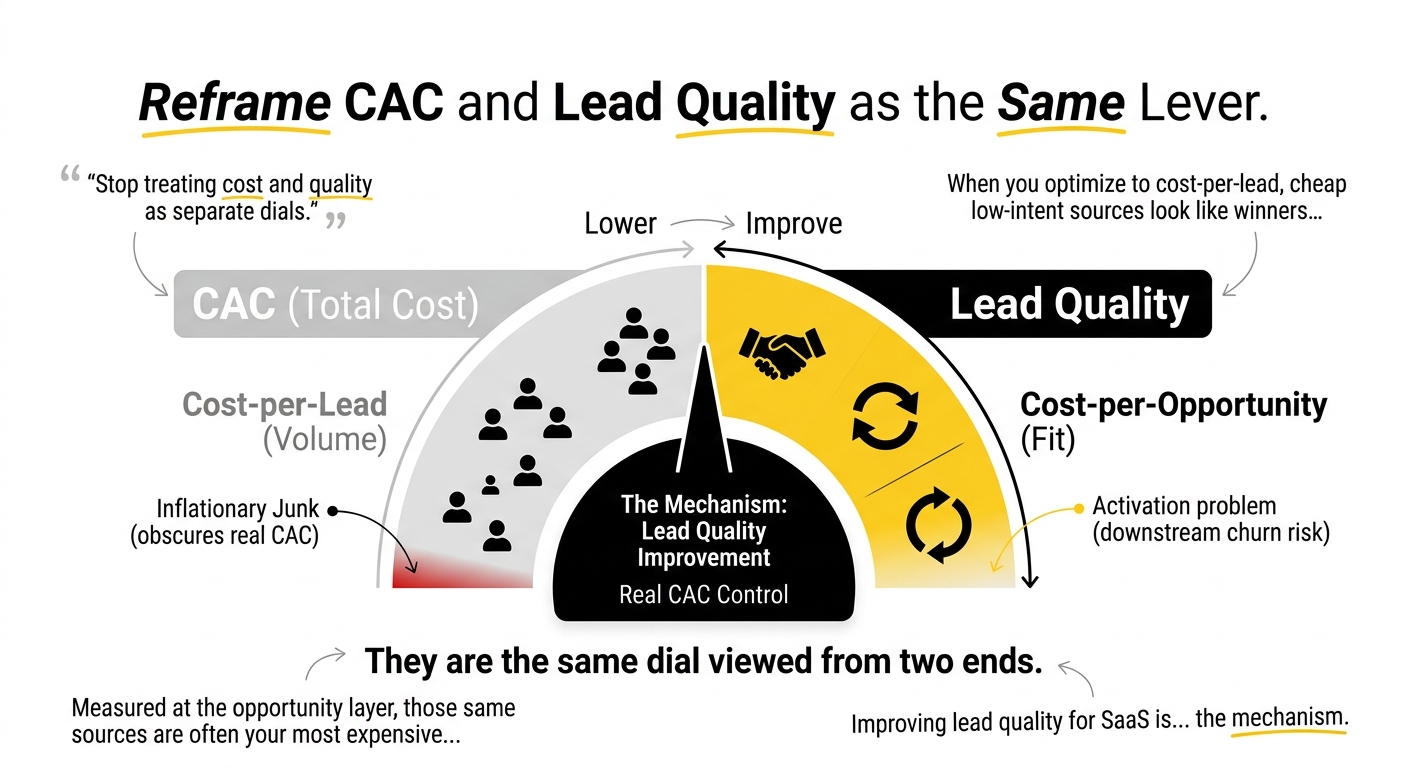
Low-quality leads inflate real CAC in ways the headline number obscures. Sales time spent disqualifying junk is acquisition cost that never shows up in a media report. So is the activation problem downstream: if a meaningful share of the customers you do win never reach first value, you have paid full price for revenue that churns. Improving lead quality for SaaS is not a separate initiative from lowering CAC. It is the mechanism.
A framework for lowering SaaS CAC without sacrificing lead quality
Four moves, in order. Each one compounds the next.
1. Measure at the opportunity and revenue layer
You cannot reduce what you cannot see, and lead-level dashboards hide the waste. Shift the reporting line down the funnel so channel decisions are made on what sales accepts, not on what fills a form.
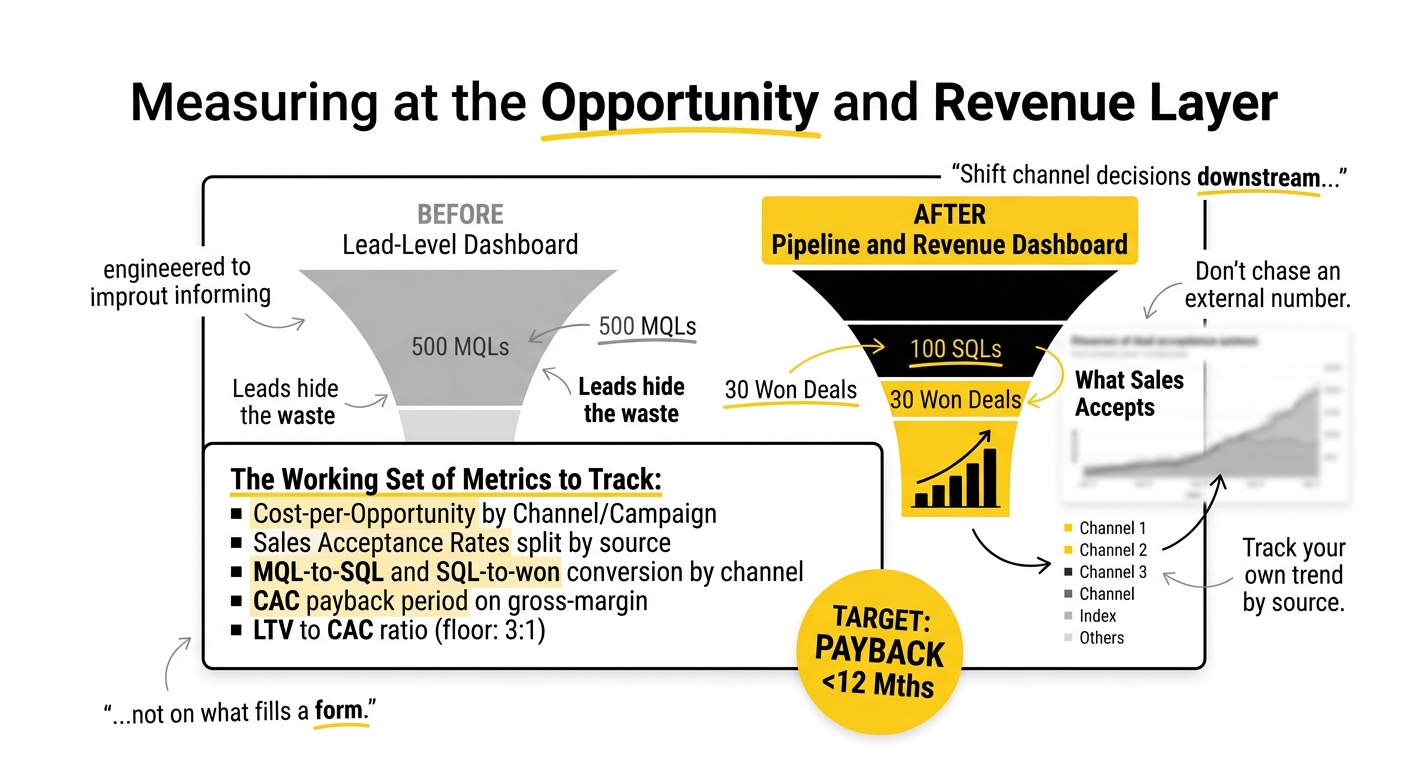
Track these as your working set:
- Cost-per-opportunity by channel and campaign, not cost-per-lead
- Sales acceptance rates (the share of MQLs sales agrees to work) split by source
- MQL-to-SQL and SQL-to-won conversion by channel, so you can see where each source dies
- CAC payback period, calculated on gross-margin contribution
- LTV to CAC ratio, with 3:1 as the working floor and payback under twelve months as the target
Note that MQL-to-SQL benchmarks vary wildly between published sources, from the low teens to well over 40 percent, because everyone defines an MQL differently. Do not chase an external number. Track your own trend by source and improve it.
2. Reallocate by channel role, not channel cost
Once you can see cost-per-opportunity by source, the reallocation is usually obvious, and it is rarely an across-the-board cut. It is a shift of spend from channels that produce cheap volume toward channels that produce accepted pipeline.
Give each channel a defined job. Demand capture channels, brand and high-intent search, exist to convert people already in-market. Demand creation channels build the future pipeline that capture later harvests. Problems start when teams fund capture as though it were infinite and expect it to scale forever. Capture has a ceiling set by how many people are actively looking, and in a shrinking-click environment that ceiling is lower every year.
Effective marketing spend means matching budget to the role, then judging each channel against the metric that role is responsible for. Marketing budget optimisation is not about finding the single cheapest source. It is about the mix that produces the most sales-accepted pipeline per pound.
The specific pitfalls of chasing efficiency inside paid media, the moves that look cheaper but quietly degrade lead quality, are a topic in their own right. We cover them in False Efficiency Gains in SaaS Paid Media That Damage Lead Quality.
3. Close the loop with sales
Lead quality is defined by sales, so the fastest quality gains come from a working feedback loop rather than a better scoring model. Most teams score leads on assumptions marketing made in isolation. The teams reducing CAC score them on what sales actually converts.
Set a standing rhythm where sales reports back on the leads they received: which converted, which were disqualified, and why. Feed that straight into targeting and scoring. Over a quarter or two this does more for sales acceptance rates than any tightening of the form, because it corrects the definition of quality at the source rather than filtering after the fact.
This is also the single most persuasive thing you can bring to a budget conversation. A VP who can show which channels produce accepted, closing pipeline, and which do not, is defending decisions with evidence rather than opinion.
4. Qualify upstream, before the click converts
The cheapest disqualification happens before you pay for the click. Targeting, offer, and message do more filtering than any form field. Clear ICP targeting, an offer pitched to genuine buyers rather than casual browsers, and messaging that names the problem your best customers actually have will thin out low-fit traffic without touching the funnel mechanics at all.
This is where lead quality improvement and conversion work meet. The tactical side of turning qualified traffic into sales-accepted opportunities, form design, page structure, offer sequencing, is covered separately in Conversion Optimisation for More Sales Accepted Opportunities from PPC.
The pitfalls that quietly raise CAC
A few common moves look like progress and are not:
- Optimising campaigns to cost-per-lead. You get more leads and a worse pipeline.
- Judging channels before the sales cycle completes. In SaaS the deal that justifies the spend closes months later. Pausing a channel at week six kills it before the evidence arrives.
- Treating all MQLs as equal in reporting. A demo request and a gated-ebook download are not the same lead. Averaging them hides everything.
- Cutting brand and demand creation first. They are the easiest to cut because their payback is slow, which is exactly why cutting them raises capture CAC a few quarters later.
Where to start
If you are under pressure this quarter, resist the visible move. Do not cut across the board and do not slam the funnel shut. Do this instead.
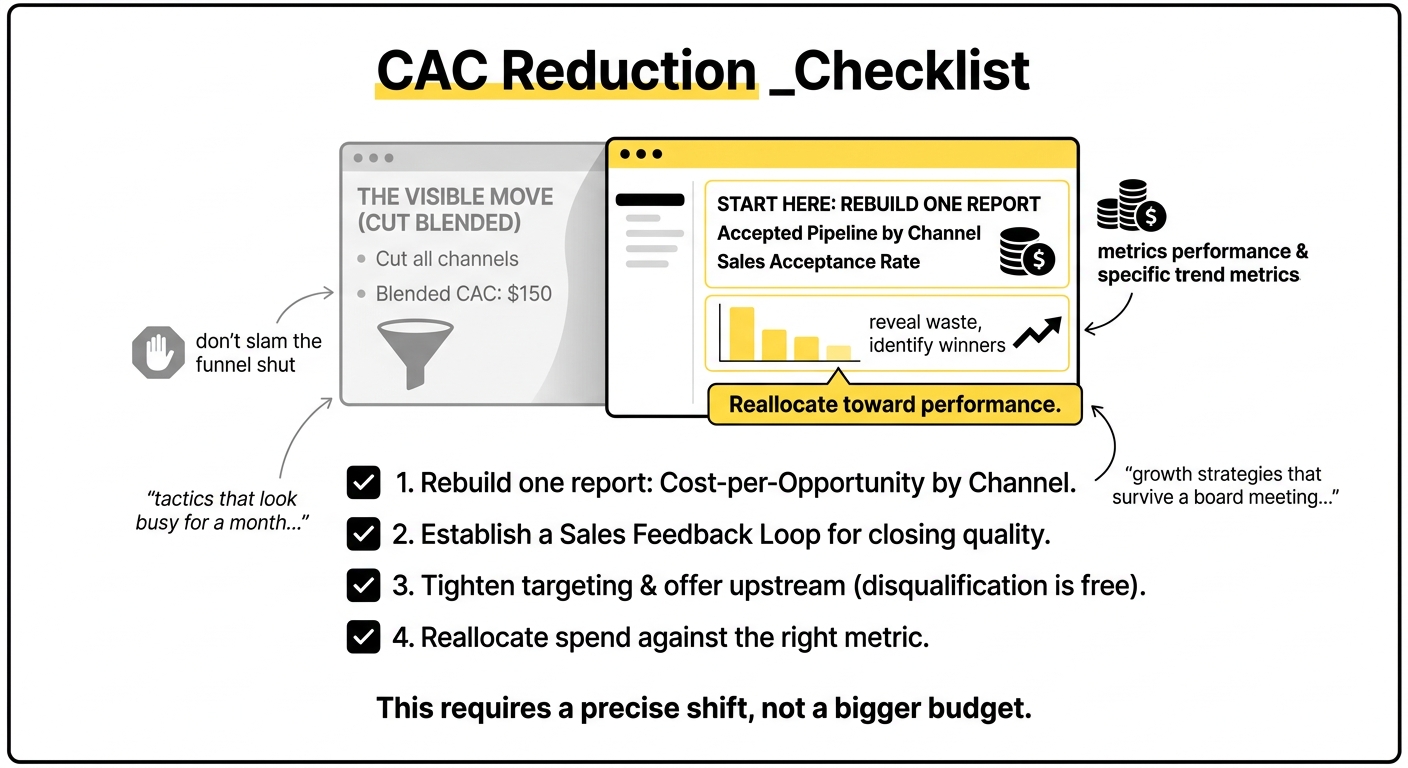
Start by rebuilding one report: cost-per-opportunity and sales acceptance rate by channel. That single view usually reveals that a small number of sources are carrying your accepted pipeline while others are inflating your blended CAC. Reallocate toward the former. Stand up the sales feedback loop so quality is defined by what closes. Then tighten targeting and offer upstream, where disqualification is free.
None of this requires a bigger budget. It requires spending the budget you have against the right metric. That is the difference between SaaS growth strategies that survive a board meeting and tactics that look busy for a month. For the wider picture of how paid media fits a SaaS growth engine, our SaaS PPC agency page sets out how we think about the whole system.
This is the exact exercise we run with SaaS teams when CAC and lead quality are both under scrutiny. If you are working through it and want a second read on where your spend is actually landing, we are happy to take a look.
Frequently Asked Questions
How can SaaS companies reduce Customer Acquisition Cost (CAC)?
Reduce CAC by shifting spend toward the channels that produce sales-accepted, closing pipeline rather than the cheapest leads. Measure cost-per-opportunity instead of cost-per-lead, build a feedback loop with sales so quality is defined by what converts, and qualify prospects upstream through targeting and offer. Cutting budget across the board or tightening the funnel indiscriminately usually raises CAC within two quarters because both starve the pipeline that justified the spend.
What strategies can improve lead quality in SaaS marketing?
The highest-leverage strategy is a working sales feedback loop: sales reports which leads converted and which were disqualified, and that data corrects targeting and scoring at the source. Beyond that, define your ICP tightly, pitch offers to genuine buyers rather than casual researchers, and score leads on behaviour that predicts conversion rather than on demographics alone. Quality is defined by what sales accepts, so build the definition from sales data, not marketing assumptions.
How do budget constraints affect lead generation in SaaS companies?
Budget constraints push teams toward cheap, high-volume channels, which often produce the leads sales will not touch. The result is a funnel that looks productive on a cost-per-lead dashboard but delivers little accepted pipeline. Constraints are manageable when spend is judged on cost-per-opportunity: you can hold the budget flat, reallocate toward sources that convert, and improve pipeline without spending more. The problem is rarely the size of the budget. It is what the budget is optimised against.
What are the best practices for minimising waste in SaaS marketing spend?
Judge every channel on cost-per-opportunity and sales acceptance rate, not on volume or cost-per-lead. Give each channel a defined role, capture versus creation, and hold it to the metric that role owns. Let the full sales cycle complete before ruling a channel in or out, since SaaS deals close months after the click. Qualify upstream through targeting and offer so low-fit traffic never becomes a paid lead in the first place.
How can sales acceptance rates be improved without limiting the lead funnel?
Improve acceptance rates by fixing the inputs rather than filtering the outputs. Sharpen ICP targeting and offer so the funnel attracts better-fit prospects from the start, and run a feedback loop where sales tells marketing which sources produce workable leads. This raises the quality of what enters the funnel without arbitrarily cutting volume. Slamming the form or scoring threshold shut lowers acceptance-eligible volume too, which starves sales rather than helping them.
What metrics should VPs of Marketing track to demonstrate ROI in SaaS?
Track cost-per-opportunity by channel, sales acceptance rate by source, MQL-to-SQL and SQL-to-won conversion, CAC payback period on gross-margin contribution, and LTV to CAC ratio. These connect spend to accepted, closing pipeline rather than to lead volume, which is the language boards and CFOs respond to. Vanity metrics like lead count and cost-per-lead rarely survive scrutiny because they do not show whether the spend produced revenue.
How can SaaS companies balance budget constraints with the need for a strong pipeline?
Balance the two by reallocating rather than cutting. Move spend from channels producing cheap, low-acceptance leads toward those producing sales-accepted opportunities, so the same budget generates more usable pipeline. Protect demand creation even under pressure, since cutting it first lowers capture efficiency a few quarters later. The goal is not minimum spend. It is maximum accepted pipeline per pound, which keeps the funnel strong while the budget stays flat.
How can VPs of Marketing defend their budget decisions effectively?
Defend budget with pipeline evidence, not activity metrics. A view of cost-per-opportunity and sales acceptance rate by channel shows exactly which spend produces accepted, closing revenue and which does not. That reframes the conversation from "marketing is expensive" to "here is the spend generating pipeline and here is the spend we are cutting." Decisions backed by conversion data through to closed-won are far harder for a CFO to challenge than lead-volume reports.