When LinkedIn Should Lead Your SaaS Media Plan
Discover when LinkedIn should be your primary SaaS demand channel and how to evaluate agency capabilities for qualified pipeline growth.

Your pipeline review comes around and the numbers look awkward. MQL volume is healthy. Cost per lead is within range. The sales team is getting handed something every week. But cost-per-opportunity is climbing, deal size is inconsistent, and the closed-won rate from paid channels has flattened for three quarters in a row.
The problem is usually not the channels. It is the sequence in which they were chosen.
Most B2B SaaS teams build their media plan around what is cheapest or most familiar, then retrofit LinkedIn when everything else stalls. That is backwards. For a specific set of companies, in specific circumstances, LinkedIn should anchor the media plan from the start, with other channels built around it. This article sets out when that is true, what it requires to work, and how to evaluate whether an agency is capable of running it properly.
What B2B Demand Generation Actually Means on LinkedIn
Demand generation in the SaaS context is the systematic work of creating awareness and intent in people who are not yet in market, so that when they do enter a buying cycle, your product is already in the conversation. That is distinct from demand capture, which targets people already searching.
LinkedIn sits firmly on the demand creation side. The audience is not searching for your product when your ad appears. They are scrolling through professional content, consuming thought leadership, and absorbing signals about which vendors are worth paying attention to. Your ads and sponsored content intercept that process. Done well, they shift perception. Done badly, they produce clicks from people who were never going to buy anything.
What makes LinkedIn structurally different from Google or Meta is the quality of professional identity signal. Job title, seniority, company, industry and skills are all verified by the user because their reputation depends on it. No other platform offers that level of ICP precision at scale. For a B2B SaaS company selling to a defined set of roles in a defined set of company types, that precision is the entire argument for being there.
According to Dreamdata’s 2025 analysis, LinkedIn now captures 41% of total B2B ad budgets, up two points year-on-year, while non-branded search dropped from 37% to 33% in the same period. B2B marketers are reallocating toward LinkedIn. The question is whether they are doing it at the right time and with the right infrastructure.
When LinkedIn Should Lead the Media Plan
Not every SaaS company should lead with LinkedIn. The platform is expensive relative to other paid channels. A CPL of £75 to £150 via Lead Gen Forms, and £100 to £250 via landing pages, is the working benchmark for mid-market B2B SaaS in 2026. That is not inherently wrong, but it demands certain conditions to be viable.
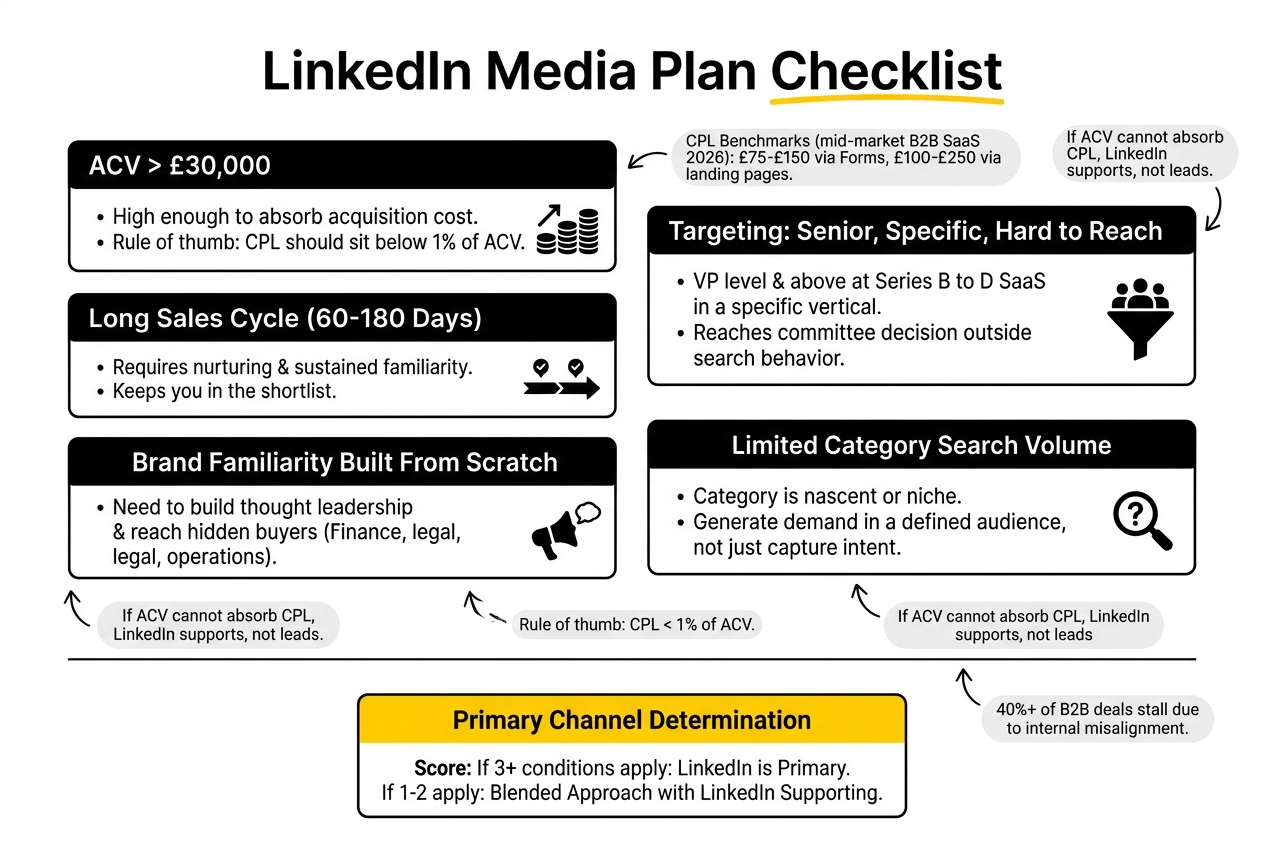
LinkedIn earns the leading position when:
- ACV is high enough to absorb the acquisition cost. A £150 CPL is efficient if your ACV is £30,000 or above and your MQL-to-deal rate is reasonable. Against a £5,000 ACV product, the same CPL requires near-perfect conversion at every stage. The rule of thumb is that CPL should sit below 1% of ACV. If it cannot, LinkedIn should support other channels, not lead them.
- Your ICP is senior, specific, and hard to reach elsewhere. If you need to reach VP-level and above at Series B to D SaaS companies in a specific vertical, LinkedIn’s targeting is unmatched. Google can reach people searching for a solution. It cannot select for seniority, company headcount and job function simultaneously. If your product requires a committee decision involving roles that sit outside search behaviour entirely, LinkedIn is your only credible reach channel.
- The sales cycle is long and requires nurturing. Short sales cycles, particularly in PLG motions, often perform better with intent-based capture on search. LinkedIn’s strength is creating and sustaining familiarity over a buying cycle that may last months. If your average deal takes 60 to 180 days to close from first touch, the repeated exposure LinkedIn enables is not a luxury. It is what keeps you in the shortlist.
- Organic search volume for your category is limited. If the category you play in is either nascent or niche, the total addressable search demand may not be large enough to build a full pipeline from. LinkedIn lets you generate demand in a defined audience regardless of whether they are searching. For early-stage or category-creating SaaS products, this is often the primary channel argument.
- Brand familiarity needs to be built from scratch. The 2025 Edelman-LinkedIn B2B Thought Leadership Impact Report found that 79% of hidden buyers (the finance, legal, compliance and operations stakeholders who shape decisions from the background) are more likely to support proposals from vendors who publish strong thought leadership. More than 40% of B2B deals stall due to internal misalignment. LinkedIn advertising, paired with organic content, reaches those stakeholders before the sales conversation begins.
If three or more of these conditions apply to your business, LinkedIn should be the primary channel with other platforms in a supporting role. If only one or two apply, a blended approach with LinkedIn as a secondary layer is more appropriate.
The Infrastructure LinkedIn Requires to Work
The cost of LinkedIn advertising is not the CPL. The cost is the CPL multiplied by whatever happens to those leads downstream. Teams that run LinkedIn campaigns without the supporting infrastructure in place routinely generate expensive, low-converting leads and conclude the platform does not work. Often, the platform worked fine. The plumbing was broken.
Before a LinkedIn media plan scales, these elements need to be in place:
CRM integration and lead routing. Lead Gen Forms feed into HubSpot, Salesforce or Pipedrive via native integration or Zapier. Every lead captured needs an immediate, properly attributed entry in the CRM, assigned to the right rep, with source data intact. If a LinkedIn lead lands in a spreadsheet or sits in Campaign Manager with no downstream tracking, you cannot measure cost-per-opportunity, and everything becomes guesswork.
A defined offer architecture. LinkedIn works best when each campaign stage has a specific, stage-appropriate offer. Top of funnel might be a report or benchmark data. Middle of funnel is a demo request or consultation. Bottom of funnel is direct sales outreach from a named rep. Running the same offer at all stages produces the right metrics for the wrong audience or the wrong metrics for the right audience. Neither is useful.
Marketing automation with lead scoring. Not every LinkedIn lead is sales-ready. A director who downloads a whitepaper needs a different follow-up sequence than one who requests a demo. Marketing automation handles that routing. Without it, sales receives every lead simultaneously and treats them all the same, which produces the complaint that marketing sends leads sales will not touch.
A minimum viable budget. LinkedIn’s minimum daily budget is £10 per campaign, but that produces no statistically useful data. A realistic testing budget for one campaign is £3,000 to £5,000 per month. Below that, the platform’s algorithm cannot optimise, and you are essentially paying for market research rather than pipeline generation.
A clear attribution model. LinkedIn operates largely in dark social territory. People see an ad, do not click, and later search for the brand directly or respond to a cold email. Last-touch attribution assigns that deal to search or SDR. Multi-touch or first-touch models credit LinkedIn more accurately. The attribution model needs to be agreed before the campaign launches, not debated after the first quarter of spend.
Best LinkedIn Strategies for SaaS Marketing: What Actually Produces Pipeline
Most LinkedIn campaigns for SaaS companies are technically correct and strategically underpowered. The targeting is sensible. The creative is professionally produced. The offer is a demo request. And the pipeline contribution is marginal because nothing in the campaign sequence builds the familiarity required to convert a cold ICP into a sales conversation.
The campaigns that produce qualified pipeline consistently share three characteristics.
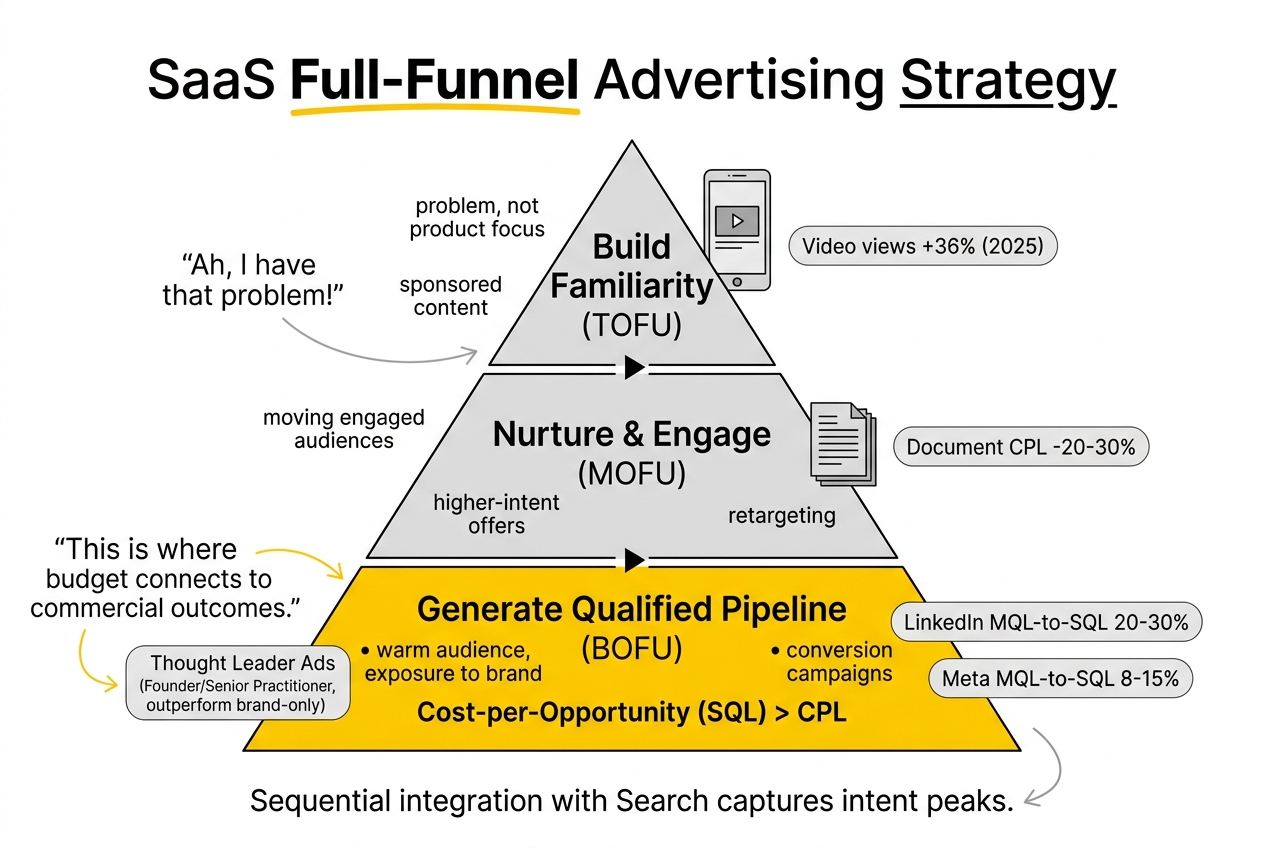
They operate full-funnel, not just at conversion. Top-of-funnel Sponsored Content builds familiarity with the problem the product solves, not the product itself. Middle-funnel retargeting moves engaged audiences toward higher-intent offers. Bottom-funnel conversion campaigns target the warm audience already exposed to brand messaging. Running only the conversion layer without building the audiences above it is like running paid search without any brand awareness and wondering why quality scores are low.
They use content formats that earn attention. Document Ads consistently deliver the lowest CPL on LinkedIn, often 20-30% below equivalent Sponsored Content in the same campaign. Thought Leader Ads, where sponsored content appears from an individual founder or senior practitioner rather than the company page, tend to outperform brand-only content significantly. Video is growing, with LinkedIn video views up 36% in 2025. The format distribution matters as much as the budget level.
They track cost-per-SQL, not cost-per-lead. CPL is a diagnostic metric. The metric that belongs in a board deck is cost-per-opportunity. A LinkedIn-sourced lead that converts to a qualified opportunity at 25% is more valuable than a cheaper lead from another channel converting at 8%, even if the CPL looks unfavourable in isolation. According to 2026 benchmarks, LinkedIn delivers MQL-to-SQL conversion rates of 20 to 30%, compared to 8 to 15% for Meta. The cost per SQL gap is often smaller than the CPL gap suggests.
For SaaS companies working with a SaaS PPC agency, this full-funnel approach also requires alignment with search campaigns. LinkedIn warms the audience. Search captures them when intent peaks. The two channels are not alternatives. They are sequential.
Evaluating SaaS Marketing Agencies Specialising in LinkedIn Advertising
The number of agencies claiming LinkedIn expertise has grown in proportion to LinkedIn ad spend. Most offer the same surface-level capability: campaign setup, targeting, creative production, monthly reporting. What separates agencies that build sales pipeline from agencies that report impressions and leave the pipeline question unanswered is a narrower set of characteristics.
Ask for pipeline attribution, not platform metrics. Any agency can show you a CPL declining over a campaign flight. The right question is how LinkedIn-sourced leads convert through the pipeline relative to other channels, and how that is tracked. If the agency cannot answer this, or has no framework for connecting Campaign Manager data to CRM outcomes, they are not equipped to manage LinkedIn as a demand generation channel. They are equipped to manage it as a performance advertising channel, which is different.
Look for vertical SaaS experience. LinkedIn strategy for a Series A HR tech company is not the same as LinkedIn strategy for an enterprise cybersecurity platform. The audiences, the content that resonates, the offer cadence and the sales cycle shape every structural decision. An agency with a relevant vertical track record can move faster and make fewer costly targeting errors in months one and two.
Test their CRM integration knowledge. Before campaign launch, a capable agency should map how leads flow from LinkedIn Campaign Manager into your CRM, how they are scored, and how follow-up sequences are triggered. If this conversation does not happen during scoping, the agency is treating your campaigns as an isolated channel rather than part of a pipeline system.
Ask about thought leadership amplification. The strongest LinkedIn campaigns for SaaS brands combine paid distribution with organic content from founders and senior practitioners. If the agency only manages paid and has no view on how organic content interacts with campaign performance, they are missing the structural advantage LinkedIn offers over other paid channels. The 2025 Edelman data is clear: buyer receptivity increases significantly when thought leadership accompanies sales and marketing outreach.
Require transparency on minimum budget and expected timeline. Agencies that overpromise in month one are usually padding their pitch. LinkedIn campaigns typically need 60 to 90 days to produce reliable pipeline data. A realistic agency sets that expectation upfront and proposes a phased approach: audience building and testing in months one and two, conversion optimisation in months three and four, and full-funnel scaling from month five onwards.
Measuring LinkedIn Advertising Effectiveness
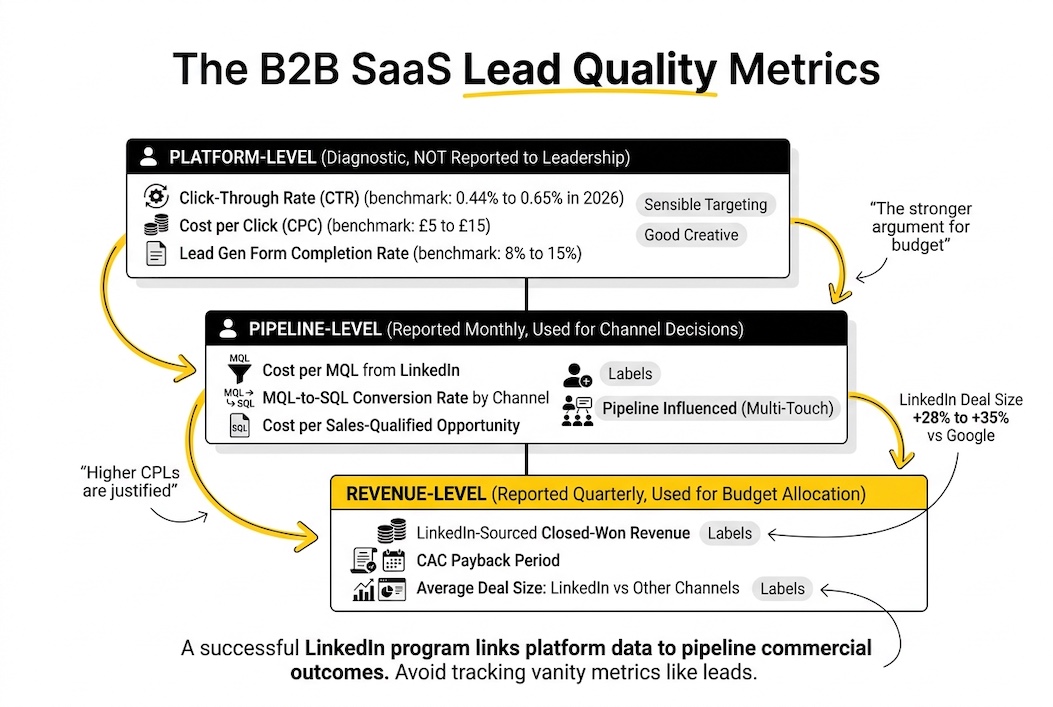
The metrics that matter for LinkedIn in a SaaS demand generation context split into three categories.
Platform-level (diagnostic, not reported to leadership):
- Click-through rate (benchmark: 0.44% to 0.65% for B2B SaaS in 2026)
- Cost per click (benchmark: £5 to £15 for B2B SaaS)
- Lead Gen Form completion rate (benchmark: 8% to 15%)
Pipeline-level (reported monthly, used for channel decisions):
- Cost per MQL from LinkedIn
- MQL-to-SQL conversion rate by channel
- Cost per sales-qualified opportunity
- Pipeline influenced (multi-touch, not last-touch)
Revenue-level (reported quarterly, used for budget allocation):
- LinkedIn-sourced closed-won revenue
- CAC payback period for LinkedIn-originated deals
- Average deal size: LinkedIn vs other channels
LinkedIn consistently delivers deal sizes 28% to 35% larger than Google-sourced deals, according to GrowthSpree’s analysis of over £60M in managed LinkedIn spend across B2B SaaS accounts. That premium justifies higher CPLs in most enterprise SaaS contexts. If you are not tracking deal size by source, you are leaving the strongest argument for LinkedIn budget on the table.
Common Mistakes in LinkedIn Advertising for SaaS
A few patterns appear repeatedly in accounts that underperform.
Running conversion-only campaigns without building the warm audience first. Cold decision-makers asked for a demo from a brand they have never encountered convert poorly. Building a retargetable audience through content engagement before pushing bottom-funnel offers typically reduces cost per opportunity by 30% to 40%.
Targeting too broadly to reduce CPL. Expanding targeting to reduce cost per click produces cheaper leads from less relevant audiences. The right optimisation is toward cost per SQL, which often means tighter targeting with higher CPLs.
Ignoring the minimum daily budget constraint. Spreading budget across too many campaigns starves each one of the impression volume needed for LinkedIn’s algorithm to learn. Three well-funded campaigns consistently outperform ten underfunded ones.
Using only the company page as the content source. Personal profiles from founders and practitioners reach further organically and generate higher engagement in paid formats. Thought Leader Ads exist specifically for this reason.
Frequently Asked Questions
When should LinkedIn advertising take precedence in a B2B SaaS media plan?
LinkedIn should lead when your ACV is high enough to absorb CPLs of £75 to £150 or above, your ICP is senior and role-specific in ways that search cannot target accurately, your sales cycle extends beyond 60 days, and organic search volume in your category is limited. If three or more of these conditions apply, LinkedIn earns the primary budget allocation.
What are the key benefits of using LinkedIn for demand generation in SaaS companies?
LinkedIn’s primary advantage is ICP precision. Job title, seniority, company size, industry and skills are self-reported and regularly updated, giving advertisers access to decision-maker audiences unavailable on any other platform. The secondary benefit is deal quality: LinkedIn-sourced pipeline typically converts to closed-won at higher rates and larger deal sizes than equivalent leads from Meta or display.
How can SaaS marketing agencies optimise LinkedIn campaigns for better ROI?
The most reliable optimisation path runs through offer architecture and funnel structure rather than bidding strategy. Build audience pools through content at the top of the funnel before pushing conversion offers. Use Document Ads and Thought Leader Ads for the best CPL efficiency. Track cost-per-SQL rather than CPL, and align LinkedIn reporting to CRM outcomes rather than platform metrics.
What criteria should be used to evaluate SaaS marketing agencies specialising in LinkedIn advertising?
Ask for evidence of pipeline attribution, not just platform performance. Confirm they understand how LinkedIn leads integrate with your CRM and marketing automation. Look for vertical SaaS experience relevant to your product category. Require a realistic timeline (90 days minimum before meaningful pipeline data exists) and a phased approach to scaling.
What are the essential elements for a successful LinkedIn advertising strategy?
CRM integration with proper attribution, a segmented offer architecture across funnel stages, marketing automation for lead scoring and routing, a minimum viable monthly budget (£3,000 to £5,000 for initial testing), and an agreed attribution model before the campaign launches. Without these, LinkedIn will produce leads. It will not reliably produce pipeline.
How can demand generation leaders measure the effectiveness of LinkedIn advertising?
Use platform metrics (CTR, CPL) diagnostically for optimisation decisions. Report on MQL-to-SQL conversion rate, cost-per-opportunity and pipeline influenced at the monthly level. Assess closed-won revenue and CAC payback quarterly. The metric that justifies or challenges LinkedIn investment in a board conversation is cost-per-opportunity compared across channels, not CPL.
What common mistakes should be avoided when advertising on LinkedIn for SaaS?
Running conversion-only campaigns without warming audiences first. Expanding targeting to reduce CPL at the expense of lead quality. Spreading budget too thinly across campaigns so none achieve sufficient impression volume. Relying solely on company page content rather than using Thought Leader Ad formats.
How does LinkedIn advertising compare to other social media platforms for B2B marketing?
LinkedIn’s CPL is higher than Meta (£75 to £150 versus £25 to £60), but LinkedIn-sourced leads convert to sales opportunities at 20% to 30%, compared to 8% to 15% for Meta. The cost-per-opportunity gap is smaller than the CPL gap implies. LinkedIn is the right channel when ICP precision and deal quality matter more than raw lead volume.
What role does content play in LinkedIn advertising for SaaS companies?
Content determines whether paid distribution produces pipeline or produces vanity metrics. Problem-centric thought leadership at the top of the funnel builds the audience that conversion campaigns later target. The 2025 Edelman-LinkedIn B2B Thought Leadership Impact Report found that 79% of hidden buyers, the internal stakeholders who shape but do not sign purchasing decisions, are more likely to support vendors that produce strong thought leadership consistently.
How can collaboration between marketing and sales teams be enhanced through LinkedIn strategies?
Align on what constitutes a sales-ready lead before campaigns launch. Agree on the follow-up sequence for LinkedIn-sourced leads at each funnel stage. Share MQL-to-SQL data back to the demand gen team monthly so targeting and offer decisions are informed by sales feedback. LinkedIn campaigns that run in isolation from the sales team typically produce leads sales will not touch.
If your demand gen strategy is at the point where LinkedIn allocation is under discussion, we are happy to look at the specifics. This is the kind of channel-mix question we work through with SaaS teams regularly. Worth a conversation if you are at that point.