Elevate Your SaaS Growth with a Strong PPC Agency Process

You review the monthly report. Spend is on plan. Click-through rate is up. Then the CFO asks how much of that translated into pipeline, and nobody in the room can answer with confidence. This is the moment most SaaS CMOs realise their PPC agency has a reporting process, not an account management process.
Those are different things. A reporting process tells you what happened in the ad platform. An account management process tells you why it happened, what changes next, and how confident you can be in that recommendation. For mid-market and enterprise SaaS, where sales cycles run months and multiple stakeholders touch every deal, that difference determines whether paid media becomes a predictable growth engine or a recurring source of board-level doubt.
What an Effective PPC Agency Approach for SaaS Account Management Actually Looks Like
An effective PPC agency approach for SaaS account management is a documented, repeatable system of onboarding, review, and quality control that connects ad spend to pipeline, rather than a loose collection of optimisation tasks performed whenever time allows. The process exists independently of any one account manager. It survives staff changes, client-side reorganisations, and the inevitable weeks when everyone is busy.
This matters more in SaaS than in most other verticals. B2B SaaS sales cycles run from weeks to many months, involve buying committees rather than single decision-makers, and rarely convert on the first touch. A PPC agency process for SaaS has to account for all three, which means the process itself needs to be more rigorous than what a transactional or e-commerce account requires.
Three things distinguish a genuinely robust process from a reactive one:
- A fixed cadence of reviews that happens whether or not something has gone wrong
- Documentation that exists independently of any single person’s memory
- Quality assurance checks that catch problems before the client notices them, not after
Reactive Account Management vs a Proactive, Scalable Process
Reactive account management looks fine until something breaks. Campaigns run, small adjustments happen when someone notices a metric drift, and the client hears from the agency mainly when there is good news to share or a fire to explain. It works, until the account manager goes on leave, or spend scales past what a single person can watch closely, or a platform change quietly erodes performance for three weeks before anyone catches it.
A proactive process assumes all three of those things will eventually happen and builds around them. Structured onboarding means a new account manager can pick up the account without losing context. Documented QA rituals mean problems get caught on a Tuesday review, not discovered by the client on a Friday. Clear reporting standards mean the CMO can walk into a board meeting without needing to translate platform jargon into revenue language themselves.
The distinction is not about working harder. It is about whether quality depends on individual effort or on a system that holds regardless of who is running the account that week.
The Core Process: Onboarding, Cadence, and QA Rituals
.jpg)
Structured Onboarding
A strong SaaS PPC agency methodology starts before the first campaign goes live. Onboarding should establish the account structure, conversion tracking, CRM integration, and baseline KPIs before spend increases past a testing budget. Skipping this step is the single most common reason accounts underperform in the first ninety days: budget gets allocated against assumptions nobody validated.
For a Series B analytics platform moving from an in-house team to an agency, a proper onboarding process typically covers account structure and historical performance audit, conversion tracking and CRM connection (HubSpot, Salesforce, or Pipedrive), agreement on which metrics count as capture KPIs versus demand-generation KPIs, and a documented 30/60/90 plan that is honest about what month one can realistically deliver. None of this is glamorous. All of it is what prevents the CMO from discovering in month four that the agency has been optimising toward the wrong definition of success.
Weekly and Monthly QA Rituals
Quality assurance in PPC for SaaS is not a single audit performed at kickoff. It is a recurring ritual with a fixed checklist, run whether or not anything appears to be wrong. Reactive agencies check accounts when a metric looks off. Proactive ones check on a schedule, because the metrics that matter in SaaS (assisted conversions, multi-touch pipeline influence, sales-qualified rate) do not always show up as an obvious red flag in a weekly dashboard.
A defensible QA cadence includes:
- Weekly: budget pacing, conversion tracking integrity, negative keyword and audience exclusion checks, and a scan for any account-level anomalies
- Monthly: full performance review against the agreed KPIs, competitive landscape check, and a documented set of recommendations tied to specific budget or targeting changes
- Quarterly: strategic review against the original 30/60/90 plan, with an honest assessment of what should change for the next quarter
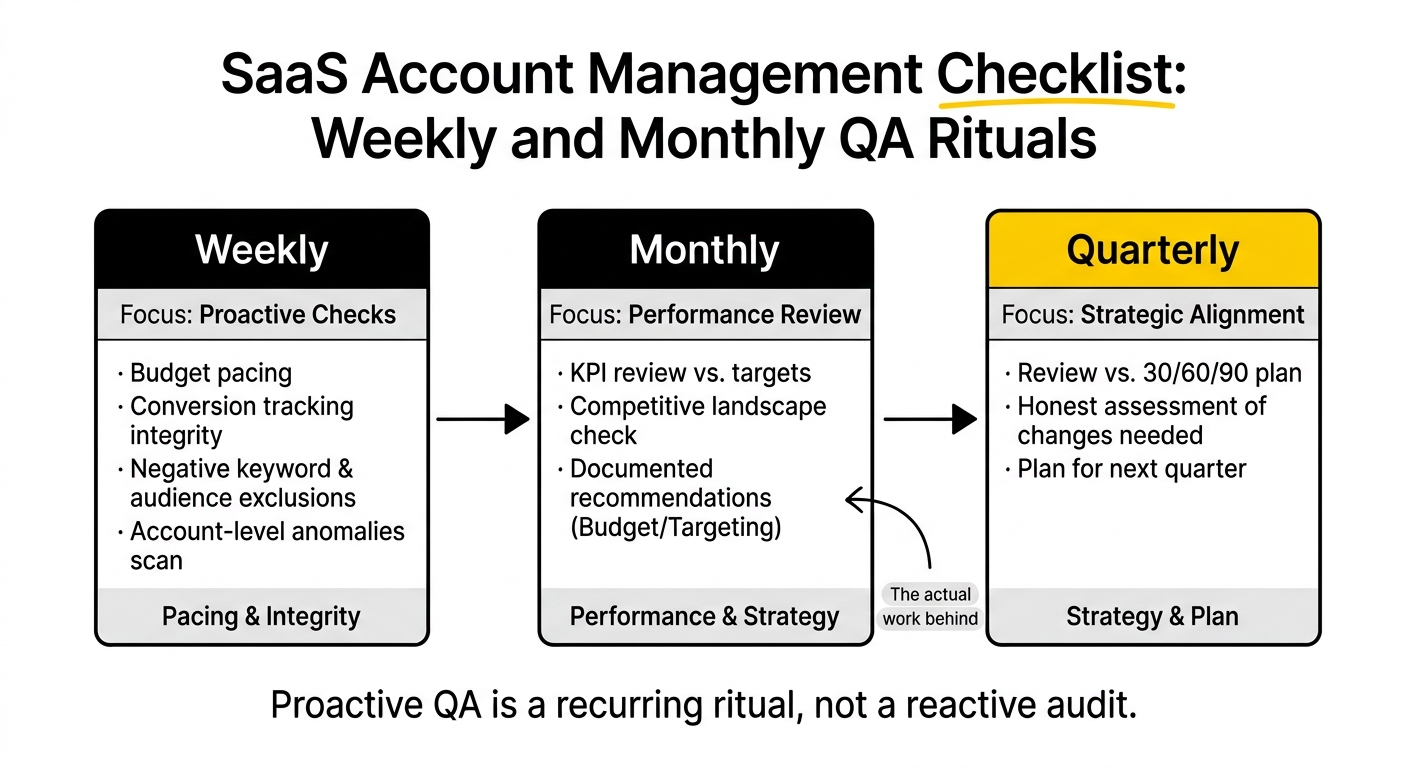
The point of documenting this cadence is that it becomes checkable. A CMO evaluating a prospective agency can ask what the QA ritual actually looks like week to week, and a strong agency should be able to answer in specifics, not in generalities about being “hands-on.”
Documentation Standards
Documentation standards are what make a PPC agency process for SaaS auditable rather than anecdotal. Every significant account change (a new campaign structure, a bid strategy shift, a landing page test) should be logged with the reasoning behind it and the result it produced. This is not bureaucracy for its own sake. It is what allows a new team member to understand why the account looks the way it does, and what allows a CMO to trace a specific recommendation back to the data that justified it.
The absence of this discipline is usually invisible until it becomes a problem: a senior strategist who built the account leaves, a junior account manager inherits it with no record of past decisions, and the client spends the next quarter re-explaining context the agency should already have had.
Attribution Clarity: The Piece Most Reporting Gets Wrong
Attribution clarity in PPC campaigns is one of the hardest problems in B2B SaaS, and a strong agency process does not pretend otherwise. Platform-reported conversions, CRM-recorded leads, and closed-won revenue rarely line up cleanly, because a meaningful share of buyer research happens before a prospect ever fills out a form. That gap is often called the dark funnel: the research, peer conversations, and community mentions that shape a shortlist long before a demo request appears in a CRM.
A defensible approach does not try to solve this with a single tool. It blends platform and CRM data with self-reported attribution, typically an open-text “how did you hear about us” field on every demo or trial form, and treats the resulting picture as directionally accurate rather than perfectly precise. Attribution will never be perfect in a sales cycle this long and this complex. The goal is consistent, directional data that the whole team trusts enough to act on, not a single dashboard number that looks precise but hides the gaps underneath it.
This is also where agency documentation earns its keep. If attribution windows, tracking setup, and CRM field mapping are written down and reviewed quarterly, the CMO can defend the reporting to the board with confidence. If they exist only in one person’s head, the numbers are only as trustworthy as that person’s memory.
Growth Metrics SaaS CMOs Should Actually Track
SaaS marketing growth metrics that matter to a CMO are rarely the ones a platform surfaces by default. Click-through rate and cost-per-click describe the ad platform’s behaviour, not the business’s growth. The metrics that hold up in a board meeting sit further downstream:
- Cost-per-opportunity, not cost-per-lead, since lead volume alone says nothing about sales-readiness
- MQL-to-SQL ratio, which reveals whether the agency is optimising for volume that sales will actually work
- Sales-qualified pipeline generated per channel, tied to CRM stage progression rather than platform conversion events
- CAC payback period, which contextualises whether the acquisition cost is sustainable at the company’s growth stage
For context on where these numbers typically land: WordStream’s 2026 Google Ads benchmarks report puts average click-through rate at 6.64 percent across industries, but B2B SaaS accounts convert on a materially different curve, with search conversion rates from click to demo or trial typically landing between 3 and 5 percent for well-structured accounts, well below cross-industry averages, because the conversion event demands more from the buyer than a single click. A strong agency should be able to explain where an account sits against SaaS-specific benchmarks like these, not against generic cross-industry figures that do not reflect the buying process.
Aligning PPC Strategy with Organisational Goals
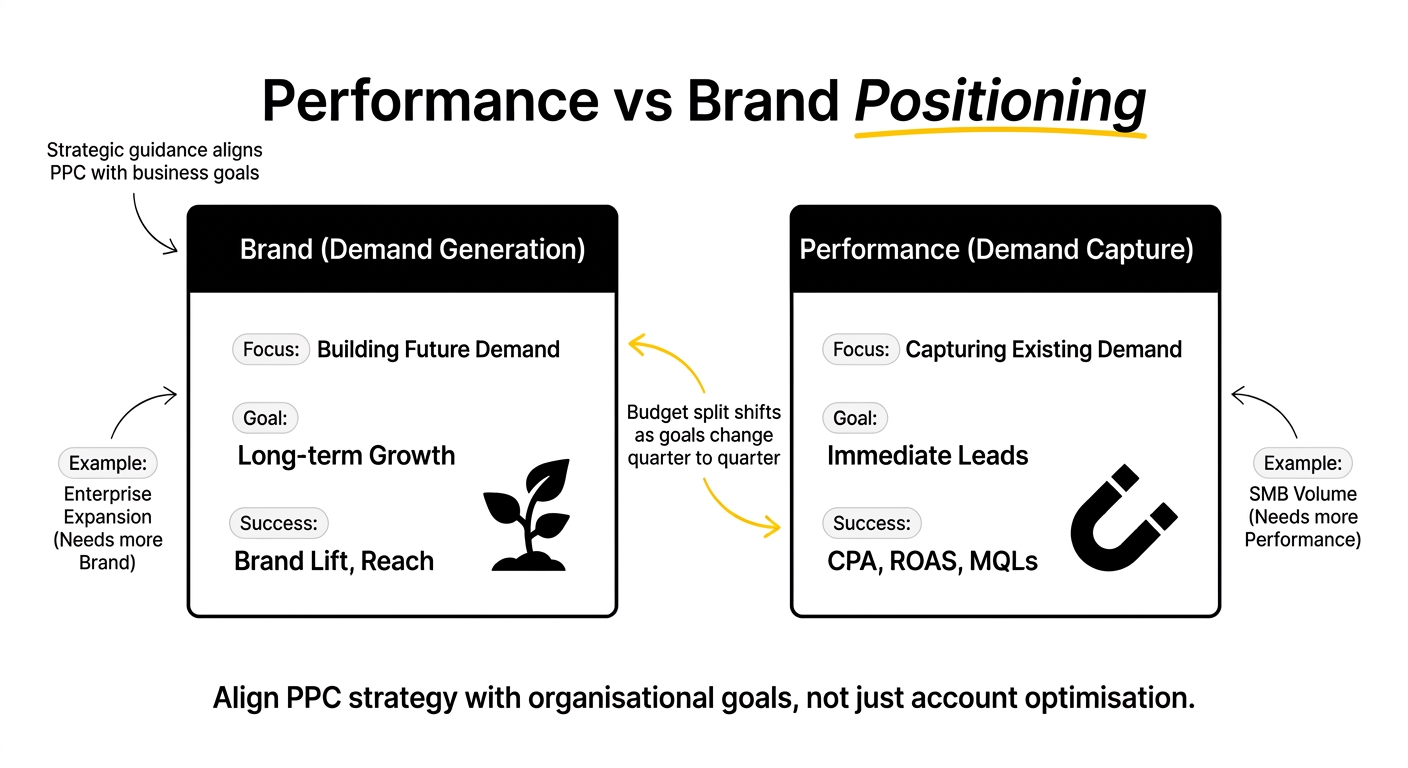
Strategic guidance for SaaS CMOs means the agency understands what the business is actually trying to do this year, not just what the ad account is optimising for. A company pushing for enterprise expansion needs a different budget split, targeting approach, and even a different definition of success than one focused on SMB volume. An agency running the same process regardless of that context is not providing strategic guidance. It is running a template.
This is where the tension between brand and performance usually surfaces. Most SaaS teams treat demand generation and demand capture as competing priorities and end up starving one to fund the other. A strong process does not resolve that tension by picking a side. It makes the trade-off explicit: how much budget builds future demand, how much captures demand that already exists, and how that split should shift as the company’s goals change quarter to quarter.
Evaluating a PPC Agency Against This Process
When a CMO is comparing agencies, the process itself is the most reliable signal available, more reliable than the pitch deck or the client logos. Ask what the onboarding sequence actually covers. Ask to see a sample QA checklist. Ask how attribution windows are set and reviewed. Ask what documentation looks like when an account manager changes.
Agencies with a genuinely strong process for SaaS PPC agency account management will answer these questions with specifics: exact cadences, named tools, concrete examples of a QA ritual catching an issue before it affected performance. Agencies without one will answer in generalities about being responsive and hands-on. That gap in specificity is usually the clearest signal a CMO gets before signing a contract. If you are reading agency reviews and testimonials as part of that evaluation, it is worth knowing how to separate genuine signal from marketing copy in that content, which is a separate evaluation skill in itself.
Frequently Asked Questions
What is PPC account management?
PPC account management is the ongoing work of running, monitoring, and optimising paid advertising campaigns after launch, including budget pacing, bid strategy adjustments, creative testing, and performance reporting. For SaaS specifically, it also includes attribution tracking against long sales cycles and coordination with CRM data to connect spend to pipeline rather than just platform-reported conversions.
What are the key processes involved in effective SaaS PPC account management?
The core processes are structured onboarding (account audit, tracking setup, and a documented 30/60/90 plan), a fixed cadence of weekly and monthly QA reviews, documentation standards that log the reasoning behind account changes, and an attribution approach that blends platform data with self-reported sourcing to account for the dark funnel.
How can a strong PPC agency ensure predictable growth for SaaS companies?
Predictable growth comes from consistency in process, not from any single tactic. An agency that runs the same QA cadence, documentation standard, and reporting structure every month produces results that are directionally reliable even when individual campaigns fluctuate, which is what allows a CMO to forecast with confidence.
What quality assurance rituals should a PPC agency implement for SaaS accounts?
At minimum: weekly checks on budget pacing and conversion tracking integrity, monthly performance reviews against agreed KPIs with documented recommendations, and quarterly strategic reviews against the original growth plan. Each ritual should have a fixed checklist rather than being performed only when something looks wrong.
What documentation standards are essential for SaaS PPC account management?
Every significant account change (campaign restructuring, bid strategy shifts, landing page tests) should be logged with the reasoning behind it and the outcome it produced. This makes the account auditable by anyone on the team, not dependent on one person’s memory.
How does clarity in attribution impact PPC strategies for SaaS companies?
Without attribution clarity, budget allocation decisions get made on incomplete data, often overweighting last-touch channels and underweighting the research and dark-social influence that shaped the buyer’s shortlist earlier. Clear attribution, even if imperfect, lets the team direct spend toward what is actually influencing pipeline.
What metrics should SaaS CMOs focus on to evaluate agency performance?
Cost-per-opportunity, MQL-to-SQL ratio, sales-qualified pipeline by channel, and CAC payback period. These connect spend to revenue outcomes, unlike platform-level metrics such as click-through rate or cost-per-click, which describe ad performance but not business impact.
How can SaaS CMOs assess the alignment of a PPC agency with their organisational goals?
Ask the agency to explain how their current budget split and targeting approach reflect the company’s specific growth priorities this year, not a generic best-practice template. An agency that cannot connect its tactical choices to the business’s actual goals is running a standard playbook, not a tailored strategy.
What are the common challenges faced in SaaS PPC account management?
The most common challenges are attribution gaps caused by long, multi-touch sales cycles, the tension between funding brand-building and demand capture, inconsistent reporting when account ownership changes, and a lack of documented process that leaves quality dependent on individual account managers rather than a system.
How does strategic guidance from a PPC agency contribute to reliable acquisition strategies for SaaS?
Strategic guidance means the agency actively shapes budget allocation and targeting decisions around the company’s specific stage and goals, rather than applying the same approach to every account. That alignment is what turns paid media from a cost centre into an acquisition engine the business can plan around.
If your current PPC reporting cannot answer what happened to last month’s spend without a follow-up call, that is usually a process gap rather than a performance gap. We run this exact framework, onboarding, QA cadence, documentation, and attribution, with every SaaS client we take on. Worth a conversation if you are evaluating what a stronger process should look like for your account.