Mastering Account-Based Paid Social Strategies for Enterprise SaaS
Learn how to use account lists, intent data, and personalised creative to run effective ABM paid social campaigns that build pipeline for enterprise SaaS.

You launch campaigns. Engagement looks healthy. Platform dashboards show reach climbing across your ICP. Six months later, your pipeline review reveals that half the accounts you spent the quarter targeting never became a qualified opportunity.
This is the defining frustration of paid social in enterprise SaaS. Standard demand gen thinking applies reach logic to an environment that requires precision logic. Account-based paid social exists to fix that disconnect.
This guide covers how to build account-based paid social campaigns that actually move enterprise accounts through the buying cycle, from constructing effective account lists to using intent data intelligently and creating personalised creative that lands with buying committees, not just individual clicks.
What Account-Based Paid Social Actually Is (And What It Isn’t)
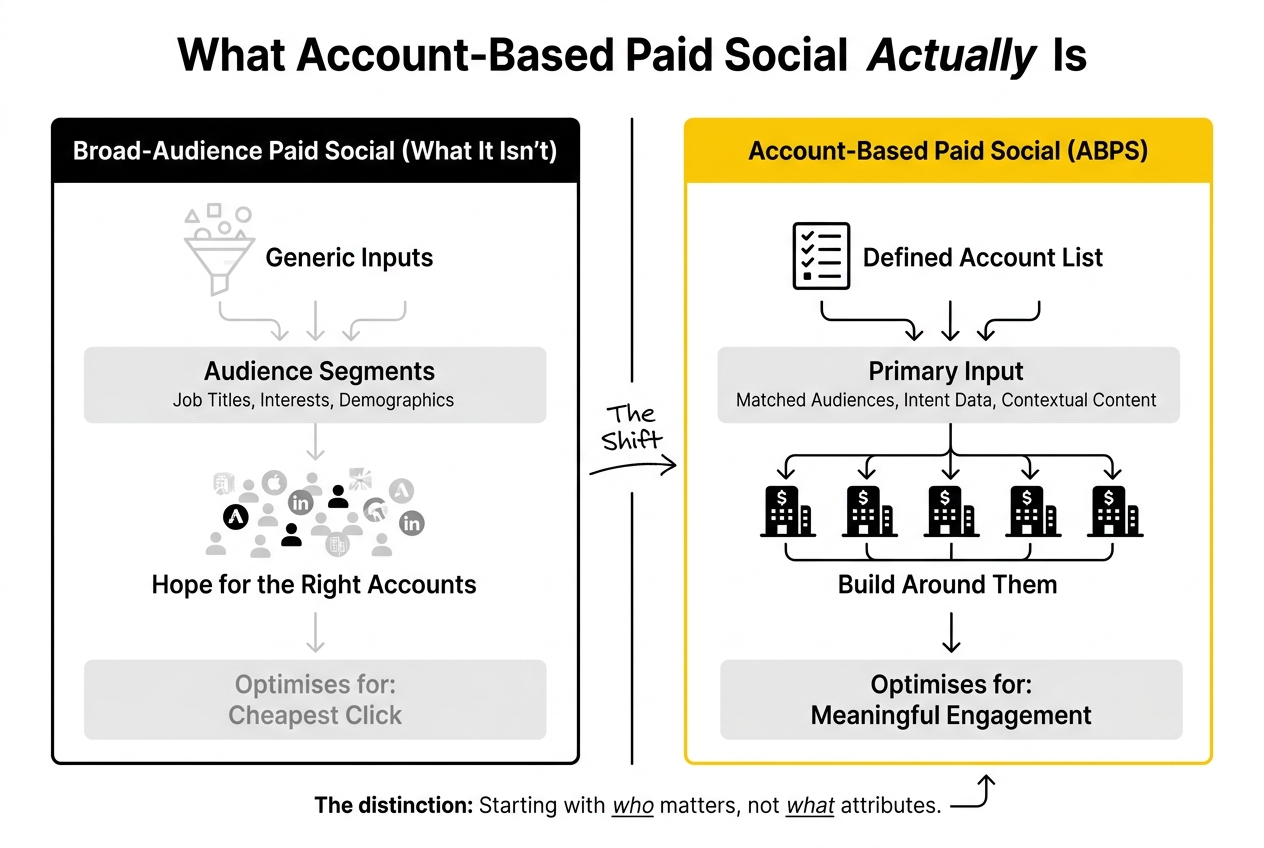
Account-based paid social (ABPS) is a targeting approach that uses defined account lists, not audience segments, as the primary input for paid social campaigns. Rather than building audiences by job title, industry, or interest and hoping the right accounts show up in the results, ABPS works in reverse: you start with the accounts that matter and build the campaign around them.
In practice, this means uploading matched account lists to LinkedIn’s Matched Audiences, using intent data to prioritise which accounts are active in a buying window, and creating ad content that speaks to the specific context of those accounts, not a generic “Head of Marketing at a B2B SaaS company” persona.
The distinction matters because enterprise SaaS deals involve buying committees of six to ten stakeholders, sales cycles that often run to six months or more, and high ACVs that make wasted spend on the wrong accounts genuinely expensive. Broad-audience paid social optimises for the cheapest click from within a rough demographic. ABPS optimises for meaningful engagement from accounts that could actually close.
Building Account Lists That Are Worth Targeting
The quality of an account-based paid social programme is determined upstream, at the account list stage. Most teams treat this as an administrative step. It isn’t.
An effective account list for ABPS is built from the intersection of three inputs.
ICP fit comes first. This is your ideal customer profile applied to company-level data: industry, headcount, ARR band, tech stack, buying motion. If your current best customers are Series B to Series D SaaS companies with 150 to 500 employees running Salesforce and HubSpot, that profile shapes which accounts qualify. ICP-fit scoring should come from your CRM, enriched with firmographic data from tools like Clearbit, Bombora, or ZoomInfo.
Sales qualification comes second. The accounts marketing targets through paid social should largely overlap with the accounts sales has identified as strategic priorities. Where they diverge, the mismatch needs to be a deliberate decision, not an oversight. Sales leaders know which accounts are already in active conversations, which are long-term targets, and which are currently walled off. Marketing campaigns running against accounts already in late-stage sales conversations waste budget and can create noise for the sales team. Service Blueprint: What ‘SaaS PPC & Paid Search Management UK’ Should Actually Include, also on this blog, takes this further.
Intent signals come third. More on this below, but the point here is that account lists should not be static. An account that shows strong buying intent today is worth prioritising over one that was manually added to a list three months ago. Build the list logic so that account prioritisation responds to signal data, not just a quarterly planning cycle.
LinkedIn’s Matched Audiences accepts both company lists and contact lists. Company matching typically achieves around 70 to 80 per cent coverage depending on list quality. Contact matching is higher when lists are sourced directly from your CRM. Aim to refresh account lists at least monthly to reflect new accounts entering the ICP fit, accounts that have progressed past campaigns, and new intent signals.
Using Intent Data to Prioritise and Time Your Campaigns
Intent data is the strongest lever most enterprise SaaS marketing teams are underusing in their account-based paid social programmes. It tells you which accounts are actively researching your category, surfacing buying intent before those accounts appear in a form submission or a sales conversation.
Bombora and G2 Buyer Intent are the two most commonly integrated intent sources for enterprise SaaS. Bombora’s Company Surge data aggregates third-party content consumption across a co-operative of B2B publishers. G2 Buyer Intent captures in-market signals from companies viewing your category page, competitor pages, or your own product listing on G2.
The practical application in ABPS is account prioritisation. Rather than running the same campaign budget evenly across your entire target account list, you use intent signals to identify which accounts are currently in an active buying window and weight your spend accordingly.
A useful way to frame this is a three-tier prioritisation model.
- Active intent accounts: Accounts showing surge signals across category or competitor terms in the past 30 days. These get the most targeted, most personalised creative and the highest budget allocation per account.
- Passive intent accounts: ICP-fit accounts with no strong current signal but within your strategic target list. Awareness and nurture content, lighter spend.
- Dormant accounts: Previously engaged accounts where intent has dropped. Minimal presence to maintain visibility.
One important caveat for CMOs presenting intent data at board level: intent signals are directional, not definitive. A company consuming content about your category is more likely to be in a buying window, but they may also be conducting research, training a new hire, or evaluating a competitor with no intention of changing. Intent data improves the odds of reaching the right account at the right time. It does not guarantee purchase intent.
Personalised Creative for Enterprise Buying Committees
Enterprise SaaS deals are not approved by one person. The economic buyer, the technical evaluator, the end-user champion, and the security or procurement reviewer all have different concerns. Most paid social creative treats these as a single audience. That is why most paid social creative fails.
Personalised creative in an ABPS context means creating ad content that speaks to the specific concern of a specific stakeholder type within a specific account context, not a single ad that tries to appeal to everyone.
At the account level, personalisation can mean referencing the account’s industry, use case, or technology environment. A mid-market HR software company and an enterprise logistics platform may both be in your ICP, but the language that lands with each will differ. LinkedIn’s Dynamic Ads allow some degree of account-name personalisation at scale, but the more durable approach is building creative variants mapped to ICP sub-segments.
At the persona level, personalisation means understanding what each stakeholder cares about. The CFO reviewing a spend decision wants to see cost-to-value. The technical lead wants integration capability and security. The end-user champion wants efficiency gains and adoption data. If your paid social creative is showing the same ROI headline to all three, you are leaving influence on the table.
In practice, this does not mean building hundreds of individual ad variants. It means building a creative matrix: three to four stakeholder types, two to three messaging angles per type, tested across your highest-priority account tiers. The matrix gives you coverage without requiring a production budget that most teams cannot sustain.
According to a LinkedIn B2B Institute study on buying committee engagement, campaigns that reach three or more personas within a target account are measurably more likely to progress to pipeline than campaigns that reach only one. The message here is not just personalise, it is multiply your surface area within the account.
Demand Generation Mechanics: How ABPS Fits the Funnel
Account-based paid social for enterprise SaaS is primarily a demand generation play, not a demand capture play. This distinction matters for how you measure it and how you defend it internally.
Demand capture is intent-led. The buyer knows what they need, they’re searching for it, and you’re competing to be visible at that moment. Google Search, category keywords, branded terms. The feedback loop is relatively short.
Demand generation is different. You’re reaching accounts before they’ve formalised a buying process, creating the conditions for pipeline to form. ABPS sits here. Your LinkedIn campaigns against a target account list are not closing deals directly. They are making your brand the familiar, credible option when the buying conversation eventually starts.
The implication for CMOs is that ABPS needs to be evaluated over a timeframe that reflects the sales cycle, not the campaign sprint. If your average enterprise sales cycle runs five to seven months, the attribution window for ABPS influence needs to match that. A campaign that shows low direct conversion in week four but shows up as a touchpoint across 60 per cent of deals closed in the following two quarters is performing well. It just doesn’t look like it if you’re measuring against last-touch models.
This is where pipeline development for enterprise SaaS gets genuinely complex. If you need guidance on structuring attribution models to capture this kind of multi-touch influence, our b2b social agency team works through this setup regularly with SaaS clients and can help you structure something defensible.
Measuring Account-Based Paid Social: Metrics That Hold Up
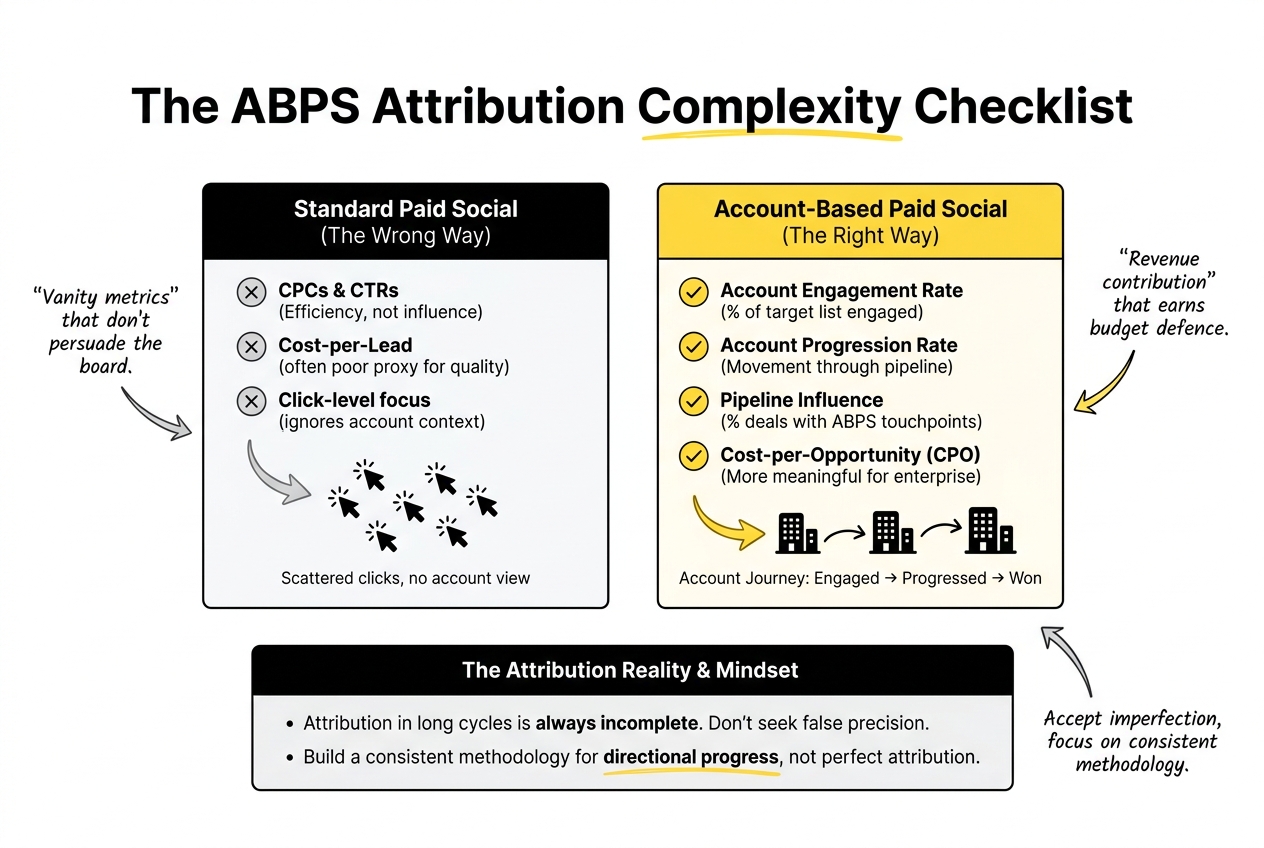
The wrong way to measure ABPS is to apply standard paid social KPIs to an account-based model. CPCs, CTRs, and cost-per-lead from LinkedIn campaigns tell you how efficiently you’re spending, not whether you’re influencing the right accounts.
The metrics that matter in an ABPS model are account-level, not click-level.
Account engagement rate measures the percentage of your target account list that has engaged with at least one ad in a given period. A healthy ABPS programme is touching a meaningful proportion of its target accounts consistently, not just reaching the same small cluster of engaged users repeatedly.
Account progression rate tracks whether accounts are moving through your defined pipeline stages over time. Are accounts that entered your ABPS programme six months ago now in active sales conversations at a higher rate than accounts that were not in the programme? This is the metric that earns budget defence in a board setting.
Pipeline influence captures the percentage of closed-won and open pipeline deals that had ABPS touchpoints prior to or during the sales process. When combined with sales data from your CRM, this metric makes the revenue contribution of paid social visible even in long sales cycles.
Cost-per-opportunity (CPO) is more meaningful than cost-per-lead in enterprise settings. MQLs from paid social are often poor proxies for deal quality. An ABPS programme that generates fewer MQLs but higher-quality opportunities with lower CPO is objectively performing better.
The measurement setup requires CRM integration and a willingness to accept that some attribution will always be incomplete. Attribution in long sales cycles is not a problem to be solved with the right tool. It is a condition to be managed with consistent methodology. Build a measurement framework you can maintain across quarters, and use it to show directional progress, not false precision.
Balancing Brand and Performance in Paid Social Campaigns
The brand-versus-performance tension in enterprise SaaS marketing is real, and ABPS sits uncomfortably in the middle of it. Performance marketing leaders push for direct response creative and short attribution windows. Brand and demand gen advocates argue for awareness investment that doesn’t show up in a 30-day dashboard.
The answer for ABPS is that both are required, sequenced correctly.
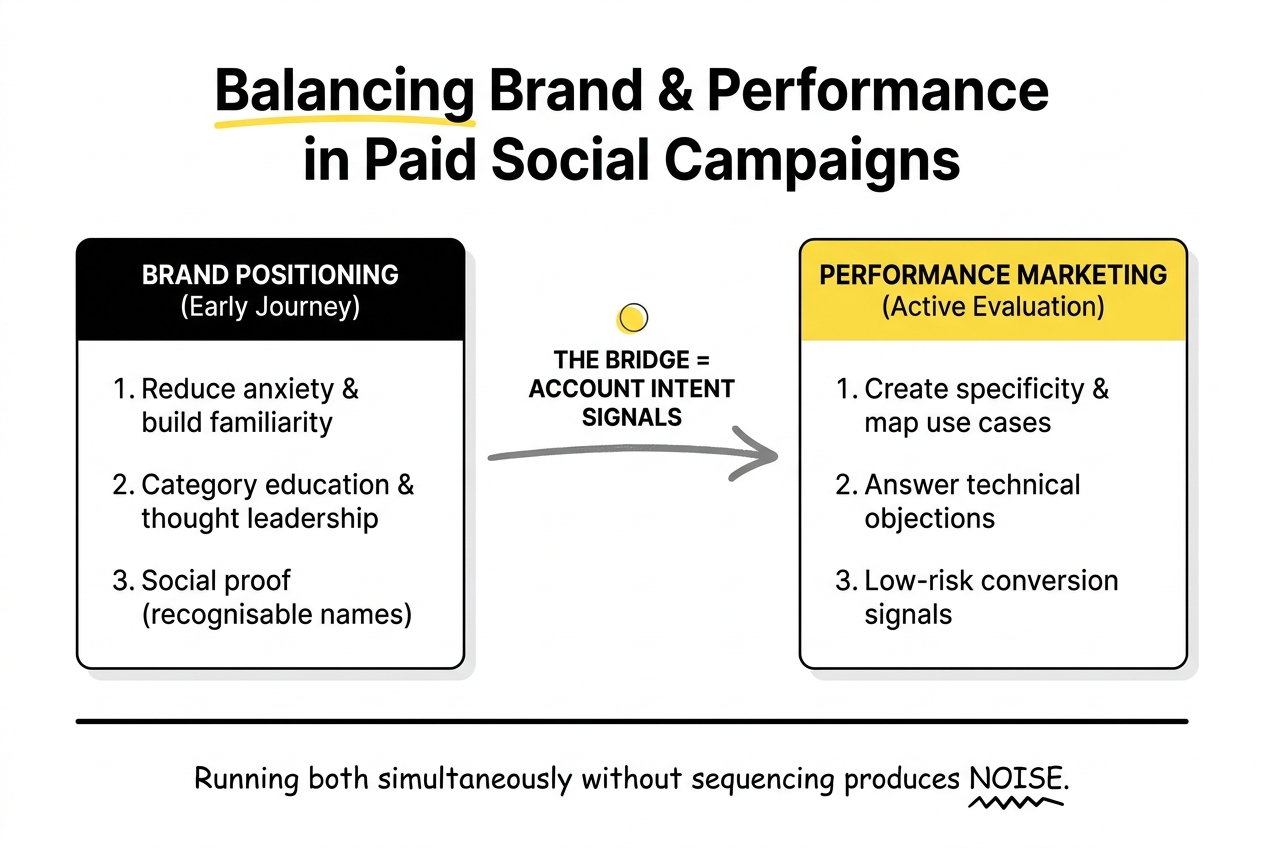
Accounts that have never heard of your product are not ready for a case study ad. Accounts that have been in your nurture sequence for three months and are now showing intent signals are ready for something more direct. The sequencing of brand-building creative followed by proof-led creative, triggered by account-level engagement or intent data, is how you bridge that tension in practice.
A useful heuristic: early in the account journey, creative should reduce anxiety and build familiarity. Category education, thought leadership, and social proof from recognisable customer names all serve this function. Later in the journey, when intent signals indicate an active evaluation is underway, creative should create specificity: the use case that maps to their context, the integration that answers the technical objection, the commercial signal that makes conversion feel low-risk.
Running both types simultaneously without sequencing produces noise. Accounts see a brand awareness video and a “Book a Demo” ad in the same week and the message is incoherent. The creative strategy and the intent data need to be connected, not managed in separate workstreams.
Communicating ABPS Value to Your Board
CMOs who fund ABPS programmes and cannot explain them in pipeline terms lose that budget eventually. The board does not want to hear about impression volumes or engagement rates. They want to understand what marketing is contributing to revenue, and they want a number they can interrogate.
A board-ready ABPS narrative has three components.
First, the target: how many accounts are in your programme, why those accounts, and what is the estimated revenue opportunity if a defined percentage of them convert to customers over the next 12 to 18 months.
Second, the progress: what percentage of those accounts have been reached, what engagement patterns are you seeing, and how many are now in active sales conversations that trace back to programme touchpoints.
Third, the efficiency comparison: what does it cost to source an opportunity through ABPS versus other channels, and how does the quality of those opportunities compare in terms of ACV and close rate.
This framing converts a paid social programme from a line item that looks like spending into a pipeline investment that looks like leverage. The underlying data needs to come from your CRM, not your ad platform. If your CRM integration is not set up to capture this, that is the first thing to fix before the next board cycle.
Frequently Asked Questions
What is Account-Based Paid Social and how does it differ from traditional paid social strategies?
Account-based paid social uses defined company and contact lists as the targeting foundation, rather than building audiences from demographic or interest-based criteria. Traditional paid social reaches a broad segment that approximately matches your ICP and hopes the right accounts are in it. ABPS starts with the accounts that matter and builds the campaign around them. The result is tighter targeting, more relevant creative, and metrics that reflect account-level engagement rather than just aggregate platform performance.
What are the key components of an effective Account-Based Paid Social strategy for enterprise SaaS?
The three core components are a well-constructed account list, intent data to prioritise that list dynamically, and personalised creative that speaks to different stakeholders within each account. These are supported by a measurement framework that tracks account-level engagement and pipeline influence rather than standard lead-gen KPIs, and CRM integration to connect campaign activity to revenue outcomes.
How can intent data be leveraged to enhance Account-Based Paid Social campaigns?
Intent data identifies which accounts are actively researching your category or evaluating competitors, allowing you to weight budget and creative toward accounts in an active buying window. Sources like Bombora and G2 Buyer Intent feed into account prioritisation models. Accounts showing strong intent signals get the most tailored creative and highest budget allocation; accounts with weaker signals get lighter-touch awareness content. Intent data should refresh monthly at minimum to reflect real buying cycles.
What role do account lists play in targeting for Account-Based Paid Social?
Account lists are the primary targeting input for ABPS. They should be built from ICP fit scoring, sales-qualified priorities, and intent signals, then uploaded to LinkedIn Matched Audiences as both company and contact lists. Static lists built once at the start of a quarter underperform because buying contexts shift. Effective account lists are refreshed regularly and structured into tiers based on account priority and current intent.
What are best practices for creating personalised creative for enterprise SaaS audiences?
Build a creative matrix mapped to stakeholder type and journey stage rather than a single ad variant. Economic buyers need cost-to-value framing; technical evaluators need integration and security proof points; end-user champions need efficiency and adoption evidence. Early in the account journey, creative should build familiarity and reduce anxiety. Later, when intent signals indicate an active evaluation, creative should provide specificity and remove conversion friction. Connect your creative sequencing to your intent data so the right message lands at the right stage.
How can CMOs measure the success of their Account-Based Paid Social initiatives?
The meaningful metrics are account engagement rate (what proportion of your target list is being reached and engaging), account progression rate (are targeted accounts moving to pipeline over time), pipeline influence (what percentage of closed-won deals had ABPS touchpoints), and cost-per-opportunity compared against other channels. Platform metrics like CPCs and CTRs measure spend efficiency, not programme effectiveness. Measurement needs to run over a timeframe that matches your actual sales cycle length.
What challenges do data-driven CMOs face when implementing Account-Based Paid Social in long sales cycles?
The core challenge is attribution. Enterprise deals with five-to-seven-month sales cycles accumulate touchpoints across multiple channels, and last-touch models will credit whatever happens closest to the close, often a branded search or a BDR outreach. ABPS influence is often invisible in these models even when it was a genuine factor. Building a consistent multi-touch attribution methodology and educating internal stakeholders on directional measurement rather than precision is the practical response.
How can Account-Based Paid Social contribute to predictable growth and pipeline development in enterprise SaaS?
ABPS creates predictability by giving marketing influence over which accounts enter the pipeline, rather than waiting for inbound signals. When account lists are built from strategic ICP targets and weighted by intent data, the pipeline that ABPS generates is higher-quality by design. Over time, a consistent ABPS programme produces a traceable relationship between campaign investment and opportunity volume, which is the input CMOs need to forecast marketing contribution to revenue with confidence.
What strategies can be used to balance brand awareness and performance in paid social campaigns?
Sequence them based on account stage rather than running both simultaneously. Use brand-building creative (category education, thought leadership, recognisable customer logos) for accounts early in their awareness journey. Switch to proof-led, conversion-oriented creative when intent data signals an active evaluation. Connecting the creative sequencing logic to your account-level intent signals prevents incoherent messaging and makes each ad spend more relevant to where the account actually is.
How can CMOs effectively communicate the value of Account-Based Paid Social to their boards?
Frame ABPS as a pipeline investment with three measurable outputs: the revenue opportunity represented by your target account list, the account progression rate showing movement toward pipeline, and the cost-per-opportunity efficiency versus other channels. Avoid presenting platform engagement metrics at board level. The narrative that earns budget is one that connects campaign activity to pipeline contribution using CRM data, with a realistic timeline that reflects your actual sales cycle length.
If you’re building an ABPS programme and are unsure how to connect the account targeting logic to a measurement model that holds up at board level, this is the kind of work we do with SaaS teams regularly. Worth a conversation if you’re at that point.