Harnessing Thought Leadership and Podcasts for Effective Paid Social Campaigns
Discover how to repurpose podcasts and interviews into effective paid social campaigns for B2B SaaS demand generation.

Your demand gen budget is funding the same retargeted white paper offer your competitors are running. The audience has seen it. They’re not clicking. And yet, your company publishes genuinely useful podcast episodes and interviews with people who know your space well. That content is sitting idle.
Thought leadership content and podcasts are not just brand-building assets. When repurposed correctly, they become some of the highest-performing material in a paid social strategy. Not because they’re more creative, but because they do something lead capture ads fundamentally cannot: they build the kind of trust that moves a buying committee before they raise their hand.
This article covers how to repurpose that content into structured paid social sequences, how to align it with pipeline objectives rather than vanity metrics, and how to report on it in a way that holds up with stakeholders.
Why Thought Leadership Belongs in Your Paid Social Mix
Most B2B SaaS demand gen programmes are over-indexed on capture and under-invested in the earlier stages of the buying journey. The Edelman-LinkedIn B2B Thought Leadership Impact Study found that over half of decision-makers say thought leadership has directly led them to award business to a company they were not previously considering. That is a pipeline effect, not a brand effect.
The reason paid social thought leadership works is straightforward. Buyers in a SaaS buying committee spend months in consideration before they become trackable in your CRM. They are watching content, forming opinions about vendors, and narrowing their shortlist long before they fill in a form. Thought leadership content paid social lets you show up during that window, on platforms like LinkedIn where your ICP is already spending time.
The challenge is that most teams treat podcast clips and interview content as organic assets. They post them once, get some engagement, and move on. The paid social version requires a different architecture.
Building a Podcast Content Strategy for Paid Sequences
Repurposing podcast content for paid social media advertising is not just clipping a highlight and boosting it. The goal is a sequence that moves someone from awareness of an idea to familiarity with your company’s perspective on that idea, without asking for anything before the relationship has earned it.
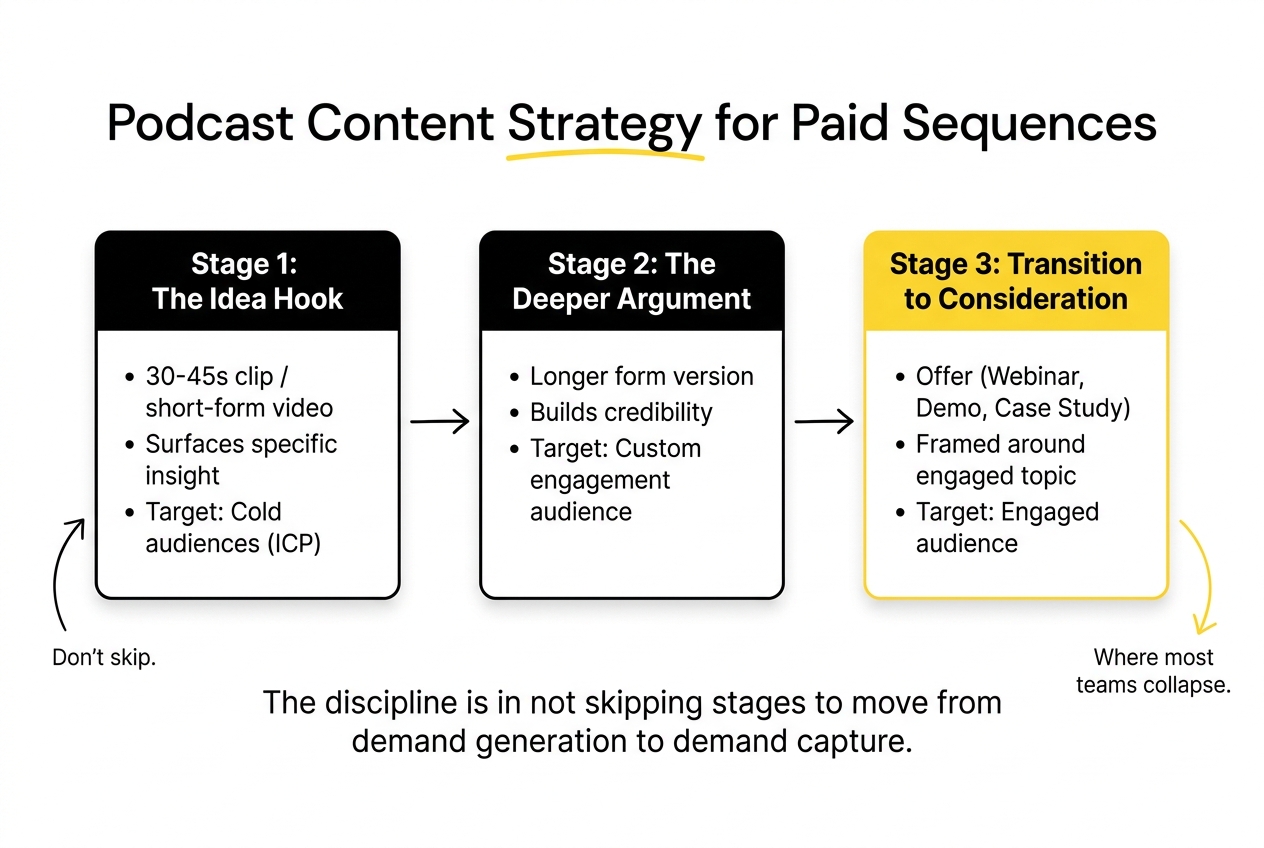
A workable three-stage structure looks like this:
- Stage 1: The idea hook. A 30-45 second clip, or a short-form video pull, that surfaces a specific insight from the episode. The content at this stage should feel like something worth knowing, not something worth downloading. Target: cold audiences matched to your ICP.
- Stage 2: The deeper argument. A longer form version of the same theme, either a full episode promotion or a written piece that expands on what the clip introduced. At this stage, you are building credibility with people who engaged with the first ad. The audience here is a custom engagement audience, not cold.
- Stage 3: The transition to consideration. Only once someone has consumed a meaningful volume of your content should they see an offer. A webinar, a demo, a case study framed around the specific topic they have already engaged with. This is where the ad set transitions from demand generation to demand capture.
The key discipline is not skipping stages. Teams under pressure on pipeline numbers collapse this sequence into a single ad asking cold audiences to request a demo from someone they have never heard of. That is not demand generation. That is demand capture of an audience that was never in the market.
Turning Interviews Into Paid Social Content
Expert interviews are a particularly underused asset. When a senior practitioner at your company or a recognisable external voice discusses a problem your ICP deals with every day, that conversation carries more weight than anything your marketing team writes independently.
The practical conversion from interview to ad content involves a few steps:
- Identify the moments, not the full episode. A 45-minute interview contains two or three moments where the guest says something sharp and specific. Find those. They become the short-form clips.
- Write a companion perspective piece. Use the interview to anchor a longer article or LinkedIn post that adds your company’s framing around the guest’s point. This becomes the Stage 2 ad content.
- Build the sequence around a single theme. Each interview repurposing effort should be tied to one ICP pain point. If the interview covers three topics, that is three separate mini-sequences, not one combined campaign.
The version of this that underperforms is the one where teams use a clip of someone saying something generic about the importance of a topic your product solves. That does not work because it reads as an ad, not as a perspective. The version that works features a guest articulating a problem in the specific language your ICP uses to describe it internally.
Aligning Educational Content with Sales Objectives
The conversation between demand gen and sales often breaks down at the point where educational content enters the mix. Sales teams want leads they can call. Demand gen leaders know that running pure lead capture at scale produces MQL volume with no substance behind it. Educational content sequences are the mechanism that closes the gap, but only if the two sides have agreed on what “ready” looks like.
Before running a thought leadership paid social sequence, align on:
- Which content themes map to which deal stages in your CRM
- What engagement signals from paid social should trigger a sales touchpoint (e.g., a prospect who has watched three video ads and clicked through to an episode)
- What the handoff looks like when someone moves from the nurture sequence into a request for contact
A SaaS social media marketing agency can help structure these sequences and the attribution logic that underpins them, particularly when the buying cycle is long and the signals are spread across multiple platforms.
The most common failure mode here is that demand gen runs the educational sequence, generates strong engagement metrics, and cannot connect those metrics to anything sales recognises as value. That is a reporting problem as much as a campaign problem.
Tracking the Right Metrics
Thought leadership strategies for paid social require a different measurement framework to lead capture campaigns. The problem is not that the data is unavailable. The problem is that teams default to the metrics their platform dashboards surface, which are mostly engagement and impression metrics with no pipeline connection.
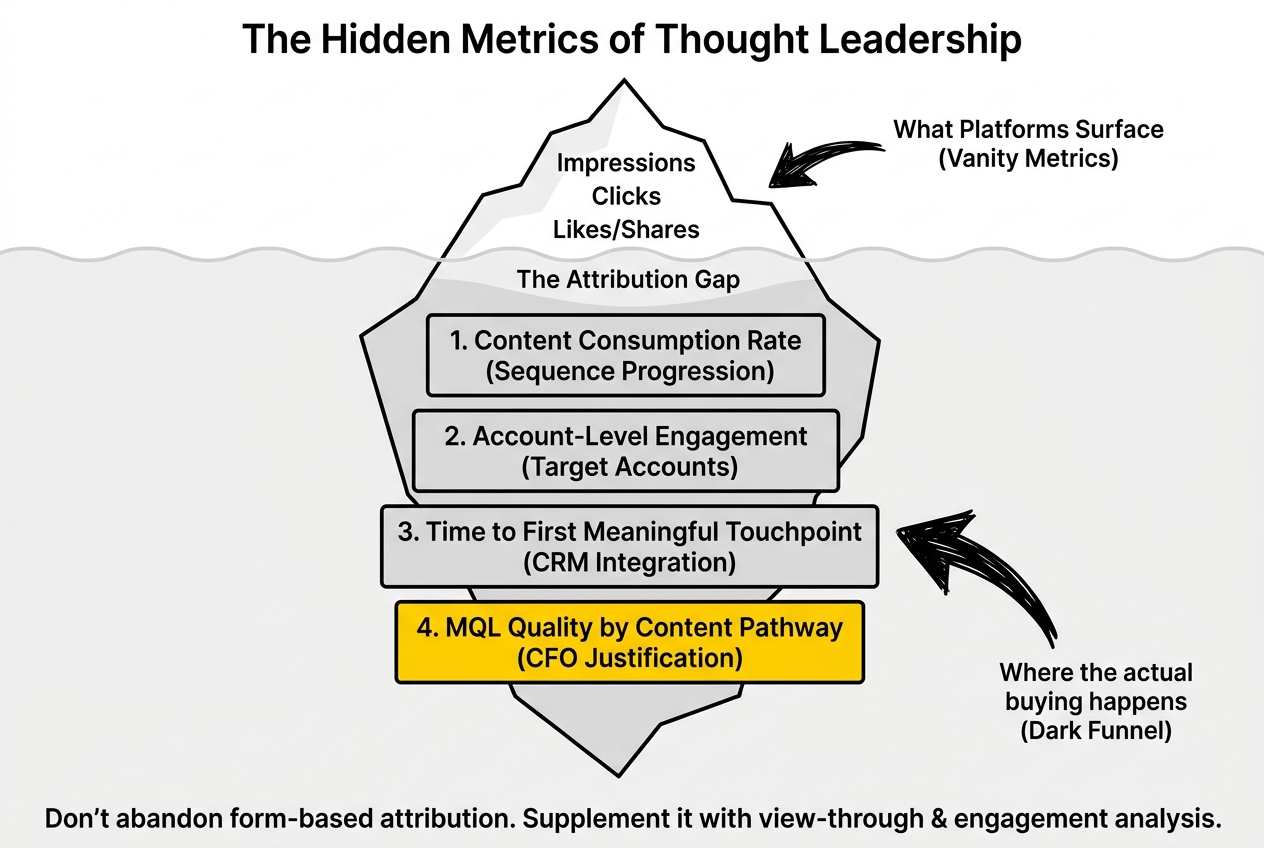
The metrics worth tracking across a thought leadership sequence:
- Content consumption rate: What percentage of people who saw the Stage 1 ad went on to engage with Stage 2? This measures whether the sequence is working as a funnel.
- Account-level engagement: For ABM-style programmes, are the accounts on your target list showing up in your engaged audiences? This is more useful than total impression volume.
- Time to first meaningful touchpoint: Among contacts who eventually converted to a pipeline opportunity, how many had previously consumed thought leadership content? And over what period? This requires CRM integration with your paid social data.
- MQL quality by content pathway: Do leads who entered the funnel through an educational sequence convert to sales-qualified pipeline at a higher rate than leads who came through direct capture? This is the number that justifies the programme to a CFO.
Refine Labs’ research on dark funnel activity consistently shows that B2B buyers consume considerably more content than last-touch attribution captures. A prospect who becomes an opportunity in month six may have watched five video ads in month two. Attribution models that only count the last interaction will attribute that opportunity to whatever ad ran closest to the form fill, which is usually a capture ad, not the educational sequence that created the intent in the first place.
This does not mean abandoning form-based attribution. It means supplementing it with a view-through and engagement-based analysis of your educational content’s role across the buyer journey.
Best Practices for Using Podcasts in Social Media Campaigns
There are a handful of things that consistently separate the paid social podcast programmes that generate pipeline from the ones that generate views and nothing else.
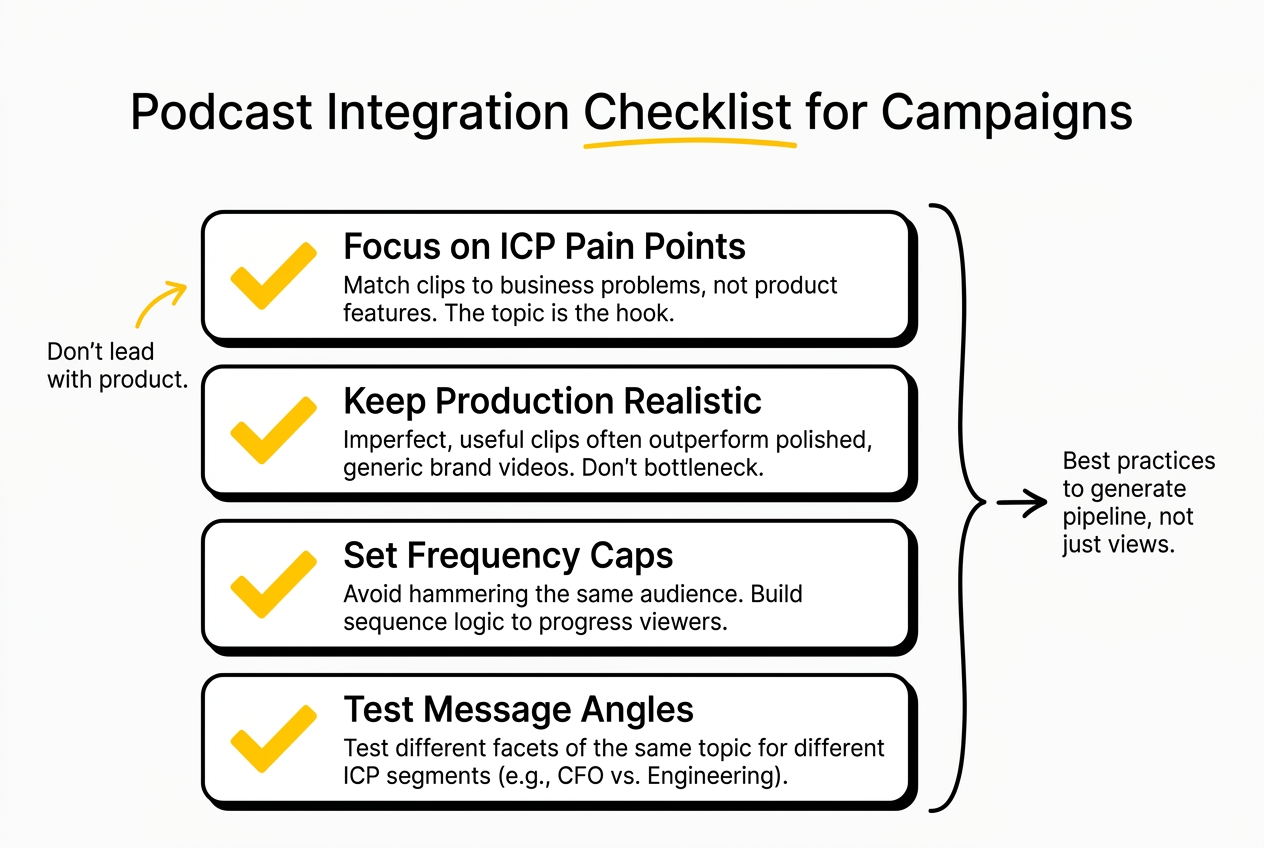
- Match clip content to ICP pain points, not product features. A clip of a guest discussing a business problem your ICP recognises will outperform a clip that mentions your product’s capabilities. At the early stages of the sequence, the topic is the hook, not the company.
- Keep the production bar realistic. LinkedIn audiences have developed a tolerance for less-polished content, particularly in the B2B space. A slightly imperfect interview clip that says something genuinely useful will outperform a heavily produced brand video that says nothing specific. Do not let production requirements become a bottleneck.
- Frequency caps matter more than reach. Hammering the same audience with the same clip repeatedly trains them to scroll past your brand. Set frequency caps, build sequence logic into your ad sets, and ensure that the same person progresses through the funnel rather than seeing Stage 1 repeatedly.
- Test the message, not just the format. The natural instinct when testing podcast content is to test different clips against each other. That is useful. But also test whether different angles on the same underlying topic perform differently with different segments of your ICP. A CFO and a Head of Engineering both in the buying committee respond to different aspects of the same product problem.
Reporting Thought Leadership Campaigns to Stakeholders
The reporting problem in paid social thought leadership is straightforward: the KPIs that make the programme look good (reach, video views, engagement) are not the KPIs that stakeholders care about (pipeline and revenue).
The solution is a tiered reporting framework that connects both.
At the campaign level, report engagement metrics that show the sequence is working: video view-through rate, cost-per-engaged-user, account coverage within target lists.
At the programme level, report the pipeline contribution: opportunities that include at least one touchpoint from the thought leadership sequence, average time-to-opportunity for leads who engaged with educational content versus those who did not, and influenced pipeline value.
The second tier requires instrumentation in your CRM and agreement with sales on how to attribute partial credit. It is not quick to set up, but it is the only version of reporting that survives a budget conversation. Structuring SaaS PPC Accounts for PLG vs Sales-Led Funnels, also on this blog, takes this further.
The framing to use with stakeholders is not “our thought leadership content generated X impressions.” It is “prospects who engaged with our educational sequence before entering the funnel converted to qualified pipeline at Y% compared to Z% for direct capture leads.” That is a business argument.
Common Pitfalls When Using Podcasts in Paid Social Campaigns
- Treating repurposing as a production task. Clipping a podcast and writing a caption is not a demand generation strategy. The content needs a distribution architecture, a target audience, and a next step for people who engage with it.
- Running educational content and capture campaigns to the same audiences simultaneously. This creates message confusion and cannibalises the sequence logic. Separate your audiences and sequence your messaging.
- Measuring too early. A thought leadership sequence operating at the top of a six-month sales cycle should not be evaluated on pipeline contribution after 30 days. Set a measurement window that reflects the actual buying timeline.
- Over-relying on organic reach to validate paid investment. An organic post that performs well does not automatically translate into a paid campaign that performs well. Organic reach rewards novelty and network effects. Paid social rewards relevance and targeting precision.
Frequently Asked Questions
How can thought leadership content enhance paid social campaigns?
Thought leadership content shifts the role of paid social from capturing existing demand to creating new demand. When buyers encounter credible, specific perspectives on problems they are already dealing with, it builds familiarity and trust with your brand before any commercial conversation begins. That trust shortens sales cycles and improves the quality of leads that eventually enter the funnel, because they arrive with context rather than cold curiosity.
What are effective ways to repurpose podcast episodes for paid social advertising?
The most effective approach is to identify two or three high-value moments from each episode, clip them for short-form use, write a companion perspective piece that adds your company’s framing, and build a three-stage sequence: awareness clip, deeper content, consideration offer. Each repurposing effort should be anchored to one specific ICP pain point, not the episode as a whole.
How can B2B SaaS companies align educational content with sales objectives in their campaigns?
Alignment happens at the planning stage, not after the campaign launches. Agree with sales on which content themes map to which deal stages, what engagement signals from paid social should trigger a sales touchpoint, and how influenced pipeline from educational content will be tracked in your CRM. Without this agreement, demand gen and sales will always be measuring different things.
What metrics should demand generation leaders track to measure the success of thought leadership in paid social?
Track content consumption rate across sequence stages, account-level engagement within your target list, MQL-to-SQL conversion rates segmented by content pathway, and influenced pipeline value. Engagement metrics (views, reactions) are useful for optimising individual assets but should not be the primary measure of programme success.
How can interviews with industry experts be transformed into engaging paid social content?
Identify the one or two moments in the interview where the guest articulates a specific problem in language your ICP would use themselves. Clip those moments for short-form ads. Write a companion piece that situates those insights in the context of your company’s perspective. Avoid clips that mention your product directly at the awareness stage. The topic and the guest are the value at that point, not the product.
What are the best practices for integrating podcasts into a paid social strategy?
Match clip content to ICP pain points rather than product features, set frequency caps to prevent audience fatigue, build sequence logic so audiences progress through stages rather than seeing the same content repeatedly, and test message angles as well as creative formats. Keep production standards realistic so that content volume is sustainable.
How can clear reporting and attribution improve campaign performance in paid social?
Clear reporting creates the feedback loops that enable optimisation. When you can see which content themes generate the highest-quality engagement, which sequence stages are losing the most people, and which pathways correlate with faster time-to-pipeline, you can make specific changes rather than general ones. Attribution that connects paid social touchpoints to CRM outcomes also provides the business case for sustaining educational content investment during periods of pipeline pressure.
What role does audience targeting play in leveraging thought leadership for paid social?
Targeting determines whether thought leadership content reaches the people capable of becoming customers. Job title and company size targeting on LinkedIn gets you into the right accounts. Engagement-based retargeting lets you build sequential journeys based on what people have already consumed. Tools like SparkToro can identify where your ICP actually spends time online, which informs both platform selection and the topics your thought leadership content should address.
How can demand generation managers communicate results of thought leadership campaigns to stakeholders?
Use a tiered framework: report campaign-level engagement metrics to show the sequence is working, and programme-level pipeline metrics to show it is contributing to revenue. The specific figure that lands in budget conversations is the conversion rate comparison: what percentage of leads who engaged with educational content before requesting contact converted to qualified pipeline, versus those who did not. That comparison frames the programme as a lead quality investment, not a brand spend.
What are common pitfalls to avoid when using podcasts in paid social campaigns?
The main ones: treating repurposing as a production task rather than a distribution strategy, running educational and capture campaigns to the same audiences simultaneously, measuring pipeline contribution too early relative to your actual sales cycle length, and using organic post performance as a proxy for paid campaign viability. Each of these errors produces misleading signals that either understate the programme’s value or inflate it.
If your team is working through how to structure thought leadership content within a paid social programme, or needs help connecting educational campaign activity to pipeline reporting, this is the kind of thing we work through with SaaS demand gen teams regularly. Worth a conversation if you are at that point.