How to Transform Complex SaaS Value Propositions into Engaging Social Ads
Learn how to translate complex SaaS value propositions into scroll-stopping social ads that drive qualified pipeline, not just impressions.

Most SaaS social ads fail before anyone reads the copy. The product is genuinely useful, the targeting is solid, and the budget is there. But the ad tries to explain too much at once, and whoever was scrolling keeps scrolling.
The problem is rarely creative. It is a messaging problem disguised as a creative problem. Translating complex SaaS value propositions for social media requires a different discipline from writing a website homepage or a sales deck. You have roughly two seconds. In that window, the viewer is not evaluating your feature set. They are deciding whether the ad is for them.
This article gives Series A marketing directors a practical framework for stripping SaaS value propositions down to their social-ready core, choosing the right ad formats for different buying stages, and building a testing approach that produces directional data quickly.
Why Complex SaaS Products Are Hard to Advertise on Social
B2B SaaS products solve problems that often require context to appreciate. A customer data platform, an AI-powered contract management tool, or an enterprise resource planning system each solves a real problem, but the problem only becomes vivid once you understand the pain it causes. That context takes time to establish. Social feeds do not give you time.
The reflex response is to cram the value into the ad. List the features. Name the integrations. Show the dashboard. The result is an ad that looks like a product brochure and performs like one too.
The more effective approach is to lead with the problem, not the solution. Your ICP scrolling LinkedIn or Meta does not know they need your product. But they do know the friction they experience every day. Start there.
April Dunford’s positioning methodology is useful here. She draws a distinction between what a product does and what it means for the buyer in their specific context. Most SaaS ads describe the former. The ones that stop scrolls communicate the latter.
Identify the One Job Your Ad Needs to Do
Before writing any ad copy, be clear about what the ad is actually trying to accomplish. This sounds obvious, but most SaaS social campaigns conflate multiple objectives into a single ad unit.
An ad targeting a VP of Operations at a 200-person B2B SaaS company who has never heard of your product cannot simultaneously introduce the brand, explain the value proposition, and drive a demo request. Each of those jobs requires a different message and a different creative approach.
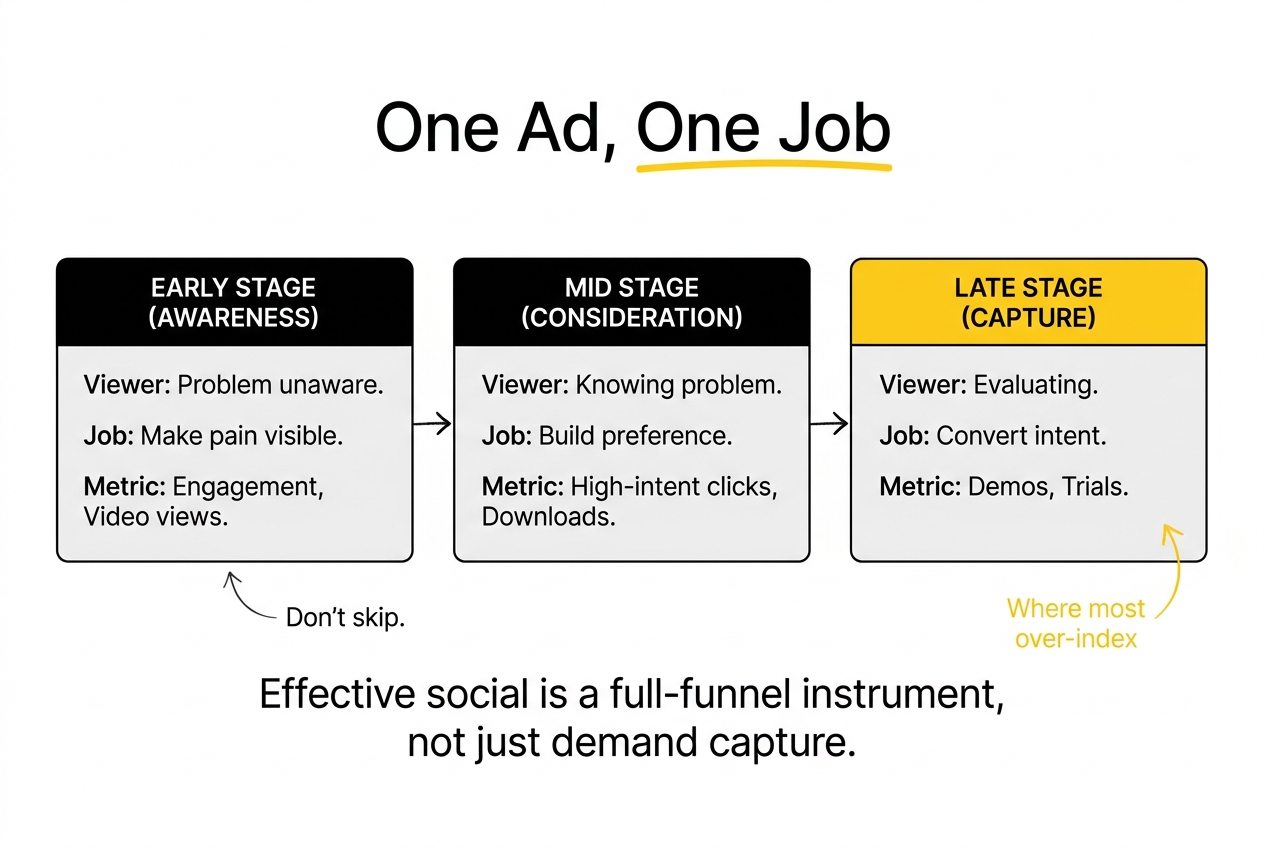
Map your paid social work to buying stage:
- Early stage (awareness): The viewer does not know the problem is solvable. The job is to make the pain visible and credible. Success metric: content engagement, video watch rate, branded search lift.
- Mid stage (consideration): The viewer knows the problem exists and is comparing options. The job is to differentiate and build preference. Success metric: click-through to high-intent pages, whitepaper downloads, social engagement from ICP profiles.
- Late stage (capture): The viewer is actively evaluating solutions. The job is to convert intent. Success metric: demo requests, free trial sign-ups, cost-per-opportunity.
Most Series A teams underweight the first two stages and over-index on capture. The result is an efficient capture machine sitting on top of an undersized addressable audience. Your CPO looks good until pipeline starts thinning out three months later.
Effective social media strategies for SaaS marketing treat paid social as a full-funnel instrument, not just a demand capture channel.
Stripping the Value Proposition Down to Social Scale
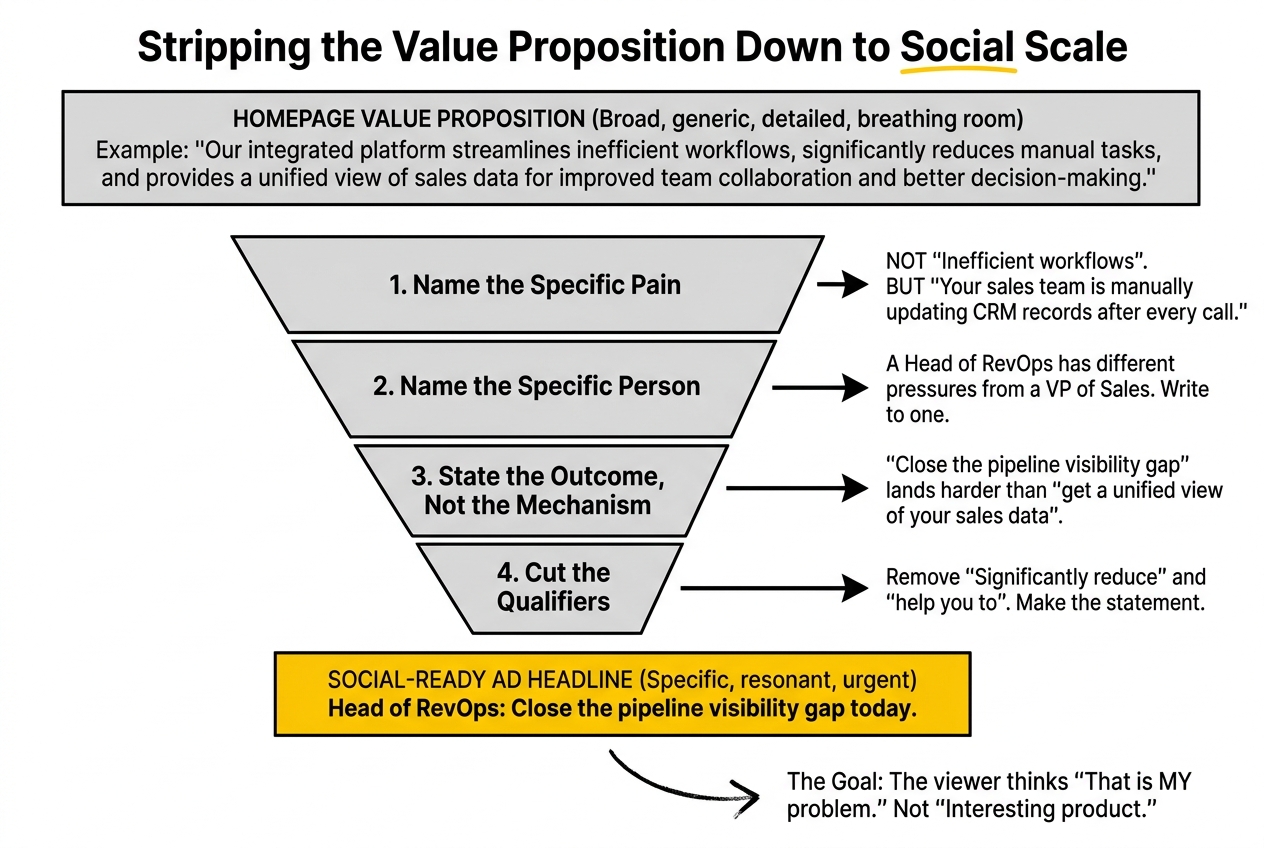
The value proposition that lives on your homepage is built for someone who has already decided to learn more. It has space to breathe. Social does not.
A useful exercise: write your homepage value proposition on a piece of paper. Then cut it in half. Then cut it in half again. What is left? If what remains is still specific and useful to your ICP, you have found your ad headline. If what remains is a generic claim that could apply to twenty other products, you have more work to do.
Here is a practical process for getting to a social-ready message:
- Name the specific pain. Not “inefficient workflows” but “your sales team is manually updating CRM records after every call.” The more specific, the more resonant.
- Name the specific person. A Head of RevOps at a 150-person SaaS company has different pressures from a VP of Sales at the same company. Write to one.
- State the outcome, not the mechanism. “Close the pipeline visibility gap” lands harder than “get a unified view of your sales data across all stages.” Both say the same thing. One of them makes a person feel it.
- Cut the qualifiers. “Significantly reduce” and “help you to” are hedges that dilute the claim. Make the statement.
The goal is an ad that a member of your ICP reads and thinks “that is my problem.” Not “interesting product.” Not “I should look into that.” The ad earns a click when the viewer believes it is specifically for them.
Choosing the Right Ad Formats for SaaS
Format selection matters in creating engaging social ads for SaaS, but it is downstream of the message. A strong message in a static image will outperform a weak message in a polished video. That said, format affects how much work your message has to do.
Static single image: Works for high-clarity, single-idea messages. Particularly effective for problem-statement ads targeting awareness audiences. The visual and the headline need to carry the full load.
Carousel ads: Effective for mid-funnel, where you need to walk through a short narrative. A carousel can show the before/after, introduce a framework, or build a case over three to five frames. Each frame needs to earn the swipe, not just add more content.
Video: High upside but requires a strong first frame. On LinkedIn, most video plays without sound, so the visual and text overlay need to communicate independently of the audio. Short form (under 30 seconds) works for awareness. Longer testimonial or case study videos can work for retargeting audiences who have already shown intent.
Conversation and lead gen ads: Useful for lowering friction on demo requests in late-stage campaigns. The conversion happens in-platform, which reduces drop-off, but the quality of leads tends to be lower than clicks to a high-intent landing page.
Platform matters too. LinkedIn delivers higher ICP precision for B2B SaaS, particularly for company size, job function, and seniority. Meta’s B2B targeting is less precise by default, but its volume and algorithm’s ability to find lookalike audiences at scale can make it effective for Series A teams building out their addressable audience. The two channels play different roles. Treating them identically is how you end up with underperforming campaigns on both.
Using Emotional Storytelling in SaaS Social Ads
Emotional appeal in SaaS advertising is underused, partly because the instinct is to lead with product logic. But B2B buyers are not immune to emotion. They experience frustration, anxiety, and relief in exactly the same way consumer buyers do. They just experience those emotions in a professional context.
Talia Wolf, founder of GetUplift, has written extensively on emotional targeting in conversion contexts. The core argument applies directly to social ad creative: people do not buy products, they buy better versions of their professional situation. The ad that speaks to the anxiety behind the problem (quarterly reviews, board scrutiny, the pipeline gap you cannot explain) connects at a level that feature lists never reach.
This does not mean being melodramatic. It means being accurate. “You are three months from your next board meeting and the pipeline report still does not make sense” is not hyperbole. For a significant proportion of your target audience, it is simply true.
Customer success stories, used correctly, carry emotional weight without sentimentality. A short customer quote that names a specific outcome (“We cut our reporting cycle from two weeks to two days”) is more convincing than a case study PDF buried behind a gated form. Use it in the ad itself.
A/B Testing Social Ads: What to Test and in What Order
A/B testing is the only reliable way to generate learning from paid social advertising for SaaS. Intuition about what will work is consistently wrong at scale. But testing without a structure produces data that is hard to act on.
A useful sequence:
- Test the problem statement first. Before testing creative formats or visuals, test whether you have the right pain point. Write three versions of the same ad, each leading with a different expression of the core problem. The winning version tells you which pain point resonates most with your target segment.
- Test the ICP frame. Once you know the pain point, test how specific you can get with audience framing. “For RevOps teams at Series B SaaS companies” vs. “For ops teams managing multi-CRM environments.” Specificity usually wins, up to a point.
- Test the creative treatment. With a proven message, test whether a static image, carousel, or short video delivers it more effectively to the audience. Do not start here.
- Test the call-to-action. The difference between “Book a demo” and “See how it works in 20 minutes” can be material for SaaS products with longer sales cycles. Test both.
Run tests with sufficient budget to reach statistical significance before drawing conclusions. The minimum depends on your volume, but as a rule: do not make decisions based on fewer than 50 conversions per variant for conversion-focused tests.
Business Performance Metrics Worth Tracking
The default social ad dashboard tells you impressions, clicks, and cost-per-click. For a Series A SaaS team defending spend in a board meeting, those numbers are near-useless. Cost Per Acquisition (CPA) - The Most Critical PPC Metric, also on this blog, takes this further.
The metrics that matter are the ones that connect paid social activity to pipeline:
- Cost-per-qualified-lead (CPQL): Not just cost-per-lead. Filter by ICP fit before reporting.
- MQL-to-SQL conversion rate by campaign: Which campaigns generate leads that sales actually wants to work with.
- Cost-per-opportunity: What does it cost to generate a sales-qualified opportunity from paid social? This is the metric that survives a CFO question.
- Pipeline influenced: For awareness and mid-funnel campaigns, track whether contacts exposed to paid social appear in open or closed-won opportunities at a higher rate.
- Payback period on social spend: What is the CAC from paid social, and how does it compare to your average ACV and retention rate?
Business intelligence at this level requires your paid social data to be joined to your CRM. If HubSpot or Salesforce is not receiving UTM data from your social campaigns, you cannot produce these numbers. Fixing the attribution infrastructure before optimising the campaigns is the right order of operations.
Multi-touch attribution will never be perfect on social, particularly for awareness campaigns where the channel’s contribution is diffuse across a long sales cycle. The goal is directional data that holds up under scrutiny, not precision.
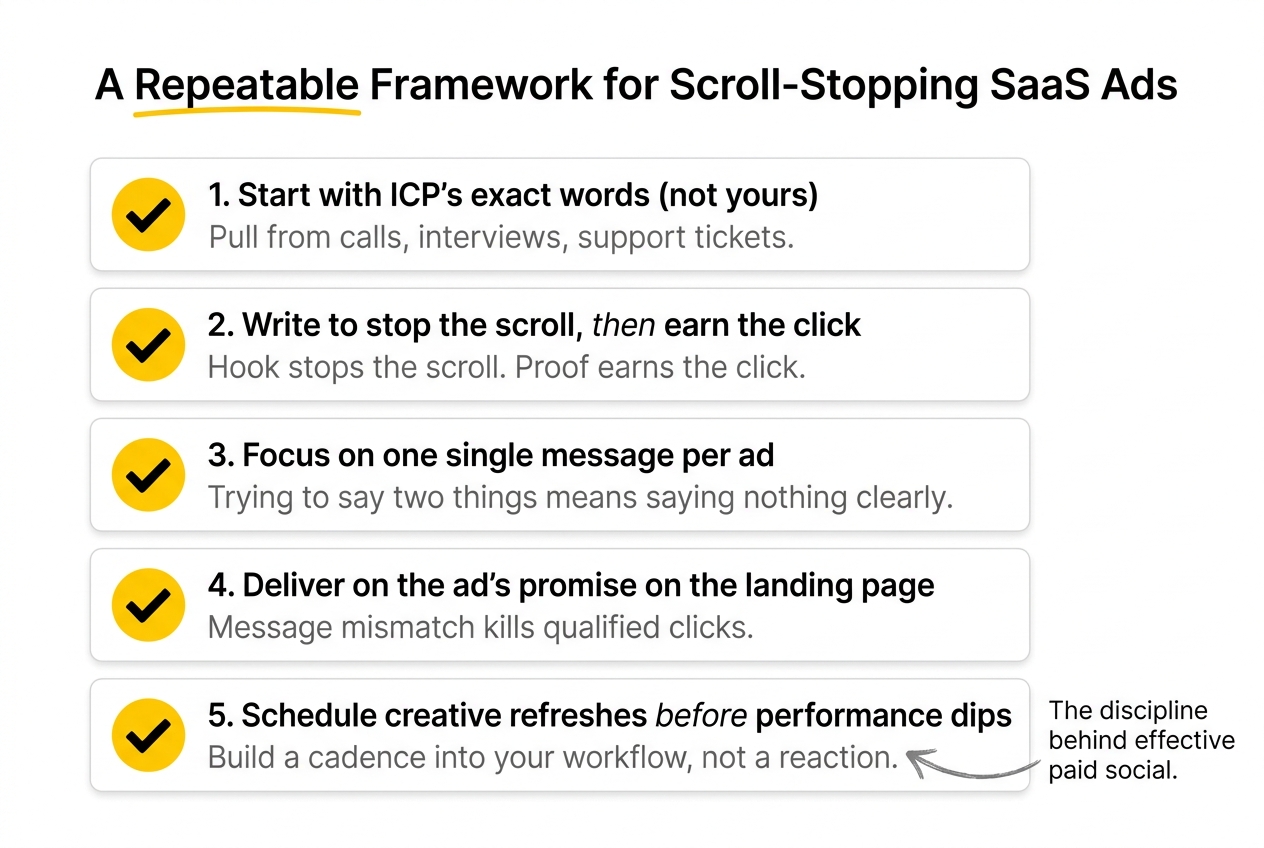
A Repeatable Framework for Scroll-Stopping SaaS Ads
The teams that consistently produce effective SaaS social ads are not doing something creative that cannot be replicated. They are following a repeatable process:
- Start with the ICP’s words, not yours. Pull language from sales call recordings, customer interviews, and support tickets. The way your customers describe the problem they had before finding you is your best ad copy.
- Write for the scroll, not the click. The ad’s first job is to stop the scroll. The second job is to earn the click. These require different things. The hook earns the stop. The proof earns the click.
- One message per ad. If the ad is trying to say two things, it is saying nothing clearly.
- Match the ad to the page. An ad that promises “see how it works in 15 minutes” should land on a page that delivers exactly that. Message mismatch between ad and landing page is where qualified clicks turn into bounce rates.
- Refresh creative before fatigue sets in. Social ad frequency is your enemy at scale. For niche B2B audiences, creative fatigue arrives faster than most teams expect. Build a creative refresh cadence into your workflow, not a response to a performance cliff.
This is the consistent discipline behind effective paid social media advertising for SaaS. It is less about individual brilliant ads and more about a system that generates, tests, and replaces creative systematically.
If you’re working on how to translate your product’s value for paid social and you’re not sure where the message is breaking down, this is the kind of challenge our SaaS digital marketing agency digs into regularly. Worth a conversation if you’re at that point.
Frequently Asked Questions
How can SaaS companies effectively convey their value propositions in social ads?
Lead with the specific problem your ICP experiences, not with your product’s features or capabilities. The value proposition that works in social is the one that makes a viewer feel seen in the first two seconds. Start from your customers’ own language, pulled from call recordings or interviews, and strip back to the single most resonant pain point. The product explanation can live on the landing page.
What creative strategies can be used to make social ads stand out in crowded feeds?
The most effective strategies are not the most elaborate ones. Problem-statement hooks in plain text often outperform polished brand visuals, particularly on LinkedIn where the feed is visually noisy. Specificity creates standout: an ad that names a job title, a company stage, or a particular operational pain will stop scrolling faster than a generic product claim. Customer quotes used as ad headlines are consistently underutilised.
What are the best practices for writing compelling ad copy for SaaS products?
Make one claim per ad. Use your ICP’s own language. State the outcome rather than the mechanism. Remove qualifiers and hedges. The copy that works is usually shorter than what feels comfortable. If a sentence is doing two jobs, split it into two sentences or cut one of them. The goal is a message that lands cleanly on the first read, not one that rewards careful study.
How can data-driven insights improve the performance of social ads?
The most useful data is the kind that connects ad performance to pipeline, not just to clicks. Segment your reporting by ICP fit so you are optimising toward qualified pipeline rather than volume. Run systematic A/B tests on problem statements before testing creative formats. Track which campaigns produce MQLs that sales actually converts, not just which ones produce the most form fills.
What metrics should Series A marketing directors track to measure the success of their social ad campaigns?
Cost-per-opportunity and MQL-to-SQL conversion rate by campaign are the most defensible numbers in a board context. Alongside those, track pipeline influenced from social activity and CAC from paid social relative to your ACV. Impressions and clicks are internal optimisation data, not business performance metrics.
What role does audience targeting play in the effectiveness of social ads?
It is the most important variable in paid social advertising for SaaS, and the most frequently underinvested. LinkedIn’s targeting allows you to reach specific job functions, seniority levels, company sizes, and technology stacks. Narrow targeting reduces volume but increases the proportion of impressions landing in front of your actual ICP. A well-targeted ad with an average message will outperform a well-written ad served to the wrong audience.
How can emotional appeal enhance the effectiveness of SaaS social advertising?
SaaS buyers experience the same professional anxieties as any buyer: the risk of a bad decision, the pressure of quarterly performance, the frustration of broken processes. Ads that name those feelings accurately create more connection than product feature lists. The emotional hook is not manipulation; it is accuracy. If your product genuinely reduces the anxiety your ICP carries about their KPIs or board reviews, say that directly.
What are common mistakes to avoid when creating social ads for SaaS products?
Leading with features instead of problems. Trying to convey the full product story in one ad. Mismatching the ad message to the landing page experience. Using the same creative for awareness audiences and retargeting audiences. Not joining social ad data to CRM data, which makes it impossible to measure pipeline contribution. And allowing creative to run until performance collapses, rather than refreshing on a planned cadence.
How can A/B testing be used to optimise social ad performance?
Test in order: problem statement first, then audience framing, then creative format, then call-to-action. Do not test creative variables before you have validated the core message. Run tests to sufficient volume before drawing conclusions, and change one variable at a time. The learning compounds over time: each test cycle produces a stronger baseline from which the next test starts.