Choosing the Right Conversion Path for Your SaaS Paid Social Campaigns
When to use webinars, demo requests, or content offers in SaaS paid social, and how to match each path to your sales process and pipeline.

Most SaaS teams pick a paid social conversion path by default. The demand gen manager inherits a “Request a demo” campaign, or spins up a gated ebook because that is what the last agency ran, then spends the next quarter wondering why the pipeline does not follow the lead volume.
The conversion path, meaning what you ask someone to do after they click your ad, is one of the highest-leverage decisions in b2b demand generation. It shapes lead quality, cost per opportunity, and whether sales trusts the leads at all. Choose the wrong one and you can run sharp creative against a well-built audience and still generate leads that sales will not touch.
This article covers when to use webinars, demo requests, and content offers in paid social, and gives you a framework for choosing between them based on your sales process rather than habit. It sits alongside our wider work on saas demand generation.
The Three Paths: Webinars, Demo Requests and Content Offers
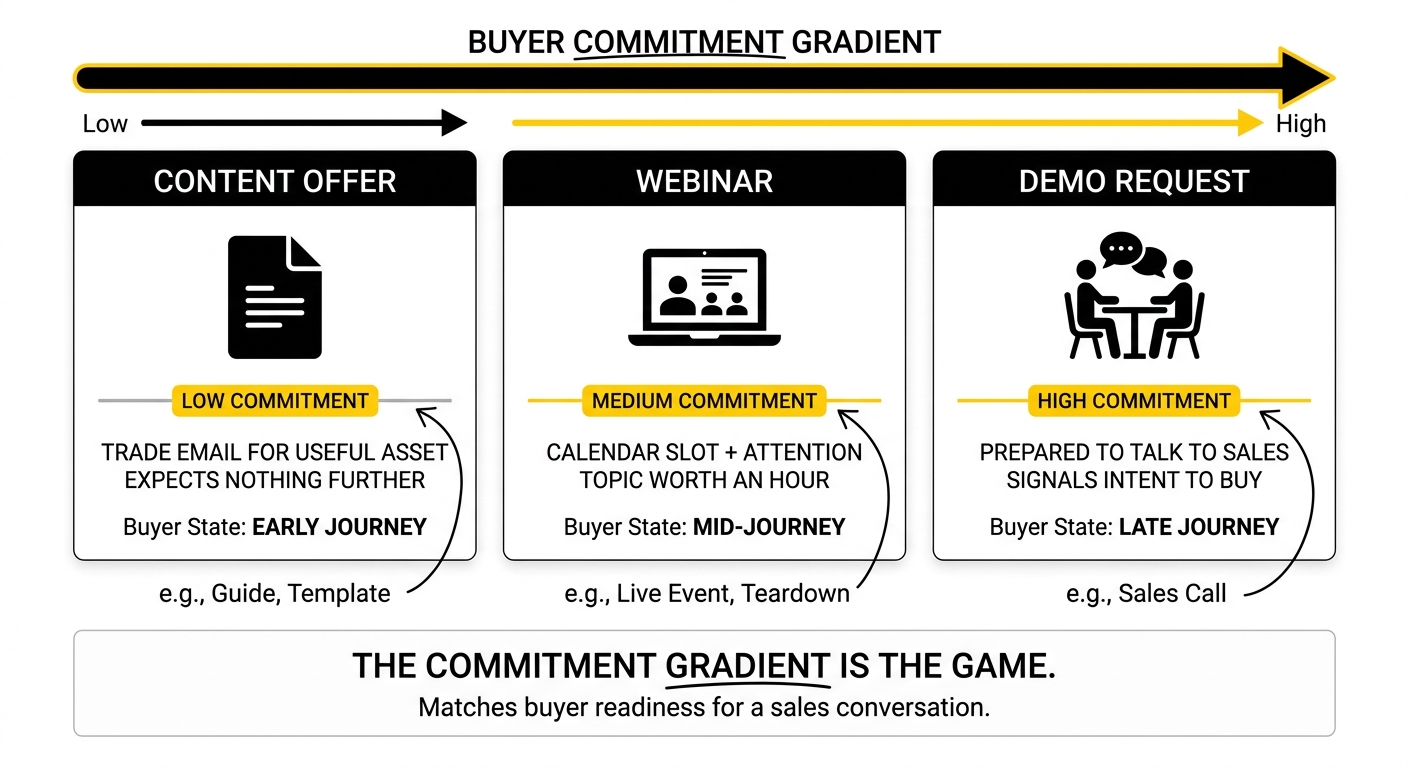
The three conversion paths differ in one thing that matters more than format: how much commitment they ask of the buyer.
A content offer (a report, template, guide, or teardown) asks for the least. The buyer trades an email for something useful and expects nothing further. A webinar asks for more: a calendar slot, attention, and usually a sense that the topic is worth an hour. A demo request asks for the most. It signals the buyer is prepared to talk to sales, which is a materially different act from downloading a PDF.
That commitment gradient is the whole game. It maps directly onto where a buyer sits in their journey and how ready they are for a sales conversation. A demo request from someone who is not in-market is not a win. It is a discovery call that wastes an SDR’s morning.
So the question is never “which path is best”. It is “which path matches the buyer we are reaching, and the sales motion behind it”.
How Each Path Affects Lead Quality
Lead quality is where the differences become expensive.
Demo requests are, by definition, hand-raisers. They tend to convert to opportunity at high rates once sales engages: demo-to-opportunity rates in B2B SaaS commonly sit between 60 and 80 percent for average performers, with elite teams above 90 percent, according to SaaSHero’s 2026 conversion benchmarks. The catch is volume. Demo requests are scarce because few people are ready to talk to sales at any given moment.
Content offers sit at the other end. They generate volume cheaply, but the intent is thin. Lead source data tells the story: website-generated leads convert to qualified pipeline at roughly 31 percent, while webinars convert at closer to 18 percent, per the same 2026 benchmark set. A gated ebook downloaded from a paid social ad typically performs below both.
This is the trap most teams fall into. Cheap, high-volume content conversions inflate MQL counts, sales rejects most of them, and the reported conversion rate collapses downstream. Refine Labs has argued for years that gating your best content trains buyers to expect low value behind a form, and produces leads that were never really in-market. Their point holds up in the numbers.
Webinars sit in the middle. A registration is a weak signal on its own. Attendance, and engagement during the session, is a much stronger one. The mistake is treating the registration as the conversion when the real signal is who shows up and stays.
A Framework for Choosing a Conversion Path
Here is the decision that actually determines the right path. It comes down to three questions about your sales process, not your ad account.
Is the demand already there? If your category is established and buyers are actively searching for a tool like yours, demand exists and your job is to capture it. Demo requests and free trials make sense. If you are creating a new category, or selling to buyers who do not yet know they have the problem, demand has to be built first. That is content and webinar territory.
How long and how complex is the sales cycle? Short cycles with a single decision-maker can support a direct demo path. Long cycles with a buying committee and a high ACV rarely convert cold traffic straight to demo. The buyer needs education and trust before a sales conversation is worth anyone’s time.
What can your team actually support? A webinar is a production. It needs a topic, a presenter, promotion, and follow-up. A content offer can be live in a day. If resourcing is tight, a poorly run webinar will underperform a well-made content offer every time.
Put simply:
- In-market demand, shorter cycle, product that demos well: lead with demo requests.
- Building demand, longer cycle, complex or multi-stakeholder buy: lead with webinars for education, content offers for reach.
- Early-stage funnel or retargeting fuel: content offers, treated as a first touch, not a pipeline source.
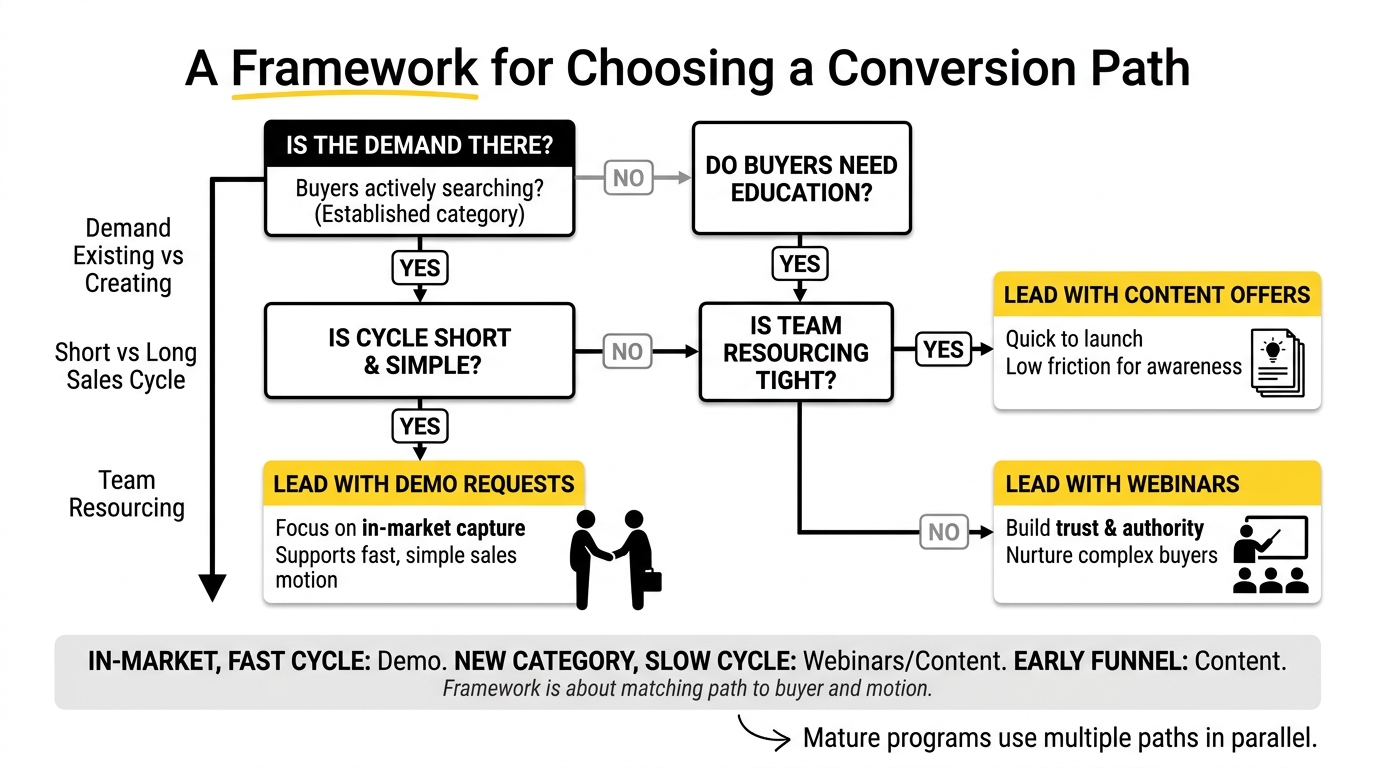
The framework is not “pick one forever”. Most mature programmes run more than one path in parallel, matched to different stages. The discipline is being honest about what each path is for.
Best Practices for SaaS Webinar Conversion
Webinars work best when the buyer needs to learn something before they can evaluate you. That makes them strong for category creation, complex products, and multi-stakeholder deals where several people need to be brought along.
The best practices for SaaS webinar conversion are less about the webinar and more about what surrounds it:
- Sell the outcome, not the event. “How three fintech teams cut CAC payback below 12 months” converts better than “Join our Q3 webinar”.
- Optimise for attendance, not registration. Reminder sequences, calendar holds, and a genuinely useful first ten minutes matter more than a slick landing page.
- Treat the recording as an asset. Most of the value comes after the live session, through the on-demand replay and the clips you cut for retargeting.
- Score on engagement. Pass attendance duration and poll responses to sales, not just the registration list.
A webinar that generates 200 registrations and 40 engaged attendees has given you 40 leads worth passing on, not 200.
Effective Demo Strategies for SaaS
Demo requests are the shortest path to pipeline when the demand is there. The effective demo strategies for SaaS are about protecting quality and reducing friction at the same time, which pull in opposite directions.
Reduce friction where it does not cost you quality: fast scheduling, clear value proposition above the fold, visible trust signals like customer logos and security badges. Add friction where it protects sales’ time: qualifying questions, or pricing context on the page that lets bad-fit buyers self-select out.
LinkedIn Lead Gen Forms convert at roughly double the rate of landing pages, but often at the expense of quality, as HockeyStack’s 2025 LinkedIn benchmark data notes. For a demo path, that trade is usually wrong. The friction of a proper landing page is doing useful filtering work.
One rule holds across every SaaS demo campaign: feed sales-qualified outcomes back to the ad platform. If LinkedIn or Meta only knows which leads became MQLs, it will optimise for more MQLs, not more qualified pipeline. Offline conversion tracking that passes SQL and opportunity data back typically shifts targeting toward better-fit buyers within four to six weeks.
Content Offer Ideas for SaaS Lead Generation
Content offers earn their place at the top of the funnel and as retargeting fuel. The strongest content offer ideas for SaaS lead generation solve a real, specific problem the buyer has right now, rather than acting as thinly veiled product brochures.
Formats that tend to work:
- Benchmark reports and original data. Buyers want to know how they compare. Original numbers earn shares and citations.
- Templates and calculators. A CAC payback calculator or a board-reporting template delivers value on download and keeps working afterwards.
- Teardowns and worked examples. Specific, named, practical. These read as expertise, not marketing.
The judgement call is gating. Gating everything trains buyers to expect little and fills your database with low-intent contacts. A reasonable middle path: ungate the content that builds trust and reach, gate the high-utility assets (calculators, templates, benchmark data) where the exchange feels fair. Treat every gated content conversion as a first touch to nurture, never as a lead sales should call today.
Testing and Measuring Conversion Paths
You cannot choose a path on theory alone. You test it, but the test has to be structured or the data will mislead you.
A workable testing approach:
- Change one variable. Hold audience and creative steady, vary only the conversion path, so the difference you see is the path, not the targeting.
- Give it enough time and volume. Long sales cycles mean early conversion data lies. Judge on downstream quality (MQL-to-SQL, opportunities created), not day-one cost per lead.
- Define the real conversion. For webinars, that is engaged attendance. For content, it is a nurture entry, not a pipeline event. For demos, it is an opportunity created.
- Track the metrics that hold up in a board deck: cost per opportunity, MQL-to-SQL rate by path, and pipeline created, not cost per lead or registration volume.

Connecting these upper-funnel activities to revenue is its own discipline, and it depends on attribution that reflects how B2B buyers actually behave. Refine Labs’ 2025 analysis found a roughly 90 percent gap between what attribution software reports and what buyers say when asked directly, particularly across dark social. Self-reported attribution on your demo form (“How did you hear about us?”) is often the most honest signal you have for whether webinars and content are doing their job.
We will cover the reporting side of this in more depth in a companion piece, Creative Reporting for SaaS Paid Social Without Vanity Metrics.
Practical Takeaways
Choosing a conversion path is a decision about matching commitment to intent. Demo requests capture existing demand and convert well but stay scarce. Webinars build trust and educate, which suits complex and multi-stakeholder deals. Content offers generate reach and retargeting fuel, provided you treat them as a first touch and not a pipeline source.
Match the path to your sales process: in-market demand and shorter cycles favour demos; demand you have to build favours webinars and content. Run more than one path in parallel once you have the volume, and measure each on downstream quality rather than surface conversions.
If you are working through which conversion paths belong in your paid social mix, we are happy to take a look at your setup and the pipeline data behind it.
Frequently Asked Questions
What are the key differences between webinars, demo requests, and content offers in B2B SaaS?
They differ in the commitment they ask of the buyer. A content offer trades an email for a useful asset and expects nothing further. A webinar asks for a calendar slot and attention. A demo request signals readiness to talk to sales. That commitment gradient maps onto buyer intent, which is why demo requests convert to pipeline at higher rates but arrive in far lower volume than content downloads.
How do webinars impact lead quality compared to content offers and demo requests?
Webinars sit between the two. A registration is a weak signal, but engaged attendance is a strong one. In 2026 benchmark data, webinars convert to qualified pipeline at around 18 percent, below website-generated leads at roughly 31 percent, but well above cold gated content. Demo requests convert highest of all once sales engages. The practical takeaway is to score webinar leads on attendance and engagement, not registration.
What factors should be considered when choosing a conversion path in B2B SaaS marketing?
Three factors decide it. First, whether demand already exists (capture it with demos) or has to be built (educate with webinars and content). Second, the length and complexity of the sales cycle, since long, multi-stakeholder cycles rarely convert cold traffic straight to demo. Third, your team’s capacity, because a poorly run webinar underperforms a well-made content offer. Match the path to the sales motion, not to habit.
What role does the sales process play in selecting a conversion path for paid social campaigns?
The sales process is the deciding factor. A short cycle with one decision-maker can support a direct demo path. A long cycle with a buying committee and a high ACV needs education and trust before a sales conversation is worthwhile, which favours webinars and content. The conversion path should feed the sales motion the right kind of lead at the right moment, rather than pushing every click toward a demo.
What scenarios are most suitable for using webinars as a conversion path?
Webinars suit situations where the buyer must learn something before they can evaluate you. That includes category creation, technically complex products, and multi-stakeholder deals where several people need bringing along. They also work well as trust-builders in long sales cycles. Webinars are a poor fit when demand is already high and buyers are ready to buy, since a direct demo path serves those buyers faster.
What are best practices for structuring tests to evaluate the effectiveness of different conversion paths?
Change one variable at a time by holding audience and creative steady and varying only the path. Give each test enough time and volume, since long sales cycles make early data unreliable. Define the real conversion for each path (engaged attendance for webinars, nurture entry for content, opportunity created for demos). Judge on downstream quality such as MQL-to-SQL rate and pipeline created, not day-one cost per lead.
What metrics should be tracked to assess the success of different conversion paths in B2B SaaS?
Track metrics that survive a board meeting: cost per opportunity, MQL-to-SQL conversion rate by path, opportunities created, and pipeline value. Registration counts, cost per lead, and download volume are activity metrics that hide quality problems. Pair platform data with self-reported attribution on demo forms, since software attribution misses a large share of how B2B buyers actually discover and evaluate vendors.
How can demand generation managers report campaign outcomes to senior stakeholders effectively?
Report in the language of pipeline and revenue, not clicks and impressions. Lead with pipeline created and cost per opportunity, broken down by conversion path so leadership can see which path produces qualified pipeline rather than volume. Acknowledge attribution’s limits openly and use self-reported data to fill the gaps. Consistent, directional reporting that ties spend to opportunities builds more trust than precise-looking dashboards full of vanity metrics.