Adapting Governance Models for SaaS PPC in a Multi-Stakeholder Environment
How governance models for SaaS PPC need to evolve once Finance, Sales leadership, and the board all have a stake in spend post-Series A, so Revenue-Accountable VPs of Marketing can keep speed without losing stakeholder trust.

Before Series A, PPC decisions moved fast because one person made them. Post-Series A, that same speed becomes a liability, because now Finance wants to see payback periods, Sales leadership wants a say in what “qualified” means, and the board wants a growth story that holds up under questioning. Nobody removed the old decision-making process. They just added more people with a legitimate claim on the answer.
This is the real shift behind governance models for SaaS PPC once multiple stakeholders own spend. It's not that the old approach was wrong. It's that it was built for a single owner, and a Revenue-Accountable VP of Marketing now needs a structure that works when several people, each with a different stake in the outcome, need to trust the same numbers.
Why Governance Models for SaaS PPC Have to Change After Series A
Series A funding doesn't just bring capital. It brings scrutiny, and scrutiny arrives through new people, not just new questions. A CFO now reviews spend against payback assumptions. Sales leadership expects a voice in lead quality standards, since their team works whatever marketing sends. The board wants a narrative that connects spend to revenue in a way a single dashboard rarely tells cleanly.
Gartner's 2025 CEO/CFO survey found that only 22% of senior executives report significant clarity from their CMO or VP of Marketing on marketing accountabilities. That gap is exactly what a multi-stakeholder governance model exists to close, because ambiguity about who owns what decision becomes a credibility problem the moment more people are watching.
From Single-Owner to Multi-Stakeholder: What Actually Changes
The practical shift isn't about adding more meetings. It's about making explicit what used to be implicit. When one person owned PPC decisions, priorities lived in their head. Once Finance, Sales, and the executive team all have a stake, those priorities need to be written down and agreed, because each stakeholder will otherwise apply their own unstated definition of success.
Stakeholder management in SaaS marketing at this stage means identifying, specifically, what each group actually needs from PPC reporting. Finance needs payback period and CAC trends. Sales needs lead quality signals they trust. The board needs a growth narrative tied to revenue, not just pipeline volume. A governance model that serves only one of these audiences will eventually frustrate the others.
Governance Frameworks for Shared Stakeholder Spending
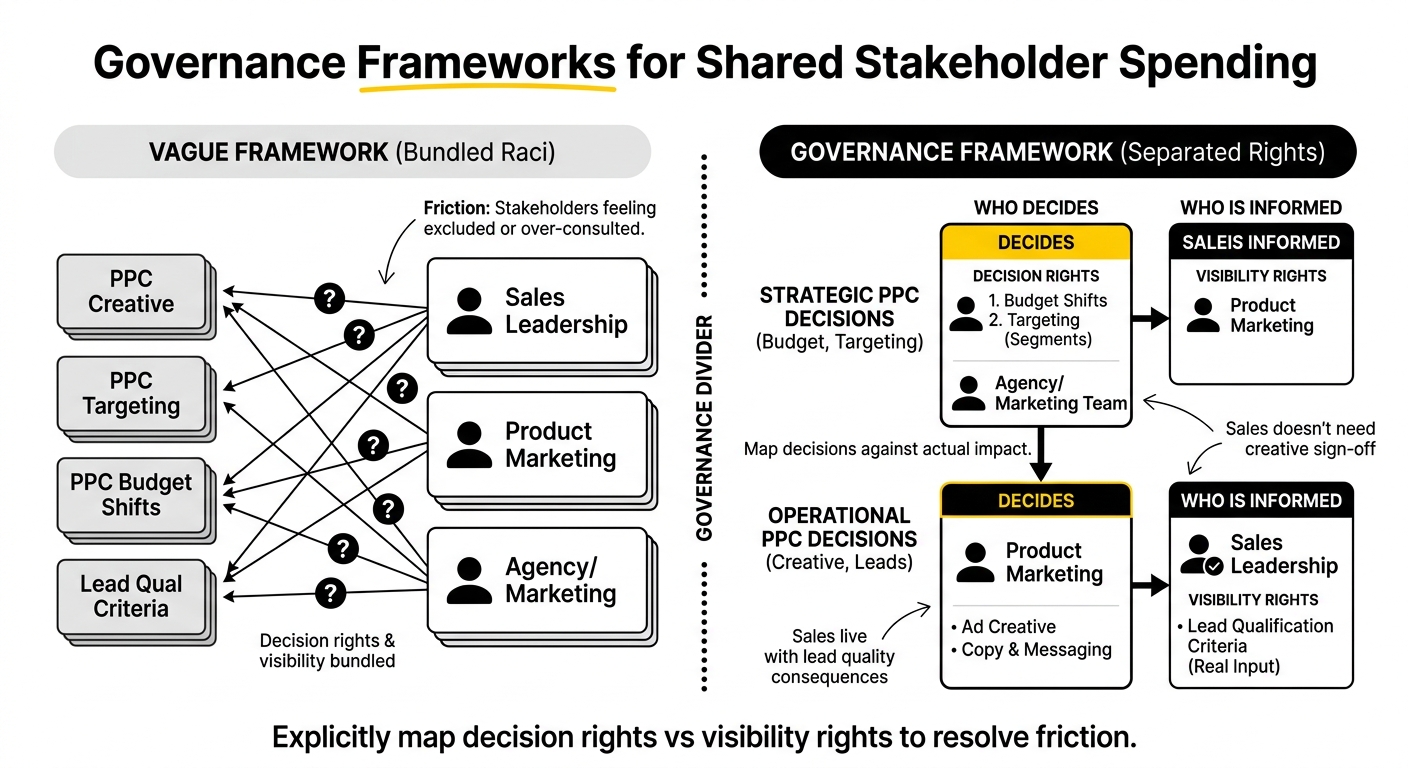
Governance frameworks for SaaS PPC with shared stakeholder spending work best when they separate two things that often get bundled: who decides, and who needs to be informed. Not every stakeholder needs decision rights over every choice. Sales leadership should have real input into lead quality thresholds, since they live with the consequences. They don't need sign-off over ad creative.
Map each major PPC decision, targeting, budget shifts, lead qualification criteria, against the stakeholders it actually affects, and assign either decision rights or visibility rights accordingly. This single exercise resolves most of the friction that shows up later as stakeholders feeling either excluded or over-consulted.
Optimising PPC Spend Across Multiple Teams Without Losing Speed
The risk with multi-stakeholder governance is that it slows everything down. Optimising PPC spend across multiple teams means protecting speed on reversible, low-stakes decisions while reserving genuine consultation for decisions that are hard to undo or affect revenue reporting.
A tiered approach works well here: day-to-day optimisation continues without a stakeholder review cycle, while quarterly budget reallocation and any change to lead qualification criteria goes through a defined, lightweight review with the stakeholders it affects. This keeps the governance model proportional to the decision, rather than uniformly heavy.
Granular Attribution as the Shared Language Between Stakeholders
Granular attribution matters more in a multi-stakeholder environment because it's the only thing every stakeholder can evaluate independently. A CFO doesn't need to trust marketing's judgment if they can see the MQL to SQL to closed-won path clearly enough to draw their own conclusion.
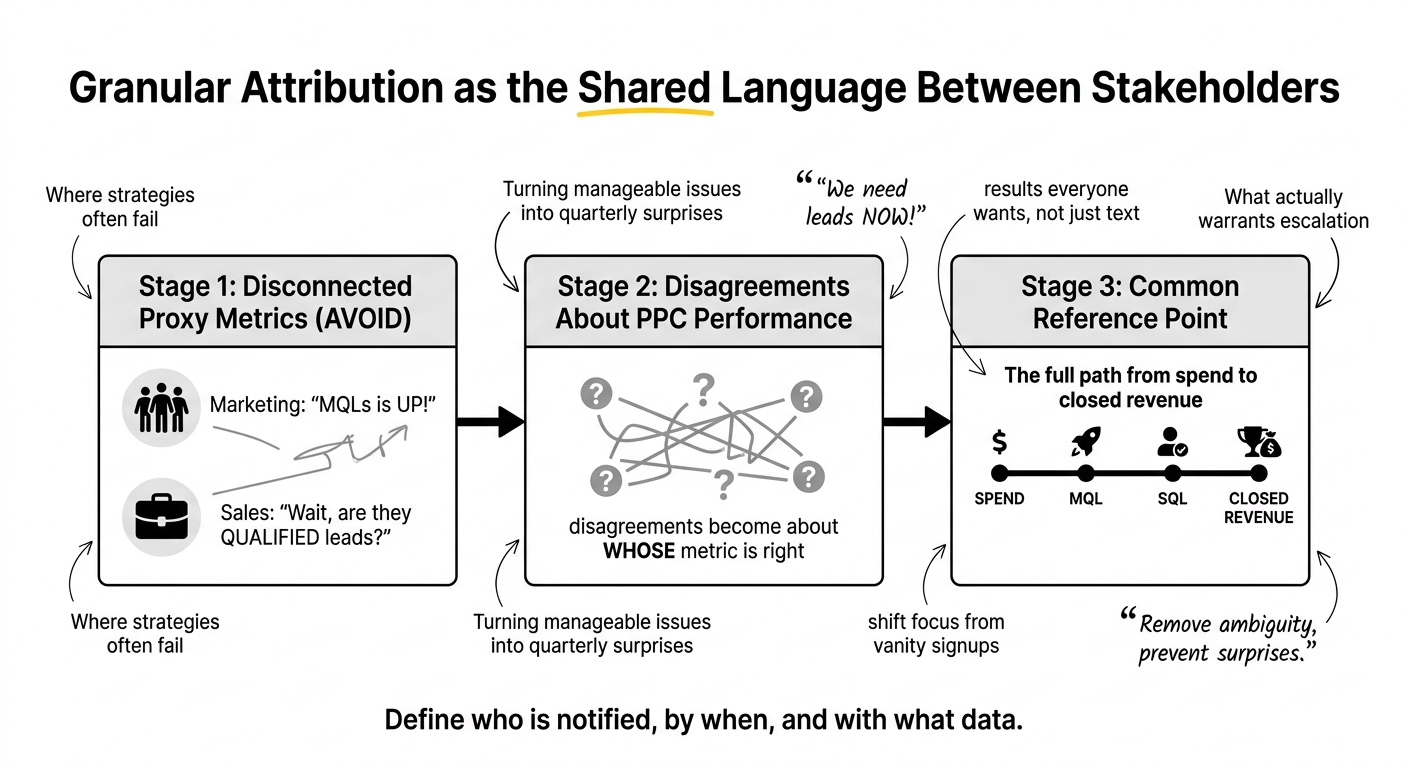
B2B SaaS marketing governance built around a shared, granular attribution model, one that shows the full path from spend to closed revenue, gives every stakeholder a common reference point. Without it, each group defaults to their own proxy metric, and disagreements about PPC performance become disagreements about whose metric is right, rather than productive conversations about what to change.
How Agencies Need to Adapt to Multi-Stakeholder PPC Management
Collaborative agency governance in this environment means the agency's reporting has to serve more than one audience. An agency still reporting purely on cost per click and volume to a company now facing CFO scrutiny is reporting to an organisation that no longer exists.
Ppc strategies for multiple stakeholders require agencies to build reporting that speaks in each stakeholder's language: payback period for Finance, lead quality distribution for Sales, and a clear spend-to-revenue narrative for the board. The best agencies in this environment ask directly which stakeholders now have a claim on the numbers, rather than assuming the brief hasn't changed.
Regular Budget Reallocation as a Governance Habit, Not a Crisis Response
Saas marketing budget strategies at this stage benefit from treating reallocation as a scheduled habit rather than a reaction to a bad quarter. Ppc performance scrutiny tends to spike after a disappointing number, which is exactly the wrong moment to be renegotiating governance for the first time.
Build a quarterly reallocation review into the governance model from the start, with clear criteria for what triggers a shift, rather than letting the first real reallocation conversation happen under pressure, with stakeholders who've never seen this process before.
Aligning PPC Strategy With Revenue Accountability Across the Business
Revenue accountability in marketing only works when PPC strategy is explicitly tied to the revenue metrics the rest of the business is judged on, not a marketing-specific proxy that doesn't translate. If Sales is measured on closed-won and Finance is measured on payback period, a PPC governance model reporting only on MQL volume is speaking a different language entirely.
Multi-stakeholder ppc management succeeds when the governance model translates PPC activity into the same revenue terms every other function already uses, so a quarterly review becomes a shared conversation about the business, not a marketing update everyone else has to interpret.
A Worked Example: When Governance Evolves Too Late
Take a hypothetical Series B billing automation SaaS six months past its raise. The VP of Marketing has run PPC the same way since seed stage, monthly updates to the CEO, no formal stakeholder process. A disappointing quarter triggers the CFO's first deep review of marketing spend, and the review surfaces three different definitions of a qualified lead in use across Sales, Marketing, and the board deck, none of them documented anywhere.
The resulting conversation isn't really about PPC performance. It's about which definition is correct, a dispute that consumes weeks and damages trust that took years to build, purely because governance never caught up to the number of people now watching the same budget. None of the three definitions were wrong on their own. The absence of an agreed one was the actual problem.
A Governance Model for Multi-Stakeholder SaaS PPC
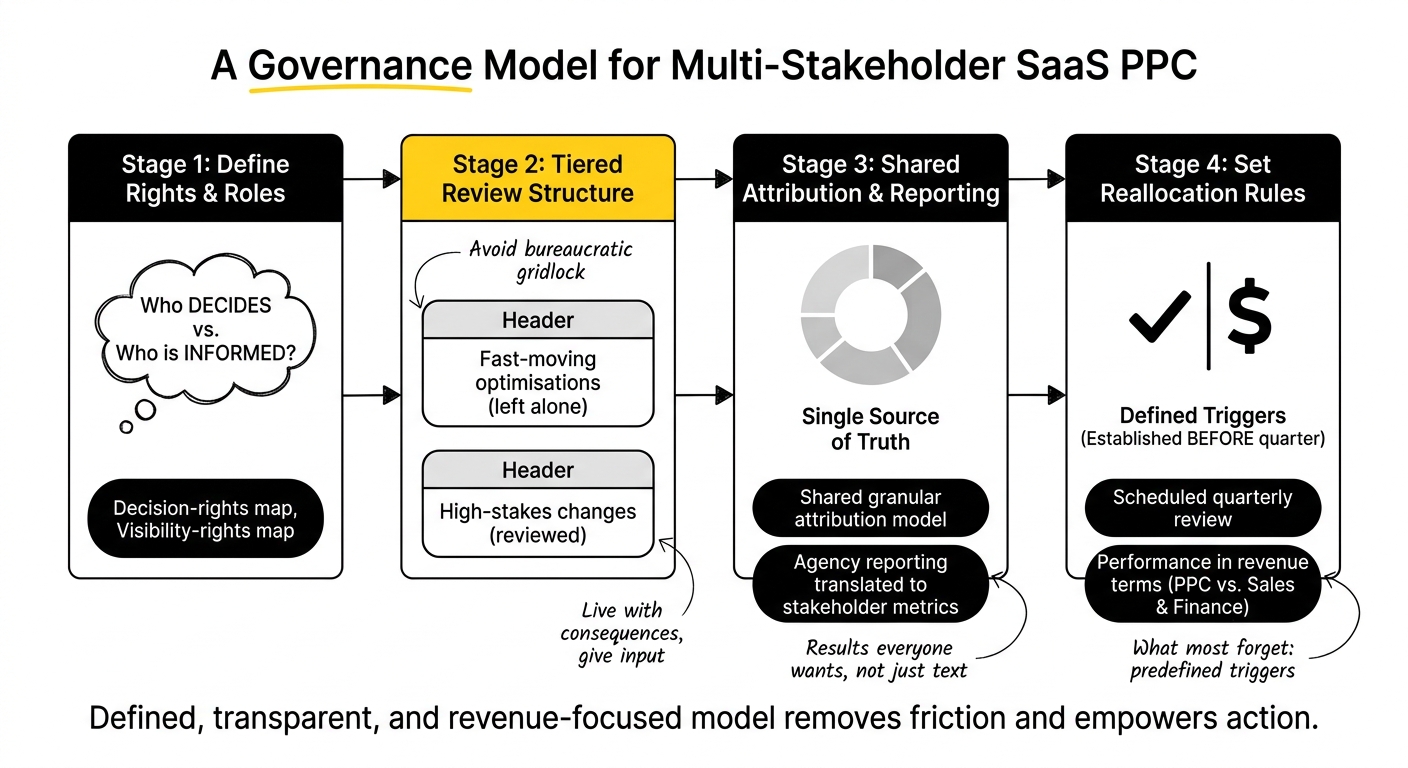
Bringing this together, the core elements of a governance model built for shared stakeholder spending:
- A decision-rights and visibility-rights map, showing which stakeholders decide versus which are informed
- A tiered review structure: fast-moving optimisation left alone, high-stakes changes reviewed with affected stakeholders
- A shared, granular attribution model every stakeholder can independently evaluate
- Agency reporting translated into each stakeholder's own metrics, not a single generic report
- A scheduled quarterly reallocation review with defined triggers, established before the first bad quarter
- PPC performance framed in the same revenue terms Sales and Finance are already judged on
Frequently Asked Questions
What are the key challenges faced by VPs of Marketing in managing PPC budgets with multiple stakeholders?
Different stakeholders apply different, often unstated definitions of success, Finance wants payback period, Sales wants lead quality, the board wants a revenue narrative, and a governance model built for a single owner can't serve all three without becoming explicit about who needs what.
How can SaaS companies establish effective governance models for PPC spend allocation?
Map each major decision against the stakeholders it affects, and assign either decision rights or visibility rights accordingly, rather than defaulting to consulting everyone on everything.
What best practices can agencies implement to adapt to multi-stakeholder environments in PPC management?
Build reporting that translates into each stakeholder's own metrics rather than one generic report, and ask directly which stakeholders now have a claim on the numbers as the company scales.
How does granular attribution impact PPC strategy and budget allocation in SaaS companies?
It gives every stakeholder a common, independently verifiable reference point, so disagreements become productive conversations about strategy rather than disputes about whose proxy metric is correct.
What role does collaboration play in the governance of PPC strategies among multiple stakeholders?
It ensures decision rights are assigned to the stakeholders who actually live with the consequences of a decision, such as Sales having real input into lead quality thresholds, without slowing down decisions that don't need broad consultation.
How can regular budget reallocations improve PPC performance in a SaaS context?
Treating reallocation as a scheduled quarterly habit, with defined triggers, prevents the first real reallocation conversation from happening reactively under pressure, when stakeholders are least receptive to a new process.
What are the implications of Series A funding on governance models for SaaS PPC?
Series A brings new stakeholders with legitimate claims on marketing spend decisions, Finance, Sales leadership, the board, and a governance model built for a single decision-maker stops serving the organisation the moment that scrutiny increases.
How can VPs of Marketing ensure PPC strategies align with overall revenue goals?
By translating PPC performance into the same revenue terms Sales and Finance already use, closed-won, payback period, rather than a marketing-specific metric the rest of the business has to interpret independently.
What are the benefits of integrating PPC with existing marketing stacks in SaaS companies?
It reduces the manual reconciliation that otherwise makes granular attribution unreliable, which matters more in a multi-stakeholder environment where each group is scrutinising the same numbers from a different angle.
What metrics should VPs of Marketing focus on to measure the ROI of PPC campaigns?
A full spend-to-revenue attribution path, MQL through SQL to closed-won, alongside payback period and lead quality distribution, since these are the specific metrics Finance, Sales, and the board each independently care about.
If your governance model hasn't evolved since your last funding round, that's usually the first place to look before the next stakeholder disagreement. This is the kind of governance work we help SaaS teams build as a B2B SaaS PPC agency. Worth addressing before the next board cycle, not during it.

.png)