Rebalancing Your Media Mix to Lower Customer Acquisition Costs
Discover how to optimise your media mix to reduce CAC without sacrificing key channels. Strategies for data-driven SaaS CMOs.

The board wants lower CAC. Your instinct is to protect the channels doing real work and cut the ones you cannot fully measure. The problem is that the channels you cannot fully measure are often the ones doing the most.
This is the tension most SaaS CMOs are sitting with right now. The New CAC Ratio has risen to $2.00 per dollar of new ARR, a 14% increase year-on-year according to Benchmarkit’s 2025 SaaS Performance Metrics report. Paid click costs are rising across every major platform. And the pressure to demonstrate efficiency has never been sharper. The default response, cutting the channels with the weakest last-touch attribution, is the wrong one. It optimises for the metric the board can read in a spreadsheet, not for the pipeline the business actually needs.
Improving customer acquisition cost without sacrificing channels is not about doing more with less. It is about allocating spend more precisely across the mix you already have.
Why Cutting Channels Tends to Make CAC Worse
Most SaaS CMOs have experienced a version of this: a demand gen programme gets cut to hit a short-term CAC target, paid search picks up the load, conversion rates drop because buyers have not been warmed, and CAC goes up.
Demand gen and demand capture work together. If you reduce brand investment or top-of-funnel spend to squeeze efficiency from performance channels, you are borrowing against future pipeline. The performance channels start drawing from a smaller pool of warm intent, CPCs rise as you compete harder for the same keywords, and CAC increases precisely because you cut the channel protecting it.
The same logic applies to content and organic programmes. Organic search still generates a significant share of B2B SaaS revenue, and educational content builds the buyer familiarity that makes paid conversion cheaper. Cutting it in favour of more paid spend is a reliable way to watch CPC benchmarks climb.
The goal is not to protect every channel indefinitely. It is to be deliberate about what each channel does in the mix, and to reduce CAC by rebalancing rather than amputating.
The CAC Formula and Where the Real Levers Are
The CAC formula is straightforward: divide total sales and marketing spend by the number of new customers acquired in the same period. What the formula does not show is which part of that equation is creating the problem.
Rising CAC usually has one of three causes.
- Spend is allocated to channels with poor conversion rates. The media mix is weighted toward acquisition types (outbound, events, broad paid social) that generate high volume and low close rates.
- The right audiences are not being reached efficiently. ICP targeting has drifted, ad creative is not resonating with buying committee members, or spend is being spread across segments with materially different conversion paths.
- The offer is not matched to the buyer’s stage. Bottom-of-funnel offers pushed to top-of-funnel audiences do not convert, and the spend is wasted. Demo-first campaigns into cold audiences are a frequent example.
Rebalancing your media mix to reduce CAC means auditing across all three axes: channel allocation, audience precision, and offer-to-stage alignment. Changing one in isolation rarely moves the number meaningfully.

Rebalancing Your Media Mix: Three Axes of Optimisation
Channel Allocation
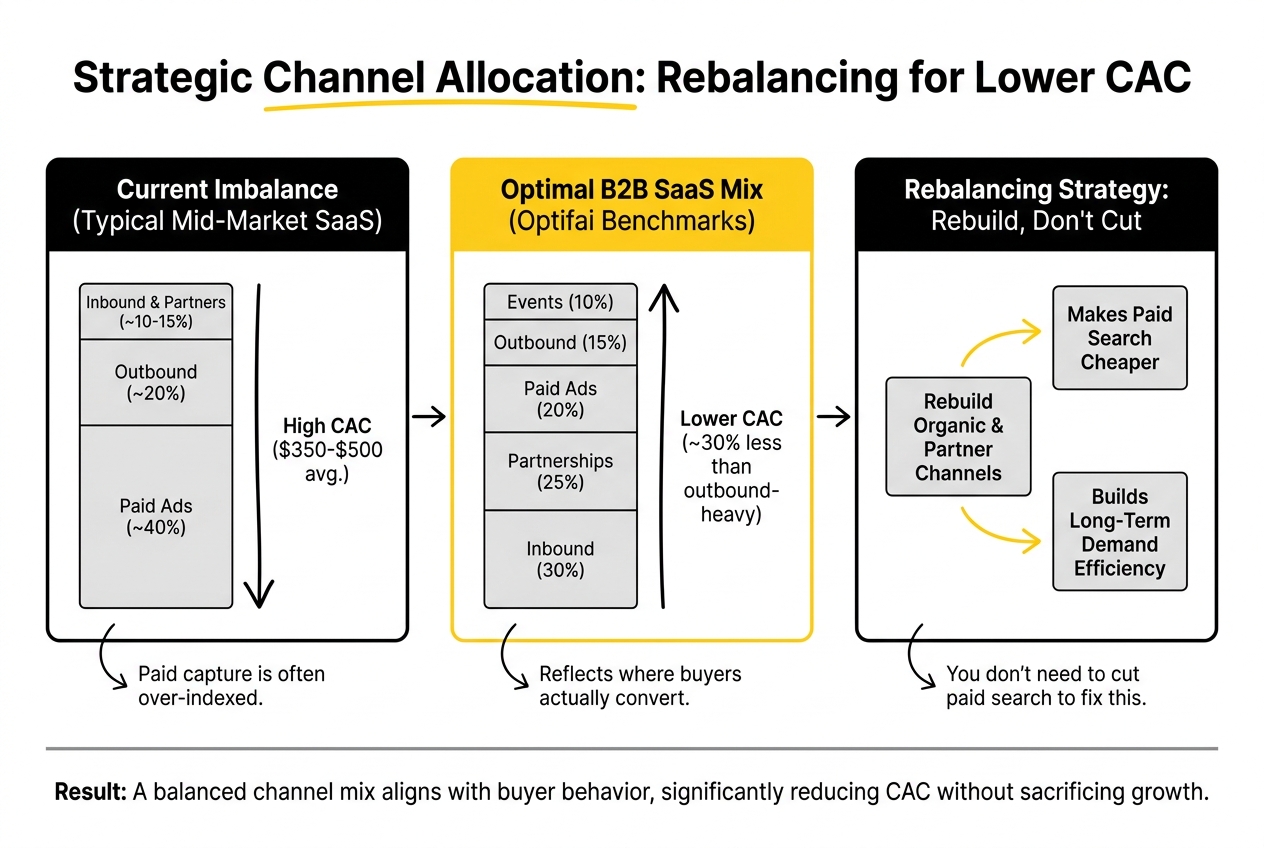
Not all channels carry the same CAC. Benchmarking from 939 B2B companies conducted by Optifai across Q2 2025 to Q1 2026 shows substantial variation: partner and referral programmes averaged $150 per customer, inbound marketing $200, paid ads $350, outbound $400, and events $500.
That does not mean you should cut events and double down on referrals. It means your channel mix should reflect your current growth stage and the sales motion your buyers expect. High-performing B2B SaaS companies in the Optifai data maintained a distribution of roughly 30% inbound, 25% partnerships, 20% paid ads, 15% outbound, and 10% events. Companies that concentrated 40 to 50% of budget in inbound and partnerships saw CAC run approximately 30% lower than outbound-heavy strategies.
The rebalancing question is: given your ICP, your average contract value, and your sales cycle length, does your current channel split reflect where your buyers actually convert? For most mid-market SaaS companies, the answer is that paid capture is over-indexed and organic and partner programmes are under-resourced.
You do not need to cut paid search to fix this. You need to rebuild the channels that make paid search cheaper.
Audience Precision
Improving CAC without cutting spend requires that the spend you retain is reaching the right people. This means tightening ICP targeting at the campaign level, not just at the CRM segmentation level.
For paid channels, this usually means reducing broad match reach and improving audience match. For B2B, LinkedIn targeting by job function, seniority, and company size tends to produce higher-quality pipeline despite higher CPCs. LinkedIn ROI for B2B SaaS has moved above Google Ads in recent benchmarks (113% versus 78% respectively), which reflects a shift in where buying decisions are being influenced rather than captured.
For content and organic programmes, audience precision means identifying which buyer roles consume which content formats, and ensuring the right content is reaching department heads and economic buyers rather than end users who are not in the decision.
Offer-to-Stage Alignment
A mismatch between what you are asking buyers to do and where they are in the buying process is one of the most consistent sources of wasted spend. A buyer who has not yet recognised the problem you solve is not going to book a demo. Sending them to a demo request page via paid social spends budget on a conversion that was never going to happen.
Mapping offers to buyer stages is not a new idea, but most SaaS teams still run too few offer types relative to the number of stages in their sales cycle. For long-cycle B2B deals involving multiple stakeholders, you need educational content for awareness, tools and frameworks for consideration, and proof points for evaluation. Each stage needs a channel and an offer matched to it. CAC falls when conversion rates rise at each stage, and conversion rates rise when the ask is appropriate for where the buyer is.
Attribution in Long Sales Cycles: What to Measure and What to Accept
Attribution in B2B SaaS is a genuine constraint, not a data quality problem you can fully solve. A deal that closes after a nine-month sales cycle, involving a buying committee of five people across three departments, will never be cleanly attributed to a single touchpoint. Accepting this is the starting point for more honest media mix decisions.
What you can build is a consistent attribution framework that gives directional insight without false precision. Multi-touch models, even imperfect ones, tend to outperform last-touch when the goal is understanding which channels are contributing to pipeline rather than which channel recorded the final click before a form submission. For a deeper look at diagnosing where attribution gaps are creating spend waste, this connects to the audit framework we cover with our SaaS paid advertising agency work.
The practical priority for CMOs is agreeing a single measurement model with the board before the review, not after. When attribution methodology changes mid-cycle, every metric becomes unreliable and the CAC conversation becomes a negotiation about methodology rather than a decision about budget.
Two reporting habits tend to improve this:
- Track CAC payback period by cohort, not just by reporting period. This surfaces whether the customers you are acquiring are actually worth what you paid for them.
- Report blended CAC and channel-level CAC separately. Blended CAC (including expansion revenue) tends to look significantly better than new-name CAC because retention and upsell offset acquisition costs. Using blended figures to justify high new-name spend can mask a structural problem.
Metrics CMOs Should Track When Rebalancing the Mix
When moving budget across channels, you need metrics that tell you whether the rebalancing is working before the next board review. Waiting for closed-won revenue to confirm a media mix change is a six-to-twelve-month lag for most SaaS businesses.
Indicators that give you faster signal without relying on closed revenue:
- Pipeline velocity by channel source: how quickly are opportunities progressing, and is that changing after the rebalancing?
- MQL-to-SQL conversion rate by source: if new-name leads from a channel rarely become sales-qualified, the channel is producing volume without contributing to CAC efficiency.
- Cost-per-opportunity by channel: more meaningful than cost-per-lead for sales-led SaaS businesses where opportunity quality varies significantly.
- CAC payback by acquisition cohort: are customers acquired via the rebalanced mix paying back faster than prior cohorts?
These metrics do not replace closed-won attribution, but they give the CMO a basis for a board conversation before the revenue data catches up.
How to Build the Stakeholder Narrative
The board conversation about CAC improvement is almost always harder than the media mix work itself. Boards tend to read CAC in isolation from the mix decisions driving it, and the instinct is to ask for cuts rather than reallocation.
The most effective framing is not “we are changing our media mix” but “we are improving the efficiency of what we are already spending.” This means:
- Leading with the channels that are over-indexed relative to their contribution to pipeline, not the channels you are protecting.
- Showing the relationship between demand gen investment and paid conversion costs, so cuts to one visibly increase costs in the other.
- Presenting CAC alongside LTV and payback period, not as a standalone figure. CAC at $1,200 looks different when payback is nine months versus twenty-four.
The goal is to shift the board’s frame from “reduce the number” to “improve the ratio.” That gives you the room to reallocate rather than cut, which is the only intervention that actually works.
Better definitions of what counts as a revenue-ready lead also matter here. When the board’s understanding of lead quality improves, the CAC conversation changes.
A Framework for Continuous Testing
Rebalancing the media mix is not a one-time decision. Markets shift, channel costs move, and buyer behaviour evolves. The SaaS teams that maintain consistent CAC improvement over time treat channel allocation as a hypothesis to be tested, not a plan to be executed once and reviewed annually.
A practical approach:
- Set a 90-day testing cadence for each channel allocation change.
- Define the leading indicators you will use to evaluate success before the test starts.
- Hold spend within a defined range rather than making large shifts in one cycle. Large moves create too many variables to isolate the effect of any single change.
- Review the mix quarterly against channel-level CAC and pipeline contribution data.
The discipline here is separating optimisation decisions (which happen continuously, within the existing mix) from rebalancing decisions (which change the allocation between channels). Most teams conflate the two and end up making large, reactive changes when incremental testing would have surfaced the same insight with less risk.
Practical Takeaways
If you are working through a CAC improvement mandate right now, these are the places to start:
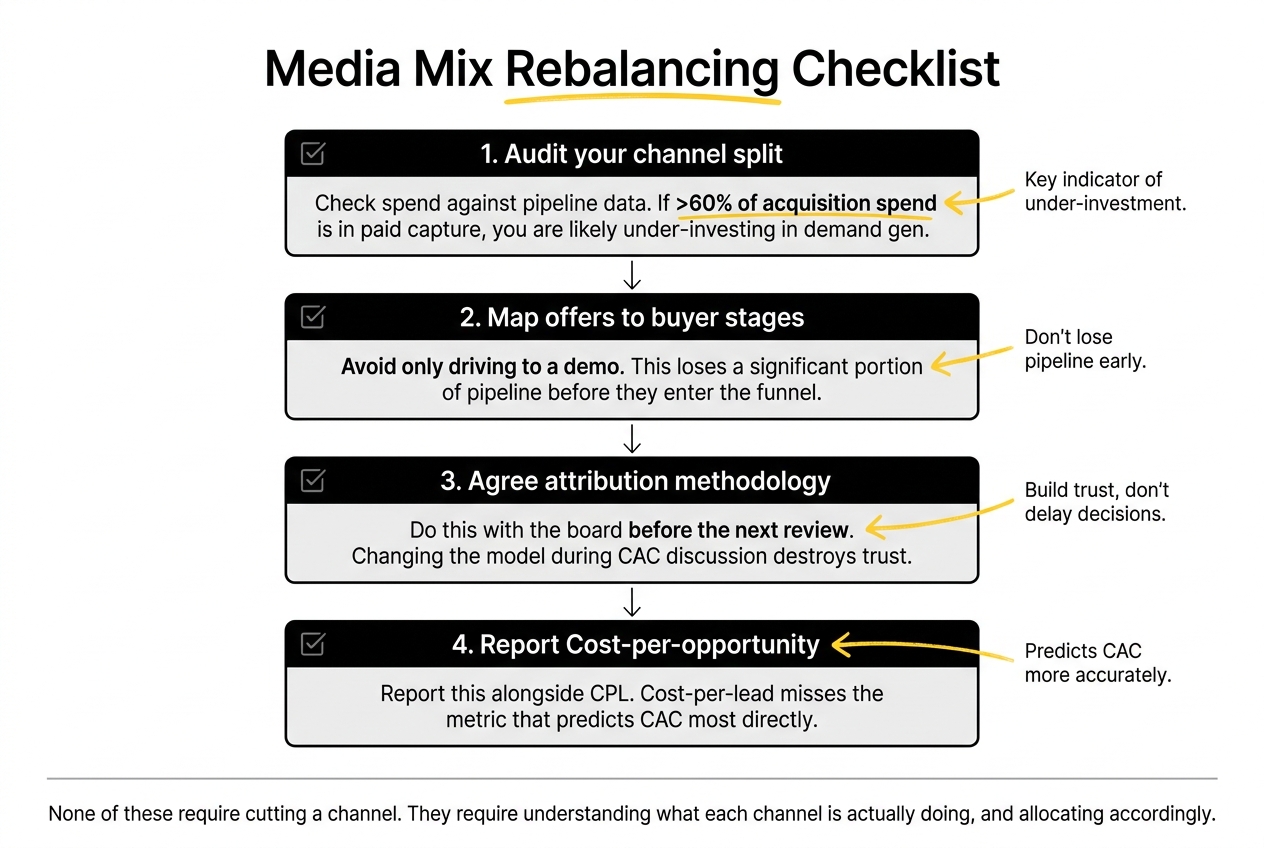
- Audit your channel split against your current pipeline data. If more than 60% of your acquisition spend is in paid capture channels, you are likely under-investing in the demand gen activity that makes paid capture efficient.
- Map your current offers to buyer stages. If the only conversion point you are driving toward is a demo request, you are losing a significant portion of your addressable pipeline before they ever enter the funnel.
- Agree your attribution methodology with the board before the next review cycle. Changing the measurement model during a CAC discussion destroys trust and delays the actual decision.
- Report cost-per-opportunity alongside CPL. If you are only reporting cost-per-lead, you are missing the metric that predicts CAC most directly.
None of these require cutting a channel. They require understanding what each channel is actually doing, and allocating accordingly.
If you are working through a CAC improvement initiative and want a second perspective on your current mix, this is the kind of thing we dig into with SaaS teams regularly. Worth a conversation if you are at that point.
Frequently Asked Questions
What strategies can SaaS companies use to improve customer acquisition cost without sacrificing key marketing channels?
The most effective approach is rebalancing spend across channels, audiences, and offer types rather than cutting outright. Start by auditing which channels produce the lowest cost-per-opportunity, not just the lowest cost-per-lead. Then identify whether demand gen investment is adequately supporting paid capture channels. Reallocating budget from high-CAC acquisition channels toward partner, referral, and inbound programmes tends to reduce blended CAC over a 90 to 180-day window without removing any single channel from the mix.
How can reallocating budgets across different media channels impact CAC in a SaaS business?
Budget reallocation affects CAC through conversion rate changes at each stage of the funnel. Moving spend toward channels with warmer, better-qualified audiences typically improves MQL-to-SQL conversion and reduces the total spend needed per closed customer. The caveat is that reallocation effects take time to materialise in closed-won data. Tracking cost-per-opportunity and pipeline velocity by source gives you a faster read on whether a reallocation is working before the revenue data catches up.
What role does data analysis play in optimising media spend for better CAC?
Data analysis identifies where conversion rates are breaking down, which audiences are converting at the highest rate relative to spend, and which channels are contributing to pipeline beyond the last touchpoint. The practical priority is ensuring CAC is tracked at the channel level, not just as a blended figure. Blended CAC including expansion revenue tends to flatter the number. Separating new-name CAC by channel reveals where the real inefficiency sits.
How can CMOs effectively balance their media mix to support predictable growth?
Predictable growth depends on having demand gen and demand capture working together. Demand gen (content, brand, organic, partner) builds the audience of buyers who are aware and considering. Demand capture (paid search, retargeting) converts that audience when they are ready. When demand gen is under-invested, paid capture becomes more expensive because it is competing for a smaller pool of warm intent. The media mix that produces predictable growth maintains investment in both, with the ratio adjusted to match the current pipeline gap.
What are the best practices for managing attribution in long sales cycles?
Accept that no attribution model will be precise across a six-to-twelve-month sales cycle with multiple stakeholders. The goal is consistent, directional data rather than perfect attribution. Agree a multi-touch model with the board before the review cycle begins, track CAC payback by acquisition cohort rather than by reporting period, and report channel contribution to pipeline (not just to closed-won) to surface the channels influencing deals that have not yet closed.
How can businesses ensure brand positioning while optimising for lower CAC?
Brand investment is often the first thing cut when a CAC reduction mandate comes in, and it is frequently the worst decision. Brand awareness reduces the cost of paid conversion by warming audiences before they hit performance channels. If you need to reduce spend, audit performance channel efficiency first. Reducing brand investment to fund paid acquisition tends to raise CPCs as you compete for a narrower pool of buyers who were never introduced to the product through awareness activity.
What metrics should CMOs focus on when assessing the effectiveness of their media mix?
The four most useful metrics for media mix assessment are: channel-level CAC (not blended), cost-per-opportunity by source, MQL-to-SQL conversion rate by channel, and CAC payback period by acquisition cohort. These metrics provide signal at different speeds. Cost-per-opportunity and MQL-to-SQL give faster feedback. CAC payback confirms whether the customers you are acquiring at a lower cost are actually worth what you paid.
How can multi-stakeholder environments complicate CAC optimisation strategies?
In B2B SaaS with buying committees of four to seven people, a single deal may involve touchpoints across multiple channels, content types, and campaign types before closing. This makes channel-level attribution inherently incomplete. The complication is that the channel that influenced the economic buyer may be different from the channel that drove the champion, and standard attribution models cannot separate the two. The practical response is to track influence across the buying committee using CRM data and account-level engagement metrics, rather than relying on contact-level attribution alone.
What actionable insights can help CMOs make informed budget decisions?
Start with a channel-level CAC audit using cost-per-opportunity data from your CRM, not platform-reported CPL. Identify the two channels with the highest cost-per-opportunity relative to closed-won contribution. Determine whether those channels are acquisition channels that could be reallocated or demand gen channels whose underperformance reflects a lack of supporting investment. Set a 90-day test with defined leading indicators before making any significant reallocation. Review against pipeline contribution data, not just closed-won revenue, before drawing conclusions.
How can a balanced media mix contribute to achieving board-level objectives in CAC management?
The board objective is typically a unit economics target: CAC payback within a specific window, or a CAC-to-LTV ratio above a threshold. A balanced media mix supports this by maintaining the demand gen investment that makes performance spend efficient, preventing the CPC inflation that occurs when paid channels compete for a narrow pool of warm buyers. Presenting the media mix to the board as a system, rather than as individual channel line items, shifts the conversation from “cut the most expensive line” to “optimise the relationship between channels.”