Optimising Paid Social Strategies: Market Validation Tests for SaaS
Discover a framework for validating audience segments and content offers in SaaS paid social before scaling spend. Drive sustainable growth.

You pick three audience segments, write four ad variations, set a budget, and turn the campaigns on. Spend climbs. A few demos come in. The numbers look plausible enough that you increase the budget. Two quarters later, cost-per-opportunity has crept up, pipeline is thinner than the platform dashboards suggested, and no one can say with confidence which segment, message, or offer actually worked.
That gap is what market validation tests for SaaS are meant to close. Before you scale ad spend, you validate the assumptions the spend depends on: that you are talking to the right people, naming a problem they recognise, and offering something they will trade their details for. Get those wrong at low spend and you lose a little. Get them wrong at high spend and you fund the mistake at scale.
This is a framework for validating audience segments, problem statements, and content offers in paid social before you commit a larger budget, with enough statistical discipline that the results hold up in a board meeting rather than a dashboard screenshot.
Why market validation matters before scaling ad spend for SaaS
The B2B buying journey has stretched. According to Dreamdata's 2026 LinkedIn Ads Benchmarks Report, drawn from 3.5 million customer journeys, the average B2B journey now runs 272 days, up from 211 the year before. Buyers spend roughly the first seven months in self-directed research before they ever enter a sales pipeline, touching around 88 points across four channels, with about ten stakeholders involved in the decision.
Two things follow from that. First, most of what your paid social does happens long before a conversion event fires, which makes premature judgements about "what works" unreliable. Second, the same report found LinkedIn was the only major platform delivering positive return on ad spend at 121%, against 67% for Google Search and 51% for Meta. Channel choice and audience precision matter more than raw spend, and both are things you can validate cheaply before scaling.
Scaling ad spend for SaaS market validation is not a single decision. It is a sequence of smaller bets, each de-risked by evidence, so that the budget increase follows the proof rather than preceding it. The alternative, scaling on the strength of a healthy-looking first month, is how teams end up with rising spend and flat qualified pipeline.
What market validation tests for SaaS paid social actually validate
Most teams jump straight to testing creative. Creative matters, but it is the last variable, not the first. If the audience is wrong or the problem statement does not land, no headline rescues the campaign. Validate in this order.
Audience segments. The first question is who responds, not which ad they respond to. Target audience segmentation for paid social means running the same core offer against distinct segments, by seniority, company size, industry, or job function, and watching which segments engage and convert at a rate worth paying for. Audience validation techniques here are comparative: you are not asking whether a segment works in isolation, you are asking which segment earns the next pound of budget.
Problem statements. A validated audience still needs to hear a problem they recognise as theirs. Before scaling, test whether your framing of the problem matches how the segment describes it. Two ads pointing the same audience at the same offer, differing only in the problem they name, will tell you which pain is sharp enough to act on. This is often where campaigns quietly fail: the audience is right, the offer is fine, but the problem statement is the vendor's language rather than the buyer's.
Content offers. Only once audience and problem are holding do you validate the offer itself. A webinar, a benchmark report, a diagnostic tool, and a demo request are not interchangeable. Each asks a different level of commitment and attracts a different intent. Content strategy at this stage is about matching offer to journey position, and testing which offer converts an engaged segment into a lead sales will actually work.
A structured experimentation framework for paid social
Experiment-led growth is less about volume of tests and more about the discipline of the loop. Each test follows the same shape: state a hypothesis, isolate one variable, define the decision the result will drive, run to a pre-set threshold, then decide.
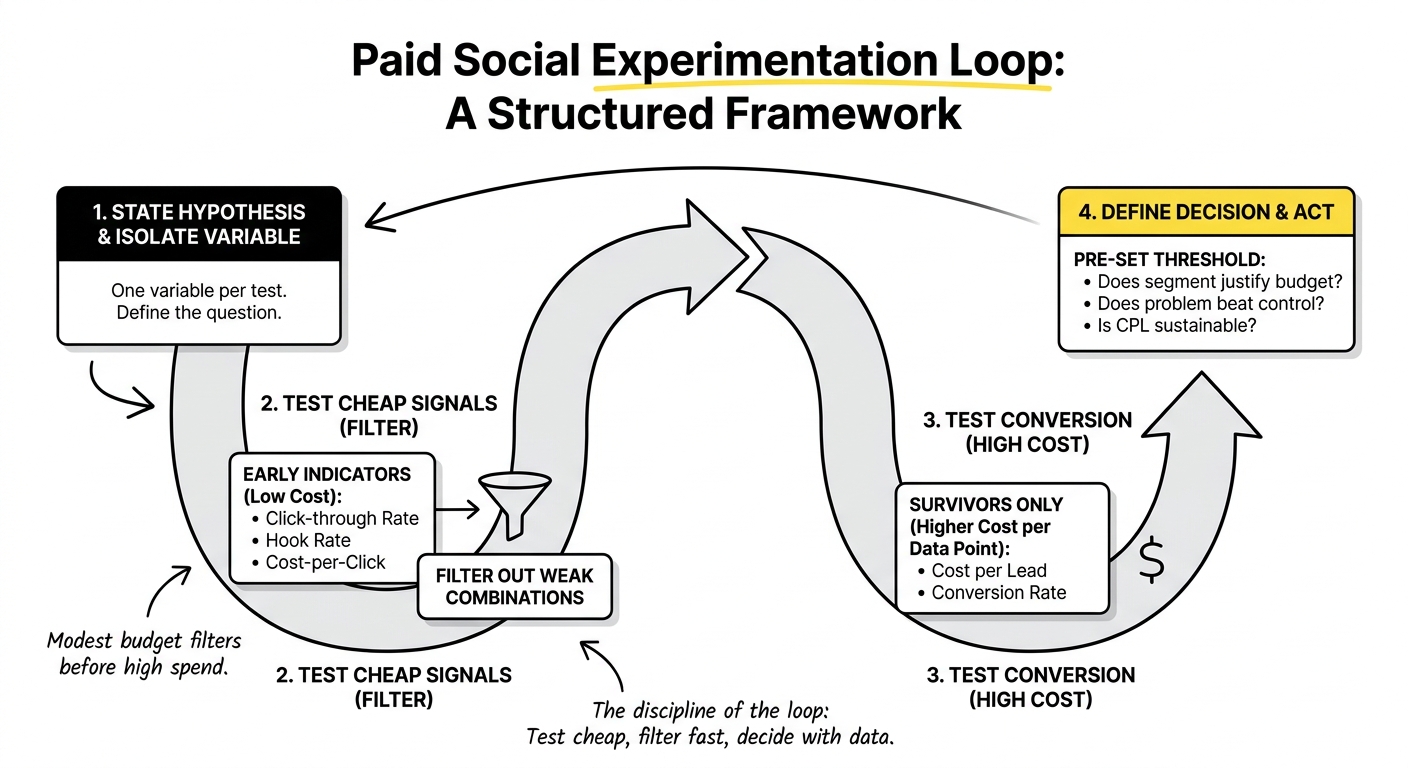
The sequencing that keeps costs down is to test cheap signals before expensive ones. Click-through rate, hook rate, and cost-per-click are early indicators you can read on a modest budget, and they filter out obviously weak combinations before you spend on conversion. Only the survivors progress to conversion-level testing, where the cost per data point is far higher.
Isolate one variable per test. If an ad set changes the audience and the creative at the same time, a lift tells you nothing about which change caused it. This is the difference between a validation test and a hunch dressed as one. Demand generation frameworks that skip variable isolation produce results that feel decisive and prove nothing.
Set the decision before you start. Every test should answer a specific question: does this segment justify more budget, does this problem statement beat the control, does this offer convert at a cost we can sustain. A test with no pre-agreed decision threshold becomes a search for a flattering number.
The role of statistical significance in market validation tests
This is where SaaS validation gets hard, and where most tests overstate what they found. Statistical significance is the check that a difference between two variations is unlikely to be random noise. The standard threshold is 95% confidence, and reaching it depends on volume.
The uncomfortable maths: to detect a 20% relative lift in conversion rate at 95% confidence, you need roughly 400 conversions per variation. Most B2B SaaS paid social campaigns generate somewhere between 20 and 80 conversions a month in total. A two-week test might see a dozen conversions per variation, at which point the "winner" is a coin flip wearing a result's clothing.
The honest response is not to fake certainty. It is to design tests around what the volume can actually support:
- Test higher up the funnel first, where volume is larger. Click-through and engagement reach significance far faster than conversion, so use them to narrow the field before conversion testing.
- Set a realistic minimum detectable effect. In low-conversion funnels you can only reliably prove large differences, so test changes big enough to matter, not marginal tweaks.
- Respect the learning phase. Platforms need roughly 50 conversions per week per ad set to optimise, so tests that never clear that bar are noisy by construction.
- Aim for at least 100 conversions per variation before treating a conversion-level result as reliable, and treat anything below 25 as directional at best.
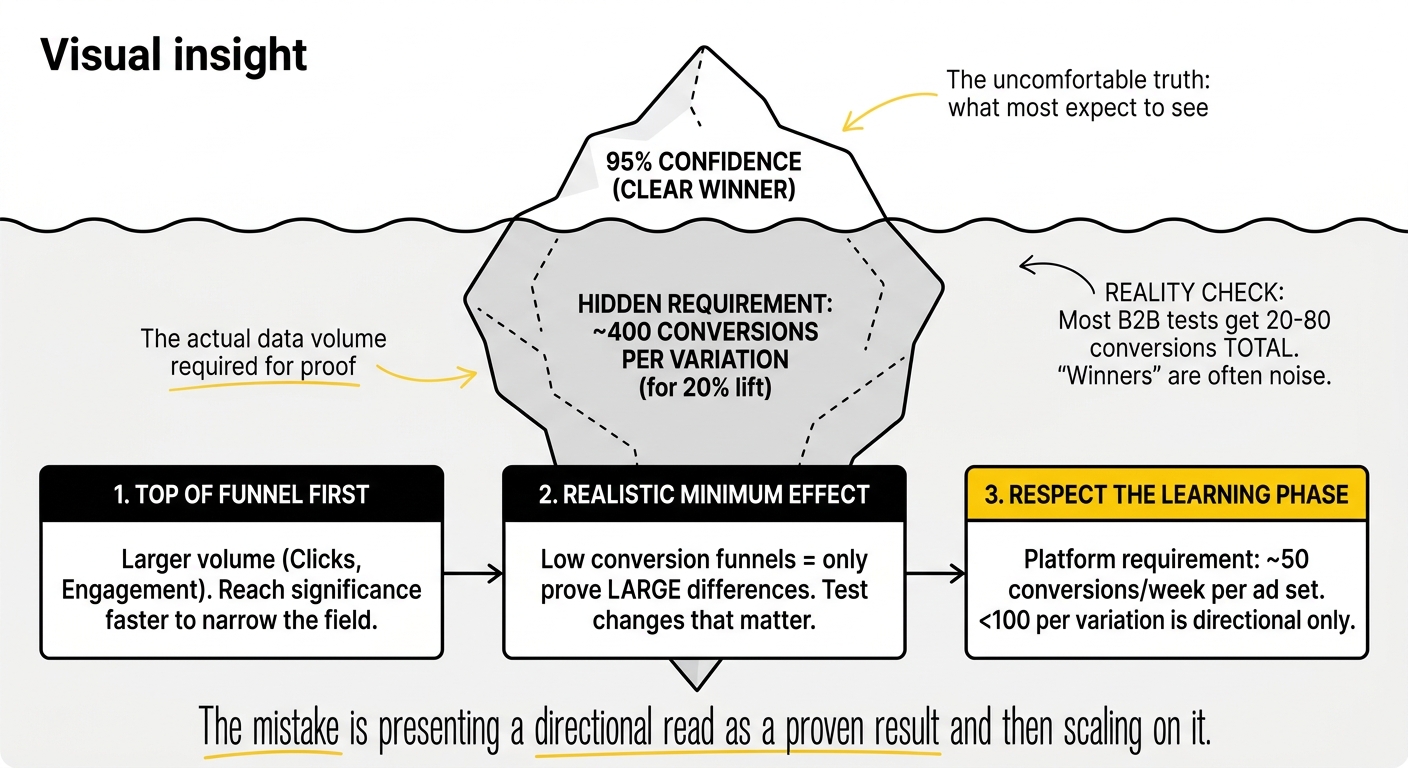
Directional signals are still useful. The mistake is presenting a directional read as a proven result and then scaling on it.
Integrating paid social validation with broader demand generation
Validation tests do not sit apart from your B2B demand generation. They feed it. The demand creation versus demand capture distinction that Refine Labs has argued for years applies directly here: paid social early in the journey is creating demand, and judging it on last-click conversions undercounts its contribution.
That has a measurement consequence for validation. If you validate audience segments purely on last-touch conversions, you will favour capture-stage audiences and starve the demand creation that the 272-day journey depends on. Account-level measurement and self-reported attribution, asking new pipeline how they first heard of you, give you a second read that platform conversion data alone will miss.
Practically, this means your validation results should be interpreted alongside CRM and pipeline data, not in the ad platform in isolation. A segment that looks weak on in-platform conversions but shows up repeatedly in self-reported attribution is not a failed segment. It is a demand creation segment your last-click model cannot see. Growth marketing strategies that align paid social validation with pipeline data catch this. Ones that live in the ad account do not.
We hold the specifics of matching offer type to conversion path for a companion piece, since it deserves its own treatment.
How to run this before you scale
Customer acquisition testing before scaling is a short, deliberate sequence, not an open-ended experiment. A workable version of SaaS paid social market testing before scaling expenditure looks like this:
- Define two to four candidate audience segments and one core offer. Run them head to head on engagement metrics at modest spend.
- Take the segments that clear your engagement bar and test problem statements against them, isolating the message variable.
- With a validated audience and problem, test content offers for conversion, watching cost-per-lead and, where you can, downstream quality.
- Cross-check the winners against CRM and self-reported attribution before drawing conclusions.
- Only then increase budget, and increase it into the specific segment, problem, and offer that earned it, not across the whole account at once.

This is the difference between SaaS marketing optimisation that compounds and spend that simply grows. Each budget increase is backed by a result you could defend, and the account gets sharper as it scales rather than blurrier.
If you are working through where to draw the line between a validated test and a hopeful one, this is the kind of thing we dig into with SaaS teams regularly. Worth a conversation if you are at that point, and you can see how we approach it through our saas paid social work.
Frequently Asked Questions
How can SaaS companies effectively validate audience segments for paid social campaigns?
Run the same core offer against distinct segments at the same time, then compare engagement and conversion rates rather than judging any segment in isolation. Segment by seniority, company size, industry, or function, and hold spend modest until a clear front-runner emerges. The goal is to identify which segment earns the next increase in budget, not to confirm that a segment you already like performs acceptably.
What are the best practices for refining problem statements in market validation tests?
Test problem statements against a validated audience with everything else held constant, so any difference in response comes from the framing alone. Use the buyer's own language for the pain, not the vendor's category language. If a segment engages with one problem statement and ignores another, you have learned which pain is sharp enough to drive action, which then shapes both your ads and your landing pages before you scale.
How can structured experimentation improve market validation for SaaS businesses?
Structured experimentation replaces gut calls with a repeatable loop: hypothesis, one isolated variable, a pre-set decision threshold, and a defined stopping point. It prevents the common failure of changing several things at once and being unable to attribute the result. For SaaS teams working with limited conversion volume, that discipline is what separates a test you can act on from a number that merely looks encouraging.
What role does statistical significance play in market validation for paid social strategies?
Statistical significance tells you whether a difference between variations is real or random. The standard is 95% confidence, which requires meaningful volume: roughly 400 conversions per variation to prove a 20% lift. Since most B2B SaaS campaigns produce far fewer conversions than that, teams should test higher-volume signals first, set realistic minimum detectable effects, and treat low-volume results as directional rather than conclusive.
How can SaaS companies test content offers before scaling their paid social spend?
Once audience and problem statement are validated, test offers against that qualified audience and compare conversion rate and cost-per-lead, ideally with a downstream quality check. A webinar, benchmark report, diagnostic, and demo request each attract different intent, so the winner is the offer that converts an engaged segment into leads sales will actually pursue. Only scale the offer that clears both cost and quality bars.
What measurement practices are essential for validating market strategies in SaaS?
Read results across three layers, not one. In-platform metrics show early engagement, CRM data shows whether leads become qualified pipeline, and self-reported attribution catches demand creation that last-click models miss. Account-level measurement matters more than contact-level for account-based buying. Set your decision thresholds before the test runs, and never scale on a single-source metric that has not been cross-checked against pipeline.
How can market validation tests align with broader demand generation strategies?
Treat paid social validation as an input to demand generation rather than a separate exercise. Early-journey paid social creates demand and is undercounted by last-click conversion, so interpret validation results alongside pipeline and self-reported attribution. A segment that looks weak in the ad platform but recurs in self-reported data is a demand creation segment worth keeping. Aligning the two prevents you from cutting audiences that are working invisibly.
What are the key indicators of successful market validation for SaaS growth leaders?
Success is a validated audience, problem, and offer that hold up against both cost and downstream quality, not just a low cost-per-lead. Look for consistency between in-platform results, CRM-qualified pipeline, and self-reported attribution. The clearest indicator is that you can name the specific segment, problem statement, and offer that earned a budget increase and defend the decision with evidence a board would accept.