PPC Agency Contract Red Flags for SaaS
The best SaaS companies treat the contract negotiation as the most important conversation with an agency. They know what red flags to watch for. They know what to demand. They know the difference between standard terms and terms that put them at risk.

Key PPC Agency Contract Red Flags Every SaaS Team Should Negotiate
You're three months into the contract with a new PPC agency and you're worried about contract pitfalls for SaaS. The campaigns are running. Performance looks okay. Then you decide you want to audit the data. The agency says the Google Ads account is on their admin account. You don't have direct access. You ask for a data export. They say it will take 60 days. You realise you've signed a contract with red flags that makes you dependent on the agency for the most critical asset: your data.
This is the contract trap. Most SaaS companies sign PPC agency agreements without negotiating the terms that matter most. They focus on pricing. They ask about services. They nod along to the SOW. And then they find out later that they don't own their data, can't see their attribution, can't transition to a new agency without losing everything, or are locked into a contract with impossible exit terms.
The best SaaS companies treat the contract negotiation as the most important conversation with an agency. They know what red flags to watch for. They know what to demand. They know the difference between standard terms and terms that put them at risk.
This article breaks down the critical red flags in PPC agency contracts, what each one means for your business, and exactly how to negotiate them before you sign. For broader context on PPC agency management, see our B2B SaaS PPC agency resource.
The Five Critical Contract Elements
PPC agency contracts have five areas that matter most for SaaS companies. Get these five right and you've protected your interests. Miss any one and you've created risk.
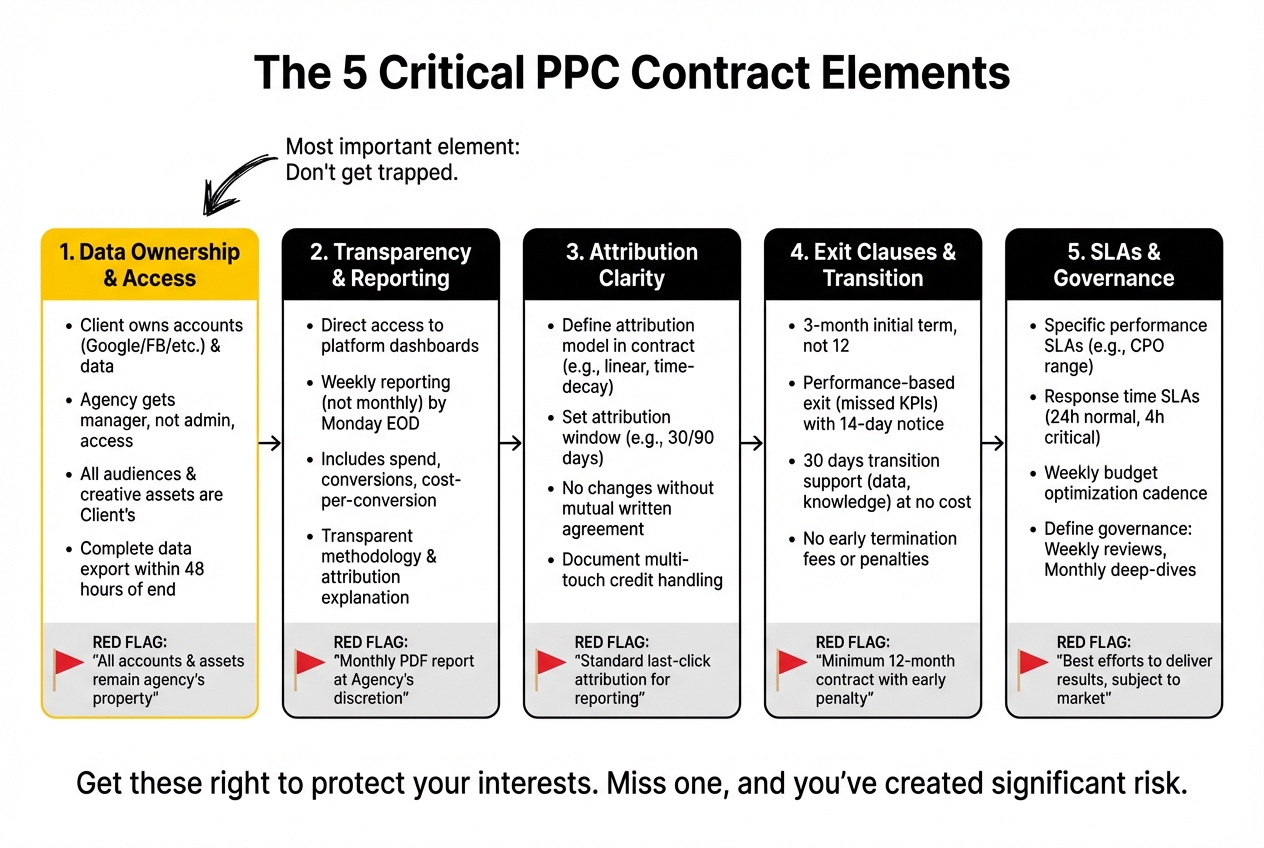
1. Data Ownership and Access
This is the most important element. Data ownership determines whether you own your campaigns, your audience lists, your creative assets, and your performance history. If the agency owns these, you're trapped.
The red flag: "All accounts and assets created by the agency remain the agency's property."
What this means: If the Google Ads account is registered to the agency, you don't have administrative access. You can't export data. You can't transition to a new agency. You're hostage to the current relationship.
How to negotiate it:
Demand that all accounts are registered in your name (not the agency's). This includes Google Ads, Facebook Ads, LinkedIn Ads, and any other platform accounts. You should be the primary account owner. The agency gets manager access. If the agency leaves, you flip the relationship and they lose access. Structuring SaaS PPC Accounts for PLG vs Sales-Led Funnels, also on this blog, takes this further.
Demand that all audience data belongs to you. Lookalike audiences, retargeting audiences, custom intent segments, these are your data, not the agency's.
Demand that all creative assets (ad copy, landing pages, design files) are your property and delivered in full at contract end.
Demand that the agency provides a complete data export within 48 hours of contract termination. This includes historical performance data, audience definitions, keyword lists, and any other data created during the engagement.
The contract language you want:
"Client retains full ownership of all accounts, data, audiences, and creative assets. Agency receives manager access, not admin access. Upon contract termination, Agency shall provide complete data exports within 48 hours. All data remains Client's property in perpetuity."
2. Transparency and Reporting Standards
Transparency determines whether you can see what's happening in your campaigns, or whether you're dependent on the agency's dashboards and interpretations.
The red flag: "Agency will provide monthly reporting in PDF format at Agency's discretion."
What this means: You get a report once a month in whatever format the agency decides. You can't access raw data. You can't verify numbers. You're trusting the agency's interpretation of performance.
How to negotiate it:
Demand direct access to all platform dashboards (Google Ads, Facebook Ads, Analytics). You should be able to log in anytime and see live performance.
Demand that the agency provides weekly reporting (not monthly) with at least these metrics: spend, impressions, clicks, conversions (by type), cost-per-conversion, and pipeline/revenue impact if available.
Demand that reporting includes a transparent explanation of methodology. How is the agency calculating ROI. What attribution model is it using. How is it defining MQL vs SQL. These should be documented upfront and consistent.
Demand that reporting is delivered by Monday EOD every week so you have time to review before your operating review meeting.
The contract language you want:
"Agency shall provide Client with direct access to all platform dashboards. Weekly reporting, due by Monday 5 PM, shall include spend, conversions, cost-per-conversion, and attributed pipeline. Reporting methodology and attribution model shall be documented and held constant throughout the engagement unless Client approves changes in writing."
3. Attribution Clarity and Measurement Definition
Attribution determines who gets credit for conversions. This matters because it affects how you evaluate the agency's performance and how you explain ROI to your board.
The red flag: "Agency uses standard last-click attribution for performance reporting."
What this means: The agency only counts the last click before conversion. This inflates the agency's contribution and hides the work of earlier touchpoints. Multi-touch attribution is more accurate but requires more rigor.
How to negotiate it:
Demand that the agency uses a consistent attribution model (linear, time-decay, or custom) and documents it explicitly in the contract. The model should reflect your actual buyer journey, not the agency's preferred method.
Demand that the attribution window is defined in the contract (e.g., 30, 60, 90, or 120 days). This determines how far back to look for contributing touchpoints.
Demand that the agency doesn't change the attribution model mid-engagement. If you want to change it, both parties have to agree in writing.
Demand that the agency documents how it handles multi-touch scenarios (a prospect sees multiple ads before converting). Does each touchpoint get credit. How much. This should be explicit.
The contract language you want:
"Agency and Client agree to use [linear/time-decay/custom] attribution with a [30/60/90/120]-day window. Attribution model shall not change without written agreement from both parties. Agency shall document how credit is assigned across multiple touchpoints and maintain this methodology throughout the engagement."

4. Exit Clauses and Transition Support
Exit clauses determine how you can leave if the relationship isn't working, and what support the agency provides during transition.
The red flag: "Minimum 12-month contract. Early termination subject to penalty equal to remaining contract value."
What this means: If you need to leave after month three because performance is poor, you owe the agency nine months of fees. You're locked in.
How to negotiate it:
Demand a 3-month contract minimum, not 12. This protects both parties. If the relationship isn't working, either party can exit with 30 days' notice.
Demand that performance-based exit clauses are included. If the agency misses agreed KPIs (cost-per-opportunity, conversion rate, ROI targets) for two consecutive months, either party can exit with 14 days' notice.
Demand that the agency provides transition support (no additional fee) for 30 days after contract end. This includes data exports, documentation, team Q&A, and knowledge transfer.
Demand that there's no "exit fee" or early termination penalty. If the relationship needs to end, it should end cleanly without financial punishment.
The contract language you want:
"Initial contract term is 3 months. Either party may terminate with 30 days' written notice after the initial term. If Agency misses agreed KPIs for two consecutive months, Client may terminate with 14 days' notice. Upon termination, Agency shall provide 30 days of transition support at no additional cost, including data exports, documentation, and knowledge transfer. No early termination fees apply."
5. Service Level Agreements (SLAs) and Governance Terms
SLAs determine what you can expect from the agency in terms of response time, optimization cadence, and decision-making speed.
The red flag: "Agency commits to best efforts to deliver results. Performance may be impacted by market conditions."
What this means: The agency has no specific commitments. If performance is weak, it can blame the market. There's no accountability.
How to negotiate it:
Demand specific performance SLAs. Example: "Cost-per-opportunity will remain within £400-£600 range. If CPO exceeds range for two consecutive weeks, Agency shall propose a remediation plan within 48 hours."
Demand response time SLAs. "Agency will respond to Client questions within 24 hours. Critical issues (campaigns not running) within 4 hours."
Demand optimization cadence. "Agency will move budget between campaigns and audiences weekly, not monthly. Weekly optimization report due by Monday EOD."
Demand governance structure. "Weekly operating reviews every Monday at [time]. Monthly deeper-dive [date/time]. Quarterly business review [date/time]."
The contract language you want:
"Agency commits to maintain cost-per-opportunity within [£X-£Y] range. Weekly optimisation cadence with budget rebalancing across campaigns and audiences. Response time: 24 hours for normal inquiries, 4 hours for critical issues. Weekly operating reviews every Monday. Monthly deeper-dive [date]. Quarterly business review [date]. If Agency misses performance SLAs for two consecutive weeks, Client may invoke performance remediation clause."
Red Flags by Contract Section
Beyond the five critical elements, here are section-by-section red flags to watch for:
Pricing Section:
Red flag: "Pricing subject to increase upon contract renewal."
What to negotiate: Lock pricing for the full contract term. If you want renewal flexibility, negotiate a maximum increase (e.g., 5 per cent annually).
Red flag: "Setup fee of £5,000, non-refundable."
What to negotiate: Setup fees are reasonable, but negotiate a refund clause if the agency fails to deliver (campaigns not live within agreed timeline, initial data transfer incomplete).
Red flag: "Additional charges for data analysis, reporting, or strategy work."
What to negotiate: Include data analysis and reporting in the base fee. Strategy should be part of onboarding. Don't pay extra for things the agency should be doing anyway.
Scope of Work:
Red flag: "Services include campaign management at Agency's discretion."
What to negotiate: Define exactly what "campaign management" means. How many campaigns. What platforms. What audience segments. Be specific.
Red flag: "Client responsible for providing all landing pages, creative assets, and copy."
What to negotiate: Push back. If the agency doesn't provide copy support or landing page optimization guidance, it's passing work to you. Clarify who owns what.
Confidentiality and IP:
Red flag: "All work product and learnings belong to Agency."
What to negotiate: You own the work product and performance data. The agency can use anonymized learnings with other clients, but not your specific data.
Red flag: "Non-compete clause preventing Client from hiring Agency employees for 2 years."
What to negotiate: Non-competes are overreach. If an Agency employee wants to join you, that's fine. Negotiate this out or limit it to current account leads (and only for 6 months).
Termination:
Red flag: "Contract auto-renews unless Client provides 90 days' notice."
What to negotiate: Change to 30 days' notice, or require affirmative renewal (both parties have to agree, not just one party not opting out).
Red flag: "Upon termination, all access to accounts reverts to Agency within 24 hours."
What to negotiate: Access reverts only after Client confirms receipt of data exports. Build in a 7-day window to verify data integrity before you lose access.
.jpeg)
The Contract Negotiation Conversation
Most SaaS companies approach contract negotiation as a formality. They sign what the agency proposes and hope it works out. The best companies treat it as a strategic conversation.
Before the call:
Document your non-negotiables. Data ownership. Direct platform access. Weekly reporting. Exit clauses. Performance SLAs. Know these inside and out.
Review the agency's contract. Highlight every red flag. Write down your proposed language for each one.
During the call:
Lead with curiosity, not antagonism. "I want to understand the contract better. Can you walk me through the data ownership clause."
Use specific language. "We need the Google Ads account registered in our name, not yours. Here's the language we'd like to use."
Offer trade-offs. If the agency resists on something, find something you can concede on. Maybe you'll accept a 6-month minimum if they'll agree to performance-based exit clauses.
Document what you agree to. "Let's confirm: Google Ads account in our name, weekly reporting by Monday EOD, attribution documented upfront. Did I get that right."
After the call:
Get the revised contract in writing. Don't rely on a verbal agreement. Stupid mistakes happen when contracts don't match conversations.
Have your legal team review (especially for mid-market and enterprise). A 30-minute legal review costs £500 and prevents £50,000 problems.
Sign only after both parties have agreed in writing to the specific language you negotiated.
Common Pitfalls to Avoid
Pitfall 1: Assuming "best practices" language is in the contract.
Reality: PPC agency contracts are heavily biased toward the agency. "Standard terms" mean the agency owns the data and you don't. Don't assume anything. Read and negotiate every clause.
Pitfall 2: Negotiating price but not terms.
Reality: A 10 per cent discount on fees is worthless if you're locked into a 12-month contract you can't exit. Negotiate terms first, price second.
Pitfall 3: Signing before you have direct access to the platform.
Reality: Sign first, get access later is backwards. Before you sign, verify that you have admin access to the Google Ads account (or manager access with clear escalation to admin). Test it.
Pitfall 4: Not defining success metrics upfront.
Reality: If the contract doesn't define what success looks like (cost-per-opportunity target, conversion rate target, payback period), you can't hold the agency accountable. The agency will claim "we're doing our best given market conditions."
Pitfall 5: Accepting vague language on data and attribution.
Reality: "Industry-standard attribution" is meaningless. Last-click attribution is the industry standard, and it inflates the agency's numbers. Demand specific, documented attribution methodology.
The Upraw Perspective
At Upraw, we've worked with companies that inherited bad contracts from previous agencies. We've seen data locked behind admin accounts that the company doesn't own. We've seen attribution models that gave credit to the wrong channel. We've seen exit penalties that made it impossible to leave even when performance was poor.
The companies that do this well are the ones that negotiated hard on the contract before signing. They understood that the contract is the foundation. It determines what access you have, how you measure success, what happens if things go wrong, and how you exit.
A well-negotiated contract doesn't make a bad agency good. But a poorly negotiated contract can make a good agency unusable.
Frequently Asked Questions
What are the key red flags to look for in a PPC agency contract for SaaS?
The most critical red flags are: (1) Data ownership, the agency owns accounts, audiences, or data; (2) Reporting opacity, vague reporting schedule or limited access to performance data; (3) Attribution murkiness, undefined or changeable attribution methodology; (4) Exit traps, 12+ month minimums with high early termination penalties; (5) SLA vagueness, no specific performance targets or response time commitments. Any of these signals risk.
How can SaaS companies ensure data ownership in PPC agreements?
Demand that all platform accounts (Google Ads, Facebook, LinkedIn) are registered in your company's name, not the agency's. You should be the admin owner. The agency receives manager access. Demand that all audience data, creative assets, and performance history are your property. Demand a 48-hour data export clause: the agency must provide complete data exports within 48 hours of contract termination. Write this explicitly in the contract.
What transparency measures should be included in a PPC agency contract?
Demand direct access to all platform dashboards. You should be able to log in anytime and see live performance. Demand weekly reporting (not monthly) delivered by Monday EOD with specific metrics: spend, conversions, cost-per-conversion, and pipeline impact. Demand transparent methodology: how the agency calculates ROI, what attribution model it uses, and how it defines MQL vs SQL. Demand that this methodology is documented and held constant unless you agree to changes in writing.
What reporting standards are essential in a PPC agency contract for SaaS?
Weekly reporting minimum. Monthly reporting is too infrequent for SaaS PPC. Essential metrics: spend, conversions by type, cost-per-conversion, attributed pipeline, and cost-per-opportunity. Secondary metrics: CTR, conversion rate, CPC, quality score. Methodology must be documented: attribution model, attribution window, how multi-touch scenarios are handled. Reporting must be delivered consistently (e.g., every Monday EOD, not ad-hoc).
How can exit clauses in PPC contracts impact SaaS companies?
Poorly negotiated exit clauses create lock-in. A 12-month contract with high early termination penalties means you're stuck even if performance is poor or your needs change. A good exit clause includes: 3-month minimum (not 12), 30-day notice after the minimum, performance-based exit (if KPIs are missed), no early termination fees, and transition support for 30 days post-contract. Without these protections, you're trapped.
What negotiation strategies can CMOs use to address PPC contract red flags?
Lead with curiosity, not antagonism. Understand why the agency proposed certain terms. Offer trade-offs: if the agency won't budge on contract length, negotiate on pricing or reporting frequency. Use specific language: don't accept vague terms like "best efforts." Get everything in writing: what you agree to verbally must match the contract. Have legal review (especially for enterprise). Know your non-negotiables and be willing to walk if the agency won't negotiate on core issues.
How does attribution clarity affect PPC contracts for SaaS businesses?
Attribution determines how you evaluate the agency's true performance. Last-click attribution inflates agency performance and hides the work of earlier touchpoints. Multi-touch attribution is more accurate but requires rigorous definition. If the contract doesn't specify the attribution model, the agency can change it whenever it wants. Demand explicit methodology: linear, time-decay, or custom. Demand a defined attribution window (30/60/90/120 days). Demand that the model doesn't change without written agreement. This prevents the agency from gaming the numbers mid-engagement.
What are common pitfalls in PPC agency contracts that SaaS companies should avoid?
Pitfall 1: Assuming "standard terms" protect you. They don't. Standard contracts are agency-favourable. Pitfall 2: Negotiating price without negotiating terms. A 10 per cent discount is worthless if you're locked in and can't access your data. Pitfall 3: Signing before you have verified access to platform accounts. Pitfall 4: Not defining success metrics. If you don't define cost-per-opportunity targets or KPIs upfront, the agency can miss targets and blame the market. Pitfall 5: Accepting vague language on data and attribution. Demand specific, documented definitions.
How can SaaS companies balance brand positioning and performance metrics in PPC agreements?
The contract should require the agency to report on both brand metrics and performance metrics. Performance metrics are mandatory: cost-per-opportunity, conversion rate, payback period. Brand metrics are optional but valuable: branded search volume, brand sentiment if tracked, share of voice. Demand that the agency optimises for performance (cost-per-opportunity) without sacrificing quality (MQL-to-SQL conversion rate). The agency should monitor both metrics weekly and escalate if either diverges from target. The contract should require the agency to propose brand-building initiatives alongside performance campaigns.
What should CMOs prioritise when reviewing PPC agency contracts?
Priority 1: Data ownership and access. If you don't own your data and have direct access, everything else is secondary. Priority 2: Attribution and measurement definition. If success metrics aren't clear, you can't hold the agency accountable. Priority 3: Exit clauses and transition support. If you're locked in with no way out, you're trapped. Priority 4: Reporting standards and transparency. You need visibility into what's happening. Priority 5: SLAs and governance. You need specific commitments and accountability. Get these five right and you've protected your core interests.
Key Takeaways
The five critical contract elements for PPC agencies are data ownership and access, transparency and reporting standards, attribution clarity and measurement definition, exit clauses and transition support, and service level agreements and governance terms.
Data ownership is the most important. Demand that accounts are registered in your name, not the agency's. Demand complete data exports within 48 hours of contract end.
Transparency means direct access to platform dashboards and weekly reporting with defined methodology. No more "we'll send you a report when we feel like it."
Attribution must be explicit and consistent. Define the model upfront. Document how multi-touch scenarios are handled. Don't let the agency change it mid-engagement.
Exit clauses determine whether you're locked in for 12 months or free to leave if things don't work. Negotiate for 3-month terms with performance-based exit rights.
SLAs give you accountability. Specific cost-per-opportunity targets, response time commitments, and governance cadence. If the agency misses these, you have grounds to exit.
If you're negotiating a PPC agency contract or want to audit an existing one for red flags, we're happy to take a look. This is where most SaaS companies get trapped, and it's completely preventable with the right negotiation upfront.