How to Run Google Ads and Social Media as One Cohesive System for SaaS
Discover how SaaS advertising agencies can align Google Ads, LinkedIn, and Meta into one demand system. Best practices for search and social integration.

Your Google Ads are generating clicks. Your LinkedIn campaigns are building impressions. Your Meta retargeting is running. And yet the pipeline report at the end of the quarter tells a completely different story.
This is the most common failure mode in SaaS paid media: every channel is managed well in isolation, and nothing works well together. Search captures whoever is already looking. Social targets whoever fits the profile. And because neither team is talking to the other, the same prospect gets a demo-request CTA on LinkedIn three days before they’ve ever heard of your product.
Running search and social as a unified system is not about centralising everything or creating a single monolithic campaign. It is about making sure each channel knows what the others are doing, shares the right audiences, speaks consistent messaging, and contributes to the same pipeline measurement. This guide covers how to do that in practice for B2B SaaS.
Why Search and Social Break Down in Separate Silos
Most SaaS teams set up demand capture and demand creation as parallel workstreams and then wonder why neither performs as well as the platform dashboards suggest.
Google Ads is excellent at capturing intent. When a Head of RevOps searches “revenue attribution software for Salesforce,” they are already in the market. The problem is that this audience is finite. You cannot expand it by bidding harder or adding more keywords. The number of people actively searching for what you sell is capped by how many people already know they have the problem you solve.
LinkedIn and Meta serve a different job. They reach people before they search: the VP of Sales who has not yet connected poor forecast accuracy to a tooling gap, or the Marketing Director who has not framed scattered attribution data as a software problem. These channels build the demand that eventually shows up in Google.
When these channels are managed separately, teams treat them as competitors for budget rather than as complementary mechanisms. According to the Demand Gen Report’s 2025 research, B2B companies allocate an average of 42% of digital ad spend to search and 27% to social. The ratio is defensible, but the problem is not the split. It is that the two sides rarely share audiences, messaging, or measurement.
The result: a prospect sees a LinkedIn ad for an awareness piece, searches the brand name a week later, converts via Google, and the attribution model credits search entirely. Meanwhile, LinkedIn loses budget because it cannot prove pipeline contribution. This is not a LinkedIn problem. It is a measurement and orchestration problem.
The Architecture of a Unified Paid System
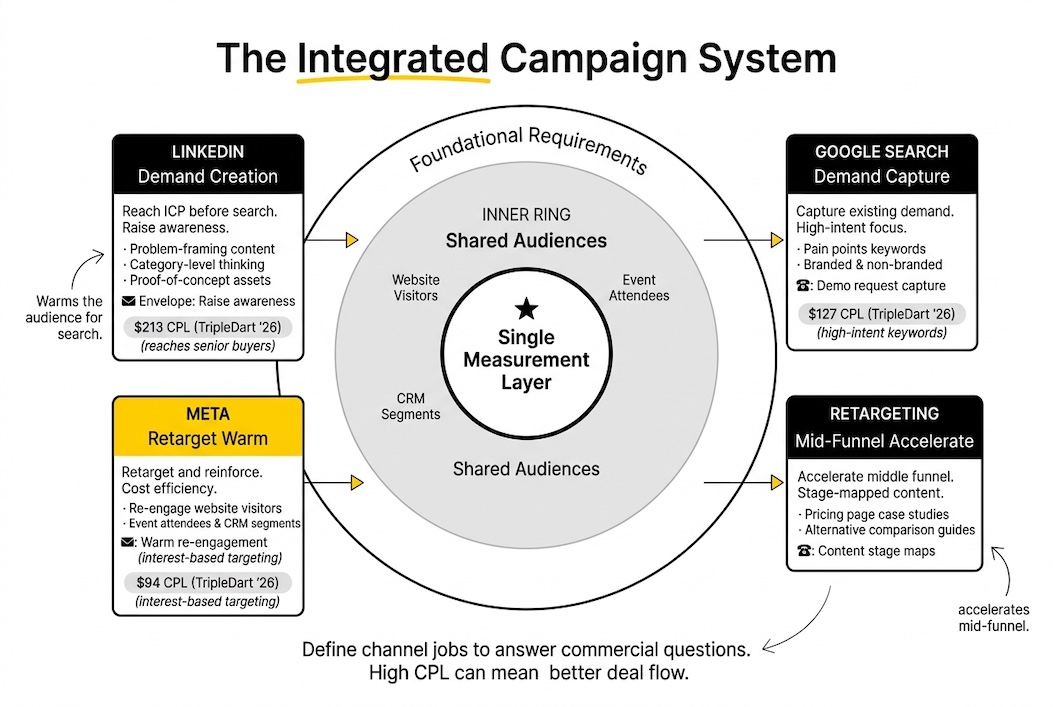
Running search and social as one system requires agreement on three things: channel roles, shared audiences, and a single measurement layer.
Define the role of each channel clearly
Before any campaign goes live, each channel needs an explicit job in the buyer journey. Trying to make LinkedIn generate demo requests from cold audiences is the paid equivalent of asking a blog post to close a deal.
A practical channel role framework for B2B SaaS:
- Google Search (branded and non-branded): Capture existing demand. Serve people who are already looking for solutions in your category. Focus on high-intent keywords tied to pain points and job titles. This is demand capture.
- LinkedIn: Reach your ICP before they search. Raise awareness with senior decision-makers and buying committee members. Promote problem-framing content, category-level thinking, and proof-of-concept assets. This is demand creation.
- Meta: Retarget and reinforce. Meta’s cost efficiency makes it well-suited to re-engaging website visitors, event attendees, and CRM segments. Cold B2B prospecting on Meta rarely performs because targeting is interest-based rather than firmographic. Keep Meta focused on warm audiences.
- Retargeting (across platforms): Accelerate the middle of the funnel. Serve content that maps to buying stage: case studies for prospects who have visited your pricing page, comparison guides for anyone researching alternatives.
When each channel has a defined job, the question “is this channel working?” becomes answerable. The benchmark data supports this division: according to TripleDart’s 2026 State of SaaS PPC Benchmark Report, drawn from $60M+ in managed spend, average cost per lead on Google Ads sits at $127, LinkedIn at $213, and Meta at $94. LinkedIn’s higher CPL looks expensive until you factor in deal size. LinkedIn-sourced deals consistently close larger because the targeting reaches senior buyers earlier in the cycle.
Build shared audiences across platforms
The most underused integration in SaaS advertising is audience sharing. Most teams build their Google Ads customer match lists, their LinkedIn Matched Audiences, and their Meta Custom Audiences independently. They contain different data, get refreshed at different times, and represent different definitions of ICP.
A unified approach looks different. Start with your CRM. Export segments that matter: closed-won customers, churned accounts, active opportunities in specific pipeline stages, and contacts from target accounts that have not yet engaged. Push these lists to all three platforms simultaneously, with the same refresh cadence.
This serves two purposes. First, it enables suppression. You do not want to spend money showing awareness ads to existing customers or wasting Google Ads budget on accounts already deep in an active sales cycle. Second, it enables sequential messaging. A prospect in your CRM who downloaded a whitepaper last month should see a different LinkedIn ad than someone who has never interacted with your brand.
Lookalike audiences built from closed-won accounts are worth testing on Meta and LinkedIn. For LinkedIn, Conversation Ads and Document Ads have shown strong engagement with matched account lists, with some data pointing to 4x higher engagement for ABM-targeted account lists compared to broader campaign targeting.
Align your creative and messaging across channels
This is where most agencies fall short on best practices for SaaS advertising agencies. Each channel ends up with its own creative brief, written by a different person, reviewed at different times, and producing messaging that has nothing to do with what the prospect saw on a different platform last week.
Messaging alignment does not mean identical ads everywhere. It means the same problem framing, the same language around outcomes, and the same proof points appearing across all touchpoints. If your Google Ads headline addresses “disconnected revenue attribution,” your LinkedIn creative should build on that frame. If your Meta retargeting is promoting a case study about a fintech customer reducing close time by 30%, your Google Ads landing page should carry that proof point prominently.
A simple way to enforce this: create a channel messaging matrix before any creative goes into production. Map your core problem statement, primary proof point, and CTA to each channel and funnel stage. Any creative that cannot be placed on this matrix does not go live.
Coordinating Google Ads and Social Media: Campaign Sequencing
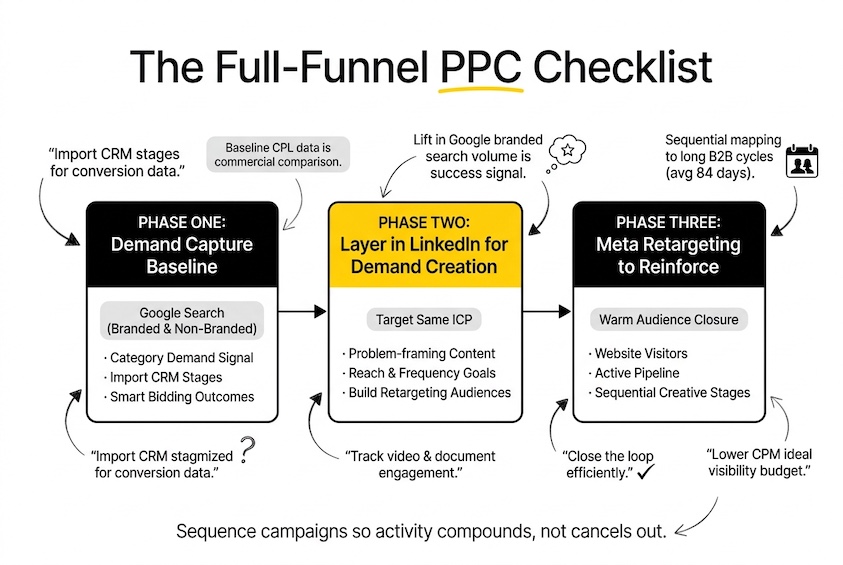
Beyond architecture, the practical question is how to sequence campaigns so each channel’s activity compounds rather than cancels out.
Phase one: establish your demand capture baseline
Before investing heavily in demand creation on LinkedIn, establish clean Google Ads performance on branded and non-branded terms. This gives you a baseline CPL and conversion rate to compare against as social investment builds brand awareness.
Non-branded search campaigns are the best early indicator of category demand. If you are running campaigns against “pipeline forecasting software” and the impression volume is low with high CPCs, that is a signal the category is either crowded or poorly defined. LinkedIn content can address this over time by helping your ICP name the problem before they search for the solution.
Set conversion tracking to capture the full funnel, not just form fills. Import CRM stages into Google Ads as offline conversions. At a minimum, track the point at which a lead becomes a sales-qualified opportunity. This trains Google’s Smart Bidding algorithms on the outcomes that actually matter rather than raw conversion volume.
Phase two: layer in LinkedIn for demand creation
Once Google Ads is stable, add LinkedIn campaigns targeting the same ICP. The goal in this phase is not leads. It is reach and frequency among senior buyers who fit your target account criteria.
Run document ads and video ads that address the problem your product solves without leading with the product. Track engagement and build retargeting audiences of people who have watched at least 50% of a video or downloaded a document. These are warmer prospects than cold web visitors.
After four to six weeks, you should start to see lift in branded search volume on Google. If branded CPCs remain flat but click volume increases, LinkedIn is doing its job: more people are searching for you specifically because they have seen your content.
Phase three: add Meta retargeting to reinforce the cycle
Once LinkedIn and Google are generating consistent traffic, layer in Meta retargeting to close the loop. The audience here should be tightly defined: website visitors who have not converted, CRM contacts in active pipeline, and lookalike audiences built from recently closed accounts.
Meta’s lower CPMs make it cost-efficient for keeping your brand visible to warm audiences throughout a long sales cycle. A B2B SaaS sales cycle averages 84 days according to HubSpot’s 2026 State of Marketing data. Meta retargeting over a 60 to 90-day window, with sequential creative that maps to buying stage, keeps you present without requiring the budget of a LinkedIn campaign.
Unified Pipeline Measurement for SaaS Advertising Agencies
Running three channels as one system is only possible if you measure them as one system. Platform-native metrics will always tell channel-specific stories. Google will show you conversion volume. LinkedIn will show you reach and engagement. Meta will show you frequency and cost efficiency. None of these individually tells you whether the system is working.
Build a shared attribution framework
The goal is not perfect attribution. Attribution will never be perfect across a 90-day buying cycle with multiple decision-makers and a dozen touchpoints. The goal is consistent, directional data that lets you make allocation decisions with confidence.
For most B2B SaaS teams, a position-based model works well: weighting first touch and last touch more heavily while distributing credit across mid-funnel interactions. This acknowledges that both awareness (LinkedIn) and capture (Google) matter, without pretending you can measure micro-conversions on dark social precisely.
Connect all paid channels to your CRM. HubSpot and Salesforce both allow UTM-based campaign tracking that can tie paid touchpoints to deal stages. Push that data back into your paid platforms as offline conversions. This creates a feedback loop where Google’s bidding algorithms optimise on SQL creation, not just form fills, and LinkedIn campaign reporting shows influenced pipeline rather than raw leads.
Measuring pipeline performance in SaaS means moving beyond cost-per-lead as the primary metric. The metrics that hold up in board meetings are:
- Cost per sales-qualified opportunity by channel
- Influenced pipeline by channel over 90 days
- MQL-to-SQL ratio by lead source
- Time to opportunity by channel
These numbers reveal what platform-level dashboards obscure. LinkedIn may generate fewer leads than Google, but if LinkedIn-sourced leads convert to opportunities at twice the rate, the cost per opportunity is competitive.
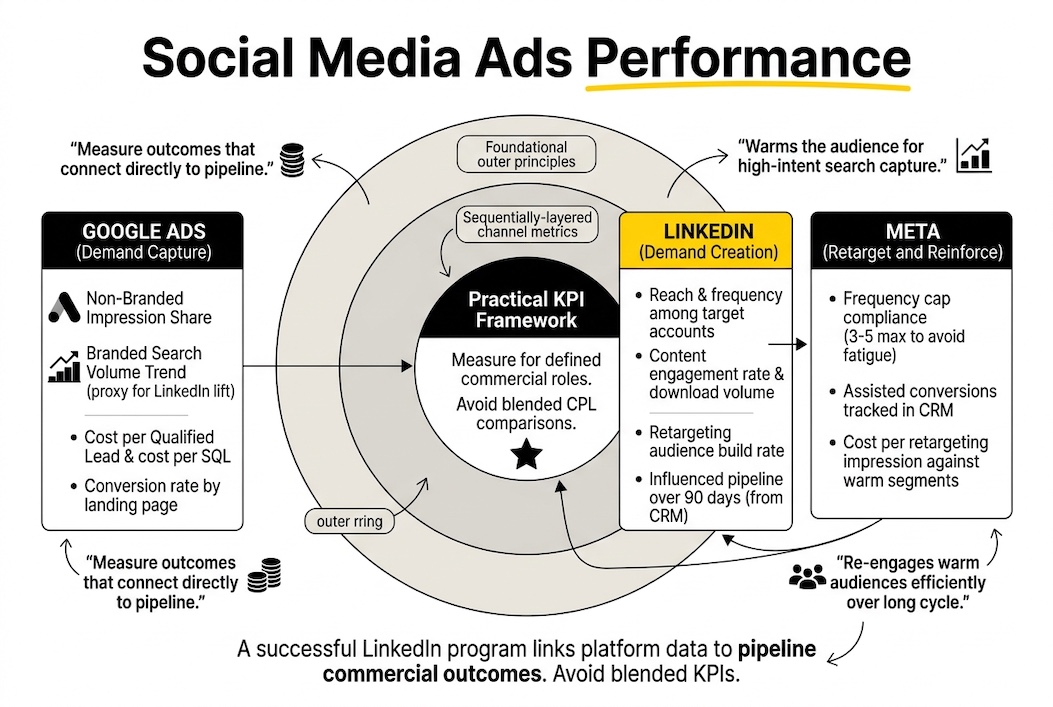
Set channel-specific KPIs that reflect each channel’s job
One reason paid systems fail is that teams apply the same KPIs across channels with fundamentally different roles. Measuring a LinkedIn awareness campaign on CPL is like measuring a billboard on click-through rate. It is the wrong instrument for the job.
A practical KPI framework by channel:
Google Ads (demand capture):
- Cost per qualified lead and cost per SQL
- Non-branded impression share
- Conversion rate by landing page
- Branded search volume trend (as a proxy for LinkedIn’s awareness lift)
LinkedIn (demand creation):
- Reach and frequency among target accounts
- Content engagement rate and download volume
- Retargeting audience build rate
- Influenced pipeline over 90 days (pulled from CRM, not LinkedIn’s platform)
Meta (retargeting and reinforcement):
- Frequency cap compliance (3-5 impressions per week maximum to avoid fatigue)
- Assisted conversions tracked in CRM
- Cost per retargeting impression against warm segments
Optimising Lead Quality in SaaS Advertising
Even a well-structured system produces bad leads if the targeting and messaging are not tight enough. Lead quality problems in B2B SaaS paid media usually trace back to one of three things: audience definition is too broad, messaging addresses a pain point that does not map to your ICP, or the offer (the CTA) attracts the wrong type of engagement.
Tighten ICP targeting before scaling spend
On LinkedIn, over-reliance on job title targeting is one of the most common errors. Job titles vary wildly across company sizes and industries. “Director of Operations” at a 20-person startup and “Director of Operations” at a 500-person scale-up are different buyers with different budgets and different problems.
Layer company size, industry, and revenue filters on top of job title. If your ICP is clearly defined, LinkedIn’s firmographic targeting can get close. Where it cannot, use matched account lists built from your CRM rather than relying on LinkedIn’s algorithmic targeting.
On Google Ads, negative keyword hygiene is the primary lead quality lever. A campaign targeting “revenue attribution software” will pick up searches from students, competitors, and job seekers unless you are actively pruning irrelevant terms. Review search term reports weekly, especially in the first 60 days of a new campaign. The leads that sales will not touch are often traceable to keyword gaps that went unaddressed for months.
Align the offer to the funnel stage
One of the less-discussed best practices for SaaS advertising agencies is matching the CTA to where the prospect actually is in the buying process.
A cold LinkedIn prospect who has never heard of your product is unlikely to book a demo. Asking them to do so wastes the impression and trains your algorithm to optimise for a conversion action that the audience cannot complete at this stage. Instead, offer something that provides value without requiring a high-commitment decision: a diagnostic tool, a framework document, a benchmark report. Capture contact data, move them into a nurture sequence, and serve retargeting ads that escalate the CTA as engagement increases.
For Google Ads on high-intent searches, the demo CTA is appropriate. The prospect is already looking. The conversion action and the intent are aligned. The issue here is usually the landing page, not the ad.
Retargeting Strategies for SaaS: Closing the Loop
Retargeting is where the unified system compounds. Every impression served on LinkedIn and every click captured by Google creates an audience that can be followed across the web with contextually relevant messaging.
Effective retargeting for SaaS is not about frequency for its own sake. The most common retargeting mistake is showing the same creative to everyone who visited any page on your website, regardless of what they looked at or where they are in the buying cycle. This produces high frequency, low relevance, and increasing CPMs as audiences burn out.
Segment retargeting audiences by intent signal instead:
- Pricing page visitors: high intent, show proof-points and a friction-reducing CTA (free trial, quick ROI calculator)
- Blog readers: mid-funnel, show a content upgrade or case study that deepens engagement
- Webinar attendees or content downloaders: warm, show a direct CTA to speak to the team
- Churned customers: suppress from prospecting; consider a separate win-back campaign if your product has evolved
Each segment should have its own creative and its own frequency cap. A pricing page visitor who sees your ad 12 times in a week is not more likely to convert. They are more likely to install an ad blocker.
Frequently Asked Questions
How can SaaS advertising agencies integrate PPC and social media ads effectively?
Integration starts with defining what each channel is responsible for, not running the same campaign type everywhere. Google Search handles demand capture from people already looking. LinkedIn creates demand among ICP accounts that do not yet know they need your product. Meta reinforces messaging with warm retargeting audiences. Once roles are defined, shared audiences from your CRM and aligned messaging across channels create the cohesion. Measurement in your CRM, rather than each platform’s native dashboard, ties it all together.
What are the best practices for aligning Google Ads and LinkedIn campaigns?
The most effective alignment is at the audience layer. Export your CRM segments (target accounts, active pipeline, closed-won customers) and use them in both platforms for targeting, suppression, and lookalike building. Refresh these lists on the same schedule. At the messaging layer, ensure the problem framing in your LinkedIn ads sets up the intent your Google Ads are designed to capture. If LinkedIn content raises awareness of “forecast accuracy gaps in fast-scaling sales teams,” Google non-branded campaigns should be live on searches that reflect that awareness.
How can retargeting strategies enhance the effectiveness of PPC and social media ads?
Retargeting closes the loop between demand creation and demand capture. A prospect who engaged with a LinkedIn thought-leadership post but did not click through can be retargeted on Meta with a more direct offer once they visit your website via organic search. Segmenting retargeting audiences by intent signal (pricing page visitors versus blog readers versus content downloaders) and serving creative that matches their buying stage produces far better results than blanket retargeting of all site visitors.
What metrics should SaaS companies focus on for unified pipeline measurement?
The metrics that matter are cost per sales-qualified opportunity by channel, influenced pipeline over 90 days, and MQL-to-SQL ratio by lead source. Platform-level metrics like CPL, CTR, and impression share are useful for diagnosing performance within a channel, but they do not tell you whether the system is producing pipeline. Connect all paid channels to your CRM and import offline conversions to your ad platforms so that bidding algorithms optimise on opportunities, not just form fills.
How can demand generation leaders optimise lead quality through paid advertising?
Lead quality problems almost always trace back to audience definition, message-to-audience fit, or CTA-to-funnel-stage mismatch. On LinkedIn, tighten firmographic targeting to match your ICP more precisely. On Google, review search term reports regularly and build negative keyword lists aggressively. Across both channels, ensure the conversion action you are asking for reflects where the prospect actually is: high-commitment CTAs like “book a demo” work for high-intent Google searches but burn cold social audiences.
What are the benefits of a cohesive system for search and social advertising?
The compounding benefit is the most significant. LinkedIn awareness activity lifts branded search volume on Google. Google retargeting data informs LinkedIn audience segmentation. Meta reinforces messaging between touchpoints, shortening the time from first exposure to qualified conversation. Teams that manage channels in silos consistently undervalue social investment because the attribution credit flows to the last touch, usually search. A unified system with CRM-based attribution shows the full picture and allows more confident budget allocation.
How can shared messaging improve campaign performance across different platforms?
Consistent problem framing across channels creates familiarity, and familiarity lowers the friction of every subsequent touchpoint. A prospect who has seen your LinkedIn content frame “revenue leakage from disconnected data” as a structural problem is primed to respond when your Google ad surfaces during their eventual search for solutions. The effect is measurable in branded search lift and in improved conversion rates on retargeting campaigns, where the audience has already been exposed to your core message.
What strategies can be employed to iterate on campaigns quickly in a SaaS context?
Run structured creative tests with clear hypotheses rather than changing multiple variables simultaneously. On LinkedIn, test one message angle at a time (problem-framing versus outcome-framing versus social proof) against a stable audience. On Google, isolate landing page variants before testing ad copy. Set decision thresholds before tests start: how many conversions, at what confidence level, before you call a result. Teams with resource constraints should prioritise testing on the channel with the highest spend first, and carry winners to secondary channels rather than testing everything everywhere at once.
How can clear attribution of upper-funnel activities be achieved in B2B SaaS marketing?
The most practical approach is CRM-based multi-touch attribution with offline conversion imports to each ad platform. Tag every paid touchpoint with UTM parameters and ensure your CRM captures first touch, last touch, and the channel sequence that preceded each stage of the pipeline. Import SQL creation and opportunity creation as offline conversions into Google Ads and LinkedIn Campaign Manager. This gives both platforms the signal to optimise on real pipeline outcomes. Avoid over-investing in attribution precision; consistent, directional data is more actionable than a theoretically perfect model that takes months to build.
What role does audience targeting play in the success of integrated PPC and social media campaigns?
Audience targeting is the primary mechanism through which integration becomes a system rather than a set of co-existing channels. When all three platforms are working from the same CRM-derived audience segments, target account lists, and suppression lists, every campaign is working on the same definition of who matters. Without this, each platform optimises for its own version of your audience, producing overlap, contradiction, and wasted spend. Shared audiences make coordinated messaging possible and give your CRM attribution model a consistent signal to work with.
Working Through This?
Building a unified search and social system is not a one-week project. It requires decisions about attribution that have to survive a board conversation, creative processes that span multiple teams, and measurement infrastructure that your CRM and ad platforms have to support simultaneously.
If you are a SaaS advertising agency thinking through how to structure this, or a Demand Generation leader trying to make the case for LinkedIn investment to a sceptical finance team, we work through exactly this with SaaS teams regularly. Worth a conversation if you are at that point.